

Benefits and Pitfalls of Multimedia and Interactive Features in Technology-Enhanced Storybooks: A Meta-Analysis
Open accessThe DOI matches its Crossref record; 111 of the 113 references it cites were found in a registry or an index.
Abstract
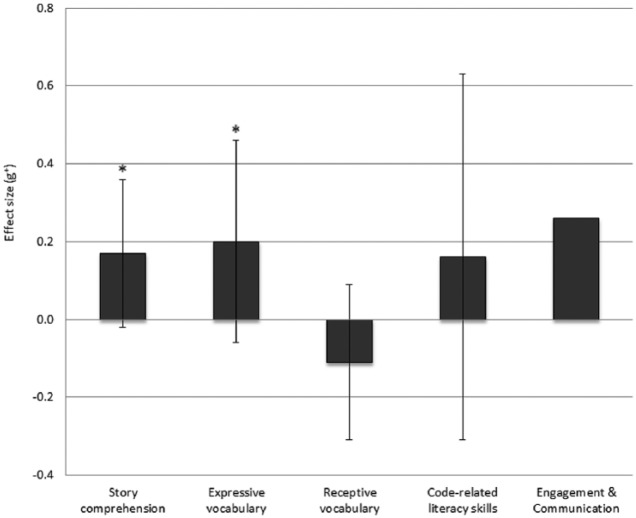
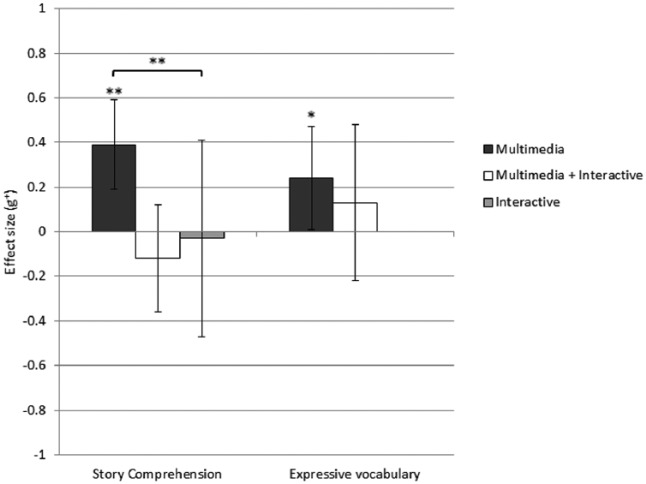
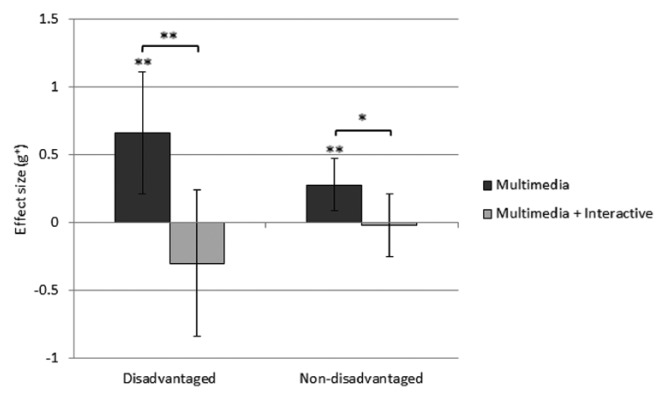
A meta-analysis was conducted on the effects of technology-enhanced stories for young children’s literacy development when compared to listening to stories in more traditional settings like storybook reading. A small but significant additional benefit of technology was found for story comprehension (g+ = 0.17) and expressive vocabulary (g+ = 0.20), based on data from 2,147 children in 43 studies. When investigating the different characteristics of technology-enhanced stories, multimedia features like animated pictures, music, and sound effects were found beneficial. In contrast, interactive elements like hotspots, games, and dictionaries were found to be distracting. Especially for children disadvantaged because of less stimulating family environments, multimedia features were helpful and interactive features were detrimental. Findings are discussed from the perspective of cognitive processing theories.
Overview
The claims and statistics of this paper haven’t been checked yet.
Free: it reads the open-access text and checks the first 5 claims that cite a source we can check. Create a free account to check every claim.
Integrity signals
Registry
Cites
Statistics
Figures
Verification
Claims the paper makes
The claims and statistics of this paper haven’t been checked yet.
Free: it reads the open-access text and checks the first 5 claims that cite a source we can check. Create a free account to check every claim.
Claims other papers make about this one
Each is checked against this paper’s own text: does it say what the citing paper says it does?
The cited source says what the claim attributes to it.
In the citing paper
“That is, the design aimed for a strong match between the verbal and nonverbal information in the stories (Takacs et al. 2015).”
From Supporting Literacy and Digital Literacy Development in Early Childhood Education Using Storytelling Activities (2018) · cites this paper as Takacs et al. 2015
Self-check
Percentages, sums and reported differences re-computed from the paper’s own numbers.
The self-check needs the paper’s full text.
Citations
Cites
Tabachnick, B. G., & Fidell, L. S. (1983) · Cited by 80,058
Borenstein, M., Hedges, L. V., Higgins, J. P. T., & Rothstein, H. R. (2009) · doi:10.1002/9780470743386 · Cited by 14,225
Borenstein, M., Hedges, L. V., Higgins, J. P. T., & Rothstein, H. R. (2021) · doi:10.1002/9781119558378 · Cited by 9,799
(2000) · Cited by 9,198
The file drawer problem and tolerance for null results.
Rosenthal, R. (1979) · Psychological Bulletin · doi:10.1037/0033-2909.86.3.638 · Cited by 9,068 · cited 1×
“A fail-safe number of 5 k + 10 is considered robust, where k is the number of studies in the meta-analysis (Rosenthal, 1979).”
Background(1991) · Choice Reviews Online · doi:10.5860/choice.28-5764 · Cited by 6,847
The Handbook of Research Synthesis and Meta-Analysis
(2019) · doi:10.7758/9781610448864 · Cited by 4,553
Nine Ways to Reduce Cognitive Load in Multimedia Learning
Mayer, R. E., & Moreno, R. (2003) · Educational Psychologist · doi:10.1207/s15326985ep3801_6 · Cited by 4,207 · cited 2×
“This outcome is probably because the processing of games and extra animations can be considered as extraneous materials that interfere with the processing of the story content (Mayer & Moreno, 2003).”
BackgroundA Nonparametric “Trim and Fill” Method of Accounting for Publication Bias in Meta-Analysis
Duval, S., & Tweedie, R. (2000) · Journal of the American Statistical Association · doi:10.1080/01621459.2000.10473905 · Cited by 2,955
Morris, S. B., & DeShon, R. P. (2002) · Psychological Methods · doi:10.1037/1082-989x.7.1.105 · Cited by 2,502
Research works printed but not linked: 7
- McKenna M. C. Labbo L. D. Kieffer R. D. Reinking D. (Eds.). (2006). International handbook of literacy and technology: Vol. II. Mahwah, NJ: Lawrence Erlbaum Associates.
- *Chiong C. Ree J. Takeuchi L. Erickson I. (2012). Print books vs e-books. Comparing parent-child co-reading on print, basic and enhanced e-book platforms. New York, NY: The Joan Ganz Cooney Center at Sesame Workshop Retrieved from http://www.joanganzcooneycenter.org/wp-content/uploads/2012/07/jgcc_ebooks_quickreport.pdf
- *Critelli K. (2011). The effect of multimedia e-books on the acquisition of early literacy skills (Master’s thesis). Retrieved from Proquest Dissertations and Theses Global (UMI: 1500577).
- Guernsey L. Levine M. Chiong C. Severns M. (2012). Pioneering literacy in the digital wild west: Empowering parents and educators. New York, NY: The Joan Ganz Cooney Center at Sesame Workshop Retrieved from http://www.joanganzcooneycenter.org/wp-content/uploads/2012/12/GLR_TechnologyGuide_final.pdf
- Meringoff L. K. (1982, 3). What pictures can and can’t do for children’s story understanding. Paper presented at the Annual Meeting of the American Educational Research Association, New York, NY.
- Roskos K. Burstein K. (2013, 4). Engagement with e-Books: Does device matter? Paper presented at the annual meeting of the American Educational Research Association, San Francisco, CA.
- *Verhallen M. J. A. J. Bus A. (2009b). Video storybooks: a worthwhile investment for all young L2 learners? (Unpublished doctoral dissertation). Leiden University, Leiden, the Netherlands.
Cited by
Items 301–400 of 401
Chen, C., Jamiat, N., Rabu, S. N. A., & Du, S. (2026) · Educational Technology Research and Development · doi:10.1007/s11423-026-10610-5 · Cited by 2
“E-books are digital texts resembling traditional paper books but can be accessed on electronic displays (Chuang & Jamiat, 2023; Kong et al., 2018; Takacs et al., 2015).”
Tølbøll, K. B. (2026) · Clinical Child and Family Psychology Review · doi:10.1007/s10567-026-00577-3 · Cited by 2
“…can learn words from screens, and preschoolers seem to benefit from well-designed and education-oriented learning aids, including e-books with features like animations and sound effects that promote vocabulary (Dore et al., 2019; Madigan et al., 2020 ; Mares & Pan, 2013; Takacs et al., 2015).”
Bernés, A. R., Guerrero, V. B., Bernés, S. R., & García, A. F. (2019) · EDUCATECONCIENCIA · doi:10.58299/edu.v22i23.102
Il lettore 'distratto': Leggere e comprendere nell’epoca degli schermi digitali
Nardi, A. (2022) · Studi e saggi · doi:10.36253/978-88-5518-501-1 · Cited by 23
Design and Development of a Mobile Writing Application for Students With Dysgraphia
Hopcan, S., Tokel, S. T., Karasu, N., & Aykut, Ç. (2021) · IGI Global eBooks · doi:10.4018/978-1-6684-3670-7.ch036 · Cited by 1
Çocuklar için Bir E-Kitap Uygulaması: TRT Çocuk Kitaplık
YILDIZ, C., & Doğan, S. A. (2023) · Türk Kütüphaneciliği · doi:10.24146/tk.1132369 · Cited by 1
TÜRKÇE ÖĞRETMENLERİNİN DİJİTAL HİKÂYE OLUŞTURMA DENEYİMLERİ
TOKSUN, S. E., & EROĞLU, A. (2023) · International Journal Of Turkish Literature Culture Education · doi:10.7884/teke.1285738 · Cited by 2
Coughler, C., Bardell, T., Schouten, M. A., Smith, K. L., & Archibald, L. M. D. (2024) · Language Speech and Hearing Services in Schools · doi:10.1044/2024_lshss-23-00022 · Cited by 2
Global perspectives: library professionals' views on multimedia books in airlines
Subaveerapandiyan, A. (2024) · Digital Library Perspectives · doi:10.1108/dlp-12-2023-0105 · Cited by 1
Filizlenen Çift Dillilik Gelişimi ve Çift Dilli Okuryazarlık Eğitiminde Teknoloji Entegrasyonu
Gezer, M. Ü. (2024) · Uludağ Üniversitesi Eğitim Fakültesi Dergisi · doi:10.19171/uefad.1449064 · Cited by 4
Mise-en-scène: Playful Interactive Mechanics to Enhance Children’s Digital Books
Aamri, F. A., & Greuter, S. (2015) · Lecture notes in computer science · doi:10.1007/978-3-319-27036-4_20 · Cited by 1
Selecting ‘Just Right’ Electronic Books for the Early Childhood Classroom
McNelly, T. A. (2018) · Kappa Delta Pi Record · doi:10.1080/00228958.2018.1407172 · Cited by 1
e-Book Design and Young Children’s Behaviour: The Case of Alphabet Books
Evans, M. A. (2019) · Literacy studies · doi:10.1007/978-3-030-20077-0_5 · Cited by 1
Berding, F., Jahncke, H., & Albersmann, M. (2020) · Springer eBooks · doi:10.1007/978-3-658-31146-9_13 · Cited by 5
Noguera, I., (ANPCyT), A. N. D. P. C. Y. T., Salsa, A., & (CONICET), C. N. D. I. C. Y. T. (2021) · Revista de Psicología y Educación - Journal of Psychology and Education · doi:10.23923/rpye2021.02.212 · Cited by 2
Aguilar, R. (2019) · Scholars Archive - University at Albany (University at Albany, State University of New York) · doi:10.54014/knqr-dze3 · Cited by 7
Roskos, K. A., Northrop, L., Brueck, J., Lenhart, L. A., & Evans, M. (2019) · Journal of Cognitive Education and Psychology · doi:10.1891/1945-8959.18.2.174
How Can Digital Storybooks Foster EAL Children’s Reading Motivation: A Multiple Case Study
Kuo, J.-F. (2021) · Open Access Victoria University of Wellington | Te Herenga Waka (Figshare) · doi:10.26686/wgtn.14109905.v1
Social Networking Platforms and Classroom Culture
Van, T. H. Q., Underwood, M. J., & Tai, L. (2021) · Polish Journal of Educational Studies · doi:10.2478/poljes-2021-0010 · Cited by 1
Integrating Social Media in Classroom: Rejuvenating the Communication While Teaching
Musheer, Z., & Dubey, G. (2021) · Journal of Knowledge & Communication Management · doi:10.5958/2277-7946.2021.00009.7
(2021) · Emerald Group Publishing Limited eBooks · doi:10.1108/978-1-80043-944-320211013
Reading From Paper Compared to Electronic Media: A Systematic Review and Meta-Analysis
Clinton‐Lisell, V. (2019) · American Educational Research Association Annual Meeting (AERA) · doi:10.3102/1442591
Shang, Y. (2019) · American Educational Research Association Annual Meeting (AERA) · doi:10.3102/1428891
Quantitative Meta-Analyses: A Review of Current Practice
Park, S.-Y. (2019) · American Educational Research Association Annual Meeting (AERA) · doi:10.3102/1436798
Implementing and Testing an Interactive Educational Story Mobile App
Nawahdah, M., & Ehmouda, H. (2022) · International Symposium on Educational Technology · doi:10.1109/iset55194.2022.00060
Permainan Tematik dalam Pembelajaran Pendidikan Jasmani, Olahraga dan Kesehatan
Adi, I. P. P., Satyawan, I. M., & Dartini, N. P. D. S. (2022) · Jurnal Pedagogi dan Pembelajaran · doi:10.23887/jp2.v5i2.46564
Development of Media Pembebas (Adobe Flash-Based Learning) on eclipse theme
Irhamni, G., Munzil, M., Affriyenni, Y., Marsuki, M. F., & Habiddin, H. (2023) · AIP conference proceedings · doi:10.1063/5.0114901
Literatura digital como recurso para desarrollar la comprensión lectora
Jiménez-Díaz, A. C. (2023) · HUMAN REVIEW International Humanities Review / Revista Internacional de Humanidades · doi:10.37467/revhuman.v12.4758
(2023) · Vandenhoeck & Ruprecht eBooks · doi:10.13109/9783666703348.163
Sadan, M., Lipka, O., & Katzir, T. (2023) · SSRN Electronic Journal · doi:10.2139/ssrn.4458776
Zumaeta, R. (2023) · doi:10.31979/etd.fcvj-9gah
Sadan, M., Lipka, O., & Katzir, T. (2023) · SSRN Electronic Journal · doi:10.2139/ssrn.4482206
The Magic of Cartoons? How English-learning Animations Enhance Child L2 AcquisitionPreprint
Huang, L. (2023) · PsyArXiv (OSF Preprints) · doi:10.31234/osf.io/nkbr7 · Cited by 2
Utilization of e-books to enhance self-directed learning for clinical laboratory science specialists
Mohsen, Z. A., & Alqassab, H. A. (2023) · Journal of Education Technology in Health Sciences · doi:10.18231/j.jeths.2023.009 · Cited by 2
Bir Okuma Deneyimi Olarak Elektronik Çocuk Kitapları
AKYÜZ, E. (2023) · Korkut Ata Türkiyat Araştırmaları Dergisi · doi:10.51531/korkutataturkiyat.1342303
Ulusal Yabancı Dil Eğitimi Kurultayının Önemi ve Tarihçesi
Sarıçoban, A. (2024) · doi:10.5152/3701
Yabancı Dil Öğretmeni Eğitiminde Değişen Koşullar, Gereksinimler ve Öneriler
Sarıçoban, A., Kaban, A. L., Hatipoğlu, Ç., Günay, D., İNAL, E., Gümüşok, F., Ekşi, G. Y., Balıkçı, G., Taner, G., Genç, G., et al. (2024) · doi:10.5152/3700
Erken Yaşta Teknoloji Kullanımının Dil Gelişimine Etkisi
Kaban, A. L. (2024) · doi:10.5152/3703
Pandemi ve Sonrasında Öğretmenlik Uygulaması: Yansımalar, Öngörüler, Öneriler
Taner, G., Balıkçı, G., & Gümüşok, F. (2024) · doi:10.5152/3709
Kazazoğlu, S., & Tunaboylu, O. (2024) · doi:10.5152/3710
Yeni Atanan Öğretmenlerin Çevrimiçi İngilizce Öğretimine Hazırbulunuşluğu
Sarı, Ö., & Kızıltan, N. (2024) · doi:10.5152/3707
Agustín, M. P., & Guillén, T. F. (2024) · Encuentro: revista de investigación e innovación en la clase de idiomas · doi:10.37536/ej.2024.32.2443
Lammertink, I. L., Segers, E., Scheper, A., Wauters, L., & Vissers, C. (2024) · Language Learning and Development · doi:10.1080/15475441.2024.2313226
“We decided to work with a zoom function, because this type of multimedia feature, rather than interactive elements, was found most beneficial for story comprehension and expressive vocabulary in children (see meta-analysis by Takacs et al., 2015).”
Two decades of research synthesis on digital cultural education: A tertiary review_PostprintPreprint
Christ, A., Penthin, M., & Kröner, S. (2024) · doi:10.31219/osf.io/b92eg
Lemire, C., Chiasson-Roussel, M., Marianne, P., Myre-Bisaillon, J., & Martinez-Manningham, E. (2024) · Canadian Journal of Education / Revue canadienne de l éducation · doi:10.53967/cje-rce.6145
Miller, C., Boone, K. M., Pattisapu, P., & Malhotra, P. (2024) · PLoS ONE · doi:10.1371/journal.pone.0302734 · Cited by 2
Mues, A., Wirth, A., Schiele, T., & Niklas, F. (2024) · Essentials · doi:10.1007/978-3-662-69759-7_3
Özdemir, Ö., Karaçoban, F., & Efendioğlu, A. (2024) · Reading & Writing Quarterly · doi:10.1080/10573569.2024.2435889 · Cited by 17
Tortorelli, L. S., & Strong, J. Z. (2025) · Journal of Research in Reading · doi:10.1111/1467-9817.70004 · Cited by 3
“…features can provide students with scaffolds for learning vocabulary and improving text comprehension; however, some kinds of interactivity, particularly games and tools that direct attention away from the text, have negative impacts (Christ et al., 2019; Kucirkova, 2017; Takacs et al., 2015).”
Strouse, G. A., & Ganea, P. A. (2025) · Journal of Experimental Child Psychology · doi:10.1016/j.jecp.2025.106291 · Cited by 2
Andriono, M. A., Curtis, C. J., Block, N. C., & Prasasti, S. (2025) · Journal of Children and Media · doi:10.1080/17482798.2025.2506488 · Cited by 3
“The minimalist approach was more effective, avoiding distractions that could potentially hinder comprehension, as noted in prior research (Takacs et al., 2015).”
Si, Q., & Wind, S. A. (2025) · The Elementary School Journal · doi:10.1086/736504
Gellen, S., Ainsworth, S., Morris, S. P., Lewin, C., & Wicker, K. (2025) · Frontiers in Education · doi:10.3389/feduc.2025.1513465 · Cited by 2
Dijital Oyunlarda İslamofobik Şiddet
Ar, M. (2025) · Dinbilimleri Akademik Araştırma Dergisi · doi:10.33415/daad.1710962
Improvement of the delivery of information about books online: Focusing on book-flipping behavior
Park, N., Lee, J.-G., & Lee, D. (2025) · Information Development · doi:10.1177/02666669251399814 · Cited by 1
Wen, C.-N., Huang, C.-G., Chang, P.-Y., Yang, T.-H., You, H.-L., Ning, H.-C., & Tsao, K.-C. (2022) · Figshare · doi:10.6084/m9.figshare.21310691
Typography and Illustration in Visual Storytelling
Kaya, S. (2025) · Özgür Yayınları eBooks · doi:10.58830/ozgur.pub1149.c4773
Teacher roles in early years digital shared reading contexts
Karademir, N. (2026) · Education 3-13 · doi:10.1080/03004279.2026.2619734
Urra, P., & Mendive, S. (2026) · Ocnos Revista de Estudios sobre Lectura · doi:10.18239/ocnos_2026.26.1.576
“Las revisiones existentes (Furenes et al., 2021; Takacs et al., 2014; 2015) se han centrado en sistematizar los efectos de los libros digitales en comparación con los libros impresos, bajo el supuesto de que el libro digital podría producir efectos diferentes en relación con el impreso, así también…”
Wang, S., Cabell, S. Q., Schatschneider, C. W., Phillips, B. M., & DeCoster, J. (2026) · Early Education and Development · doi:10.1080/10409289.2026.2635575
“At the same time, other studies suggest that these same features can distract attention and interfere with comprehension when not carefully designed (e.g., Richter & Courage, 2017; Takacs et al., 2015), highlighting the need to consider both their affordances and potential drawbacks.”
Integrated Collaborative Learning Storybooks and Animation Improve Explanatory Writing
Istanti, N., Roshonah, A. F., & Misriandi, M. (2026) · Academia Open · doi:10.21070/acopen.11.2026.13623 · Cited by 4
Humardhiana, A., Udin, T., & Atikoh, N. (2025) · International Conference on Education and Multimedia Technology (ICEMT) · doi:10.1145/3761843.3761897 · Cited by 1
Bali, C., Csibi, K. Z., Arató, N., & Zsido, A. N. (2026) · Acta Psychologica · doi:10.1016/j.actpsy.2026.106718
Tosun, N. S., & ÖZDEMİR, A. A. (2026) · Batı anadolu eğitim bilimleri dergisi · doi:10.51460/baebd.1833313 · Cited by 2
Pu, W., Park, S., Dore, R. A., Bonus, J. A., & Hassinger‐Das, B. (2026) · Computers & Education · doi:10.1016/j.compedu.2026.105673
Kirsch, C. (2026) · Educational Research for Policy and Practice · doi:10.1007/s10671-026-09424-2
Dialogisches Lesen – mit einem digitalen Bilderbuch oder doch besser klassisch?
Kühn, W., Cordes, A.-K., & Egert, F. (2026) · Zeitschrift für Grundschulforschung · doi:10.1007/s42278-026-00272-w
“Takacs et al. (2015) fin-den signifikante Effekte für die Erzählfähigkeiten beim Lesen digitaler Geschichten ( g = 0,17).”
InfluentialUscianowski, C., Almeda, M. V., & Ginsburg, H. P. (2018) · Emerald Group Publishing Limited eBooks · doi:10.1108/978-1-64113-282-420251011
Models and Approaches to Engaging Families in Stem
(2018) · Emerald Group Publishing Limited eBooks · doi:10.1108/978-1-64113-282-420251007
Savva, M., Beckmann, N., & Higgins, S. (2026) · Early Childhood Education Journal · doi:10.1007/s10643-026-02251-3 · Cited by 5
“These interactive elements allowed for repeated exposure to key vocabulary, promoting both visual and auditory learning (Korat & Falk, 2019; Takacs et al., 2015 ).”
CoStage: An Embodied AI Co-Creation System for Children’s Performative Storytelling with Robots
Song, J., Wan, H., Han, L., Gao, Y., Yip, D. K. M., & Tong, X. (2026) · Designing Interactive Systems Conference · doi:10.1145/3800645.3813101 · Cited by 1
14 346Picturebooks as interactive artefacts: materiality beyond the two-dimensional page
Lin, S., & Bateman, J. A. (2026) · De Gruyter eBooks · doi:10.1515/9783111411651-014
Shaked, K. B.-Z., Shneor, S., & Shamir, A. (2026) · Reading and Writing · doi:10.1007/s11145-026-10852-y · Cited by 4
Sun, H., Wang, X., & Chen, H. G. (2026) · Frontiers in Psychology · doi:10.3389/fpsyg.2026.1755341 · Cited by 1
Chen, S., Ge, X., Li, M., Li, Y., & Zhang, Y. (2026) · Applied Soft Computing · doi:10.1016/j.asoc.2026.115840
OKATAN, Ö. (2026) · Abant İzzet Baysal Üniversitesi Eğitim Fakültesi Dergisi · doi:10.17240/aibuefd.2026..-1689803
Wu, Z., & Amzah, F. (2026) · Education Sciences · doi:10.3390/educsci16070998 · Cited by 3
Yamada, M., Aiura, W., Goda, Y., Fukushima, S., & Teasley, S. D. (2026) · Lecture notes in computer science · doi:10.1007/978-3-032-31421-5_19
Do congruent gestures on touchscreens enhance young children's word learning?
Wang, F., Wu, Y., Gao, C., Mao, Y., & Nielsen, M. (2026) · British Journal of Educational Psychology · doi:10.1111/bjep.70108
Hsieh, C., & Huang, J.-W. (2026) · Lecture notes in computer science · doi:10.1007/978-3-032-31308-9_10
Gfeller, N., & Kayali, F. (2026) · Global Journal of Human-Social Science · doi:10.34257/gjhssg259076
Parent Programs to Reduce Online Harm Experienced by Young People: A Systematic ReviewPreprint
Ewin, C. A., Klettke, B., Mikocka, J., Teo, H., McKenzie, S., Westrupp, E. M., & Clancy, E. M. (2026) · SSRN Electronic Journal · doi:10.2139/ssrn.7292194
Kyaw, H. M. M., & Li, Y. (2026) · Early Childhood Education Journal · doi:10.1007/s10643-026-02326-1
“…despite the common use of multimedia and interactive features in apps, careful consideration of using them in literacy apps to support specific literacy areas, such as the significant positive effect of mul - timedia features on expressive vocabulary (Takacs et al., 2015), should be provided.”
Eichen, L., Dunekacke, S., Jenßen, L., & Oppermann, E. (2026) · Zeitschrift für Bildungsforschung · doi:10.1007/s35834-026-00564-2
An Investigation into the Views of Parents of Preschool-Aged Children on Home Literacy
Ogelman, H. G., & Bozkaya, C. (2026) · Research on Education and Psychology · doi:10.54535/rep.1935986
Dargiewicz, L., Wehrhöfer, S., Ohle-Peters, A., Ludewig, U., Lauermann, F., & McElvany, N. (2026) · Educational Research Review · doi:10.1016/j.edurev.2026.100834
Cao, L., & Zhao, R. (2026) · International Conference on Artificial Intelligence, Virtual Reality and Interaction Design · doi:10.1145/3820915.3821018
“Longitudinal studies are required to determine if the heightened “presence” afforded by AI-generated worlds translates into durable professional skills or if it merely facilitates transient behavioral engagement [21].”
InfluentialKüçükkara, M. F. (2026) · Ordu Üniversitesi Bilim ve Teknoloji Dergisi · doi:10.54370/ordubtd.1965654
Darmayanti, N. W. S., Pradnyana, P. B., & Santosa, I. M. A. (2026) · Research Square · doi:10.21203/rs.3.rs-11356066/v1
The Reflection Penalty: when managers accept leadership coaching from a human but not an AI agent
Forshaw, T., Hale, J., & Longmire, M. (2026) · Human-Computer Interaction · doi:10.1080/07370024.2026.2744236
Educational apps for preschool and primary school-age children: pedagogical potential
Черненко, В. (2026) · Academic Visions · doi:10.66556/2786-586x.60.chernenko-v
Metadata
- Authors
- Takacs, Z. K., Swart, E. K., & Bus, A. G.
- Affiliations
- Leiden University
- Leiden University (NL)
- Venue
- Review of Educational Research
- Published
- 2015-12
- Volume
- 85
- Issue
- 4
- Pages
- 698-739
- ISSN
- 0034-6543 (ISSN-L)
- 1935-1046
- PMC
- PMC4647204
- OpenAlex
- W2161429259
- Cited by
- 403
- References
- 113
- Citations by year
- 2026: 39 · 2025: 32 · 2024: 33 · 2023: 62 · 2022: 40 · 2021: 40 · 2020: 36 · 2019: 51 · 2018: 30 · 2017: 21 · 2016: 17 · 2015: 2
- FWCI
- 59.00
- Type
- journal article
- Language
- en
- Open access
- hybrid
- doi.org
- Licence
- cc-by-nc
- journals.sagepub.com/page/policies/text-and-data-mining-license (tdm)
- Locations
- Review of Educational Research (publishedVersion, cc-by-nc)
- PubMed Central (publishedVersion, cc-by-nc)
- PubMed (publishedVersion)
- Edinburgh Research Explorer (University of Edinburgh) (submittedVersion, cc-by-nc)
- Leiden Repository (Leiden University) (submittedVersion)
- Data Archiving and Networked Services (DANS) (submittedVersion)
- Data Archiving and Networked Services (DANS) (submittedVersion, other-oa)
- Topics
- Social Sciences › Psychology › Developmental and Educational Psychology › Reading and Literacy Development
- Social Sciences › Psychology › Experimental and Cognitive Psychology › Visual and Cognitive Learning Processes
- Social Sciences › Education › Digital Storytelling and Education
- Keywords
- multimedia features, interactive features, early literacy development, narrative comprehension, expressive vocabulary, young children, animated pictures, hot spots, family environment
About these checks
Registry, retraction, Cites and statistics results are computed, not judged, with one exception: a printed reference that no index lists is read once by a model before it counts as a citation error. Claims are extracted by a model and kept only when their quote appears verbatim in the text; each cited source is then checked, with a model’s help, for whether it says what the claim relies on. Those verdicts can be wrong — read the claim’s quote and the cited source before relying on one.
Statistics and arithmetic are recomputed, not judged.
Confidence bands are shown only for fields calibrated on our annotated test set. None is calibrated yet, so no band is shown.
What counts as a claim ›How we measure confidence ›How we check this ›
Are you an author, or do you see a problem with this page? Request a review
Data sources
Bibliographic data: Semantic Scholar, OpenAlex, Crossref.
Contains information from the Semantic Scholar Academic Graph Datasets, made available under the ODC Attribution License (ODC-BY 1.0).
Semantic Scholar’s data is described in: Kinney, R., et al. (2023). The Semantic Scholar Open Data Platform. arXiv:2301.10140.
