

Benefits and Pitfalls of Multimedia and Interactive Features in Technology-Enhanced Storybooks: A Meta-Analysis
Open accessThe DOI matches its Crossref record; 111 of the 113 references it cites were found in a registry or an index.
Abstract
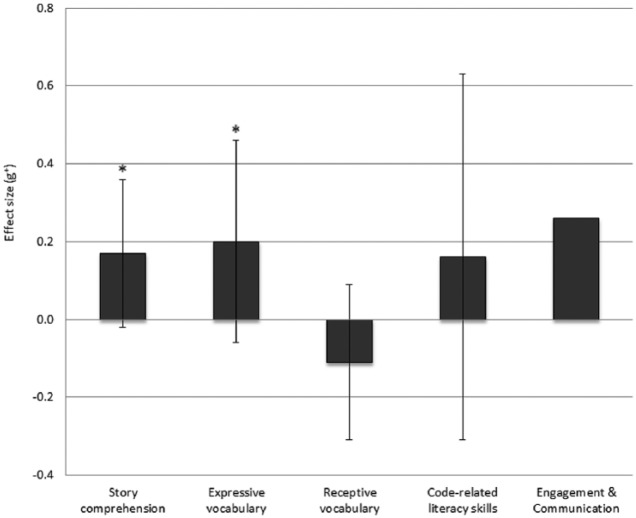
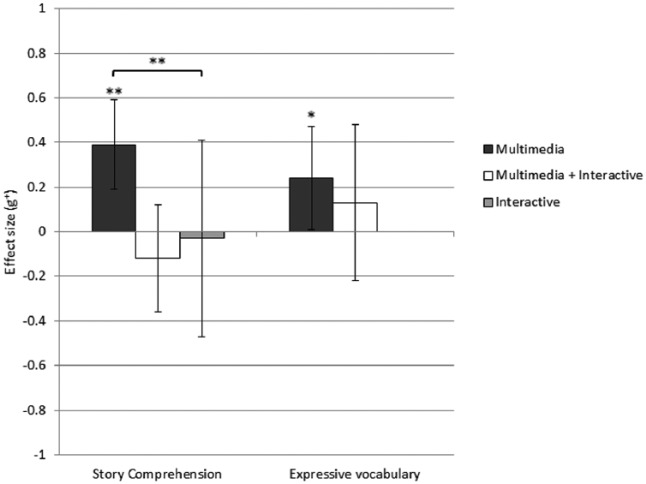
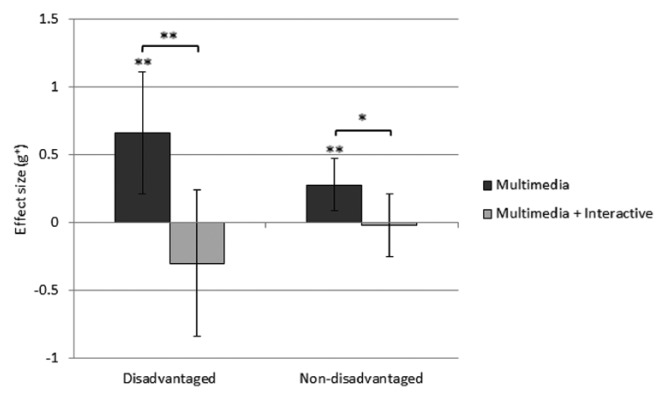
A meta-analysis was conducted on the effects of technology-enhanced stories for young children’s literacy development when compared to listening to stories in more traditional settings like storybook reading. A small but significant additional benefit of technology was found for story comprehension (g+ = 0.17) and expressive vocabulary (g+ = 0.20), based on data from 2,147 children in 43 studies. When investigating the different characteristics of technology-enhanced stories, multimedia features like animated pictures, music, and sound effects were found beneficial. In contrast, interactive elements like hotspots, games, and dictionaries were found to be distracting. Especially for children disadvantaged because of less stimulating family environments, multimedia features were helpful and interactive features were detrimental. Findings are discussed from the perspective of cognitive processing theories.
Overview
The claims and statistics of this paper haven’t been checked yet.
Free: it reads the open-access text and checks the first 5 claims that cite a source we can check. Create a free account to check every claim.
Integrity signals
Registry
Cites
Statistics
Figures
Verification
Claims the paper makes
The claims and statistics of this paper haven’t been checked yet.
Free: it reads the open-access text and checks the first 5 claims that cite a source we can check. Create a free account to check every claim.
Claims other papers make about this one
Each is checked against this paper’s own text: does it say what the citing paper says it does?
The cited source says what the claim attributes to it.
In the citing paper
“That is, the design aimed for a strong match between the verbal and nonverbal information in the stories (Takacs et al. 2015).”
From Supporting Literacy and Digital Literacy Development in Early Childhood Education Using Storytelling Activities (2018) · cites this paper as Takacs et al. 2015
Self-check
Percentages, sums and reported differences re-computed from the paper’s own numbers.
The self-check needs the paper’s full text.
Citations
Cites
Tabachnick, B. G., & Fidell, L. S. (1983) · Cited by 80,058
Borenstein, M., Hedges, L. V., Higgins, J. P. T., & Rothstein, H. R. (2009) · doi:10.1002/9780470743386 · Cited by 14,225
Borenstein, M., Hedges, L. V., Higgins, J. P. T., & Rothstein, H. R. (2021) · doi:10.1002/9781119558378 · Cited by 9,799
(2000) · Cited by 9,198
The file drawer problem and tolerance for null results.
Rosenthal, R. (1979) · Psychological Bulletin · doi:10.1037/0033-2909.86.3.638 · Cited by 9,068 · cited 1×
“A fail-safe number of 5 k + 10 is considered robust, where k is the number of studies in the meta-analysis (Rosenthal, 1979).”
Background(1991) · Choice Reviews Online · doi:10.5860/choice.28-5764 · Cited by 6,847
The Handbook of Research Synthesis and Meta-Analysis
(2019) · doi:10.7758/9781610448864 · Cited by 4,553
Nine Ways to Reduce Cognitive Load in Multimedia Learning
Mayer, R. E., & Moreno, R. (2003) · Educational Psychologist · doi:10.1207/s15326985ep3801_6 · Cited by 4,207 · cited 2×
“This outcome is probably because the processing of games and extra animations can be considered as extraneous materials that interfere with the processing of the story content (Mayer & Moreno, 2003).”
BackgroundA Nonparametric “Trim and Fill” Method of Accounting for Publication Bias in Meta-Analysis
Duval, S., & Tweedie, R. (2000) · Journal of the American Statistical Association · doi:10.1080/01621459.2000.10473905 · Cited by 2,955
Morris, S. B., & DeShon, R. P. (2002) · Psychological Methods · doi:10.1037/1082-989x.7.1.105 · Cited by 2,502
Research works printed but not linked: 7
- McKenna M. C. Labbo L. D. Kieffer R. D. Reinking D. (Eds.). (2006). International handbook of literacy and technology: Vol. II. Mahwah, NJ: Lawrence Erlbaum Associates.
- *Chiong C. Ree J. Takeuchi L. Erickson I. (2012). Print books vs e-books. Comparing parent-child co-reading on print, basic and enhanced e-book platforms. New York, NY: The Joan Ganz Cooney Center at Sesame Workshop Retrieved from http://www.joanganzcooneycenter.org/wp-content/uploads/2012/07/jgcc_ebooks_quickreport.pdf
- *Critelli K. (2011). The effect of multimedia e-books on the acquisition of early literacy skills (Master’s thesis). Retrieved from Proquest Dissertations and Theses Global (UMI: 1500577).
- Guernsey L. Levine M. Chiong C. Severns M. (2012). Pioneering literacy in the digital wild west: Empowering parents and educators. New York, NY: The Joan Ganz Cooney Center at Sesame Workshop Retrieved from http://www.joanganzcooneycenter.org/wp-content/uploads/2012/12/GLR_TechnologyGuide_final.pdf
- Meringoff L. K. (1982, 3). What pictures can and can’t do for children’s story understanding. Paper presented at the Annual Meeting of the American Educational Research Association, New York, NY.
- Roskos K. Burstein K. (2013, 4). Engagement with e-Books: Does device matter? Paper presented at the annual meeting of the American Educational Research Association, San Francisco, CA.
- *Verhallen M. J. A. J. Bus A. (2009b). Video storybooks: a worthwhile investment for all young L2 learners? (Unpublished doctoral dissertation). Leiden University, Leiden, the Netherlands.
Cited by
Items 201–300 of 401
Eutsler, L., Antonenko, P., & Dawson, K. (2018) · Computers in the Schools · doi:10.1080/07380569.2018.1531652 · Cited by 8
“…children reading technology-enhanced storybooks that examined 43 studies (e.g., e-book, CD-ROM, video book) showed that children achieved gains in story comprehension and expressive vocabulary resulting from multimedia features such as illustrations, music, and sound effects (Takacs et al., 2015).”
BackgroundChancen von Digitalisierung im inklusiven Leseunterricht
Seifert, S. (2019) · Springer eBooks · doi:10.1007/978-3-658-24221-3_12 · Cited by 15
Is contextual animation needed in multimedia learning games for children? An eye tracker study
Javora, O., Hannemann, T., Volná, K., Děchtěrenko, F., Tetourová, T., Stárková, T., & Brom, C. (2020) · Journal of Computer Assisted Learning · doi:10.1111/jcal.12489 · Cited by 15
Annotating digital text with phonemic cues to support decoding in struggling readers
Donnelly, P. M., Larson, K., Matskewich, T., & Yeatman, J. D. (2020) · PLoS ONE · doi:10.1371/journal.pone.0243435 · Cited by 19
Gohar, R. H. A. (2017) · المجله الدولیه للتعلیم بالانترنت · doi:10.21608/ijie.2017.13879 · Cited by 7
Exploring parent profiles in parent–child interactions with e-books
Turco, R. G., Rowe, M. L., & Blatt, J. H. (2023) · First Language · doi:10.1177/01427237231160242 · Cited by 10
“…of experimental studies with preschool children from diverse backgrounds that measure the effect of independent use of e-books on literacy skills, and these studies demonstrate that e-books can be an effective tool for improving literacy development (e.g. for a review see Takacs et al., 2015).”
BackgroundFiorentini, J. P., Leif, S. A., Fasching-Varner, K. J., & McCreery, M. P. (2025) · Technology Knowledge and Learning · doi:10.1007/s10758-025-09851-9 · Cited by 7
“Recent literature reviews of gaming in education, however, have shown mixed results for a variety of academic topics (Girard et al., 2013; Young et al., 2012), and researchers have called for more complex examinations of literacy learning within gaming environments (Takacs et al., 2015).”
Ciesielska, M., Kucirkova, N. I., & Thomson, J. (2025) · Early Education and Development · doi:10.1080/10409289.2025.2516989 · Cited by 24
“Similar to other interdisciplinary meta-analytical studies concerned with children’s reading and development (e.g. Fikrat-Wevers et al., 2021; Takacs et al., 2015) we define storybooks as illustrated narrative fiction, containing written words and a plot: in any format (paper-based or digital with…”
Kim, S. J. (2022) · Learning Media and Technology · doi:10.1080/17439884.2022.2036189 · Cited by 9
“…both the possibilities and concerns of using these resources for young children’s literacy development in both monolingual and bilingual/ELL contexts (e.g., Christ et al. 2019; Kelley and Kinney 2017; Wang, Christ, and Mifsud 2020; Sun, Loh, and Charles Roberts 2019; Takacs, Swart, and Bus 2015).”
BackgroundThe shared reading of digital storybooks with young children: Parents’ perspectives
Nicholas, M., & Paatsch, L. E. (2023) · Research Papers in Education · doi:10.1080/02671522.2023.2205411 · Cited by 19
“…take into consideration the varied content and form of the digital, such as nuances in the type, format, content and genre of digital books, and how some technology-enhanced storybooks have been found to benefit children’s story comprehension and expressive vocabulary (Takacs, Swart, and Bus 2015).”
Christ, A., Smolarczyk, K., & Kröner, S. (2023) · Zeitschrift für Erziehungswissenschaft · doi:10.1007/s11618-023-01210-7 · Cited by 10
Representation in best-selling preschool storybook apps in the United States
Bruner, L., & Kucirkova, N. I. (2024) · Journal of Children and Media · doi:10.1080/17482798.2024.2402273 · Cited by 6
“Recent meta-analysis suggest digital books may be more advantageous for word learning than other types of screen media, such as TV/video and electronic games (e.g., Takacs et al., 2015).”
Understanding Stories as Multimodal Experiences in Young Children’s Development
Narey, M. J. (2019) · Educating the young child · doi:10.1007/978-3-030-19266-2_8 · Cited by 6
The Effectiveness of Applying Multimedia Web-Based Technologies in Culinary Skills Training
Hsu, L., Chien, M.-Y. C., & Chien, M.-Y. C. (2015) · International Research in Education · doi:10.5296/ire.v3i2.8055 · Cited by 9
Loftus‐Rattan, S. M., & Furey, J. (2020) · Reading & Writing Quarterly · doi:10.1080/10573569.2020.1800540 · Cited by 8
“Our findings are in contrast to the results of Takacs et al. (2015) meta-analysis, which compared technology-based storybook interventions with traditional storybook interventions in terms of expressive vocabulary outcomes, and found small benefits in favor of technology (g þ ¼ .20).”
BackgroundResultUmarji, O., Day, S., Xu, Y., Zargar, E., Yu, R., & Connor, C. M. (2020) · Reading and Writing · doi:10.1007/s11145-020-10081-x · Cited by 6
OKUL ÖNCESİ DÖNEM ÇOCUKLARINDA DİJİTAL HİKÂYE ANLATIMININ DİNLEME BECERİLERİNE ETKİSİ
KÖSE, H. B. T., & Bartan, M. (2021) · Ankara Universitesi Egitim Bilimleri Fakultesi Dergisi · doi:10.30964/auebfd.703473 · Cited by 11
Bernard, R. M., Borokhovski, E., Schmid, R. F., & Tamim, R. M. (2018) · Springer eBooks · doi:10.1007/978-3-319-17727-4_109-1 · Cited by 8
Theorising materiality in children’s digital books
Kucirkova, N. I. (2019) · Libri et Liberi · doi:10.21066/carcl.libri.8.2.2 · Cited by 9
Bus, A. G., Kucirkova, N. I., ten Braak, D., & Ciesielska, M. (2025) · Early Education and Development · doi:10.1080/10409289.2025.2571978 · Cited by 25
“The objective of our study was to focus specifically on digital picture books with interactive features, rather than on films or other media as in Takacs et al. (2015).”
Self-citationHaptics and hotspots: creating usable and educational apps for children in the Netherlands
Piotrowski, J. T., & Broekman, F. L. (2022) · Journal of Children and Media · doi:10.1080/17482798.2022.2059536 · Cited by 7
Parent Verbalizations and Toddler Responses With Touchscreen Tablet Nursery Rhyme Apps
Munzer, T. G., Miller, A. L., Yeo, S., Wang, Y., McCaffery, H., Kaciroti, N., & Radesky, J. S. (2021) · PEDIATRICS · doi:10.1542/peds.2021-049964 · Cited by 5
Bagaimana Literasi Dini dengan Cerita Sebelum Tidur?
Sufiati, V., & Paramita, M. V. A. (2021) · Jurnal Pendidikan Anak Usia Dini Undiksha · doi:10.23887/paud.v9i1.32837 · Cited by 12
A Different Approach to Evaluation in Early Childhood Curriculum: Learning Stories
Cengiz, G. Ş. T., & Altındağ, A. (2022) · Sustainability · doi:10.3390/su141811218 · Cited by 5
Experts prefer text but videos help novices: an analysis of the utility of multi-media content
Song, H., Healey, J., Siu, A. F., Wigington, C., & Stasko, J. (2023) · CHI Conference Extended Abstracts on Human Factors in Computing Systems (CHI EA) · doi:10.1145/3544549.3585900 · Cited by 15
Shamir, A., & Dushnitzky, G. (2019) · Literacy studies · doi:10.1007/978-3-030-20077-0_13 · Cited by 5
The Effectiveness of Online Dialogic Storytelling on Vocabulary Skills of Hard of Hearing Children
rezaiyan, F., Movallali, G., Adibsereshki, N., & Bakhshi, E. (2020) · Iranian Rehabilitation Journal · doi:10.32598/irj.18.3.949.1 · Cited by 8
Mobile learning for early reading in Cambodia
Oakley, G., Pegrum, M. A., Kheang, T., & Seng, K. (2021) · Education and Information Technologies · doi:10.1007/s10639-021-10615-y · Cited by 9
“, 2017) through enhanced engagement, with support provided by features such as interactivity, animation and text narration (Son et al., 2020; Takacs et al., 2015).”
Background3 in 1: Förderung von Sprache, Vorläuferfähigkeiten und frühem Lesen
Egert, F., Cordes, A.-K., & Hartig, F. (2022) · Kindheit und Entwicklung · doi:10.1026/0942-5403/a000362 · Cited by 5
YİĞİT, N., & Uzun, E. M. (2022) · Uluslararası Bilim ve Eğitim Dergisi · doi:10.47477/ubed.1030715 · Cited by 9
Kucirkova, N. I., & Sakr, M. (2016) · Springer eBooks · doi:10.1007/978-981-4585-92-7_29-1 · Cited by 5
Harnessing Early Spatial Learning Using Technological and Traditional Tools at Home
Lee, J., Ho, A., & Wood, E. (2018) · Mathematics education in the digital era · doi:10.1007/978-3-319-72381-5_11 · Cited by 6
Acerra, E. (2020) · Revue de recherches en littératie médiatique multimodale · doi:10.7202/1073681ar · Cited by 7
“Nous avons, en revanche, intégré au répertoire d’écrits considérés les méta-analyses de Takacs et al. (2015) et de Zucker et al. (2009) 1.2.”
InfluentialRaja, S. E. L. (2021) · Journal of Education Action Research · doi:10.23887/jear.v5i4.12336 · Cited by 5
Maureen, I. Y. (2020) · doi:10.3990/1.9789036551144 · Cited by 7
Comparing the effects of AR picture books and print picture books on preschoolers’ reading effect
Wu, L., & Ma, Y. (2025) · Early Child Development and Care · doi:10.1080/03004430.2025.2539870 · Cited by 7
“Additionally, poorly designed multimedia elements in AR picture books may increase cognitive load and divert attention from learning objectives (Takacs et al., 2015).”
Developing Digital Storybook to Improve Children’s Language Learning
Fibriasari, H., Baharuddin, B., Gultom, S., Gultom, S., Restuati, M., Ritonga, W. P., Dalle, J., Putra, A. P., Biyatmoko, D., Mutalib, A. B. A., et al. (2021) · Advances in Social Science, Education and Humanities Research/Advances in social science, education and humanities research · doi:10.2991/assehr.k.211110.214 · Cited by 4
The challenge of screen mediated shared reading for children’s learning and engagement
Read, K., Harrison, H., Mireku, B., & Ying, K. (2023) · Frontiers in Psychology · doi:10.3389/fpsyg.2023.1212173 · Cited by 7
“Previous e-book reading studies have explored the balance between including features that promote children’s engagement to encourage learning versus avoiding novel features that could potentially distract children from learning (Takacs et al., 2015; Rvachew et al., 2017; Revelle et al., 2019).”
Reading with a Touch of Gameplay: Gamified E-Books’ Convergence with Classical Literary Worlds
Rughinis, R. V., & Rughiniş, C. (2016) · Progress in IS · doi:10.1007/978-3-319-45557-0_10 · Cited by 6
Schulz-Heidorf, K., Jernes, M., Hoel, T., & Mangen, A. (2021) · European Early Childhood Education Research Journal · doi:10.1080/1350293x.2021.1968461 · Cited by 11
“Another meta-analysis (Takacs, Swart, and Bus 2015) and two reviews (Bus, Takacs, and Kegel 2015; Reich, Yau, and Warschauer 2016) reveal that interactive features that are not related to the story, are distracting and detrimental to learning.”
BackgroundThe Development of Digital Technology to Support Learning in Children with Disabilities
Hongngam, K., Injumpa, D., & Chanapai, K. (2022) · International Education Studies · doi:10.5539/ies.v15n4p117 · Cited by 7
Samtalebasert lesing med bok eller nettbrett:Gjør mediet en forskjell?
Mangen, A., & Hoel, T. (2017) · Norsk pedagogisk tidsskrift · doi:10.18261/issn.1504-2987-2017-04-06 · Cited by 11
Design and Development of a Mobile Writing Application for Students With Dysgraphia
Hopcan, S., Tokel, S. T., Karasu, N., & Aykut, Ç. (2019) · Advances in educational technologies and instructional design book series · doi:10.4018/978-1-5225-8106-2.ch012 · Cited by 5
Supporting Children’s Literacy Learning in Low- and Middle-income Countries through M-learning
Oakley, G., & Imtinan, U. (2018) · Emerald Group Publishing Limited eBooks · doi:10.1108/978-1-78714-879-620181010 · Cited by 4
Practical Strategies for e-Book Use in Early Childhood Classrooms (K-5)
Moody, A. K., & Swafford, J. (2019) · Literacy studies · doi:10.1007/978-3-030-20077-0_12 · Cited by 4
Toward Reciprocity and Agency in Students’ Digital Reading
Kucirkova, N. I. (2020) · The Reading Teacher · doi:10.1002/trtr.1893 · Cited by 7
Soydan, S., Pirpir, D. A., Karaçelik, E., & Çelik, E. S. (2025) · Early Child Development and Care · doi:10.1080/03004430.2025.2501105 · Cited by 4
Third graders’ digital and paper text comprehension
Ruffini, C., Pecini, C., Saldaña, D., & Delgado, P. (2025) · Learning and Instruction · doi:10.1016/j.learninstruc.2025.102186 · Cited by 7
Investigating Children’s Multimodal Enactment in Digitally Augmented Tabletop Storytelling
Liu, T., Gomez, G., & Shipman, F. M., III (2025) · International Journal of Child-Computer Interaction · doi:10.1016/j.ijcci.2025.100770 · Cited by 11
Zhang, Y. (2025) · Journal of Chinese Writing Systems · doi:10.1177/25138502251369889 · Cited by 4
“…illustrations have been found to enhance children ’ s attention (Cao et al., 2018 ; Chuang and Jamiat, 2023a ; Montalvo Castro and Martos Castañeda, 2022 ; Müller-Brauers et al., 2020 ), especially when they are meaningfully aligned with the text (Bus and Anstadt, 2021 ; Takacs et al., 2015 ).”
Butcher, K. R. (2024) · Discourse Processes · doi:10.1080/0163853x.2024.2357983 · Cited by 5
“…been strong condemnation of irrelevant digital features (e.g., games) in storybook apps (Bus et al., 2015), there has been less consensus on whether interactive illustrations are beneficial (Takacs et al., 2015), neutral (De Jong & Bus, 2004), or harmful (Krcmar & Cingel, 2014) for comprehension.”
Lessons learned from remote, early-literacy instruction
Jones, J. S., Grifenhagen, J. F., & McKinney, S. (2024) · Journal of Early Childhood Literacy · doi:10.1177/14687984241281206 · Cited by 4
“Much of this research focused on limited, targeted intervention sessions, teaching speci fi c content such as letter identi fi cation or vocabulary terms, or children working independently with e-books or language-and literacy-focused apps (Madigan et al., 2020; Takacs et al., 2015).”
Adam, P., Kleemans, T., Droop, M., Amorim, A. N., & Segers, E. (2025) · The Journal of Educational Research · doi:10.1080/00220671.2025.2490963 · Cited by 6
“Other studies also found that multimedia-enhanced digital stories gave a better impact on vocabulary development compared to traditional print-like stories (Korat et al., 2017; Takacs et al., 2015).”
Implementation of STEM in Preschool Education
Turk, A. M., & Akcanca, N. (2021) · Cited by 3
Aqazade, M. (2022) · Education Sciences · doi:10.3390/educsci12120879 · Cited by 3
Multimedia Learning: Contributions of Learners’ Verbal Abilities and Presentation Modalities
Kim, S., & Lombardino, L. J. (2019) · International Journal of Learning Teaching and Educational Research · doi:10.26803/ijlter.18.1.6 · Cited by 8
Les applications littéraires pour la jeunesse : œuvres et lecteurs
Acerra, E. (2019) · theses.fr (ABES) · doi:10.70675/0dfeec8ezfc2dz479aza1a7z83c6efb34870 · Cited by 13
Bali, C., & Zsido, A. N. (2024) · Integrated science · doi:10.1007/978-3-031-60713-4_11 · Cited by 6
Navigator: A Decentralized Scheduler for Latency-Sensitive AI Workflows
Yang, Y., Merlina, A., Song, W., Yuan, T., Birman, K., & Vitenberg, R. M. (2024) · IEEE International Conference on Edge Computing and Communications (EDGE) · doi:10.1109/edge62653.2024.00015 · Cited by 2
Fostering Early Childhood Literacy: The Crucial Role of Family Environments
Kurniawati, F., Motimona, P. D., & Maryatun, I. B. (2024) · Indonesian Journal Of Educational Research and Review · doi:10.23887/ijerr.v7i3.67982 · Cited by 2
“The results of the study observed that various activities can be carried out at home to encourage the development of early childhood literacy, and parental involvement is very important in forming a culture of literacy from an early age (Takacs et al., 2015; Wildová & Kropáčková, 2015).”
Gaze-based word highlighting boosts reading performance: an eye tracking study in second graders
Rummens, K., & Beier, S. (2025) · Ergonomics · doi:10.1080/00140139.2025.2514600 · Cited by 2
“Furthermore, technology has the potential to enhance young children’s literacy development: a meta-analysis revealed slightly better story comprehension and expressive vocabulary for technology-enhanced stories compared to more traditional storybook reading (takacs, swart, and Bus 2015).”
Kayır, G. T., & Akyol, T. (2025) · Early Childhood Education Journal · doi:10.1007/s10643-025-02084-6 · Cited by 9
“…childhood education are examined, it is seen that digital stories included in the classroom environment increase students’ phonological awareness (Shamir et al., 2008), support story comprehension and word recognition skills (Zipke, 2017), and support early literacy skills (Takacs et al., 2015 ).”
Magaldi, D., & Fayne, H. R. (2022) · Journal for Multicultural Education · doi:10.1108/jme-08-2021-0134 · Cited by 4
The dragon’s AR: Narrative augmentation in Russell’s The Dragon Defenders
Halliday, M., Narayan, A., & Frommherz, G. (2023) · Journal of Pervasive Media · doi:10.1386/jpm_00007_1 · Cited by 2
Principles of Accessible Multimedia Learning
Hinderliter, H. (2022) · Journal of Applied Instructional Design · doi:10.51869/114/hh122 · Cited by 6
Digital högläsning för flerspråkande i förskolan
Nilsen, M., Petersen, P., & Danielsson, K. (2023) · Utbildning & Lärande · doi:10.58714/ul.v17i4.18253 · Cited by 33
Convergencias y divergencias en la competencia digital de los docentes en formación
Aguilar, D. L., García, M. D., & Prieto, F. J. G. (2024) · Campus Virtuales · doi:10.54988/cv.2024.1.1112 · Cited by 3
Liu, N., Chen, C., Liu, Y., Jiang, S., Gao, Q., & Wu, R. (2024) · Journal of Eye Movement Research · doi:10.16910/jemr.17.4.1 · Cited by 5
Rademacher, A., Bäker, N., Jungmann, T., von Düring, U., Zumbach, J., & Goagoses, N. (2025) · Zeitschrift für Entwicklungspsychologie und Pädagogische Psychologie · doi:10.1026/0049-8637/a000308 · Cited by 2
Individual differences in word learning from print and digital shared book reading
Diprossimo, L., & Cain, K. (2025) · Journal of Experimental Child Psychology · doi:10.1016/j.jecp.2025.106345 · Cited by 7
Liang, C., & Zhang, L. (2025) · Journal of Chinese Writing Systems · doi:10.1177/25138502251371320 · Cited by 8
“Many of these offer multimedia features such as music, narration, and animations, as well as interactive tools like built-in dictionaries, games, and comprehension prompts (Takacs et al., 2015 ).”
Evaluate of digital book criteria using fuzzy analytical hierarchy process
Yasa, A. D., Wadu, L. B., Chrisyarani, D. D., Wibawa, A. P., Kuswandi, D., & Utama, D. M. (2021) · IOP Conference Series Materials Science and Engineering · doi:10.1088/1757-899x/1098/3/032106 · Cited by 2
Kucirkova, N. I., & Sakr, M. (2018) · Springer eBooks · doi:10.1007/978-981-287-026-1_29 · Cited by 3
Wainwright, B. R., Allen, M. L., & Cain, K. (2020) · Autism & Developmental Language Impairments · doi:10.1177/2396941520931728 · Cited by 3
“Children often prefer objects to pictures (Geraghty et al., 2014), especially interactive stimuli with multimedia features such as sound effects (Takacs et al., 2015).”
BackgroundProfessionally Oriented English Teaching of Future Aviation Industry Professionals
Rashid, Q. J., & Тесленко, Н. (2020) · Universal Journal of Educational Research · doi:10.13189/ujer.2020.082211 · Cited by 2
El impacto de las tecnologías en el ocio de la primera infancia.
Díaz-Herrera, L., Talledo, I. S., & Fernández, N. G. (2021) · Revista Fuentes · doi:10.12795/revistafuentes.2021.12753 · Cited by 7
Cabello, P., Arriagada, S., & Felmer, P. L. (2021) · Calidad en la educación · doi:10.31619/caledu.n55.1034 · Cited by 9
Şanal, S. Ö., & Erdem, M. (2022) · Education and Information Technologies · doi:10.1007/s10639-022-11378-w · Cited by 5
“It is common to think that presenting different multimedia elements in addition to the text may distract the reader (Reich et al., 2016; Salmon, 2014; Takacs et al., 2015; Zucker et al., 2009).”
BackgroundEfektivitas Multimedia IPA berbasis Kearifan Lokal Keris (M-Keris) terhadap Pemahaman Konsep Siswa
Dolo, F. X., & Prodjosantoso, A. K. (2022) · JPI (Jurnal Pendidikan Indonesia) · doi:10.23887/jpiundiksha.v11i2.22654 · Cited by 2
Weihmayer, L. S., Flämig, K., & Groth, K. (2023) · MedienPädagogik Zeitschrift für Theorie und Praxis der Medienbildung · doi:10.21240/mpaed/52/2023.02.05.x · Cited by 2
Köroğlu, Z. Ç. (2023) · Advances in educational technologies and instructional design book series · doi:10.4018/979-8-3693-0353-5.ch008 · Cited by 2
Addriani, R., Dewi, W. S., Akmam, A., & Sundari, P. D. (2023) · Jurnal Penelitian Pendidikan IPA · doi:10.29303/jppipa.v9i12.5894 · Cited by 4
Nastasiuk, A., Courteau, É., Thomson, J., & Deacon, S. H. (2024) · Journal of Research in Reading · doi:10.1111/1467-9817.12451 · Cited by 4
Hand position affects performance on multiplication tasks
Davoli, C. C., O’Rear, C. D., McAulay, E., McNeil, N. M., & Brockmole, J. R. (2020) · Journal of Numerical Cognition · doi:10.5964/jnc.v6i1.211 · Cited by 4
“The presence of these hotspots is, therefore, associated with lower levels of learning, possibly because they distract children from the to-belearned material (Takacs et al., 2015).”
BackgroundAnnotating digital text with phonemic cues to support decoding in struggling readersPreprint
Donnelly, P. M., Larson, K., Matskewich, T., & Yeatman, J. D. (2019) · PsyArXiv (OSF Preprints) · doi:10.31234/osf.io/7mw5b · Cited by 2
Haben digitale Bilderbücher in Kitas einen sprachförderlichen Mehrwert?
Hemmerich, F., & Cohen, F. (2021) · Frühe Bildung · doi:10.1026/2191-9186/a000510 · Cited by 1
Literature Review: Digital Books in Preschool Period
SEÇİM, E. S., & Toledo, E. M. (2023) · Journal of Educational Technology and Online Learning · doi:10.31681/jetol.1330790 · Cited by 4
Udoudom, U. I. (2023) · Journal of Applied Science and Education (JASE) · doi:10.54060/jase.2023.45 · Cited by 1
Zheng-ming, S., Du, W., Guo, W., Shi, M., & Song, X. (2023) · Communications in computer and information science · doi:10.1007/978-3-031-49212-9_41 · Cited by 1
Rosli, M. S., Saleh, N. S., Ali, A. M., Bakar, S. A., & Isa, K. (2024) · AIP conference proceedings · doi:10.1063/5.0195068 · Cited by 1
Digital Media Use and Language Development in Early Childhood
Dore, R. A., Jing, M., Taylor, G., Madigan, S., Samudra, P. G., Sundqvist, A. S., & Xu, Y. (2025) · Handbook of Children and Screens · doi:10.1007/978-3-031-69362-5_6 · Cited by 1
Visual literacy in kindergarten as media play: a multi case study of stop motion animation videos
Anagnostidou, M. A., Psoma, A., & Theodosiadou, S. (2025) · Journal of Visual Literacy · doi:10.1080/1051144x.2025.2496027 · Cited by 3
“What is more, motion pictures built in storybooks make picture books exposure one of the strongest incentives for developing language and literacy skills in the pre-school age and boost the effects of stories on young children’s story comprehension and word learning (Takacs et al., 2015).”
Literatura digital como recurso para desarrollar la comprensión lectora
Jiménez-Díaz, A. C. (2023) · HUMAN REVIEW International Humanities Review / Revista Internacional de Humanidades · doi:10.37819/revhuman.v17i5.1599 · Cited by 1
The price of learning: Assessing cost versus quality in children's reading apps
Bruner, L., & Kucirkova, N. I. (2025) · Literacy · doi:10.1111/lit.70005 · Cited by 1
“More speci fi cally, digital features have been shown to support or inhibit children ’ s vocabulary learning depending on their design quality (Furenes et al., 2021; Jing et al., 2023; Takacs et al., 2015), the topic of several reviews in the past decade (e.g., Hirsh-Pasek et al., 2015).”
Dotan, S., & Katzir, T. (2025) · Education Sciences · doi:10.3390/educsci15101306 · Cited by 1
Feng, D. (2025) · SAGE Open · doi:10.1177/21582440251393196 · Cited by 3
“According to Table 2, the top three cited ones are all review articles (Burston, 2015; Golonka et al., 2014; Takacs et al., 2015).”
Learning through picture books: a meta-analysis of their impact on literacy development
Auliya, H. R., Sayekti, O. M., Wibowo, S. E., Rakhmawati, S., Suryani, L., & Haliem, T. D. (2026) · Reading and Writing · doi:10.1007/s11145-025-10753-6 · Cited by 6
Parental emotional expression and children's oral narrative ability: a systematic review
Zhang, Z. H., Mohamed, S. B., & Bakar, K. A. (2026) · Frontiers in Psychology · doi:10.3389/fpsyg.2025.1629744 · Cited by 3
Mediating Digital Narratives: Parental Roles in Enhancing Multimodal Literacy for Early Childhood
Maylani, I., Putri, F. R., & Kamilatun, A. N. (2026) · Jurnal Obsesi Jurnal Pendidikan Anak Usia Dini · doi:10.31004/obsesi.v10i1.7490 · Cited by 3
“These practices highlight how mothers scaffolded comprehension by asking questions and encouraging children’s active involvement, echoing Takacs et al. (2015) conclusion that adult mediation is essential for comprehension in digital reading.”
Zhou, W., Wang, R., Xiong, Y., Zhang, X., Liu, X., Lin, C., Zheng, H., Yin, L., Zheng, D., Xie, B., et al. (2026) · Reading and Writing · doi:10.1007/s11145-026-10775-8 · Cited by 2
Metadata
- Authors
- Takacs, Z. K., Swart, E. K., & Bus, A. G.
- Affiliations
- Leiden University
- Leiden University (NL)
- Venue
- Review of Educational Research
- Published
- 2015-12
- Volume
- 85
- Issue
- 4
- Pages
- 698-739
- ISSN
- 0034-6543 (ISSN-L)
- 1935-1046
- PMC
- PMC4647204
- OpenAlex
- W2161429259
- Cited by
- 403
- References
- 113
- Citations by year
- 2026: 39 · 2025: 32 · 2024: 33 · 2023: 62 · 2022: 40 · 2021: 40 · 2020: 36 · 2019: 51 · 2018: 30 · 2017: 21 · 2016: 17 · 2015: 2
- FWCI
- 59.00
- Type
- journal article
- Language
- en
- Open access
- hybrid
- doi.org
- Licence
- cc-by-nc
- journals.sagepub.com/page/policies/text-and-data-mining-license (tdm)
- Locations
- Review of Educational Research (publishedVersion, cc-by-nc)
- PubMed Central (publishedVersion, cc-by-nc)
- PubMed (publishedVersion)
- Edinburgh Research Explorer (University of Edinburgh) (submittedVersion, cc-by-nc)
- Leiden Repository (Leiden University) (submittedVersion)
- Data Archiving and Networked Services (DANS) (submittedVersion)
- Data Archiving and Networked Services (DANS) (submittedVersion, other-oa)
- Topics
- Social Sciences › Psychology › Developmental and Educational Psychology › Reading and Literacy Development
- Social Sciences › Psychology › Experimental and Cognitive Psychology › Visual and Cognitive Learning Processes
- Social Sciences › Education › Digital Storytelling and Education
- Keywords
- multimedia features, interactive features, early literacy development, narrative comprehension, expressive vocabulary, young children, animated pictures, hot spots, family environment
About these checks
Registry, retraction, Cites and statistics results are computed, not judged, with one exception: a printed reference that no index lists is read once by a model before it counts as a citation error. Claims are extracted by a model and kept only when their quote appears verbatim in the text; each cited source is then checked, with a model’s help, for whether it says what the claim relies on. Those verdicts can be wrong — read the claim’s quote and the cited source before relying on one.
Statistics and arithmetic are recomputed, not judged.
Confidence bands are shown only for fields calibrated on our annotated test set. None is calibrated yet, so no band is shown.
What counts as a claim ›How we measure confidence ›How we check this ›
Are you an author, or do you see a problem with this page? Request a review
Data sources
Bibliographic data: Semantic Scholar, OpenAlex, Crossref.
Contains information from the Semantic Scholar Academic Graph Datasets, made available under the ODC Attribution License (ODC-BY 1.0).
Semantic Scholar’s data is described in: Kinney, R., et al. (2023). The Semantic Scholar Open Data Platform. arXiv:2301.10140.
