

The DOI matches its Crossref record; 1 of the 1 references it cites were found in a registry or an index.
Gamified Inoculation Interventions Do Not Improve Discrimination Between True and Fake News: Reanalyzing Existing Research With Receiver Operating Characteristic Analysis
Preprint — published as 10.1037/xge0001395
Abstract
Gamified inoculation interventions designed to improve detection of online misinformation are becoming increasingly prevalent. Two of the most notable interventions of this kind are Bad News and Go Viral!. To assess their efficacy, prior research has typically used pre-post designs in which participants rated the reliability or manipulativeness of true and fake news items before and after playing these games, while most of the time also including a control group who played an irrelevant game (Tetris) or did nothing at all. Mean ratings were then compared between pre-tests and post-tests and/or between the control and experimental conditions. Critically, these prior studies have not separated response bias effects (overall tendency to respond “true” or “fake”) from discrimination (ability to distinguish between true and fake news, commonly dubbed discernment). We reanalyzed the results from five prior studies using receiver operating characteristic (ROC) curves, a method common to signal detection theory (SDT) that allows for discrimination to be measured free from response bias. Across the studies, when comparable true and fake news items were used, Bad News and Go Viral! did not improve discrimination, but rather elicited more “false” responses to all news items (more conservative responding). These novel findings suggest that the current gamified inoculation interventions designed to improve fake news detection are not as effective as previously thought and may even be counterproductive. They also demonstrate the usefulness of ROC analysis, a largely unexploited method in this setting, for assessing the effectiveness of any intervention designed to improve fake news detection.
Overview
The claims and statistics of this paper haven’t been checked yet.
Free: it reads the open-access text and checks the first 5 claims that cite a source we can check. Create a free account to check every claim.
Integrity signals
Registry
Cites
Statistics
Figures







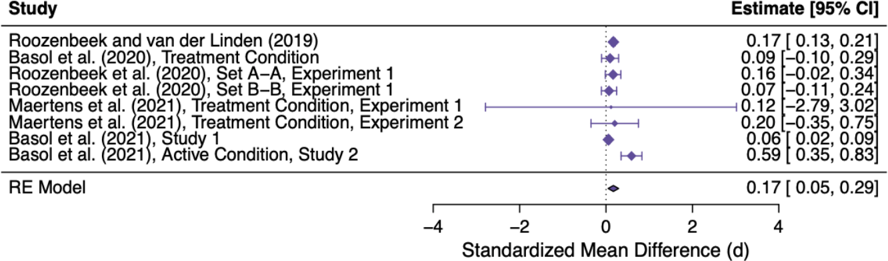
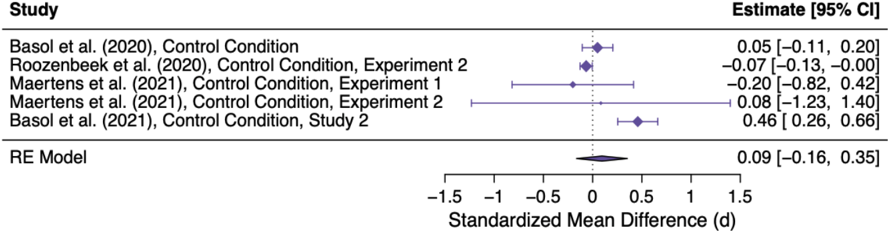
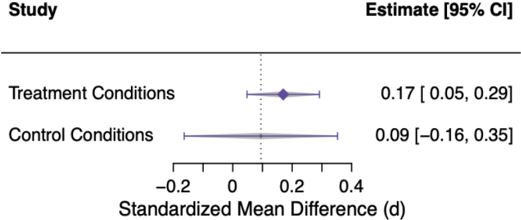
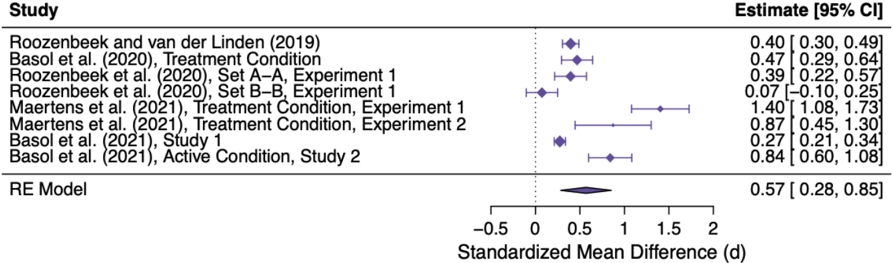


Verification
Claims the paper makes
The claims and statistics of this paper haven’t been checked yet.
Free: it reads the open-access text and checks the first 5 claims that cite a source we can check. Create a free account to check every claim.
Claims other papers make about this one
Each is checked against this paper’s own text: does it say what the citing paper says it does?
In the citing paper
“Contrary to the opinion that psychological inoculation reduces the credibility of all information [6], psychological inoculation improves individuals’ ability to distinguish between real information and misinformation [7].”
From Psychological Inoculation for Credibility Assessment, Sharing Intention, and Discernment of Misinformation: Systematic Review and Meta-Analysis (2023) · cites this paper as [6]
Self-check
Percentages, sums and reported differences re-computed from the paper’s own numbers.
The self-check needs the paper’s full text.
Citations
Cites
The psychological drivers of misinformation belief and its resistance to correction
Ecker, U. K. H., Lewandowsky, S., Cook, J., Schmid, P., Fazio, L. K., Brashier, N., Kendeou, P., Vraga, E. K., & Amazeen, M. A. (2022) · Nature Reviews Psychology · doi:10.1038/s44159-021-00006-y · Cited by 1,372
Research works printed but not linked: 75
- Adjin-Tettey, T. D. (2022). Combating fake news, disinformation, and misinformation: Experimental evidence for media literacy education. Cogent Arts & Humanities, 9(1), Article 2037229. https://doi.org/10.1080/23311983.2022.2037229 · DOI · Paper page
- Afolabi, A. A., & Ilesanmi, O. S. (2021). Dealing with vaccine hesitancy in Africa: The prospective COVID-19 vaccine context. The Pan African Medical Journal, 38, Article 3. https://doi.org/10.11604%2Fpamj.2021.38.3.27401 · DOI
- Aleci, C. (2021). Measuring the soul. EDP Sciences. https://doi.org/10.1051/978-2-7598- 2518-9 · doi:10.1051/978-2-7598-2518-9
- Allen, J., Howland, B., Mobius, M., Rothschild, D., & Watts, D. J. (2020). Evaluating the fake news problem at the scale of the information ecosystem. Science Advances, 6(14), Article eaay3539. https://doi.org/10.1126/sciadv.aay3539 · DOI · Paper page
- Banas, J. A., & Rains, S. A. (2010). A meta-analysis of research on inoculation theory. Communication Monographs, 77(3), 281-311. http://dx.doi.org/10.1080/03637751003758193 · DOI · Paper page
- Basol, M., Roozenbeek, J., Berriche, M., Uenal, F., McClanahan, W. P., & van der Linden, S. (2021). Towards psychological herd immunity: Cross-cultural evidence for two prebunking interventions against COVID-19 misinformation. Big Data & Society, 8(1), 1-18. https://doi.org/10.1177%2F20539517211013868 · DOI · Paper page
- Basol, M., Roozenbeek, J., & van der Linden, S. (2020). Good news about bad news: Gamified inoculation boosts confidence and cognitive immunity against fake news. Journal of Cognition, 3(1), Article 2. https://doi.org/10.5334/joc.91 · DOI · Paper page
- Batailler, C., Brannon, S. M., Teas, P. E., & Gawronski, B. (2022). A signal detection approach to understanding the identification of fake news. Perspectives on Psychological Science, 17(1), 79-98. https://doi.org/10.1177/1745691620986135 · DOI · Paper page
- Borenstein, M., Hedges, L. V., Higgins, J. P. T., & Rothstein, H. R. (2010). A basic introduction to fixed-effect and random-effects models for meta-analysis. Research Synthesis Methods, 1(2), 97-111. https://doi.org/10.1002/jrsm. · DOI · Paper page
- Brady, T. F., Robinson, M. M., Williams, J. R., & Wixted, J. T. (2022). Measuring memory is harder than you think: How to avoid problematic measurement practices in memory research. Psychonomic Bulletin & Review. https://doi.org/10.3758/s13423-022- 02179-w · DOI
- Brashier, N. M., Pennycook, G., Berinsky, A. J., & Rand, D. G. (2021). Timing matters when correcting fake news. Proceedings of the National Academy of Sciences, 118(5), Article e2020043118. https://doi.org/10.1073/pnas.2020043118 · DOI · Paper page
- Calvillo, D. P., Rutchick, A. M., & Garcia, R. J. B. (2021). Individual differences in belief in fake news about election fraud after the 2020 U.S. election. Behavioral Sciences, 11(12), 175. https://doi.org/10.3390/bs11120175 · DOI
- Clayton, K., Blair, S., Busam, J. A., Forstner, S., Glance, J., Green, G., Kawata, A., Kovvuri, A., Martin, J., Morgan, E., Sandhu, M., Sang, R., Scholz-Bright, R., Welch, A. T., Wolff, A. G., Zhou, A., & Nyhan, B. (2020). Real solutions for fake news? Measuring the effectiveness of general warnings and fact-check tags in reducing belief in false stories on social media. Political Behavior, 42(4), 1073-1095. https://doi.org/10.1007/s11109-019-09533-0 · DOI · Paper page
- Correll, J., Park, B., Judd, C. M., & Wittenbrink, B. (2002). The police officer's dilemma: Using ethnicity to disambiguate potentially threatening individuals. Journal of Personality and Social Psychology, 83(6), 1314-1329. https://doi.org/10.1037/0022- 3514.83.6.1314 · DOI · Paper page
- Corrigan, P. W. (2016). Lessons learned from unintended consequences about erasing the stigma of mental illness. World Psychiatry, 15(1), 67-73. https://doi.org/10.1002%2Fwps.20295 · DOI · Paper page
- de Gardelle, V., & Kouider, S. (2009). Cognitive theories of consciousness. In W. P. Banks (Ed.), Encyclopedia of consciousness (pp. 135-146). Elsevier. https://doi.org/10.1016/B978-012373873-8.00077-3 two or more correlated receiver operating characteristic curves: a nonparametric approach. Biometrics, 44(3), 837-845. https://doi.org/10.2307/2531595 · DOI · Paper page
- Donaldson, W. (1992). Measuring recognition memory. Journal of Experimental Psychology: General, 121(3), 275-277. https://doi.org/10.1037/0096-3445.121.3.275 · DOI
- Donaldson, W., & Good, C. (1996). A′r: An estimate of area under isosensitivity curves. Behavior Research Methods, Instruments & Computers, 28(4), 590-597. https://doi.org/10.3758/BF03200547 · DOI
- Eriksen, C. W. (1954). The case for perceptual defense. Psychological Review, 61(3), 175- 182. https://doi.org/10.1037/h0058094 · DOI
- Glassner, B. (2004). Narrative techniques of fear mongering. Social Research: An International Quarterly, 71(4), 819-826. https://doi.org/10.1353/sor.2004.0001 · DOI
- Grace, L., & Hone, B. (2019). Factitious: large scale computer game to fight fake news and improve news literacy. Extended Abstracts of the 2019 CHI Conference on Human Factors in Computing Systems, 1-8. https://doi.org/10.1145/3290607.3299046 · doi:10.1145/3290607.3299046
- Grady, R. H., Ditto, P. H., & Loftus, E. F. (2021). Nevertheless, partisanship persisted: Fake news warnings help briefly, but bias returns with time. Cognitive Research: Principles and Implications, 6(1), Article 52. https://doi.org/10.1186/s41235-021-00315-z · DOI
- Guay, B., Berinsky, A. J., Pennycook, G., & Rand, D. (2022). How to think about whether misinformation interventions work. PsyArxiv. https://doi.org/10.31234/osf.io/gv8qx · doi:10.31234/osf.io/gv8qx
- Hart, P. S., Chinn, S., & Soroka, S. (2020). Politicization and polarization in COVID-19 news coverage. Science Communication, 42(5), 679-697. https://doi.org/10.1177%2F1075547020950735 · DOI · Paper page
- Heit, E., & Rotello, C. M. (2014). Traditional difference-score analyses of reasoning are flawed. Cognition, 131(1), 75-91. https://doi.org/10.1016/j.cognition.2013.12.003 · DOI
- Higham, P. A., & Higham, D. P. (2018). New improved gamma: Enhancing the accuracy of Goodman-Kruskal's gamma using ROC curves. Behavior Research Methods, 51(1), 108-125. https://doi.org/10.3758/s13428-018-1125-5 · DOI
- Higham, P. A., Zawadzka, K., & Hanczakowski, M. (2016). Internal mapping and its impact on measures of absolute and relative metacognitive accuracy. In J. Dunlosky & S. K. Tauber (Eds.), The Oxford handbook of metamemory (pp. 39-61). Oxford University Press. http://dx.doi.org/10.1093/oxfordhb/9780199336746.013. · DOI
- Howes, D. H., & Solomon, R. L. (1950). A note on McGinnies' 'Emotionality and perceptual defense.' Psychological Review, 57(4), 229-234. https://doi.org/10.1037/h0060881 · DOI
- Huotari, K., & Hamari, J. (2016). A definition for gamification: Anchoring gamification in the service marketing literature. Electronic Markets, 27(1), 21-31. https://doi.org/10.1007/s12525-015-0212-z · DOI · Paper page
- Iyengar, A., Gupta, P., & Priya, N. (2022). Inoculation against conspiracy theories: A consumer side approach to India's fake news problem. Applied Cognitive Psychology. Advance online publication. https://doi.org/10.1002/acp.3995 · DOI
- Jeffreys, H. (1961). Theory of probability (3 rd ed.). Oxford University Press.
- Jhangiani, R. S., Chiang, I.-C. A., Cuttler, C., & Leighton, D. C. (2019). Research methods in psychology (4 th ed.). Kwantlen Polytechnic University. https://doi.org/10.17605/OSF.IO/HF7DQ · doi:10.17605/osf.io/hf7dq
- Johnson, H. M., & Seifert, C. M. (1994). Sources of the continued influence effect: When misinformation in memory affects later inferences. Journal of Experimental Psychology: Learning, Memory, and Cognition, 20(6), 1420-1436. https://doi.org/10.1037/0278-7393.20.6.1420 · DOI · Paper page
- Kanozia, R., Kaur, S., & Arya, R. (2021). Infodemic during the COVID-19 lockdown in India. Media Asia, 48(1), 58-66. https://doi.org/10.1080/01296612.2021.1881286 · DOI
- Klatzky, R. L., & Erdelyi, M. H. (1985). The response criterion problem in tests of hypnosis and memory. International Journal of Clinical and Experimental Hypnosis, 33(3), 246-257. https://doi.org/10.1080/00207148508406653 · DOI
- Lazer, D. M. J., Baum, M. A., Benkler, Y., Berinsky, A. J., Greenhill, K. M., Menczer, F., Metzger, M. J., Nyhan, B., Pennycook, G., Rothschild, D., Schudson, M., Sloman, S. A., Sunstein, C. R., Thorson, E. A., Watts, D. J., & Zittrain, J. L. (2018). The science of fake news. Science, 359(6380), 1094-1096. https://doi.org/10.1126/science.aao2998 · DOI · Paper page
- Lee, M. D., & Wagenmakers, E.-J. (2013). Bayesian cognitive modelling: A practical course. Cambridge University Press. https://psycnet.apa.org/doi/10.1017/CBO9781139087759 · DOI · Paper page
- Lewandowsky, S., Ecker, U. K. H., Seifert, C. M., Schwarz, N., & Cook, J. (2012). Misinformation and its correction: continued influence and successful debiasing. Psychological Science in the Public Interest, 13(3), 106-131. https://doi.org/10.1177%2F1529100612451018 · DOI · Paper page
- Maertens, R., Roozenbeek, J., Basol, M., & van der Linden, S. (2021). Long-term effectiveness of inoculation against misinformation: three longitudinal experiments. Journal of Experimental Psychology: Applied, 27(1), 1-16. https://psycnet.apa.org/doi/10.1037/xap0000315 · DOI · Paper page
- Mandrekar, J. N. (2010). Receiver operating characteristic curve in diagnostic test assessment. Journal of Thoracic Oncology, 5(9), 1315-1316. https://doi.org/10.1097/jto.0b013e3181ec173d · DOI · Paper page
- McGinnies, E. (1949). Emotionality and perceptual defense. Psychological Review, 56(5), 244-251. https://doi.org/10.1037/h0056508 · DOI · Paper page
- McGuire, W. J. (1964). Some contemporary approaches. In L. Berkowitz (Ed.), Advances in Experimental Social Psychology (Vol. 1, pp. 191-229). Academic Press. https://doi.org/10.1016/S0065-2601(08)60052-0 · DOI · Paper page
- Memon, A., & Higham, P. A. (1999). A review of the cognitive interview. Psychology, Crime and Law, 5(1-2), 177-196. http://dx.doi.org/10.1080/10683169908415000 · DOI
- Messori, A., Damuzzo, V., Agnoletto, L., Leonardi, L., Chiumente, M., & Mengato, D. (2019). A model-independent method to determine restricted mean survival time in the analysis of survival curves. SN Comprehensive Clinical Medicine, 2(1), 66-68. https://doi.org/10.1007/s42399-019-00199-7 · doi:10.1007/s42399-019-00199-7
- Micallef, N., Avram, M., Menczer, F., & Patil, S. (2021). Fakey: a game intervention to improve news literacy on social media. Proceedings of the ACM on Human- Computer Interaction, 5(CSCW1), Article 6. https://doi.org/10.1145/3449080 · DOI
- Mickes, L., Flowe, H. D., & Wixted, J. T. (2012). Receiver operating characteristic analysis of eyewitness memory: Comparing the diagnostic accuracy of simultaneous versus sequential lineups. Journal of Experimental Psychology: Applied, 18(4), 361-376. https://doi.org/10.1037/a0030609 · DOI · Paper page
- Modirrousta-Galian, A., & Higham, P. A. (2022, December 21). Gamified Inoculation Interventions Do Not Improve Discrimination Between True and Fake News: Reanalyzing Existing Research With Receiver Operating Characteristic Analysis. https://doi.org/10.17605/OSF.IO/85BE7 · doi:10.17605/osf.io/85be7
- Modirrousta-Galian, A., Higham, P. A., & Seabrooke, T. (in press). Effects of inductive learning and gamification on news veracity discernment. Journal of Experimental Psychology: Applied.
- Morschheuser, B., Hamari, J., & Koivisto, J. (2016). Gamification in crowdsourcing: a review. Proceedings of the 49 th Annual Hawaii International Conference on System Sciences, 4375-4384. https://doi.org/10.1109/HICSS.2016.543 · DOI · Paper page
- Mukhtar, S. (2021). Psychology and politics of COVID-19 misinfodemics: Why and how do people believe in misinfodemics? International Sociology, 36(1), 111-123. https://doi.org/10.1177/0268580920948807 · DOI
- Mumpower, J. L., & McClelland, G. H. (2014). A signal detection theory analysis of racial and ethnic disproportionality in the referral and substantiation processes of the U.S. child welfare services system. Judgment and Decision Making, 9(2), 114-128. https://journal.sjdm.org/13/13422/jdm13422.html
- Pennycook, G., Cannon, T. D., & Rand, D. G. (2018). Prior exposure increases perceived accuracy of fake news. Journal of Experimental Psychology: General, 147(12), 1865-1880. https://doi.org/10.1037/xge0000465 · DOI · Paper page
- Pennycook, G., & Rand, D. G. (2019). Cognitive reflection and the 2016 U.S. presidential election. Personality and Social Psychology Bulletin, 45(2), 224-239. https://doi.org/10.1177/0146167218783192 · DOI
- Pertwee, E., Simas, C., & Larson, H. J. (2022). An epidemic of uncertainty: rumors, conspiracy theories and vaccine hesitancy. Nature Medicine, 28(3), 456-459. https://doi.org/10.1038/s41591-022-01728-z · DOI · Paper page
- Phelan, J. C., Cruz-Rojas, R., & Reiff, M. (2011). Genes and stigma: The connection between perceived genetic etiology and attitudes and beliefs about mental illness. Psychiatric Rehabilitation Skills, 6(2), 159-185. https://doi.org/10.1080/10973430208408431 · DOI
- Pollack, I., & Hsieh, R. (1969). Sampling variability of the area under the ROC-curve of d′e. Psychological Bulletin, 71(3), 161-173. https://psycnet.apa.org/doi/10.1037/h0026862 · DOI
- Ratcliff, R., Sheu, C.-F., & Gronlund, S. D. (1992). Testing global memory models using ROC curves. Psychological Review, 99(3), 518-535. https://doi.org/10.1037/0033- 295X.99.3.518 · doi:10.1037/0033-295x.99.3.518 · Paper page
- Read, J., & Harré, N. (2009). The role of biological and genetic causal beliefs in the stigmatisation of 'mental patients'. Journal of Mental Health, 10(2), 223-235. https://doi.org/10.1080/09638230123129 · DOI · Paper page
- Read, J. (2011). Why promoting biological ideology increases prejudice against people labelled "schizophrenic". Australian Psychologist, 42(2), 118-128. https://doi.org/10.1080/00050060701280607 · DOI
- Rhodes, M. G., & Jacoby, L. L. (2007). On the dynamic nature of response criterion in recognition memory: Effects of base rate, awareness, and feedback. Journal of Experimental Psychology: Learning, Memory, and Cognition, 33(2), 305-320. https://doi.org/10.1037/0278-7393.33.2.305 · DOI
- Roozenbeek, J., Maertens, R., McClanahan, W., & van der Linden, S. (2020). Disentangling item and testing effects in inoculation research on online misinformation: Solomon revisited. Educational and Psychological Measurement, 81(2), 340-362. https://doi.org/10.1177/0013164420940378 · DOI · Paper page
- Roozenbeek, J., Traberg, C. S., & van der Linden, S. (2022) Technique-based inoculation against real-world misinformation. Royal Society Open Science, 9(5), Article 211719. https://doi.org/10.1098/rsos.211719 · DOI
- Roozenbeek, J., & van der Linden, S. (2019). Fake news game confers psychological resistance against online misinformation. Palgrave Communications, 5, Article 65. https://doi.org/10.1057/s41599-019-0279-9 · DOI · Paper page
- Rotello, C. M., Heit, E., & Dubé, C. (2015). When more data steer us wrong: Replications with the wrong dependent measure perpetuate erroneous conclusions. Psychonomic Bulletin & Review, 22(4), 944-954. https://doi.org/10.3758/s13423-014-0759-2 · DOI
- Saleh, N. F., Roozenbeek, J., Makki, F. A., McClanahan, W. P., & van der Linden, S. (2021). Active inoculation boosts attitudinal resistance against extremist persuasion techniques: A novel approach towards the prevention of violent extremism. Behavioural Public Policy, 1-24. https://doi.org/10.1017/bpp.2020. · DOI
- See, J. E., Warm, J. S., Dember, W. N., & Howe, S. R. (1997). Vigilance and signal detection theory: An empirical evaluation of five measures of response bias. Human Factors: The Journal of the Human Factors and Ergonomics Society, 39(1), 14-19. https://doi.org/10.1518/001872097778940704 · DOI
- Snodgrass, J. G., & Corwin, J. (1988). Pragmatics of measuring recognition memory: applications to dementia and amnesia. Journal of Experimental Psychology: General, 117(1), 34-50. https://doi.org/10.1037/0096-3445.117.1.34 · DOI · Paper page
- Stanislaw, H., & Todorov, N. (1999). Calculation of signal detection theory measures. Behavior Research Methods, Instruments, & Computers, 31(1), 137-149. https://doi.org/10.3758/bf03207704 · DOI · Paper page
- Steblay, N. K., Dysart, J. E., & Wells, G. L. (2011). Seventy-two tests of the sequential lineup superiority effect: A meta-analysis and policy discussion. Psychology, Public Policy, and Law, 17(1), 99-139. https://doi.org/10.1037/a0021650 · DOI · Paper page
- Tasche, D. (2008). Validation of internal rating systems and PD estimates. In G. Christodoulakis & S. Satchell (Eds.), The analytics of risk model validation (pp. 169- 196). Elsevier. https://doi.org/10.1016/B978-075068158-2.50014-7 · doi:10.1016/b978-075068158-2.50014-7
- Tay, L. Q., Hurlstone, M. J., Kurz, T., & Ecker, U. K. H. (2021). A comparison of prebunking and debunking interventions for implied versus explicit misinformation. British Journal of Psychology, 113(3), 591-607. https://doi.org/10.1111/bjop.12551 · DOI
- Urban, A., Moore, J., & Hewitt, C. (2019). Fake it to make it, media literacy, and persuasive design: Using the functional triad as a tool for investigating persuasive elements in a fake news simulator. Proceedings of the Association for Information Science and Technology, 55(1), 915-916. https://doi.org/10.1002/pra2.2018.14505501174 · doi:10.1002/pra2.2018.14505501174
- Viechtbauer, W. (2010). Conducting meta-analyses in R with the metafor package. Journal of Statistical Software, 36(3), 1-48. https://doi.org/10.18637/jss.v036.i03 · DOI · Paper page
- Van Bavel, J. J., Harris, E. A., Pärnamets, P., Rathje, S., Doell, K. C., & Tucker, J. A. (2021). Political psychology in the digital (mis)information age: A model of news belief and sharing. Social Issues and Policy Review, 15(1), 84-113. https://doi.org/10.1111/sipr.12077 · DOI · Paper page
- Witt, J. K., Taylor, J. E. T., Sugovic, M., & Wixted, J. T. (2015). Signal Detection Measures Cannot Distinguish Perceptual Biases from Response Biases. Perception, 44(3), 289-300. https://doi.org/10.1068/ · DOI · Paper page
Cited by
Lu, C., Hu, B., Li, Q., Bi, C., & Ju, X.-D. (2023) · Journal of Medical Internet Research · doi:10.2196/49255 · Cited by 118
Metadata
- Authors
- Modirrousta-Galian, A., & Higham, P. A.
- Publisher
- Center for Open Science
- Published
- 2022-08-18
- Cited by
- 14
- References
- 1
- Type
- Preprint
About these checks
Registry, retraction, Cites and statistics results are computed, not judged, with one exception: a printed reference that no index lists is read once by a model before it counts as a citation error. Claims are extracted by a model and kept only when their quote appears verbatim in the text; each cited source is then checked, with a model’s help, for whether it says what the claim relies on. Those verdicts can be wrong — read the claim’s quote and the cited source before relying on one.
Statistics and arithmetic are recomputed, not judged.
Confidence bands are shown only for fields calibrated on our annotated test set. None is calibrated yet, so no band is shown.
What counts as a claim ›How we measure confidence ›How we check this ›
Are you an author, or do you see a problem with this page? Request a review
How to cite
Cite CoChat for the checks on this page, and the paper for its own findings.
- This page
- CoChat. (2026). Citation check: Gamified Inoculation Interventions Do Not Improve Discrimination Between True and Fake News: Reanalyzing Existing Research With Receiver Operating Characteristic Analysis. https://app.cochat.ai/papers/10.31234/osf.io/4bgkd
- The paper
- Modirrousta-Galian, A., & Higham, P. A. (2022). Gamified Inoculation Interventions Do Not Improve Discrimination Between True and Fake News: Reanalyzing Existing Research With Receiver Operating Characteristic Analysis. https://doi.org/10.31234/osf.io/4bgkd
Data sources
Bibliographic data: Semantic Scholar, OpenAlex, Crossref.
Contains information from the Semantic Scholar Academic Graph Datasets, made available under the ODC Attribution License (ODC-BY 1.0).
Semantic Scholar’s data is described in: Kinney, R., et al. (2023). The Semantic Scholar Open Data Platform. arXiv:2301.10140.
