

A Metacognitive Approach to Learning and Performance in Human-AI Interaction
The DOI matches its Crossref record; 100 of the 100 references it cites were found in a registry or an index; none of the 239 sources its claims cite is checked for support yet.
Abstract
Generative artificial intelligence (GenAI) is rapidly becoming a pervasive technology across education, work, research, and everyday life. Yet growing evidence suggests that fluent, coherent, and seemingly transparent AI assistance can improve task performance while weakening the metacognitive engagement and deeper processing required for durable learning. This tension raises a central question: how does offloading to AI reshape human learning, and under what conditions do performance and learning decouple? In this Perspective, we advance a metacognitive account of human-AI interaction by conceptualising metacognitive offloading and metacognitive onloading and by introducing the Synergetic Notion of Human-AI Skills and Knowledge Construction (SYNC) model. The SYNC model explains how human-AI interaction unfolds across learning and performance dimensions, clarifying how learners may drift into overreliant AI-supported performance or move toward human-AI synergy. We further identify key pitfalls in ineffective human-AI interaction and outline strategies for scaffolding metacognitive engagement. This Perspective provides a conceptual foundation for understanding when AI-supported performance contributes to durable human capability and when it instead risks undermining durable learning.
Overview
CoChat Summary
TL;DR
This Perspective introduces the SYNC model (Synergetic Notion of Human-AI Skills and Knowledge Construction), a metacognitive account of human-AI interaction that distinguishes metacognitive offloading from metacognitive onloading. It argues that fluent GenAI support can raise task performance while decoupling it from durable learning, and proposes scaffolding-based approaches to move learners from autopilot performance toward human-AI synergy.
Key findings
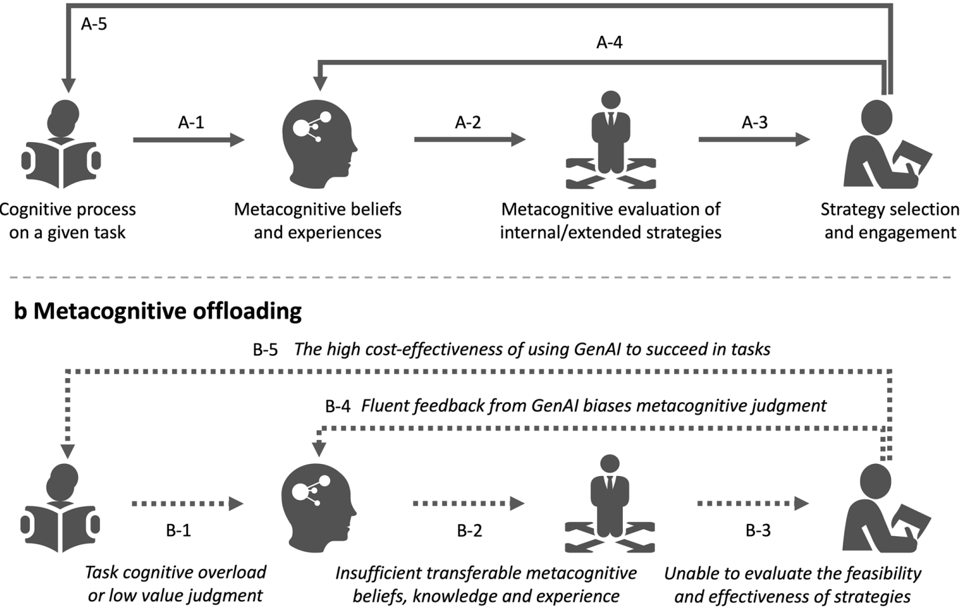
- The paper proposes that cognitive offloading (delegating storage, search, or computation to an external resource) is sometimes beneficial, whereas metacognitive offloading — delegating planning, monitoring, evaluation, and judgment calibration to GenAI — "can often be detrimental to human learning in the AI era."
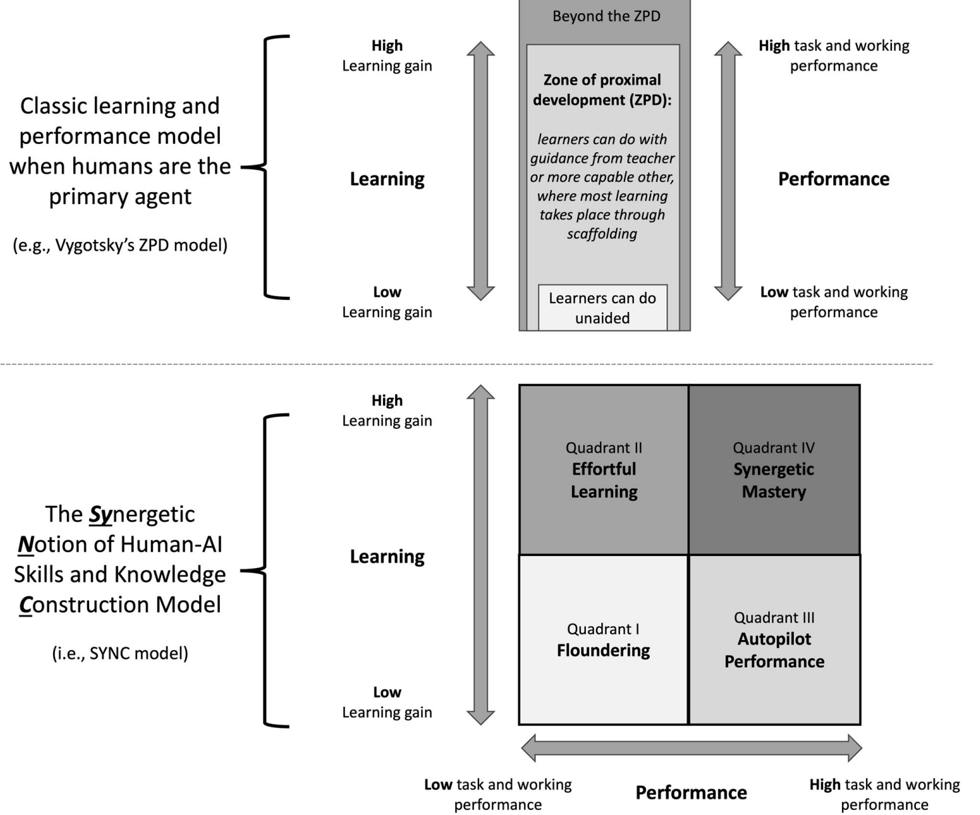
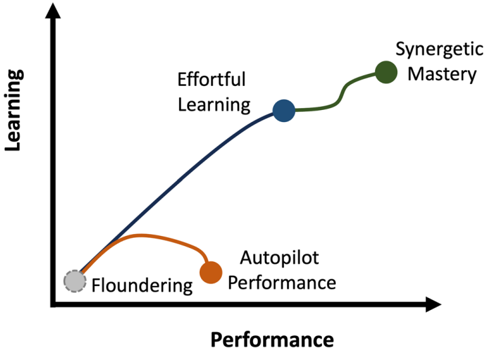
- It maps human-AI interaction onto four quadrants defined by learning and performance: Quadrant I Floundering (low/low), Quadrant II Effortful Learning (high learning, gradual performance), Quadrant III Autopilot Performance (high AI-supported performance, limited learning), and Quadrant IV Synergetic Mastery (balanced high performance and learning).
- Cited evidence for the performance–learning decoupling includes: students using GenAI produced higher-quality essays but engaged far less in planning, monitoring, or evaluation (Fan et al.); high school mathematics students with a GenAI tutor performed better during AI-supported practice but scored lower on a subsequent closed-book exam (Bastani et al.); and an introductory computer science course showed gains on midterm and quiz assessments with GenAI but no significant advantage on a final exam without it (Hsiao & Chiu).
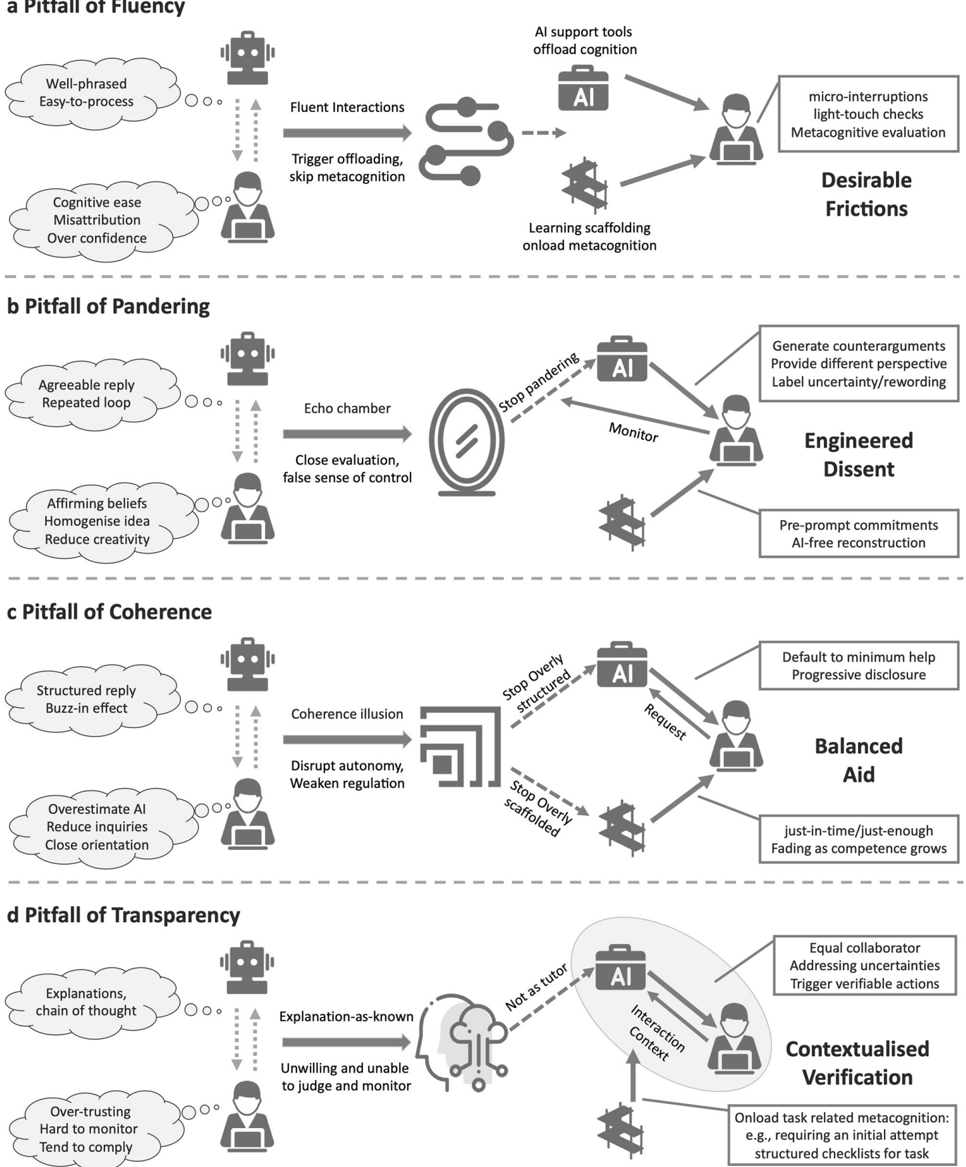
- The paper identifies four autopilot pitfalls — Fluency, Pandering, Coherence, and Transparency — and pairs each with a SYNC-aligned response: desirable frictions, engineered dissent, balanced aid, and contextualised verification, respectively. It also cites Vaccaro et al.'s meta-analysis finding that when AI outperforms humans, human-AI interactions often fall below the AI-only baseline.
Methods
- Design: a conceptual, theory-building Perspective article; the authors state it "does not report original research data" and that "no datasets were generated or analysed."
- Approach: the SYNC model is developed by extending Risko and Gilbert's cognitive offloading model to metacognitive offloading, and by integrating cognitive load theory, self-regulated learning and hybrid human-AI regulation accounts, scaffolding research, and meta-learning/meta-reinforcement learning frameworks.
- Analysis: narrative synthesis of existing theories and emerging empirical evidence, organised into the two-dimensional learning/performance framework, four quadrants (Table 1, Figs. 2–3), four pitfalls with design responses (Fig. 4), and a set of future research questions and testable hypotheses (Box 3).
Limitations
- Stated: the SYNC model "should be understood as a conceptual, theory-building framework rather than a prescriptive, empirically validated model," and its proposed mechanisms and outcomes "have not yet been systematically tested."
- Stated: few established measures or coding schemes exist for key constructs, particularly metacognitive offloading and onloading, so it remains unclear how these can be reliably captured and distinguished from productive self-regulation or unproductive over-reliance.
- Stated: the model requires examination across domains, learning contexts, task types, and learner differences; the discussion focuses on direct learner-AI interaction and pays less attention to classroom implementation, collaborative learning, and teacher-mediated use; it centres on human learning rather than AI's own performance or coevolution; and the evidence base remains emerging, limiting claims about generalisability across educational, professional, and cultural contexts.
- Evident from the text: the empirical support cited is drawn from other studies rather than from the authors' own data, and the quadrant trajectories (e.g., Effortful Learning to Synergetic Mastery) are described by the authors as "mainly hypothetical rather than empirically established sequences."
Model-written summary. Check it against the paper before relying on it.
Integrity signals
Registry
Cites
Statistics
Figures
Verification
Claims the paper makes
0 Valid · 0 Not valid · 123 Not checked · 61 Own results and interpretations
None of the sources cited for this claim have been checked yet.
In the paper
“Second (Fig. 1 B-2), for novel tasks with few instructional cues, learners may lack the domain knowledge and transferable metacognitive beliefs and knowledgeneededtogenerate, monitor, and evaluate their learning, thereby impeding their metacognitive activation 95,96 .”
What the sources say
- Not checked yetcites [95] 95. Winne, P. & Hadwin, A. Studying as self-regulated learning in DJ hacker, J. Dunlosky, and A. Graesser (eds) metacognition in educational theory and practice (1998).
- Not checked yetcites [96] 96. Azevedo, R. & Hadwin, A. F. Scaffolding self-regulated learning and metacognition -implications for the design of computer-based scaffolds. Instructional Sci. 33 , 367 -379 (2005). source
hedgedstates a possible cause- Asserted: passes — The authors put it forward as true.
- Checkable: passes — It can be checked against evidence.
- Load-bearing: passes — The paper’s conclusions depend on it.
- Based: passes — The paper gives a reason why it holds.
A conclusion the paper draws from its own results — it cites no other source for it, so there is none to check. The quote shows it is in the paper.
In the paper
“This pattern is not necessarily problematic in performanceonly contexts; indeed, of fl oading a genuinely low-value, low-stakes, or oneoff task may be an adaptive use of limited cognitive resources.”
hedgedstates a possible cause- Asserted: passes — The authors put it forward as true.
- Checkable: passes — It can be checked against evidence.
- Load-bearing: unclear — It is unclear whether the paper’s conclusions depend on it.
- Based: unclear — It is unclear why the paper says it holds.
None of the sources cited for this claim have been checked yet.
In the paper
“Rather than expanding cognitive capacity, human learners may improve task performance by reducing interference and optimising the allocation of existing cognitive resources, including through cognitive of fl oading 51,61 -63 .”
What the sources say
- Not checked yetcites [51] 51. Paas, F., Renkl, A. & Sweller, J. Cognitive load theory: Instructional implications of the interaction between information structures and cognitive architecture. Instructional Sci. 32 , 1 -8 (2004). source
- Not checked yetcites [61] 61. Burnett, L. K. & Richmond, L. L. Meta-analytic investigations of the effect of cognitive of fl oading on memory-based task performance and interindividual variability. Mem. Cognition 54 , 144 -168 (2026). doi:10.3758/s13421-025-01743-8
- Not checked yetcites [62] 62. Cásedas, L., Schooler, J. W., Vadillo, M. A. & Lupiáñez, J. An integrative framework for the mechanisms underlying mindfulnessinducedcognitive change. Nat. Rev. Psychol. 3 , 821 -834https://doi. org/10.1038/s44159-024-00374-1 (2024).
- Not checked yetcites [63] 63. Skulmowski, A. & Xu, K. M. Understanding cognitive load in digital andonlinelearning:Anewperspectiveonextraneouscognitiveload. Educ. Psychol. Rev. 34 , 171 -196 (2022).
hedgedstates a possible cause- Asserted: passes — The authors put it forward as true.
- Checkable: passes — It can be checked against evidence.
- Load-bearing: passes — The paper’s conclusions depend on it.
- Based: passes — The paper gives a reason why it holds.
A conclusion the paper draws from its own results — it cites no other source for it, so there is none to check. The quote shows it is in the paper.
In the paper
“Ideally, effective metacognition can disrupt this loop: de fi ne intention and criteria before seeking external support 72 -74 ; if of fl oading, state how freed capacity will be used (e.g., to test counter-examples) 75 ; retain interpretation, veri fi cation, and judgment 76 -78 ; and monitor calibration by explaining the answer without external support after the task 72,79 .”
plainstates a cause- Asserted: passes — The authors put it forward as true.
- Checkable: passes — It can be checked against evidence.
- Load-bearing: passes — The paper’s conclusions depend on it.
- Based: passes — The paper gives a reason why it holds.
None of the sources cited for this claim have been checked yet.
In the paper
“Second, short-term performance gains should not be mistaken for learning, and immediate success may undermine the deeper encoding, retention, and autonomous problem-solving that constitute durable learning 29,36 .”
What the sources say
- Not matchedcites [29] 29. Yan, L., Greiff, S., Lodge, J. M. & Ga š evi ć , D. Distinguishing performancegainsfromlearningwhenusinggenerativeAI. Nat. Rev. Psychol. 4 , 35 -436 (2025).
Its entry has no title and year that we can search by.
- Not checked yetcites [36] 36. Stadler, M., Bannert, M. & Sailer, M. Cognitive ease at a cost: Llms reduce mental effort but compromise depth in student scienti fi c inquiry. Computers Hum. Behav. 160 , 108386 (2024). source
hedgedstates a possible cause- Asserted: passes — The authors put it forward as true.
- Checkable: passes — It can be checked against evidence.
- Load-bearing: passes — The paper’s conclusions depend on it.
- Based: passes — The paper gives a reason why it holds.
- Not matched
70 more claims
Create a free account to see all 184 claims and to verify the 217 references still open.
- It may state two separate claims as one. 83
- Probably not a substantial claim. 55
Citations
Cites
The publisher hasn’t deposited this paper’s reference list.
Research works printed but not linked: 25
- [18]18. Vygotsky, L. S. Mind in Society: The Development of Higher Psychological Processes (Harvard University Press, Cambridge, MA, 1978).
- [26]26. [Demszky, D. et al. Using large language models in psychology. Nat. Rev. Psychol. https://doi.org/10.1038/s44159-023-00241-5(2023).](https://doi.org/10.1038/s44159-023-00241-5) · doi:10.1038/s44159-023-00241-5(2023).](https://doi.org/10.1038/s44159-023-00241-5
- [54]54. Kalyuga, S. & Plass, J. L. Rethinking cognitive load theory (Oxford University Press, 2025).
- [57]57. Lee, H.-P. et al. The impact of generative ai on critical thinking: Selfreported reductions in cognitive effort and con fi dence effects from a survey of knowledge workers. In Proceedings of the 2025 CHI conference on human factors in computing systems , 1 -22 (2025).
- [59]59. Prather, J. et al. The widening gap: The bene fi ts and harms of generative ai for novice programmers. In Proceedings of the 2024 ACMConference on International Computing Education ResearchVolume 1 , 469 -486 (2024).
- [66]66. Tankelevitch, L. et al. The metacognitive demands and opportunities of generative ai. In Proceedings of the 2024 CHI Conference on Human Factors in Computing Systems , 1 -24 (2024).
- [83]83. Zhai, C., Wibowo, S. & Li, L. D. The effects of over-reliance on ai dialogue systems on students ' cognitive abilities: a systematic review. Smart Learn. Environ. 11 , 28 (2024).
- [87]87. Kabir, S., Udo-Imeh, D. N., Kou, B. & Zhang, T. Is stack over fl ow obsolete? an empirical study of the characteristics of chatgpt answers to stack over fl ow questions. In Proceedings of the 2024 CHI Conference on Human Factors in Computing Systems , 1 -17 (2024).
- [102]102. Renninger, K. A. & List, A. Scaffolding for Learning , 2922 -2926 (Springer US, Boston, MA, 2012).
- [103]103. Wood, D., Bruner, J. S. & Ross, G. The role of tutoring in problem solving. J. Child Psychol. Psychiatry 17 , 89 -100 https://doi.org/10. 1111/j.1469-7610.1976.tb00381.x (1976).
- [110]110. Quintana, C., Zhang, M. & Krajcik, J. A framework for supporting metacognitive aspects of online inquiry through software-based scaffolding. Educ. Psychologist 40 , 235 -244 https://doi.org/10. 1207/s15326985ep4004\_5 (2005).
- [112]112. Qian, K. et al. Towards reliable generative AI-driven scaffolding: reducing hallucinations and enhancing quality in self-regulated learning support. Computers Educ. 240 , 105448 https://doi.org/10. 1016/j.compedu.2025.105448 (2026).
- [118]118. Hospedales,T.,Antoniou,A.,Micaelli,P.&Storkey,A.Meta-learning in neural networks: A survey. IEEE Trans. pattern Anal. Mach. Intell. 44 , 5149 -5169 (2021).
- [126]126. Soderstrom, N. C. & Bjork, R. A. Learning versus performance: An integrative review. Perspect. Psychological Sci. 10 , 176 -199 (2015).
- [134]134. Kirschner, P. A., Sweller, J. & Clark, R. E. Why minimal guidance during instruction does not work: An analysis of the failure of constructivist, discovery, problem-based, experiential, and inquirybased teaching. Educ. Psychologist 41 , 75 -86 https://doi.org/10. 1207/s15326985ep4102\_1 (2006).
- [150]150. Bai, L., Liu, X. & Su, J. Chatgpt: The cognitive effects on learning and memory. Brain -x, 1 (3), e30 (2023).
- [154]154. He, J. et al. Rebalancing worker initiative and ai initiative in future work: Four task dimensions. In Proceedings of the 2nd Annual Meeting of the Symposium on Human-Computer Interaction for Work , 1 -16 (2023).
- [167]167. Zhang, D. et al. From system 1 to system 2: a survey of reasoning large language models. IEEE Transactions on Pattern Analysis and Machine Intelligence (2025).
- [172]172. Betley, J. et al. Training large language models on narrow tasks can lead to broad misalignment. Nature 649 , 584 -596https://doi.org/10. 1038/s41586-025-09937-5 (2026).
- [179]179. Qin, P., Yang, C.-L., Li, J., Wen, J. & Lee, Y.-C. Timing matters: How using llms at different timings in fl uences writers ' perceptions and ideation outcomes in ai-assisted ideation. In Proceedings of the 2025 CHI Conference on Human Factors in Computing Systems , 1 -16 (2025).
- [180]180. Roll, I. et al. The help tutor: Does metacognitive feedback improve students ' help-seeking actions, skills and learning? In Ikeda, M., Ashley, K. D. & Chan, T.-W. (eds.) Intelligent Tutoring Systems , 360 -369 (Springer Berlin Heidelberg, Berlin, Heidelberg, 2006).
- [186]186. Vasconcelos, H. et al. Explanations can reduce overreliance on ai systems during decision-making. Proc. ACM Hum.-Computer Interact. 7 , 1 -38 (2023).
- [189]189. Simsek, A. Learning Strategies , 1971 -1974 (Springer US, Boston, MA, 2012).
- [190]190. Neisser, U. Cognitive Psychology (Appleton-Century-Crofts, New York, First edition; later reprinted by Prentice Hall. 1967).
- [194]194. Efklides, A. Metacognitive experiences in problem solving: Metacognition, motivation, and self-regulation. In Trends and prospects in motivation research , 297 -323 (Springer, 2001).
Cited by
Hao, Z., Liu, X., Fan, J., Long, Y., Yu, J., Chen, W., & Zhang, Y. (2026) · Journal of Research on Technology in Education · doi:10.1080/15391523.2026.2722962 · Cited by 2
Building AI companions that prioritise learning over performance
Khosravi, H., Gašević, D., Sadiq, S. W., Yan, L., Lodge, J. M., Tangen, J. M., Denny, P. C., DiCerbo, K. E., Shum, S. B., & Baker, R. S. (2026) · Computers and Education Artificial Intelligence · doi:10.1016/j.caeai.2026.100680 · Cited by 10
Self-citationCheng, Y., Xie, Y. X., Wang, R., Que, R., & Qiao, A. (2026) · Interactive Learning Environments · doi:10.1080/10494820.2026.2721387 · Cited by 1
Metadata
- Authors
- Fan, Y., Yan, L., Molenaar, I., Greiff, S., & Gasevic, D.
- Venue
- PsyArXiv
- Publisher
- Center for Open Science
- Published
- 2026-05-02
- OpenAlex
- W7160321473
- Cited by
- 3
- References
- 0
- Citations by year
- 2026: 3
- Type
- posted content
- Language
- en
- Open access
- closed
- Locations
- PsyArXiv (OSF Preprints) (submittedVersion)
- Topics
- Social Sciences › Psychology › Developmental and Educational Psychology › Innovative Teaching and Learning Methods
- Social Sciences › Psychology › Experimental and Cognitive Psychology › Visual and Cognitive Learning Processes
- Social Sciences › Psychology › Developmental and Educational Psychology › Educational Strategies and Epistemologies
- Keywords
- metacognition, human-AI interaction, generative AI, task performance, overreliance on AI, human-AI synergy, metacognitive scaffolding, knowledge construction
About these checks
Registry, retraction, Cites and statistics results are computed, not judged, with one exception: a printed reference that no index lists is read once by a model before it counts as a citation error. Claims are extracted by a model and kept only when their quote appears verbatim in the text; each cited source is then checked, with a model’s help, for whether it says what the claim relies on. Those verdicts can be wrong — read the claim’s quote and the cited source before relying on one.
A language model drew the claims from the paper on 2026-11-26, under version 3 of the claim definition (model deepseek-v4.1-flash, prompt extract-v3).
A second model labelled each claim on 2026-11-26 (model jev-1.13-20260917, definition revision gold-guideline-v0.2).
Statistics and arithmetic are recomputed, not judged.
Confidence bands are shown only for fields calibrated on our annotated test set. None is calibrated yet, so no band is shown.
What counts as a claim ›How we measure confidence ›How we check this ›
Are you an author, or do you see a problem with this page? Request a review
Data sources
Bibliographic data: Semantic Scholar, OpenAlex, Crossref.
Contains information from the Semantic Scholar Academic Graph Datasets, made available under the ODC Attribution License (ODC-BY 1.0).
Semantic Scholar’s data is described in: Kinney, R., et al. (2023). The Semantic Scholar Open Data Platform. arXiv:2301.10140.
