

The DOI matches its Crossref record; 23 of the 23 references it cites were found in a registry or an index.
The influence of long-term use of proton pump inhibitors on the gut microbiota: an age-sex-matched case-control study
Open accessAbstract
Proton pump inhibitors (PPIs) are widely used to treat gastro-esophageal reflux and prevent gastric ulcers, and have been considered as low risk. However, recent studies have identified possible associations between PPI use and gut microbiota, suggesting that PPIs use increases the risk of enteric infections, including Clostridium difficile infection. To investigate gut microbiota in Japanese PPIs users, we conducted 16S metagenomics analysis of fecal samples collected from PPI users and healthy adults. In total, 36 PPI users and 36 PPI non-users (as control subjects) matched by age and sex were recruited and fecal samples were obtained to analyze the gut microbiome using 16S rRNA gene sequencing. There were significant differences in the microbial structure between PPI non-users and PPI users. In contrast, the analysis of α-diversity revealed no significant differences between PPI non-users and PPI users. When comparing in genus level between these two groups, the genera Streptococcus was significantly abundant and the genera Faecalibacterium was significantly decreased in PPI users. Our findings indicate a probable association between PPI use and the alternation of microbiota. These alterations might provide a mechanism by which PPIs predispose enteric infection such as Clostridium difficile infection.
Overview
The claims and statistics of this paper haven’t been checked yet.
Run the check — free, no account needed. It reads the open-access text and checks the sources it cites.
Integrity signals
Registry
Cites
Statistics
Figures
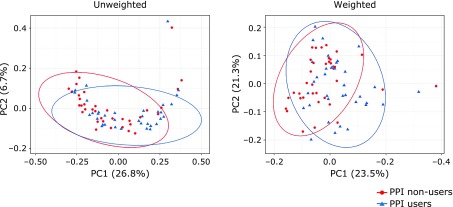
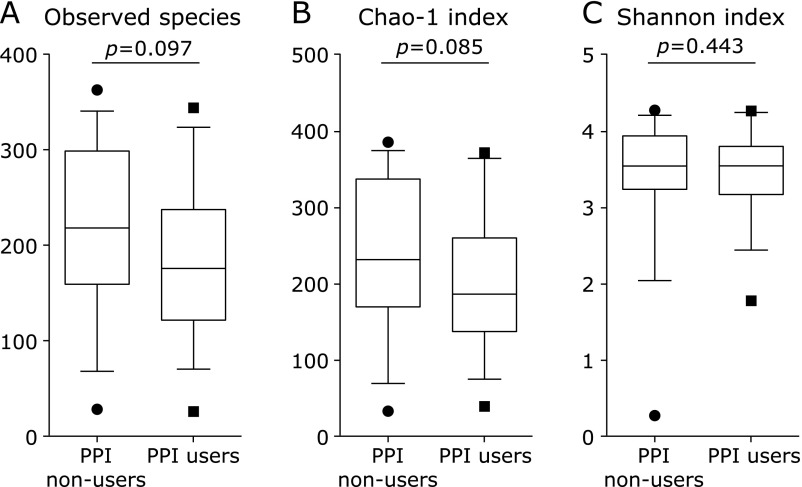
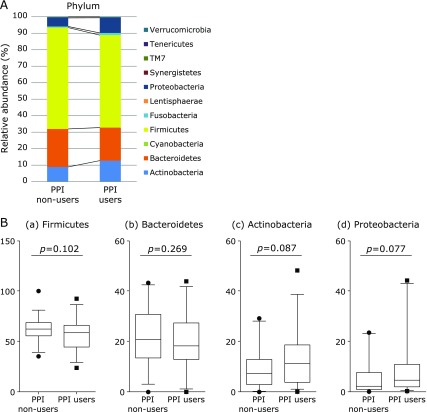
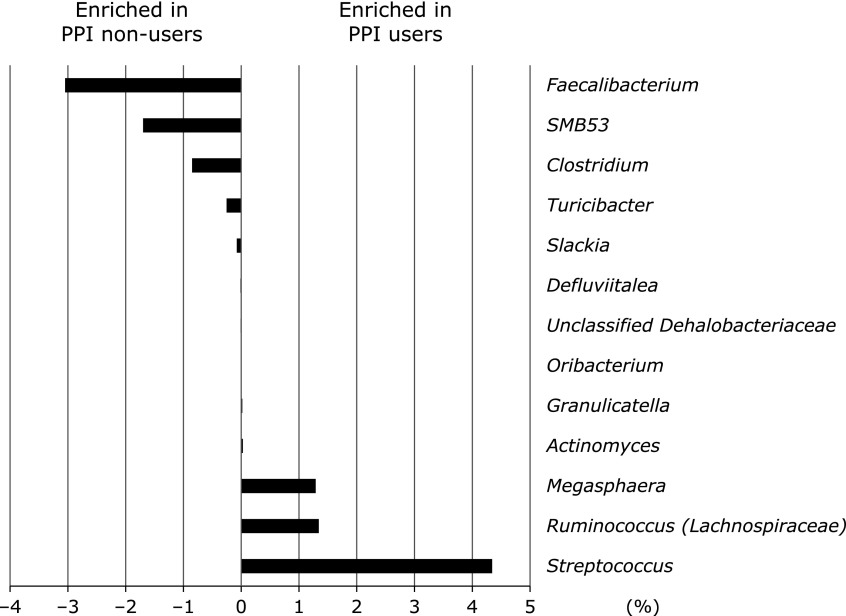
Verification
Claims the paper makes
The claims and statistics of this paper haven’t been checked yet.
Run the check — free, no account needed. It reads the open-access text and checks the sources it cites.
Claims other papers make about this one
Each is checked against this paper’s own text: does it say what the citing paper says it does?
In the citing paper
“likely due to PPI-driven gastric hypo-chlorhydria, which can cause also significant changes in gut microbiota composition[9-11]”
From Proton pump inhibitors and dysbiosis: current knowledge and aspects to be clarified (2019) · cites this paper as [11]
Self-check
Percentages, sums and reported differences re-computed from the paper’s own numbers.
The self-check needs the paper’s full text.
Citations
Cites
QIIME allows analysis of high-throughput community sequencing data
Caporaso, J. G., Kuczynski, J., Stombaugh, J., Bittinger, K., Bushman, F. D., Costello, E. K., Fierer, N., Peña, A. G., Goodrich, J. K., Gordon, J. I., et al. (2010) · Nature Methods · doi:10.1038/nmeth.f.303 · Cited by 34,887
Search and clustering orders of magnitude faster than BLAST
Edgar, R. C. (2010) · Bioinformatics · doi:10.1093/bioinformatics/btq461 · Cited by 21,098
UCHIME improves sensitivity and speed of chimera detection
Edgar, R. C., Haas, B. J., Clemente, J. C., Quince, C., & Knight, R. (2011) · Bioinformatics · doi:10.1093/bioinformatics/btr381 · Cited by 15,114
Predictive functional profiling of microbial communities using 16S rRNA marker gene sequences
Langille, M. G. I., Zaneveld, J., Caporaso, J. G., McDonald, D., Knights, D., Reyes, J. A., Clemente, J. C., Burkepile, D. E., Vega Thurber, R. L., Knight, R., et al. (2013) · Nature Biotechnology · doi:10.1038/nbt.2676 · Cited by 9,116
Enterotypes of the human gut microbiome
MetaHIT Consortium (additional members), Arumugam, M., Raes, J., Pelletier, E., Le Paslier, D., Yamada, T., Mende, D. R., Fernandes, G. R., Tap, J., Bruls, T., et al. (2011) · Nature · doi:10.1038/nature09944 · Cited by 7,548
STAMP: statistical analysis of taxonomic and functional profiles
Parks, D. H., Tyson, G. W., Hugenholtz, P., & Beiko, R. G. (2014) · Bioinformatics · doi:10.1093/bioinformatics/btu494 · Cited by 4,246
The Human Intestinal Microbiome in Health and Disease
Lynch, S. V., & Pedersen, O. (2016) · New England Journal of Medicine · doi:10.1056/nejmra1600266 · Cited by 3,637
Data, information, knowledge and principle: back to metabolism in KEGG
Kanehisa, M. I., Goto, S., Sato, Y., Kawashima, M., Furumichi, M., & Tanabe, M. (2013) · Nucleic Acids Research · doi:10.1093/nar/gkt1076 · Cited by 3,103
Machiels, K., Joossens, M., Sabino, J., De Preter, V., Arijs, I., Eeckhaut, V., Ballet, V., Claes, K., Van Immerseel, F., Verbeke, K., et al. (2014) · Gut · doi:10.1136/gutjnl-2013-304833 · Cited by 1,904
Proton pump inhibitors affect the gut microbiome
Imhann, F., Bonder, M. J., Vich Vila, A., Fu, J., Mujagic, Z., Vork, L., Tigchelaar, E. F., Jankipersadsing, S. A., Cenit, M. C., Harmsen, H. J. M., et al. (2016) · Gut · doi:10.1136/gutjnl-2015-310376 · Cited by 1,371 · cited 2×
“(4,17) In our results, as shown in Fig.”
Freedberg, D. E., Kim, L. S., & Yang, Y. (2017) · Gastroenterology · doi:10.1053/j.gastro.2017.01.031 · Cited by 933
Proton pump inhibitors alter the composition of the gut microbiota
Jackson, M. A., Goodrich, J. K., Maxan, M.-E., Freedberg, D. E., Abrams, J. A., Poole, A. C., Sutter, J. L., Welter, D., Ley, R. E., Bell, J. T., et al. (2016) · Gut · doi:10.1136/gutjnl-2015-310861 · Cited by 895
Risk of Clostridium difficile Infection With Acid Suppressing Drugs and Antibiotics: Meta-Analysis
Kwok, C. S., Arthur, A. K., Anibueze, C. I., Singh, S., Cavallazzi, R., & Loke, Y. K. (2012) · The American Journal of Gastroenterology · doi:10.1038/ajg.2012.108 · Cited by 579
Clostridium difficile-associated diarrhea and proton pump inhibitor therapy: a meta-analysis
Janarthanan, S., Ditah, I., Adler, D. G., & Ehrinpreis, M. N. (2012) · American Journal of Gastroenterology · doi:10.1038/ajg.2012.179 · Cited by 538
Complications of Proton Pump Inhibitor Therapy
Vaezi, M. F., Yang, Y., & Howden, C. W. (2017) · Gastroenterology · doi:10.1053/j.gastro.2017.04.047 · Cited by 484
Freedberg, D. E., Toussaint, N. C., Chen, S. P., Ratner, A. J., Whittier, S., Wang, T. C., Wang, H. H., & Abrams, J. A. (2015) · Gastroenterology · doi:10.1053/j.gastro.2015.06.043 · Cited by 322
Packey, C. D., & Sartor, R. B. (2009) · Current Opinion in Infectious Diseases · doi:10.1097/qco.0b013e32832a8a5d · Cited by 319
A comparison of the gut microbiome between long‐term users and non‐users of proton pump inhibitors
Clooney, A. G., Bernstein, C. N., Leslie, W. D., Vagianos, K., Sargent, M., Laserna‐Mendieta, E. J., Claesson, M. J., & Targownik, L. E. (2016) · Alimentary Pharmacology & Therapeutics · doi:10.1111/apt.13568 · Cited by 166
Influence of Proton-Pump Inhibitors on the Luminal Microbiota in the Gastrointestinal Tract
Tsuda, A., Suda, W., Morita, H., Takanashi, K., Takagi, A., Koga, Y., & Hattori, M. (2015) · Clinical and Translational Gastroenterology · doi:10.1038/ctg.2015.20 · Cited by 164
García-Mazcorro, J. F., Suchodolski, J. S., Jones, K. R., Clark‐Price, S. C., Dowd, S. E., Minamoto, Y., Markel, M. E., Steiner, J. M., & Dossin, O. (2012) · FEMS Microbiology Ecology · doi:10.1111/j.1574-6941.2012.01331.x · Cited by 150
Inoüe, R., Ohue‐Kitano, R., Tsukahara, T., Tanaka, M., Masuda, S., Inoue, T., Yamakage, H., Kusakabe, T., Hasegawa, K., Shimatsu, A., et al. (2017) · Journal of Clinical Biochemistry and Nutrition · doi:10.3164/jcbn.17-44 · Cited by 117
Otsuka, T., Sugimoto, M., Inoüe, R., Ohno, M., Ban, H., Nishida, A., Inatomi, O., Takahashi, S., Naito, Y., & Andoh, A. (2016) · Gut · doi:10.1136/gutjnl-2016-313312 · Cited by 78
Self-citationDörffel, Y., Swidsinski, A. V., Loening-Baucke, V. A., Wiedenmann, B. J., & Pavel, M. (2011) · Inflammatory Bowel Diseases · doi:10.1002/ibd.21923 · Cited by 45
Cited by
Sorted by citations
Impact of commonly used drugs on the composition and metabolic function of the gut microbiota
Vich Vila, A., Collij, V., Sanna, S., Sinha, T., Imhann, F., Bourgonje, A. R., Mujagic, Z., Jonkers, D. M. A. E., Masclee, A. A. M., Fu, J., et al. (2020) · Nature Communications · doi:10.1038/s41467-019-14177-z · Cited by 791
Gut Microbiota and Colonization Resistance against Bacterial Enteric Infection
Ducarmon, Q. R., Zwittink, R. D., Hornung, B. V. H., van Schaik, W., Young, V. B., & Kuijper, E. J. (2019) · Microbiology and Molecular Biology Reviews · doi:10.1128/mmbr.00007-19 · Cited by 566
Microbiota-Gut-Brain Axis: New Therapeutic Opportunities
Long-Smith, C., O'Riordan, K. J., Clarke, G., Stanton, C., Dinan, T. G., & Cryan, J. F. (2020) · Annual Review of Pharmacology and Toxicology · doi:10.1146/annurev-pharmtox-010919-023628 · Cited by 419
Dysbiosis of the gut and lung microbiome has a role in asthma
Hufnagl, K., Pali‐Schöll, I., Roth‐Walter, F., & Jensen‐Jarolim, E. (2020) · Seminars in Immunopathology · doi:10.1007/s00281-019-00775-y · Cited by 394
Takagi, T., Naito, Y., Inoüe, R., Kashiwagi, S., Uchiyama, K., Mizushima, K., Tsuchiya, S., Dohi, O., Yoshida, N., Kamada, K., et al. (2018) · Journal of Gastroenterology · doi:10.1007/s00535-018-1488-5 · Cited by 314
Self-citation
Metadata
- Authors
- Takagi, T., Naito, Y., Inoue, R., Kashiwagi, S., Uchiyama, K., Mizushima, K., Tsuchiya, S., Okayama, T., Dohi, O., Yoshida, N., Kamada, K., Ishikawa, T., Handa, O., Konishi, H., Okuda, K., Tsujimoto, Y., Ohnogi, H., & Itoh, Y.
- Affiliations
- Kyoto Prefectural University of Medicine (JP)
- Laboratory of Animal Science, Kyoto Prefectural University
- Takara BIO Inc. (Japan) (JP)
- Corresponding author
- Takagi, Tomohisa
- ORCID
- Venue
- Journal of Clinical Biochemistry and Nutrition
- Published
- 2018
- Volume
- 62
- Issue
- 1
- Pages
- 100-105
- ISSN
- 0912-0009 (ISSN-L)
- 1880-5086
- PMC
- PMC5773837
- OpenAlex
- W2771725285
- Cited by
- 121
- References
- 23
- Citations by year
- 2026: 5 · 2025: 10 · 2024: 9 · 2023: 11 · 2022: 20 · 2021: 9 · 2020: 20 · 2019: 22 · 2018: 15
- FWCI
- 6.37
- Type
- journal article
- Language
- en
- Open access
- diamond
- doi.org
- Locations
- Journal of Clinical Biochemistry and Nutrition (publishedVersion)
- PubMed Central (publishedVersion, cc-by)
- PubMed (publishedVersion)
- Funders
- National Agriculture and Food Research Organization
- Japan Society for the Promotion of Science (16K09322, 16H05289)
- Topics
- Life Sciences › Biochemistry, Genetics and Molecular Biology › Molecular Biology › Gut microbiota and health
- Health Sciences › Medicine › Gastroenterology › Gastrointestinal motility and disorders
- Health Sciences › Medicine › Infectious Diseases › Clostridium difficile and Clostridium perfringens research
- Keywords
- proton pump inhibitors, gut microbiota, Clostridium difficile infection, gastrointestinal infections, Faecalibacterium, Streptococcus, microbial diversity, fecal microbiota, long-term drug use, Japanese adults
About these checks
Registry, retraction, Cites and statistics results are computed, not judged, with one exception: a printed reference that no index lists is read once by a model before it counts as a citation error. Claims are extracted by a model and kept only when their quote appears verbatim in the text; each cited source is then checked, with a model’s help, for whether it says what the claim relies on. Those verdicts can be wrong — read the claim’s quote and the cited source before relying on one.
Statistics and arithmetic are recomputed, not judged.
Confidence bands are shown only for fields calibrated on our annotated test set. None is calibrated yet, so no band is shown.
What counts as a claim ›How we measure confidence ›How we check this ›
Are you an author, or do you see a problem with this page? Request a review
