

The DOI matches its Crossref record; 39 of the 39 references it cites were found in a registry or an index.
A Randomized Placebo-Controlled Pilot Trial of Omega-3 Fatty Acids and Alpha Lipoic Acid in Alzheimer's Disease
Open accessAbstract
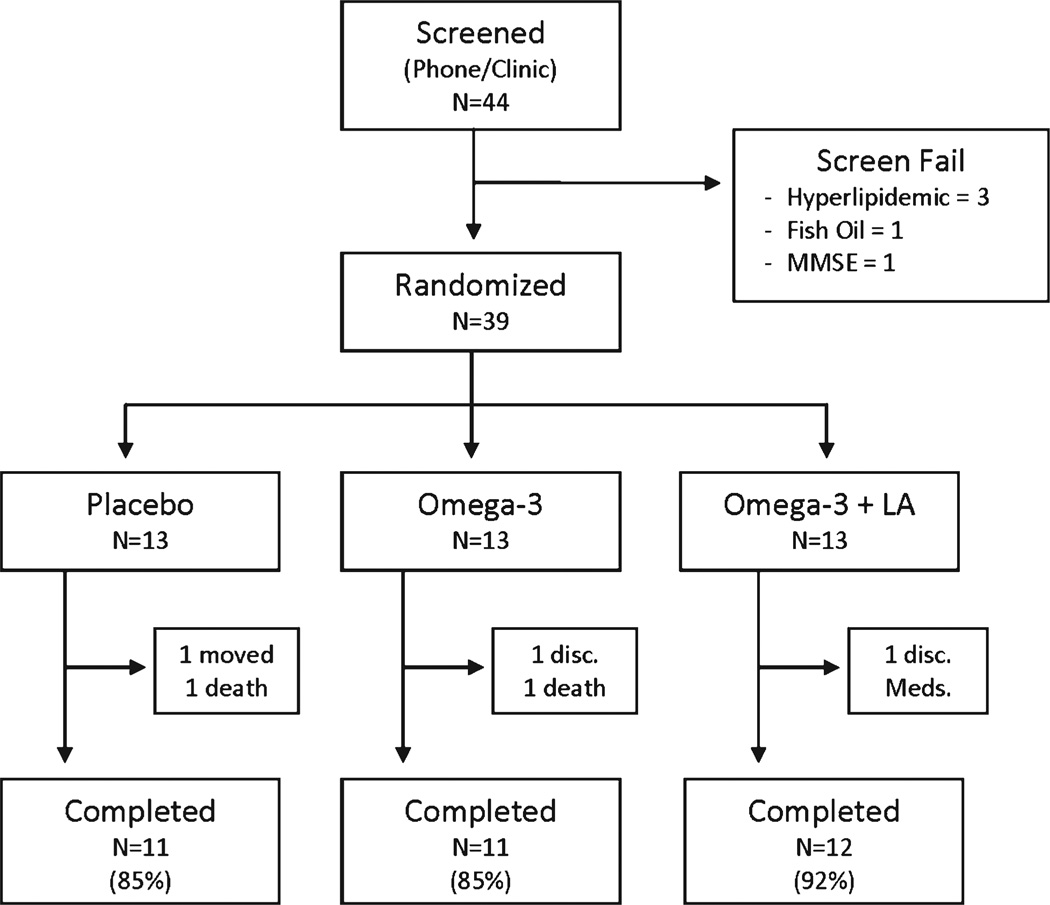
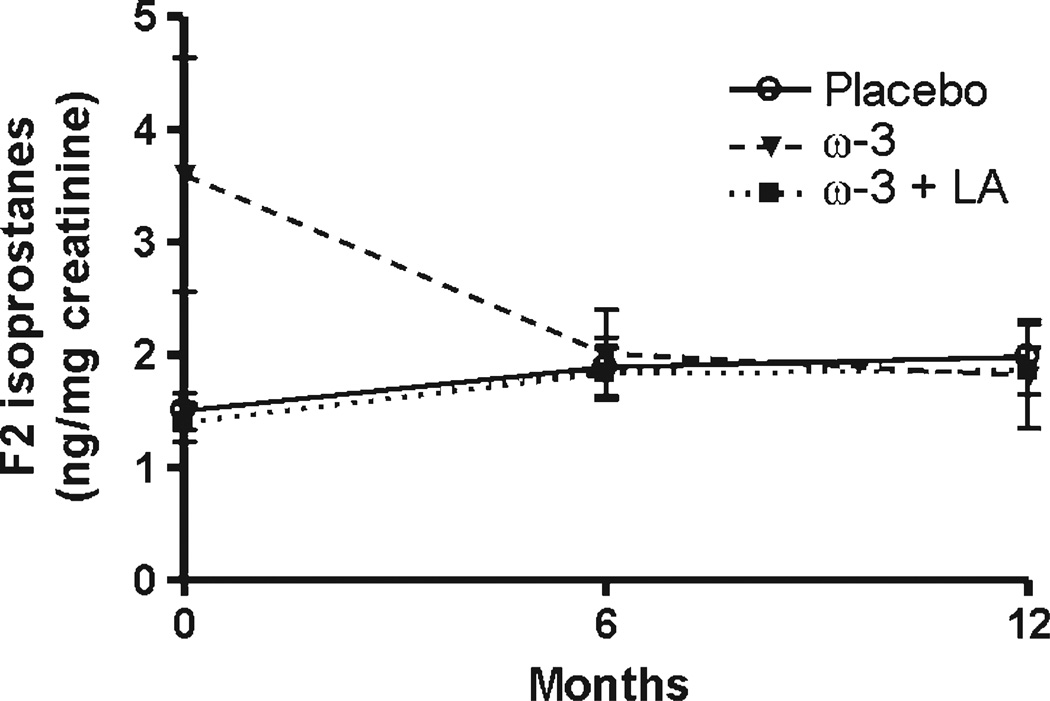
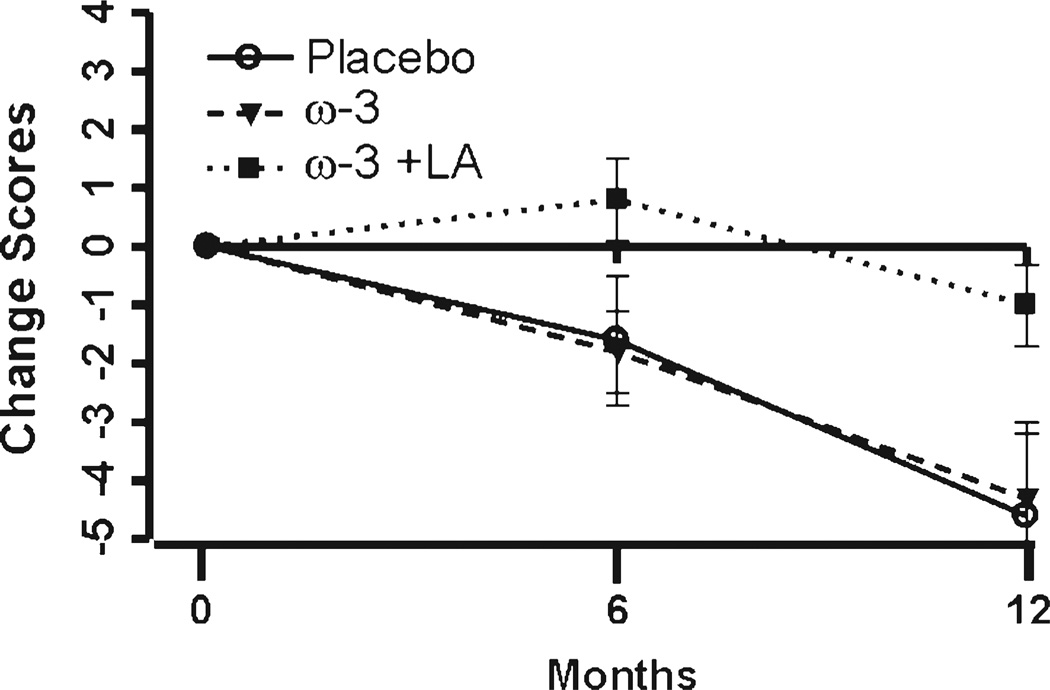
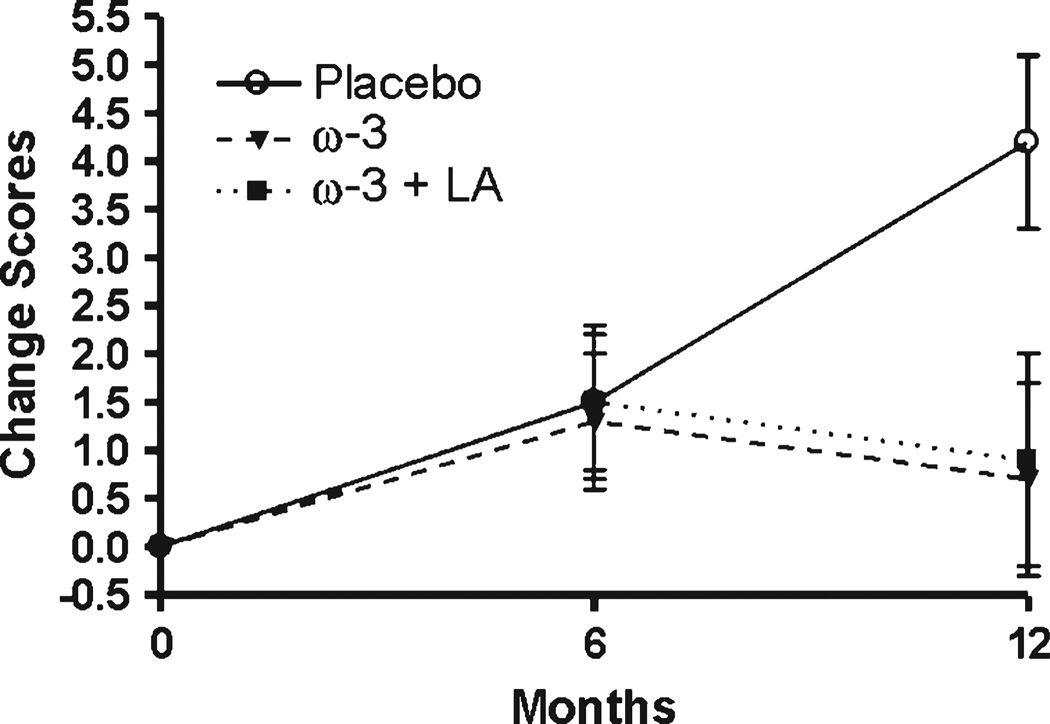
Oxidative stress, inflammation, and increased cholesterol levels are all mechanisms that have been associated with Alzheimer's disease (AD) pathology. Several epidemiologic studies have reported a decreased risk of AD with fish consumption. This pilot study was designed to evaluate the effects of supplementation with omega-3 fatty acids alone (ω-3) or omega-3 plus alpha lipoic acid (ω-3 + LA) compared to placebo on oxidative stress biomarkers in AD. The primary outcome measure was peripheral F2-isoprostane levels (oxidative stress measure). Secondary outcome measures included performance on: Mini-Mental State Examination (MMSE), Activities of Daily Living/Instrumental Activities of Daily Living (ADL/IADL), and Alzheimer Disease Assessment Scale-cognitive subscale (ADAS-cog). Thirty-nine AD subjects were randomized to one of three groups: 1) placebo, 2) ω-3, or 3) ω-3 + LA for a treatment duration of 12 months. Eighty seven percent (34/39) of the subjects completed the 12-month intervention. There was no difference between groups at 12 months in peripheral F2-isoprostane levels (p = 0.83). The ω-3 + LA and ω-3 were not significantly different than the placebo group in ADAS-cog (p = 0.98, p = 0.86) and in ADL (p = 0.15, p = 0.82). Compared to placebo, the ω-3 + LA showed less decline in MMSE (p < 0.01) and IADL (p = 0.01) and the ω-3 group showed less decline in IADL (p < 0.01). The combination of ω-3 + LA slowed cognitive and functional decline in AD over 12 months. Because the results were generated from a small sample size, further evaluation of the combination of omega-3 fatty acids plus alpha-lipoic acid as a potential treatment in AD is warranted.
Overview
The claims and statistics of this paper haven’t been checked yet.
Run the check — free, no account needed. It reads the open-access text and checks the sources it cites.
Integrity signals
Registry
Cites
Statistics
Figures
Verification
Claims the paper makes
The claims and statistics of this paper haven’t been checked yet.
Run the check — free, no account needed. It reads the open-access text and checks the sources it cites.
Claims other papers make about this one
Each is checked against this paper’s own text: does it say what the citing paper says it does?
In the citing paper
“Moreover, preclinical studies and investigations in individuals affected by Alzheimer’s disease [132] provided evidence that ALA may promote neurocognitive enhancement via pleiotropic mechanisms, including antioxidant mitochondrial activity and anti-inflammatory properties [133]”
From Cognitive remission: a novel objective for the treatment of major depression? (2016) · cites this paper as [132]
Self-check
Percentages, sums and reported differences re-computed from the paper’s own numbers.
The self-check needs the paper’s full text.
Citations
Cites
Folstein, M. F., Folstein, S. E., & McHugh, P. R. (1975) · Journal of Psychiatric Research · doi:10.1016/0022-3956(75)90026-6 · Cited by 88,282
A new rating scale for Alzheimer's disease
(1984) · American Journal of Psychiatry · doi:10.1176/ajp.141.11.1356 · Cited by 4,175
An Inventory to Assess Activities of Daily Living for Clinical Trials in Alzheimerʼs Disease
Galasko, D., Bennett, D. A., Sano, M., Ernesto, C., Thomas, R., Grundman, M., & Ferris, S. H. (1997) · Alzheimer Disease & Associated Disorders · doi:10.1097/00002093-199700112-00005 · Cited by 1,198
Consumption of Fish and n-3 Fatty Acids and Risk of Incident Alzheimer Disease
Morris, M. C., Evans, D. A., Bienias, J. L., Tangney, C. C., Bennett, D. A., Wilson, R. S., Aggarwal, N., & Schneider, J. (2003) · Archives of Neurology · doi:10.1001/archneur.60.7.940 · Cited by 1,135
Alpha-lipoic acid as a dietary supplement: Molecular mechanisms and therapeutic potential
Shay, K. P., Moreau, R. F., Smith, E. J., Smith, A. R., & Hagen, T. M. (2009) · Biochimica et Biophysica Acta (BBA) - General Subjects · doi:10.1016/j.bbagen.2009.07.026 · Cited by 976
Dietary fat intake and the risk of incident dementia in the Rotterdam study
Kalmijn, S., Launer, L. J., Ott, A., Witteman, J. C. M., Hofman, A., & Breteler, M. M. B. (1997) · Annals of Neurology · doi:10.1002/ana.410420514 · Cited by 895 · cited 1×
“A number of epidemiologic studies have observed a consistent association of a decreased risk for AD and greater fish consumption [5–7].”
BackgroundThe pharmacology of the antioxidant lipoic acid
Biewenga, G. P., Haenen, G. R. M. M., & Bast, A. (1997) · General Pharmacology The Vascular System · doi:10.1016/s0306-3623(96)00474-0 · Cited by 848
Galasko, D. R., Bennett, D., Sano, M., Ernesto, C., Thomas, R., Grundman, M., & Ferris, S. H. (1997) · PubMed · Cited by 767
Docosahexaenoic Acid Supplementation and Cognitive Decline in Alzheimer Disease: A Randomized Trial
Quinn, J. F., Raman, R., Thomas, R. G., Yurko-Mauro, K., Nelson, E. B., Van Dyck, C., Galvin, J. E., Emond, J., Jack, C. R., Weiner, M., et al. (2010) · JAMA · doi:10.1001/jama.2010.1510 · Cited by 764
Self-citationFreund-Levi, Y., Eriksdotter-Jönhagen, M., Cederholm, T., Basun, H., Faxén-Irving, G., Garlind, A., Vedin, I., Vessby, B., Wahlund, L.-O., & Palmblad, J. (2006) · Archives of Neurology · doi:10.1001/archneur.63.10.1402 · Cited by 751
Dietary patterns and risk of dementia: The Three-City cohort study
Barberger-Gateau, P., Raffaitin, C., Letenneur, L., Berr, C., Tzourio, C., Dartigues, J. F., & Alpérovitch, A. (2007) · Neurology · doi:10.1212/01.wnl.0000278116.37320.52 · Cited by 700
Cummings, J. L. (2002) · JAMA · doi:10.1001/jama.287.18.2335 · Cited by 443
Increased F 2 ‐isoprostanes in Alzheimer's disease: evidence for enhanced lipid peroxidation in vivo
Pratico, D., Lee, V. M.-Y., Trojanowski, J. Q., Rokach, J., & Fitzgerald, G. A. (1998) · The FASEB Journal · doi:10.1096/fasebj.12.15.1777 · Cited by 405
Galasko, D. R., Peskind, E., Clark, C. M., Quinn, J. F., Ringman, J. M., Jicha, G. A., Cotman, C., Cottrell, B., Montine, T. J., Thomas, R. G., et al. (2012) · Archives of Neurology · doi:10.1001/archneurol.2012.85 · Cited by 377
Self-citationAre all n-3 polyunsaturated fatty acids created equal?
Anderson, B. M., & David, W. L. (2009) · Lipids in Health and Disease · doi:10.1186/1476-511x-8-33 · Cited by 344
Therapeutic potential of n-3 polyunsaturated fatty acids in disease
Fetterman, J. W., & Zdanowicz, M. M. (2009) · American Journal of Health-System Pharmacy · doi:10.2146/ajhp080411 · Cited by 244
α-Lipoic Acid: A Metabolic Antioxidant and Potential Redox Modulator of Transcription
Packer, L., Roy, S., & Sen, C. K. (1996) · Advances in pharmacology · doi:10.1016/s1054-3589(08)60980-1 · Cited by 243
Nutrient biomarker patterns, cognitive function, and MRI measures of brain aging
Bowman, G. L., Silbert, L. C., Howieson, D. B., Dodge, H. H., Traber, M. G., Frei, B. B., Kaye, J. A., Shannon, J., & Quinn, J. F. (2011) · Neurology · doi:10.1212/wnl.0b013e3182436598 · Cited by 227
Self-citationMori, T. A., Croft, K. D., Puddey, I. B., & Beilin, L. J. (1999) · Analytical Biochemistry · doi:10.1006/abio.1998.3037 · Cited by 214
Antioxidant strategies for Alzheimer's disease
Grundman, M., & Delaney, P. (2002) · Proceedings of The Nutrition Society · doi:10.1079/pns2002146 · Cited by 197
Alpha-lipoic acid as a new treatment option for Azheimer type dementia
Hager, K., Marahrens, A., Kenklies, M., Riederer, P., & Münch, G. (2001) · Archives of Gerontology and Geriatrics · doi:10.1016/s0167-4943(01)00104-2 · Cited by 188
Helmersson, J., Larsson, A. O., Vessby, B., & Basu, S. (2005) · Atherosclerosis · doi:10.1016/j.atherosclerosis.2004.11.026 · Cited by 166
Chronic dietary α-lipoic acid reduces deficits in hippocampal memory of aged Tg2576 mice
Quinn, J. F., Bussiere, J. R., Hammond, R., Montine, T. J., Henson, E., Jones, R. E., & Stackman, R. W. (2006) · Neurobiology of Aging · doi:10.1016/j.neurobiolaging.2005.12.014 · Cited by 161
Self-citationOmega-3 fatty acids: potential role in the management of early Alzheimer’s disease
Jicha, G. A. (2010) · Clinical Interventions in Aging · doi:10.2147/cia.s5231 · Cited by 159
α-Lipoic acid as a new treatment option for Alzheimer’s disease — a 48 months follow-up analysis
Häger, K., Kenklies, M., McAfoose, J., Engel, J., & Münch, G. W. (2007) · Springer eBooks · doi:10.1007/978-3-211-73574-9_24 · Cited by 155
DHA May Prevent Age-Related Dementia
Cole, G. M., & Frautschy, S. A. (2010) · Journal of Nutrition · doi:10.3945/jn.109.113910 · Cited by 146
Wang, W., Shinto, L. H., Connor, W. E., & Quinn, J. F. (2008) · Journal of Alzheimer s Disease · doi:10.3233/jad-2008-13103 · Cited by 120
Self-citationRuyle, M., CONNOR, W. E., Anderson, G. J., & Lowensohn, R. I. (1990) · Proceedings of the National Academy of Sciences · doi:10.1073/pnas.87.20.7902 · Cited by 120
Kamenova, P. (2006) · HORMONES · doi:10.14310/horm.2002.11191 · Cited by 108
Lipoic Acid Attenuates Inflammation via cAMP and Protein Kinase A Signaling
Salinthone, S., Yadav, V., Schillace, R. V., BOURDETTE, D. N., & Carr, D. W. (2010) · PLoS ONE · doi:10.1371/journal.pone.0013058 · Cited by 103
Self-citationKelley, D. S., & Adkins, Y. C. (2012) · Proceedings of The Nutrition Society · doi:10.1017/s0029665112000080 · Cited by 62
Alpha-lipoic acid modulates NF-κB activity in human monocytic cells by direct interaction with DNA
Lee, H. A., & Hughes, D. A. (2002) · Experimental Gerontology · doi:10.1016/s0531-5565(01)00207-8 · Cited by 62
Dietary patterns and risk of dementia: The Three-City cohort study
Ballenger, J. C. (2009) · Yearbook of Psychiatry and Applied Mental Health · doi:10.1016/s0084-3970(08)79239-9 · Cited by 62
Yadav, V., Marracci, G., Munar, M. Y., Cherala, G., Stuber, L. E., Alvarez, L., Shinto, L. H., Koop, D. R., & BOURDETTE, D. N. (2010) · Multiple Sclerosis Journal · doi:10.1177/1352458509359722 · Cited by 61
Self-citationYang, Y., Lu, N., Chen, D., Meng, L., Zheng, Y., & Hui, R. (2012) · American Journal of Clinical Nutrition · doi:10.3945/ajcn.111.025924 · Cited by 50
Helmersson, J., & Basu, S. (2001) · Prostaglandins Leukotrienes and Essential Fatty Acids · doi:10.1054/plef.2001.0295 · Cited by 49
CHEN, J., Jiang, W., Cai, J., Tao, W.-Q., Gao, X., & JIANG, X. (2005) · Journal of Chromatography B · doi:10.1016/j.jchromb.2005.07.038 · Cited by 48
Salinthone, S., Schillace, R. V., Tsang, C., Regan, J. W., BOURDETTE, D. N., & Carr, D. W. (2010) · The Journal of Nutritional Biochemistry · doi:10.1016/j.jnutbio.2010.05.008 · Cited by 32
Self-citationAllen, R., Salinthone, S., Schillace, R. V., Sengupta, R., Billiar, T. R., Jl, A., & Ve, K. (2009) · Cited by 15
Cited by
Sorted by citations
Oxidative Stress in Neurodegenerative Diseases
Simonian, N. A., & Coyle, J. T. (1996) · Annual Review of Pharmacology and Toxicology · doi:10.1146/annurev.pa.36.040196.000503 · Cited by 1,377
An Overview of Oxidative Stress, Neuroinflammation, and Neurodegenerative Diseases
Teleanu, D. M., Niculescu, A.-G., Lungu, I. I., Radu, C. I., Vladâcenco, O., Roza, E., Costăchescu, B., Grumezescu, A. M., & Teleanu, R. I. (2022) · International Journal of Molecular Sciences · doi:10.3390/ijms23115938 · Cited by 1,085
Oxidative Stress in Neurodegenerative Diseases
Niedzielska, E., Smaga, I., Gawlik, M., Moniczewski, A., Stankowicz, P., Pera, J., & Filip, M. (2016) · Molecular Neurobiology · doi:10.1007/s12035-015-9337-5 · Cited by 800
Omega-3 fatty acids for the primary and secondary prevention of cardiovascular disease
Abdelhamid, A. S., Brown, T. J., Brainard, J. S., Biswas, P., Thorpe, G., Moore, H. J., Deane, K. H., AlAbdulghafoor, F. K., Summerbell, C., Worthington, H. V., et al. (2018) · Cochrane Database of Systematic Reviews · doi:10.1002/14651858.cd003177.pub3 · Cited by 647
Kamat, P. K., Kalani, A., Rai, S., Swarnkar, S., Tota, S., Nath, C., & Tyagi, N. (2014) · Molecular Neurobiology · doi:10.1007/s12035-014-9053-6 · Cited by 511
Metadata
- Authors
- Shinto, L., Quinn, J., Montine, T., Dodge, H. H., Woodward, W., Baldauf-Wagner, S., Waichunas, D., Bumgarner, L., Bourdette, D., Silbert, L., & Kaye, J.
- Affiliations
- Oregon Health & Science University (US)
- University of Washington (US)
- Corresponding author
- Shinto, Lynne
- ORCID
- Venue
- Journal of Alzheimer's Disease
- Publisher
- SAGE Publications
- Published
- 2013-10-29
- Volume
- 38
- Issue
- 1
- Pages
- 111-120
- ISSN
- 1387-2877 (ISSN-L)
- 1875-8908
- PMC
- PMC3886557
- OpenAlex
- W1528771930
- Cited by
- 288
- References
- 38
- Citations by year
- 2026: 12 · 2025: 28 · 2024: 19 · 2023: 30 · 2022: 20 · 2021: 25 · 2020: 32 · 2019: 16 · 2018: 19 · 2017: 19 · 2016: 24 · 2015: 25 · 2014: 13
- FWCI
- 19.11
- Type
- journal article
- Language
- en
- Open access
- hybrid
- doi.org
- Licence
- Locations
- Journal of Alzheimer s Disease (publishedVersion, cc-by-nc)
- PubMed (publishedVersion)
- Europe PMC (PubMed Central) (acceptedVersion, cc-by-nc)
- PubMed Central (acceptedVersion, cc-by-nc)
- Funders
- National Institutes of Health (AG‐08017)
- National Institute on Aging (AG 08017, P30AG008017, R21AG023805)
- National Center for Research Resources (M01RR00334, M01RR000334, UL1RR024140)
- Topics
- Health Sciences › Nursing › Nutrition and Dietetics › Fatty Acid Research and Health
- Life Sciences › Neuroscience › Cellular and Molecular Neuroscience › Alzheimer's disease research and treatments
- Health Sciences › Medicine › Psychiatry and Mental health › Dementia and Cognitive Impairment Research
- Keywords
- Alzheimer's disease, omega-3 fatty acids
- MeSH terms
- Activities of Daily Living, Aged, Aged, 80 and over, Alzheimer Disease, Analysis of Variance, Cognition Disorders, Double-Blind Method, Female, Humans, Thioctic Acid, Male, Mental Status Schedule, Middle Aged, Pilot Projects, Fatty Acids, Omega-3, Outcome Assessment, Health Care, F2-Isoprostanes
About these checks
Registry, retraction, Cites and statistics results are computed, not judged, with one exception: a printed reference that no index lists is read once by a model before it counts as a citation error. Claims are extracted by a model and kept only when their quote appears verbatim in the text; each cited source is then checked, with a model’s help, for whether it says what the claim relies on. Those verdicts can be wrong — read the claim’s quote and the cited source before relying on one.
Statistics and arithmetic are recomputed, not judged.
Confidence bands are shown only for fields calibrated on our annotated test set. None is calibrated yet, so no band is shown.
What counts as a claim ›How we measure confidence ›How we check this ›
Are you an author, or do you see a problem with this page? Request a review
