

The DOI matches its Crossref record; 4 of the 4 references it cites were found in a registry or an index.
Food allergies and food-induced anaphylaxis: role of cofactors
Abstract
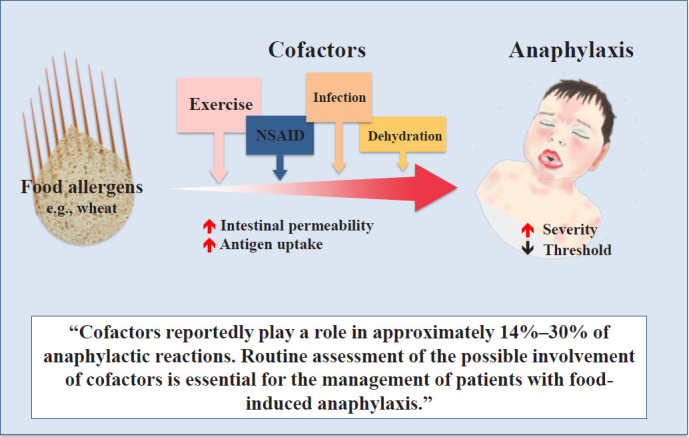
Food allergies and food-induced anaphylaxis are important health problems. Several cofactors modulating the onset of anaphylaxis have been identified. In the presence of cofactors, allergic reactions may be induced at lower doses of food allergens and/or become severe. Exercise and concomitant infections are well-documented cofactors of anaphylaxis in children. Other factors such as consumption of nonsteroidal anti-inflammatory drugs, alcohol ingestion, and stress have been reported. Cofactors reportedly play a role in approximately 30% of anaphylactic reactions in adults and 14%–18.3% in children. Food-dependent exercise-induced anaphylaxis (FDEIA) is the best-studied model of cofactor-induced anaphylaxis. Wheat-dependent exercise-induced anaphylaxis, the most common FDEIA condition, has been studied the most. The mechanisms of action of cofactors have not yet been fully identified. This review aims to educate clinicians on recent developments in the role of cofactors and highlight the importance of recognizing cofactors in food allergies and food-induced anaphylaxis.
Overview
The claims and statistics of this paper haven’t been checked yet.
Run the check — free, no account needed. It reads the open-access text and checks the sources it cites.
Integrity signals
Registry
Cites
Statistics
Figures
Verification
Claims the paper makes
The claims and statistics of this paper haven’t been checked yet.
Run the check — free, no account needed. It reads the open-access text and checks the sources it cites.
Claims other papers make about this one
Each is checked against this paper’s own text: does it say what the citing paper says it does?
In the citing paper
“Similarly, exercise can amplify the severity of allergic reactions by increasing gastrointestinal permeability and altering blood flow dynamics, particularly to the digestive system.”
From Pollen–Food Allergy Syndrome: Allergens, Clinical Insights, Diagnostic and Therapeutic Challenges (2024) · cites this paper as [35]
In the citing paper
“Cofactors such as physical exercise, alcohol consumption, or the use of nonsteroidal anti-inflammatory drugs (NSAIDs) can exacerbate symptoms, potentially tipping mild reactions into severe systemic responses [35].”
From Pollen–Food Allergy Syndrome: Allergens, Clinical Insights, Diagnostic and Therapeutic Challenges (2024) · cites this paper as [35]
Self-check
Percentages, sums and reported differences re-computed from the paper’s own numbers.
The self-check needs the paper’s full text.
Citations
Cites
Vanuytsel, T., van Wanrooy, S., Vanheel, H., Vanormelingen, C., Verschueren, S., Houben, E., Salim Rasoel, S., Tόth, J., Holvoet, L., Farré, R., et al. (2014) · Gut · doi:10.1136/gutjnl-2013-305690 · Cited by 615
Airway injury as a mechanism for exercise-induced bronchoconstriction in elite athletes
Anderson, S. D., & Kippelen, P. (2008) · Journal of Allergy and Clinical Immunology · doi:10.1016/j.jaci.2008.05.001 · Cited by 237
Exercise regulation of intestinal tight junction proteins
Zuhl, M., Schneider, S., Lanphere, K., Conn, C., Dokladny, K., & Moseley, P. (2014) · British Journal of Sports Medicine · doi:10.1136/bjsports-2012-091585 · Cited by 167
Role of gut microbiota in intestinal wound healing and barrier function
Alam, A., & Neish, A. (2018) · Tissue Barriers · doi:10.1080/21688370.2018.1539595 · Cited by 166
Research works printed but not linked: 47
- 10.4168/aair.2016.8.6.535 · DOI
- 10.1016/j.jaci.2011.09.018 · DOI
- 10.1111/all.12437 · DOI
- 10.1111/all.12532 · DOI
- 10.5414/alx01401e · DOI
- 10.1111/j.1398-9995.2012.02877.x. · DOI
- 10.1111/all.12193 · DOI
- 10.1111/j.1365-2222.2005.02257.x · DOI
- Hompes, 2011, Provoking allergens and treatment of anaphylaxis in children and adolescents--data from the anaphylaxis registry of German-speaking countries, 568
- 10.1111/all.13207 · DOI
- 10.1111/cea.13282 · DOI
- 10.1002/iid3.120 · DOI
- Dua, 2019, Effect of sleep deprivation and exercise on reaction threshold in adults with peanut allergy: a randomized controlled study, 1584
- 10.1111/j.1365-2222.2005.02213.x · DOI
- 10.23822/eurannaci.1764-1489.45 · DOI
- Christensen, 2019, A multicenter retrospective case study of anaphylaxis triggers by age in Korean children, 114
- 10.1007/s11882-010-0150-y · DOI
- Moneret-Vautrin, 2009, Drugs as risk factors of food anaphylaxis in adults: a case-control study, 351
- 10.1097/aci.0000000000000461 · DOI
- 10.1016/j.jaip.2017.12.023 · DOI
- 10.1007/s00421-017-3739-1 · DOI
- 10.1007/s00421-002-0653-x · DOI
- 10.2332/allergolint.12-oa-0495 · DOI
- 10.1186/s13601-019-0260-0 · DOI
- 10.1080/21688370.2017.1373208 · DOI · Paper page
- 10.3945/jn.109.104638 · DOI · Paper page
- 10.1016/j.intimp.2020.106557 · DOI
- Barg, 2008, Food-dependent exercise-induced anaphylaxis: possible impact of increased basophil histamine releasability in hyperosmolar conditions, 312
- 10.1111/j.1398-9995.2007.01501.x · DOI · Paper page
- 10.1111/cea.12735 · DOI
- 10.2332/allergolint.13-oa-0536 · DOI
- 10.1046/j.1365-2133.2001.04329.x · DOI
- 10.1111/j.1365-2222.2012.04071.x · DOI
- 10.1111/all.14032 · DOI
- Quiralte, 1996, Intolerance to nonsteroidal antiinflammatory drugs: results of controlled drug challenges in 98 patients, 678
- 10.1016/j.imlet.2008.08.006 · DOI · Paper page
- Lee, 2013, Antihypertensive medication use is associated with increased organ system involvement and hospitalization in emergency department patients with anaphylaxis, 1103
- 10.1016/j.iac.2010.09.009 · DOI
- 10.1016/j.anai.2013.08.002 · DOI
- 10.1111/j.1365-2982.2011.01865.x · DOI
- 10.1152/ajpgi.1994.267.5.g794 · DOI
- 10.1111/j.1365-2982.2012.01928.x · DOI
- 10.1016/j.anai.2020.01.006 · DOI
- 10.1249/00005768-199209001-00004 · DOI
- 10.1111/nmo.13477 · DOI
- 10.12965/jer.1938470.235 · DOI
- 10.1007/s004210000305 · DOI
Cited by
Sorted by citations
Pollen–Food Allergy Syndrome: Allergens, Clinical Insights, Diagnostic and Therapeutic Challenges
Haidar, L., Bănărescu, C. F., Uța, C., Moldovan, S. I., Zimbru, E.-L., Zimbru, R.-I., Ciurariu, E., Georgescu, M., & Panaitescu, C. (2024) · Applied Sciences · doi:10.3390/app15010066 · Cited by 21
Metadata
- Authors
- shin, M.
- ORCID
- shin, Meeyong
- Venue
- Clinical and Experimental Pediatrics
- Publisher
- Korean Pediatric Society
- Published
- 2021-08-15
- Volume
- 64
- Issue
- 8
- Pages
- 393-399
- ISSN
- 2713-4148
- PMC
- PMC8342881
- Cited by
- 36
- References
- 4
- Language
- en
- Funders
- Soonchunhyang University
About these checks
Registry, retraction, Cites and statistics results are computed, not judged, with one exception: a printed reference that no index lists is read once by a model before it counts as a citation error. Claims are extracted by a model and kept only when their quote appears verbatim in the text; each cited source is then checked, with a model’s help, for whether it says what the claim relies on. Those verdicts can be wrong — read the claim’s quote and the cited source before relying on one.
Statistics and arithmetic are recomputed, not judged.
Confidence bands are shown only for fields calibrated on our annotated test set. None is calibrated yet, so no band is shown.
What counts as a claim ›How we measure confidence ›How we check this ›
Are you an author, or do you see a problem with this page? Request a review
How to cite
Cite CoChat for the checks on this page, and the paper for its own findings.
- This page
- CoChat. (2026). Citation check: Food allergies and food-induced anaphylaxis: role of cofactors. https://app.cochat.ai/papers/10.3345/cep.2020.01088
- The paper
- shin, M. (2021). Food allergies and food-induced anaphylaxis: role of cofactors. Clinical and Experimental Pediatrics. https://doi.org/10.3345/cep.2020.01088
