

The DOI matches its Crossref record; 30 of the 30 references it cites were found in a registry or an index; none of the 26 sources its claims cite is checked for support yet.
Teaching Mathematics through Problem Posing: four practices for handling students’ posed problems
Open accessAbstract
Problem posing is both a learning goal and an effective instructional approach, but what are the details of using this approach to foster students’ learning? In this paper, we use teaching cases to demonstrate a step-by-step instructional model that teachers can use to convert non-problem-posing tasks into problem-posing ones and use the tasks to foster students’ learning. More importantly, we provide a detailed illustration of the four practices that teachers and students can use to handle students’ posed problems. The paper ends with a discussion of future work to validate and improve the model and the challenges that teachers experience teaching through problem posing.
Overview
CoChat Summary
TL;DR
The paper presents a step-by-step P-PBL instructional model for teaching mathematics through problem posing and details four practices—analyzing, selecting, sequencing, and solving—for handling students’ posed problems. It uses teaching cases to illustrate how teachers can convert tasks and manage posed problems within classroom constraints.
Key findings
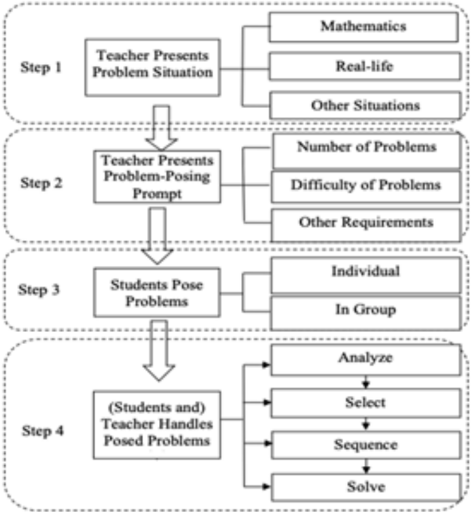
- The P-PBL model has four steps: teacher presents a problem situation, teacher presents a problem-posing prompt, students pose problems, and (students and) teacher handle posed problems. Step 4 is elaborated into four practices: analyze, select, sequence, and solve.
- Handling posed problems includes classifying same-type problems and modifying unsolvable or problematic ones. In a percent lesson, students classified Problems ② and ⑥ as asking for a percentage of a certain number, and modified Problem ⑤ because 40 ÷ (1 + 50%) did not yield a whole number of apple boxes.
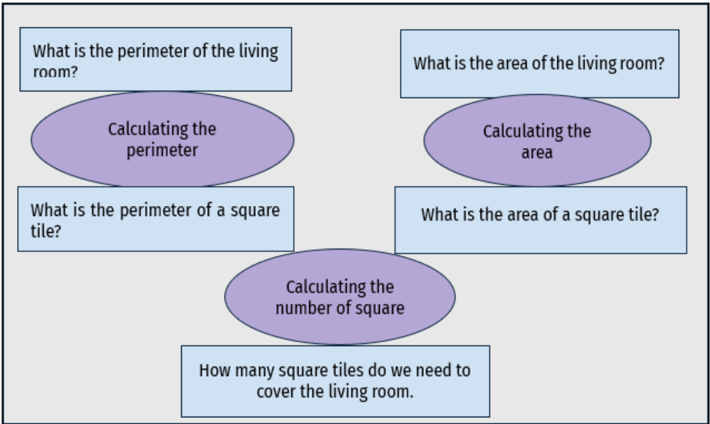
- Selection should align with teaching goals and lesson arrangements. In an example on division with remainder, the teacher moved calculation-focused questions 4 and 5 to the next class and focused on the first three questions. Sequencing can use difficulty, interest, or dependency; in a square-tile example, students sequenced by interest/dependency and solved for 200 tiles.
- The paper cites Zhang and Cai’s (2021) analysis of 22 teaching cases, where teachers skipped problems irrelevant to teaching goals, classified relevant problems by difficulty, spent class time on moderately challenging problems, and assigned very challenging problems to homework or the next class.
Methods
- Conceptual/instructional design paper, not an empirical study; it synthesizes prior research and uses teaching cases to illustrate the P-PBL model and four practices.
- Data/examples are drawn from researchers’ archive (2019, 2022) and cited studies; no sample size or participant demographics are reported for the illustrative cases.
- Main analysis is qualitative illustration and synthesis, using classroom dialogues and examples to show each practice; no statistical analysis is reported.
Limitations
- The paper states that more teaching cases are needed to illustrate and validate the model and to improve it by adding more specific practices and possible steps.
- The paper states implementation challenges: time constraints in typical classrooms, and teachers needing strong understanding of students’ prior knowledge/experience and deep content knowledge to quickly analyze posed problems and organize subsequent activities.
- Evident from the text: the four practices are illustrated with selected examples rather than systematically tested, and no empirical outcome data on effectiveness are reported.
Model-written summary. Check it against the paper before relying on it.
Integrity signals
Registry
Cites
Statistics
Figures
Verification
Claims the paper makes
0 Valid · 3 Not valid · 31 Not checked · 38 Own results and interpretations
A result the paper reports from its own data — it cites no other source for it, so there is none to check. The quote shows it is in the paper.
In the paper
“From observing problem-posing lessons, we have observed that students quickly lose interest in the activity if the selected posed problems are too easy for the whole class.”
§ Teaching Mathematics through Problem Posing: four practices for handling students' posed problems Ensino de Matemática por meio da Proposição de Problemas: quatro práticas para lidar > 5.1. Guidelines for selecting the posed problems
plainstates a cause- Asserted: passes — The authors put it forward as true.
- Checkable: passes — It can be checked against evidence.
- Load-bearing: unclear — It is unclear whether the paper’s conclusions depend on it.
- Based: passes — The paper gives a reason why it holds.
A conclusion the paper draws from its own results — it cites no other source for it, so there is none to check. The quote shows it is in the paper.
In the paper
“Therefore, problem solving is considered as a necessary instructional practice to show students' understanding of the knowledge”
§ Teaching Mathematics through Problem Posing: four practices for handling students' posed problems Ensino de Matemática por meio da Proposição de Problemas: quatro práticas para lidar > 7. Practice: solving the posed problems
plainstates a cause- Asserted: passes — The authors put it forward as true.
- Checkable: passes — It can be checked against evidence.
- Load-bearing: passes — The paper’s conclusions depend on it.
- Based: passes — The paper gives a reason why it holds.
In the paper
“However, only a comparatively small number of teachers in Li et al.'s study recognized these pedagogical advantages.”
§ Teaching Mathematics through Problem Posing: four practices for handling students' posed problems Ensino de Matemática por meio da Proposição de Problemas: quatro práticas para lidar > 2.3. Pedagogical Advantages
What the sources say
- Not matchedcites Li et al., 2020
Couldn’t be matched to a paper in Crossref, so it can’t be checked.
plain- Asserted: passes — The authors put it forward as true.
- Checkable: passes — It can be checked against evidence.
- Load-bearing: unclear — It is unclear whether the paper’s conclusions depend on it.
- Based: passes — The paper gives a reason why it holds.
- Not matched
In the paper
“Studies have also shown that students' in-terest in learning mathematics can be enhanced in a problem-posing teaching context (Walkington;Bernacki, 2015).”
§ Teaching Mathematics through Problem Posing: four practices for handling students' posed problems Ensino de Matemática por meio da Proposição de Problemas: quatro práticas para lidar > 2.2. Learners' affective outcomes
What the sources say
- Not matchedcites Walkington;Bernacki, 2015
Couldn’t be matched to a paper in Crossref, so it can’t be checked.
plainstates a possible cause- Asserted: passes — The authors put it forward as true.
- Checkable: passes — It can be checked against evidence.
- Load-bearing: unclear — It is unclear whether the paper’s conclusions depend on it.
- Based: passes — The paper gives a reason why it holds.
- Not matched
In the paper
“Hendriana et al. (2019) showed that 11 th -grade students' learning was more active in the problem-posing approach class compared to the learning in the conventional learning classroom”
§ Teaching Mathematics through Problem Posing: four practices for handling students' posed problems Ensino de Matemática por meio da Proposição de Problemas: quatro práticas para lidar > 2.2. Learners' affective outcomes
What the sources say
- Not checked yetcites Hendriana et al., 2019 source
plainstates a cause- Asserted: passes — The authors put it forward as true.
- Checkable: passes — It can be checked against evidence.
- Load-bearing: unclear — It is unclear whether the paper’s conclusions depend on it.
- Based: passes — The paper gives a reason why it holds.
20 more claims
Create a free account to see all 72 claims and to verify the 11 references still open.
- It may state two separate claims as one. 24
- Probably not a substantial claim. 37
Self-check
Percentages, sums and reported differences re-computed from the paper’s own numbers.
Each contradiction between two passages listed here was confirmed by an independent check.
Rated minor: it would not touch a result — a value no result rests on, a p-value that stays on the same side of the significance level, or a conflict that is clerical, resolved elsewhere in the paper, or outside its own findings.
In the paper
§ Teaching Mathematics through Problem Posing: four practices for handling students' posed problems Ensino de Matemática por meio da Proposição de Problemas: quatro práticas para lidar > 3.4. Step 4: (Students and) Teacher handle posed problems
“From an improvement science (Bryk et al., 2005) perspective”
§ Teaching Mathematics through Problem Posing: four practices for handling students' posed problems Ensino de Matemática por meio da Proposição de Problemas: quatro práticas para lidar > References
“BRYK, A. S., et al. Learning to improve: How America's schools can get better at getting better. Har- vard Education Press. 2015.”
Citations
Cites
The Work of Teaching and the Challenge for Teacher Education
Loewenberg Ball, D., & Forzani, F. M. (2009) · Journal of Teacher Education · doi:10.1177/0022487109348479 · Cited by 1,675
Stein, M. K., Engle, R. A., Smith, M. S., & Hughes, E. K. (2008) · Mathematical Thinking and Learning · doi:10.1080/10986060802229675 · Cited by 1,222
Learning to improve: how America's schools can get better at getting better
(2015) · Choice Reviews Online · doi:10.5860/choice.191214 · Cited by 717
National Council of Teachers of Mathematics
Sobel, M. A. (1982) · The Arithmetic Teacher · doi:10.5951/at.30.1.0060 · Cited by 608
Problem-Posing Research in Mathematics Education: Some Answered and Unanswered Questions
Cai, J., Hwang, S., Jiang, C., & Silber, S. (2015) · Springer eBooks · doi:10.1007/978-1-4614-6258-3_1 · Cited by 257
Self-citationEmbedding game-based problem-solving phase into problem-posing system for mathematics learning
Chang, K.-E., Wu, L.-J., Weng, S.-E., & Sung, Y.-T. (2012) · Computers & Education · doi:10.1016/j.compedu.2011.10.002 · Cited by 253
Developing pre-service teachers understanding of fractions through problem posing
Toluk-Uçar, Z. (2009) · Teaching and Teacher Education · doi:10.1016/j.tate.2008.08.003 · Cited by 168
Artifacts as sources for problem-posing activities
Bonotto, C. (2013) · Educational Studies in Mathematics · doi:10.1007/s10649-012-9441-7 · Cited by 165
An Approach to Measuring Cognitive Outcomes Across Higher Education Institutions
Klein, S. P., Kuh, G. D., Chun, M., Hamilton, L. S., & Shavelson, R. J. (2005) · Research in Higher Education · doi:10.1007/s11162-004-1640-3 · Cited by 138
Cai, J., & Leikin, R. (2020) · Educational Studies in Mathematics · doi:10.1007/s10649-020-10008-x · Cited by 122
Self-citation
Research works printed but not linked: 5
- BONOTTO, C.; DAL SANTO, L. How to foster creativity in problem posing and problem solving activities. In S. Carreira, N. Amado, K. Jones, & H. Jacinto (Eds.), Universidade do Algarve. Proceedings of the Problem@Web International Conference: Technology, creativity and affect in mathematical problem solving, 2014. pp. 120–132.
- EL SAYED, R. A. E. Effectiveness of problem posing strategies on prospective mathematics teachers' problem solving performance. Journal of Science and Mathematics Education in Southeast Asia, 25(1), 2002. 56–69.
- LIN, P. J. Supporting teachers on designing problem-posing tasks as a tool of assessment to understand students' mathematical learning. In M. J. Hoines & A. B. Fuglestad (Eds.), Paper presented in Proceedings of the 28th annual meeting of International Group for the Psychology of Mathematics Education (Vol. 3, pp. 257–264). Bergen, 2004. Noruega: Bergen University College.
- STOYANOVA, E.; ELLERTON, N. F. A framework for research into students’ problem posing in school mathematics. Technology in mathematics education, 4(7), 1996. p. 518-525.
- WALKINGTON, C. Design research on personalized problem posing in algebra. In E. Galindo & J. Newton (Eds.), Proceedings of the 39th annual meeting of the North American Chapter of the International Group for the Psychology of Mathematics Education (pp. 195–202). Indianapolis, IN: Hoosier Association of Mathematics Teacher Educators, 2017.
Cited by
Hwang, S., Han, J., Muirhead, F., Brown, A., Melville, M., & Cai, J. (2025) · ZDM – Mathematics Education · doi:10.1007/s11858-025-01694-z · Cited by 14
Self-citationJuhari, A. (2026) · Pedagogy Jurnal Pendidikan Matematika · doi:10.30605/wphvvm67 · Cited by 1
Conceptualizing Math Ridas in Equity-Oriented Urban Classrooms
Howell, J. R., & Orr, S. M. (2025) · Journal of Urban Mathematics Education · doi:10.21423/jume-v18i2a571
Jufri, W. N., Arnawa, I. M., Musdi, E., Abdullah, R., Hidayati, A., & Arifin, A. S. R. (2026) · International Journal of Information and Education Technology · doi:10.18178/ijiet.2026.16.11.2743
Metadata
- Authors
- Ma, Y., & Cai, J.
- Affiliations
- University of Delaware (US)
- ORCID
- Venue
- Revemop
- Publisher
- Revemop
- Published
- 2024-08-17
- Volume
- 6
- Pages
- e2024009
- ISSN
- 2596-0245 (ISSN-L)
- OpenAlex
- W4401657866
- Semantic Scholar
- 6b76bc6c1676bbe780f37e58df667d6c4df22377
- Cited by
- 4
- References
- 30
- Citations by year
- 2026: 2 · 2025: 2
- FWCI
- 1.58
- Type
- journal article
- Language
- en
- Open access
- diamond
- doi.org
- Licence
- Locations
- Revemop (publishedVersion, cc-by-nc-sa)
- LA Referencia (Red Federada de Repositorios Institucionales de Publicaciones Científicas) (submittedVersion, cc-by)
- Funders
- National Science Foundation (2101552)
- Topics
- Social Sciences › Education › Mathematics Education and Teaching Techniques
- Social Sciences › Education › Mathematics Education and Pedagogy
- Social Sciences › Education › Problem and Project Based Learning
- Keywords
- problem posing, mathematics education, student-generated problems, teaching model, teaching practice, teacher challenges, mathematics learning
About these checks
Registry, retraction, Cites and statistics results are computed, not judged, with one exception: a printed reference that no index lists is read once by a model before it counts as a citation error. Claims are extracted by a model and kept only when their quote appears verbatim in the text; each cited source is then checked, with a model’s help, for whether it says what the claim relies on. Those verdicts can be wrong — read the claim’s quote and the cited source before relying on one.
A language model drew the claims from the paper on 2026-11-15, under version 3 of the claim definition (model deepseek-v4.1-flash, prompt extract-v3).
A second model labelled each claim on 2026-11-15 (model jev-1.13-20260917, definition revision gold-guideline-v0.2).
Statistics and arithmetic are recomputed, not judged.
Confidence bands are shown only for fields calibrated on our annotated test set. None is calibrated yet, so no band is shown.
What counts as a claim ›How we measure confidence ›How we check this ›
Are you an author, or do you see a problem with this page? Request a review
How to cite
Cite CoChat for the checks on this page, and the paper for its own findings.
- This page
- CoChat. (2026). Citation check: Teaching Mathematics through Problem Posing: four practices for handling students’ posed problems. https://app.cochat.ai/papers/10.33532/revemop.e2024009
- The paper
- Ma, Y., & Cai, J. (2024). Teaching Mathematics through Problem Posing: four practices for handling students’ posed problems. Revemop. https://doi.org/10.33532/revemop.e2024009
Data sources
Bibliographic data: Semantic Scholar, OpenAlex, Crossref.
Contains information from the Semantic Scholar Academic Graph Datasets, made available under the ODC Attribution License (ODC-BY 1.0).
Semantic Scholar’s data is described in: Kinney, R., et al. (2023). The Semantic Scholar Open Data Platform. arXiv:2301.10140.
