

Stakeholder engagement in the governance of marine migratory species: barriers and building blocks
Open accessThe DOI matches its Crossref record; 88 of the 88 references it cites were found in a registry or an index.
Abstract
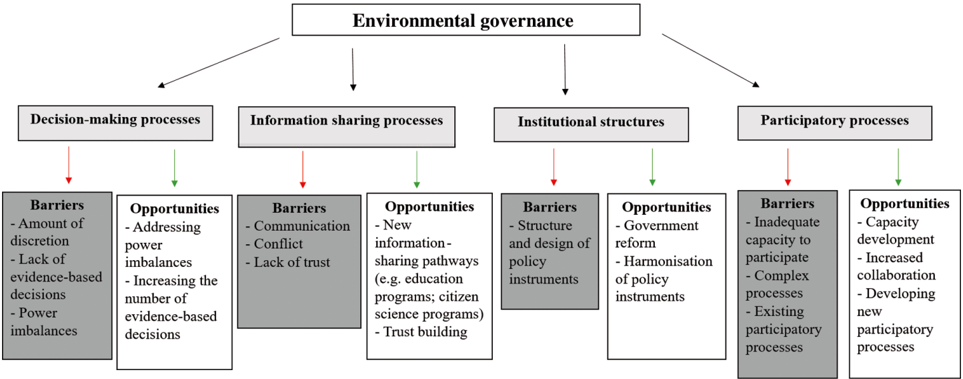
Meaningful stakeholder engagement is important to collaborative decision-making and to effective polycentric governance, particularly when managing cross-scale environmental issues like those involving marine migratory species. In this paper, we explore the barriers to, and opportunities for, stakeholder involvement in the governance of threats to marine migratory species in eastern Australia, using semi-structured qualitative interviews and a focus group, as an example of the generic problem of managing migratory species within a large range state with multiple jurisdictions. Respondents identified several barriers to, and opportunities for, improved stakeholder involvement in the governance of marine migratory species, corresponding to 4 main themes: decision-making processes, information sharing, institutional structures, and participation processes. Respondents indicated that the governance system protecting marine turtles, dugongs, humpback whales, and non-threatened migratory shorebirds in eastern Australia would benefit from the introduction of new information pathways, reformed institutional structures (including environmental legislation), and improved participatory pathways for non-government stakeholders. Such changes could help harmonise the process of managing these species, leading to more effective conservation management throughout their range.
Overview
The claims and statistics of this paper haven’t been checked yet.
Free: it reads the open-access text and checks the first 5 claims that cite a source we can check. Create a free account to check every claim.
Integrity signals
Registry
Cites
Statistics
Figures
Verification
Claims the paper makes
The claims and statistics of this paper haven’t been checked yet.
Free: it reads the open-access text and checks the first 5 claims that cite a source we can check. Create a free account to check every claim.
Claims other papers make about this one
Each is checked against this paper’s own text: does it say what the citing paper says it does?
The cited source says what the claim attributes to it.
In the citing paper
“Information technology allows the inclusion of stakeholders (Miller et al., 2020”
From Redefining Collaborative Governance in the Digital Age: insights from an integrative systematic review on the role of ICT in collaboration (2025) · cites this paper as Miller et al., 2020
Self-check
Percentages, sums and reported differences re-computed from the paper’s own numbers.
The self-check needs the paper’s full text.
Citations
Cites
A Ladder Of Citizen Participation
Arnstein, S. R. (1969) · Journal of the American Institute of Planners · doi:10.1080/01944366908977225 · Cited by 17,064
Grounded theory research: Procedures, canons, and evaluative criteria
Corbin, J. M., & Strauss, A. (1990) · Qualitative Sociology · doi:10.1007/bf00988593 · Cited by 11,133
ADAPTIVE GOVERNANCE OF SOCIAL-ECOLOGICAL SYSTEMS
Folke, C., Hahn, T., Olsson, P., & Norberg, J. (2005) · Annual Review of Environment and Resources · doi:10.1146/annurev.energy.30.050504.144511 · Cited by 5,814 · cited 1×
“Identifying and involving such stakeholders should help natural resource managers reduce bias in decision-making and capture diverse values and management concerns to develop appropriate governance interventions (Dietz et al. 2003, Folke et al. 2005, Luyet et al. 2012, Benham 2017).”
BackgroundThe Struggle to Govern the Commons
Dietz, T., Ostrom, E., & Stern, P. C. (2003) · Science · doi:10.1126/science.1091015 · Cited by 4,209
The methodology of Focus Groups: the importance of interaction between research participants
Kitzinger, J. (1994) · Sociology of Health & Illness · doi:10.1111/1467-9566.ep11347023 · Cited by 3,870 · cited 3×
“…from November 2017 to October 2018 using semistructured qualitative interviews (e.g. Rose 1994, Whiting 2008) as well as a focus group (with 5 people, e.g. Patton 1990, Kitzinger 1994) with stakeholders involved in the governance of marine migratory species on the east coast of Australia (Table 1).”
BackgroundMethodAn Integrative Framework for Collaborative Governance
Emerson, K., Nabatchi, T., & Balogh, S. (2012) · Journal of Public Administration Research and Theory · doi:10.1093/jopart/mur011 · Cited by 3,637
Who's in and why? A typology of stakeholder analysis methods for natural resource management
Reed, M. S., Graves, A., Dandy, N., Posthumus, H., Hubacek, K., Morris, J., Prell, C., Quinn, C. H., & Stringer, L. C. (2009) · Journal of Environmental Management · doi:10.1016/j.jenvman.2009.01.001 · Cited by 2,659
Evolution of co-management: Role of knowledge generation, bridging organizations and social learning
Berkes, F. (2009) · Journal of Environmental Management · doi:10.1016/j.jenvman.2008.12.001 · Cited by 2,439
Public Participation Methods: A Framework for Evaluation
Rowe, G., & Frewer, L. J. (2000) · Science, Technology, & Human Values · doi:10.1177/016224390002500101 · Cited by 2,240
Focus-group interview and data analysis
Rabiee, F. (2004) · Proceedings of the Nutrition Society · doi:10.1079/pns2004399 · Cited by 2,020
Research works printed but not linked: 7
- Byron N, Craik W, Keniry J, Possingham H (2014) A review of biodiversity legislation in NSW: final report. Prepared by Independent Biodiversity Legislation Review Panel for State of NSW and the Office of Environment and Her- itage, Sydney. State of NSW and the Office of Environ- ment and Heritage, Sydney
- Dale A, George M, Hill R, Fraser D (2016) Traditional Own- ers and sea country in the southern Great Barrier Reef - which way forward? Report to the National Environmen- tal Science Programme. Reef and Rainforest Research Centre Limited, Cairns de Loë R, Armitage D, Plummer R, Davidson S, Moraru L (2009) From government to governance: a state-of-the- art review of environmental governance. Final report. Prepared for Alberta Environment, Environmental Stew- ardship, Environmental Relations. Rob de Loë Consult- ing Services, Guelph, Ontario.
- de Loë R, Armitage D, Plummer R, Davidson S, Moraru L (2009) From government to governance: a state-of-the-art review of environmental governance. Final report. Prepared for Alberta Environment, Environmental Stewardship, Environmental Relations. Rob de Loë Consulting Services, Guelph, Ontario.
- Holling CS (ed) (1978) Adaptive environmental assessment and management. Wiley, Chichester
- Jones G (2005) Is the management plan achieving its objec- tives? In: Worboys G, Lockwood M, De Lacy T (eds) Pro- tected area management: principles and practice, 2nd edn. Oxford University Press, South Melbourne
- Weiss KC (2011) Towards social-ecological resilience in nat- ural resource governance: issues of power, diversity and scale. PhD thesis, James Cook University, Townsville
- Woodley S, Williams DMcB, Harvey T, Jones A (2006) World Heritage research: making a difference. CRC Reef Research, Education and Capacity Building 1999-2006. CRC Reef Research Centre, Townsville Young O (2002) The institutional dimensions of environmen- tal change: fit, interplay, and scale. MIT Press, Cam- bridge, MA
Cited by
Barriers to stakeholder engagement in sustainable procurement of public works
Agyekum, A. K., Fugar, F. D. K., Agyekum, K., Akomea-Frimpong, I., & Pittri, H. (2022) · Engineering Construction & Architectural Management · doi:10.1108/ecam-08-2021-0746 · Cited by 70
Foresight science in conservation: Tools, barriers, and mainstreaming opportunities
Ednie, G., Kapoor, T., Koppel, O., Piczak, M. L., Reid, J. L., Murdoch, A. D., Cook, C. N., Sutherland, W. J., & Cooke, S. J. (2022) · AMBIO · doi:10.1007/s13280-022-01786-0 · Cited by 30
“Miller et al. (2020) identified inadequate communication, lack of evidence-informed decisions, lack of trust, and power imbalances as common themes in preventing stakeholder engagement for marine conservation in Australia.”
BackgroundPerez, M. A., Limpus, C. J., Hofmeister, K. M., Shimada, T., Strydom, A., Webster, E. G., & Hamann, M. (2022) · Marine Biology · doi:10.1007/s00227-022-04061-8 · Cited by 13
“With the expansion of Australian trawl fisheries in the 1960 s to 1980 s, a marked decline was observed from the mid-1970 s in the population of annually breeding loggerhead females at all index monitored beaches in Queensland up until the regulated mandatory use of turtle exclusion devices (TEDs) in bottom trawl fish…”
BackgroundInfluentialSelf-citationEnhancing collaboration across the knowledge system boundaries of ecosystem governance
Badry, N. A., & Hickey, G. M. (2022) · Advances in ecological research/Advances in Ecological Research · doi:10.1016/bs.aecr.2022.04.010 · Cited by 12
Barr, C. E., Hamann, M., Shimada, T., Bell, I. P., Limpus, C. J., & Ferguson, J. (2021) · Wildlife Research · doi:10.1071/wr20183 · Cited by 11
“This requires effective communication and coordination, such as, for example, through various State and Australian Governments and their associated management plans and policies because the turtles we studiedmoved between State (Queensland) waters, Commonwealth waters and jurisdictions managed under the Protected Zone…”
BackgroundSelf-citationViana, L. B. F. (2025) · Technium Social Sciences Journal · doi:10.47577/tssj.v67i1.12358 · Cited by 5
Grassi, G., Zennaro, F., Ferraro, G., Beunen, R., Douguet, J.-M., & Furlan, E. (2025) · Environmental Science & Policy · doi:10.1016/j.envsci.2025.104111 · Cited by 5
Zhou, W. H., Chen, Y., & Shu, Q. (2022) · Mathematical Problems in Engineering · doi:10.1155/2022/5638806
Smith, J. S., Limpus, C. J., Shimada, T., Booth, L., Hinchliffe, E. C., Fuentes, M. M. P. B., Loban, F., Preston, S., & Hamann, M. (2024) · Wildlife Research · doi:10.1071/wr24054
Self-citationKey Drivers of Stakeholder Collaboration in Developing Kitesurfing Tourism in Jeneponto
Arief, E. I., Yunus, M. H., Syahribulan, S., & Ibrahim, M. A. (2025) · KnE Social Sciences · doi:10.18502/kss.v10i18.19453
Badry, N. A. (2025) · eScholarship@McGill (McGill) · doi:10.82308/7836
Bannor, P., Nani, G., Osei-Tutu, S., Asamoah, R. O., Kyong-Ire, S., & Mensah, J. A.-P. (2026) · doi:10.54117/xq55pp50
JOSHUA, P., Ahmadu, H. A., & Olamilokun, O. (2026) · Kaduna State University Environmental Sciences Journal · doi:10.66884/kesj.2026.6fxg3cf4
Roy, N. (2020) · DalSpace (Dalhousie University) · Cited by 2
Metadata
- Authors
- Miller, R., Marsh, H., Benham, C., & Hamann, M.
- Affiliations
- James Cook University (AU)
- Corresponding author
- Miller, RL
- Venue
- Endangered Species Research
- Publisher
- Inter-Research Science Center
- Published
- 2020-09-03
- Volume
- 43
- Pages
- 1-19
- ISSN
- 1613-4796 (ISSN-L)
- 1863-5407
- OpenAlex
- W3037260056
- Semantic Scholar
- d231b0092a911b1b745477e2bcce8bb93dba48a2
- Cited by
- 12
- References
- 88
- Citations by year
- 2026: 1 · 2025: 3 · 2024: 1 · 2023: 1 · 2022: 5 · 2021: 1
- FWCI
- 2.07
- Type
- journal article
- Language
- en
- Open access
- gold
- doi.org
- Locations
- Endangered Species Research (publishedVersion, cc-by)
- ResearchOnline - JCU (James Cook University) (submittedVersion)
- DOAJ (DOAJ: Directory of Open Access Journals) (submittedVersion, cc-by-sa)
- Funders
- James Cook University
- Topics
- Physical Sciences › Environmental Science › Management, Monitoring, Policy and Law › Coastal and Marine Management
- Physical Sciences › Environmental Science › Nature and Landscape Conservation › Turtle Biology and Conservation
- Social Sciences › Public Administration › Public Policy and Administration Research
- Keywords
- stakeholder engagement, polycentric governance, collaborative decision-making, sea turtle conservation, dugong conservation, migratory shorebirds, information sharing, institutional framework, environmental law, range states, eastern Australia
About these checks
Registry, retraction, Cites and statistics results are computed, not judged, with one exception: a printed reference that no index lists is read once by a model before it counts as a citation error. Claims are extracted by a model and kept only when their quote appears verbatim in the text; each cited source is then checked, with a model’s help, for whether it says what the claim relies on. Those verdicts can be wrong — read the claim’s quote and the cited source before relying on one.
Statistics and arithmetic are recomputed, not judged.
Confidence bands are shown only for fields calibrated on our annotated test set. None is calibrated yet, so no band is shown.
What counts as a claim ›How we measure confidence ›How we check this ›
Are you an author, or do you see a problem with this page? Request a review
Data sources
Bibliographic data: Semantic Scholar, OpenAlex, Crossref.
Contains information from the Semantic Scholar Academic Graph Datasets, made available under the ODC Attribution License (ODC-BY 1.0).
Semantic Scholar’s data is described in: Kinney, R., et al. (2023). The Semantic Scholar Open Data Platform. arXiv:2301.10140.
