

Stakeholder engagement in the governance of marine migratory species: barriers and building blocks
Open accessThe DOI matches its Crossref record; 88 of the 88 references it cites were found in a registry or an index.
Abstract
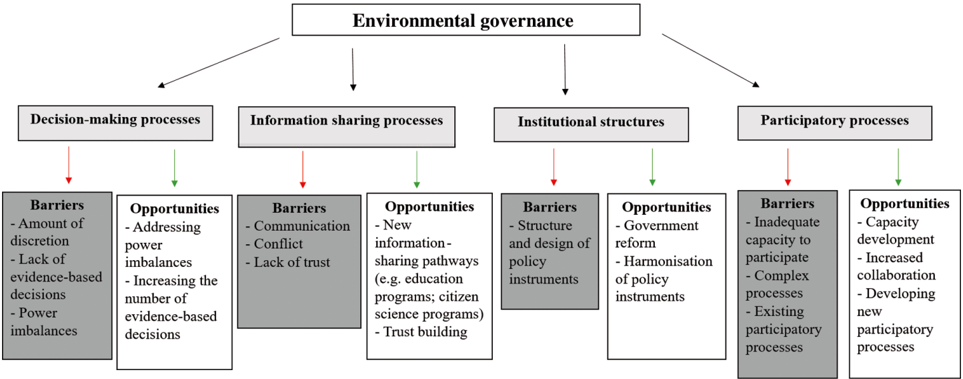
Meaningful stakeholder engagement is important to collaborative decision-making and to effective polycentric governance, particularly when managing cross-scale environmental issues like those involving marine migratory species. In this paper, we explore the barriers to, and opportunities for, stakeholder involvement in the governance of threats to marine migratory species in eastern Australia, using semi-structured qualitative interviews and a focus group, as an example of the generic problem of managing migratory species within a large range state with multiple jurisdictions. Respondents identified several barriers to, and opportunities for, improved stakeholder involvement in the governance of marine migratory species, corresponding to 4 main themes: decision-making processes, information sharing, institutional structures, and participation processes. Respondents indicated that the governance system protecting marine turtles, dugongs, humpback whales, and non-threatened migratory shorebirds in eastern Australia would benefit from the introduction of new information pathways, reformed institutional structures (including environmental legislation), and improved participatory pathways for non-government stakeholders. Such changes could help harmonise the process of managing these species, leading to more effective conservation management throughout their range.
Overview
The claims and statistics of this paper haven’t been checked yet.
Free: it reads the open-access text and checks the first 5 claims that cite a source we can check. Create a free account to check every claim.
Integrity signals
Registry
Cites
Statistics
Figures
Verification
Claims the paper makes
The claims and statistics of this paper haven’t been checked yet.
Free: it reads the open-access text and checks the first 5 claims that cite a source we can check. Create a free account to check every claim.
Claims other papers make about this one
Each is checked against this paper’s own text: does it say what the citing paper says it does?
The cited source says what the claim attributes to it.
In the citing paper
“Information technology allows the inclusion of stakeholders (Miller et al., 2020”
From Redefining Collaborative Governance in the Digital Age: insights from an integrative systematic review on the role of ICT in collaboration (2025) · cites this paper as Miller et al., 2020
Self-check
Percentages, sums and reported differences re-computed from the paper’s own numbers.
The self-check needs the paper’s full text.
Citations
Cites
A Ladder Of Citizen Participation
Arnstein, S. R. (1969) · Journal of the American Institute of Planners · doi:10.1080/01944366908977225 · Cited by 17,064
Grounded theory research: Procedures, canons, and evaluative criteria
Corbin, J. M., & Strauss, A. (1990) · Qualitative Sociology · doi:10.1007/bf00988593 · Cited by 11,133
ADAPTIVE GOVERNANCE OF SOCIAL-ECOLOGICAL SYSTEMS
Folke, C., Hahn, T., Olsson, P., & Norberg, J. (2005) · Annual Review of Environment and Resources · doi:10.1146/annurev.energy.30.050504.144511 · Cited by 5,814 · cited 1×
“Identifying and involving such stakeholders should help natural resource managers reduce bias in decision-making and capture diverse values and management concerns to develop appropriate governance interventions (Dietz et al. 2003, Folke et al. 2005, Luyet et al. 2012, Benham 2017).”
BackgroundThe Struggle to Govern the Commons
Dietz, T., Ostrom, E., & Stern, P. C. (2003) · Science · doi:10.1126/science.1091015 · Cited by 4,209
The methodology of Focus Groups: the importance of interaction between research participants
Kitzinger, J. (1994) · Sociology of Health & Illness · doi:10.1111/1467-9566.ep11347023 · Cited by 3,870 · cited 3×
“…from November 2017 to October 2018 using semistructured qualitative interviews (e.g. Rose 1994, Whiting 2008) as well as a focus group (with 5 people, e.g. Patton 1990, Kitzinger 1994) with stakeholders involved in the governance of marine migratory species on the east coast of Australia (Table 1).”
BackgroundMethodAn Integrative Framework for Collaborative Governance
Emerson, K., Nabatchi, T., & Balogh, S. (2012) · Journal of Public Administration Research and Theory · doi:10.1093/jopart/mur011 · Cited by 3,637
Who's in and why? A typology of stakeholder analysis methods for natural resource management
Reed, M. S., Graves, A., Dandy, N., Posthumus, H., Hubacek, K., Morris, J., Prell, C., Quinn, C. H., & Stringer, L. C. (2009) · Journal of Environmental Management · doi:10.1016/j.jenvman.2009.01.001 · Cited by 2,659
Evolution of co-management: Role of knowledge generation, bridging organizations and social learning
Berkes, F. (2009) · Journal of Environmental Management · doi:10.1016/j.jenvman.2008.12.001 · Cited by 2,439
Public Participation Methods: A Framework for Evaluation
Rowe, G., & Frewer, L. J. (2000) · Science, Technology, & Human Values · doi:10.1177/016224390002500101 · Cited by 2,240
Focus-group interview and data analysis
Rabiee, F. (2004) · Proceedings of the Nutrition Society · doi:10.1079/pns2004399 · Cited by 2,020
Mixed Methods Sampling: A Typology With Examples
Teddlie, C., & Yu, F. (2007) · Journal of Mixed Methods Research · doi:10.1177/1558689806292430 · Cited by 1,762
Lemos, M. C., & Agrawal, A. (2006) · Annual Review of Environment and Resources · doi:10.1146/annurev.energy.31.042605.135621 · Cited by 1,694
Toward Principles for Enhancing the Resilience of Ecosystem Services
Biggs, R., Schlüter, M., Biggs, D., Bohensky, E. L., BurnSilver, S., Cundill, G., Dakos, V., Daw, T. M., Evans, L. S., Kotschy, K., et al. (2012) · Annual Review of Environment and Resources · doi:10.1146/annurev-environ-051211-123836 · Cited by 1,241
Adaptive co-management and the paradox of learning
Armitage, D., Marschke, M., & Plummer, R. (2008) · Global Environmental Change · doi:10.1016/j.gloenvcha.2007.07.002 · Cited by 1,067
Mace, G. M. (2014) · Science · doi:10.1126/science.1254704 · Cited by 1,047 · cited 1×
“Addressing the negative impact of the Anthropocene will require robust and effective environmental governance (Mace 2014, Leenhardt et al. 2015).”
BackgroundThe Institutional Dimensions of Environmental Change: Fit, Interplay, and Scale
Young, O. R. (2002) · The MIT Press eBooks · doi:10.7551/mitpress/3807.001.0001 · Cited by 1,034
Bridging In-school and Out-of-school Learning: Formal, Non-Formal, and Informal Education
Eshach, H. (2007) · Journal of Science Education and Technology · doi:10.1007/s10956-006-9027-1 · Cited by 868
Polycentric Systems of Governance: A Theoretical Model for the Commons
Carlisle, K., & Gruby, R. L. (2019) · Policy Studies Journal · doi:10.1111/psj.12212 · Cited by 745
Good governance for terrestrial protected areas: A framework, principles and performance outcomes
Lockwood, M. (2010) · Journal of Environmental Management · doi:10.1016/j.jenvman.2009.10.005 · Cited by 683 · cited 7×
“…to the intertidal area of 80% of the Northern Territory coastline (Gumana v Northern Territory 2007) Endang Species Res 43: 1–19, 2020 vant and accessible to each stakeholder agency (e.g. government-sharing information with other stakeholder agencies and vice versa; Arnstein 1969, Lockwood 2010).”
BackgroundMethodResultInfluentialTargeting global conservation funding to limit immediate biodiversity declines
Waldron, A., Mooers, A. O., Miller, D. C., Nibbelink, N., Redding, D., Kuhn, T. S., Roberts, J. T., & Gittleman, J. L. (2013) · Proceedings of the National Academy of Sciences · doi:10.1073/pnas.1221370110 · Cited by 625 · cited 1×
“Australia already underfunds biodiversity conservation when compared to other developed countries (Waldron et al. 2013, 2017, Threatened Species Scientific Committee 2018), and it is unlikely that environmental decision-making will be prioritised over other areas of public policy in the foreseeable…”
BackgroundThe Political Economy of Cross-Scale Networks in Resource Co-Management
Adger, W. N., Brown, K., & Tompkins, E. L. (2005) · Ecology and Society · doi:10.5751/es-01465-100209 · Cited by 524 · cited 1×
“Examples of these barriers include communication barriers (e.g. sharing information between different governance bodies; Arlinghaus 2006), capacity barriers, and resource barriers (including financial, e.g. Adger et al. 2006, Fraser et al. 2017).”
BackgroundSemi-structured interviews: guidance for novice researchers
Whiting, L. S. (2008) · Nursing Standard · doi:10.7748/ns2008.02.22.23.35.c6420 · Cited by 502 · cited 1×
“We conducted 36 interviews (with 38 respondents) from November 2017 to October 2018 using semistructured qualitative interviews (e.g. Rose 1994, Whiting 2008) as well as a focus group (with 5 people, e.g. Patton 1990, Kitzinger 1994) with stakeholders involved in the governance of marine migratory…”
MethodA framework to implement Stakeholder participation in environmental projects
Luyet, V., Schlaepfer, R., Parlange, M. B., & Buttler, A. (2012) · Journal of Environmental Management · doi:10.1016/j.jenvman.2012.06.026 · Cited by 468 · cited 2×
“Identifying and involving such stakeholders should help natural resource managers reduce bias in decision-making and capture diverse values and management concerns to develop appropriate governance interventions (Dietz et al. 2003, Folke et al. 2005, Luyet et al. 2012, Benham 2017).”
BackgroundDynamics of two populations of the humpback whale, Megaptera novaeangliae (Borowski)
Chittleborough, R. (1965) · Australian Journal of Marine and Freshwater Research · doi:10.1071/mf9650033 · Cited by 464
Olsson, P., Folke, C., Galaz, V., Hahn, T., & Schultz, L. (2007) · Ecology and Society · doi:10.5751/es-01976-120128 · Cited by 458
Translating Marine Animal Tracking Data into Conservation Policy and Management
Hays, G. C., Bailey, H., Bograd, S. J., Bowen, W. D., Campagna, C., Carmichael, R. H., Casale, P., Chiaradia, A., Costa, D. P., Cuevas, E., et al. (2019) · Trends in Ecology & Evolution · doi:10.1016/j.tree.2019.01.009 · Cited by 419 · cited 2×
“…(2) produce decisions that are biologically and socially appropriate, and (3) aid in educating nongovernment stakeholder agencies in policy and protocol to help them better navigate complex governance processes (Sunderland et al. 2009, Pietri et al. 2015, Hays et al. 2019) (see Section 4.4).”
BackgroundInfluentialSelf-citationImperial, M. T. (1999) · Environmental Management · doi:10.1007/s002679900246 · Cited by 410 · cited 1×
“…balance centralised and decentralised governance approaches because the governance bodies within the governance regime can organise themselves using either top-down (centralised) or bottom-up (decentralised) processes of learning and adaptation (Imperial 1999, Carlisle & Gruby 2017, Morrison 2017).”
BackgroundMostert, E., Pahl-Wostl, C., Rees, Y., Searle, B., Tàbara, D., & Tippett, J. (2007) · Ecology and Society · doi:10.5751/es-01960-120119 · Cited by 403
Environmental governance: A practical framework to guide design, evaluation, and analysis
Bennett, N. J., & Satterfield, T. (2018) · Conservation Letters · doi:10.1111/conl.12600 · Cited by 374
Reductions in global biodiversity loss predicted from conservation spending
Waldron, A., Miller, D. C., Redding, D., Mooers, A., Kuhn, T. S., Nibbelink, N., Roberts, J. T., Tobias, J. A., & Gittleman, J. L. (2017) · Nature · doi:10.1038/nature24295 · Cited by 369 · cited 1×
“Threatened species listing drives the development of management tools (e.g. recovery plans and conservation advices) for natural resource governance in Australia (Hawke 2009, Walsh et al. 2013, McDonald et al. 2015).”
BackgroundThe dos and don’ts of influencing policy: a systematic review of advice to academics
Oliver, K., & Cairney, P. (2019) · Palgrave Communications · doi:10.1057/s41599-019-0232-y · Cited by 363
Synapses in the Network: Learning in Governance Networks in the Context of Environmental Management
Newig, J., Günther, D., & Pahl-Wostl, C. (2010) · Ecology and Society · doi:10.5751/es-03713-150424 · Cited by 360
How Much Is Enough? The Recurrent Problem of Setting Measurable Objectives in Conservation
TEAR, T. H., KAREIVA, P., ANGERMEIER, P. L., COMER, P., CZECH, B., KAUTZ, R., LANDON, L., MEHLMAN, D., MURPHY, K., RUCKELSHAUS, M., et al. (2005) · BioScience · doi:10.1641/0006-3568(2005)055[0835:hmietr]2.0.co;2 · Cited by 357
Network Governance of the Commons
Carlsson, L. G., & Sandström, A. C. (2007) · International Journal of the Commons · doi:10.18352/bmgn-lchr.20 · Cited by 346
A Typology of Collaboration Efforts in Environmental Management
Margerum, R. D. (2008) · Environmental Management · doi:10.1007/s00267-008-9067-9 · Cited by 338 · cited 4×
“At lower governance levels, such as in local government areas with small human populations, collaboration is often fo - cused on implementing action and conservation initiatives (Ostrom 1986, Margerum 2008).”
BackgroundInfluentialTermeer, C. J. A. M., Dewulf, A., & Lieshout, M. V. (2010) · Ecology and Society · doi:10.5751/es-03798-150429 · Cited by 335 · cited 2×
“…systems involve multiple governance bodies, they also involve networks of diverse stakeholder agencies that serve as vertical (between governance levels) and horizontal (same governance level) links across jurisdictions (Olsson et al. 2007, Carlsson & Sandström 2008, Termeer et al. 2010).”
BackgroundLiverman, D. (2004) · Annals of the Association of American Geographers · doi:10.1111/j.1467-8306.2004.00428.x · Cited by 309 · cited 1×
“There may be no other governance body equipped to facilitate linkages between governance scales, as many other groups, such as NGOs, have limited capacity to conduct research of their own and contract independent researchers to do re - search (Liverman 2004).”
BackgroundMigratory marine species: their status, threats and conservation management needs
Lascelles, B., Notarbartolo Di Sciara, G., Agardy, T., Cuttelod, A., Eckert, S., Glowka, L., Hoyt, E., Llewellyn, F., Louzao, M., Ridoux, V., et al. (2014) · Aquatic Conservation: Marine and Freshwater Ecosystems · doi:10.1002/aqc.2512 · Cited by 221 · cited 2×
“Marine migratory species migrate across jurisdictional boundaries, within Australian waters and outside of Australia, and are affected by cumulative anthropogenic threats in different jurisdictions (e.g. Meek et al. 2011, Lascelles et al. 2014, Miller et al. 2018, 2019, Gallo-Cajiao et al. 2019).”
BackgroundAdaptive Comanagement and Its Relationship to Environmental Governance
Plummer, R., Armitage, D. R., & de Loë, R. C. (2013) · Ecology and Society · doi:10.5751/es-05383-180121 · Cited by 200 · cited 1×
“Collaborative adaptive governance is a decentralised, hybridised form of adaptive governance (Lemos & Agrawal 2006, Plummer et al. 2013).”
BackgroundCooperatives, concessions, and co-management on the Pacific coast of Mexico
McCay, B. J., Micheli, F., Ponce-Díaz, G., Murray, G., Shester, G., Ramirez-Sanchez, S., & Weisman, W. (2014) · Marine Policy · doi:10.1016/j.marpol.2013.08.001 · Cited by 198 · cited 1×
“Co-management of marine migratory species has the capacity to be successful, as shown in UK territories in the Caribbean (e.g. Campbell et al. 2009), Mexico (e.g. McCay et al. 2014), and Africa (e.g. Cinner et al. 2012).”
BackgroundEvolving polycentric governance of the Great Barrier Reef
Morrison, T. H. (2017) · Proceedings of the National Academy of Sciences · doi:10.1073/pnas.1620830114 · Cited by 187 · cited 2×
“…is generally better than monocentric governance at addressing large-scale environmental management issues because a single government agency is unlikely to have the knowledge or capacity to address large-scale, complex environmental problems (Lockwood 2010, Biggs et al. 2012, Morrison 2017).”
BackgroundMees, H. L. P., Uittenbroek, C. J., Hegger, D. L. T., & Driessen, P. P. J. (2019) · Environmental Policy and Governance · doi:10.1002/eet.1847 · Cited by 173
Woinarski, J. C. Z., Garnett, S. T., Legge, S. M., & Lindenmayer, D. B. (2017) · Conservation Biology · doi:10.1111/cobi.12852 · Cited by 172
Sunderland, T., Sunderland‐Groves, J., Shanley, P., & Campbell, B. (2009) · Biotropica · doi:10.1111/j.1744-7429.2009.00557.x · Cited by 172
Cinner, J. E., Daw, T. M., McClanahan, T. R., Muthiga, N., Abunge, C., Hamed, S., Mwaka, B., Rabearisoa, A., Wamukota, A., Fisher, E., et al. (2012) · Global Environmental Change · doi:10.1016/j.gloenvcha.2012.03.002 · Cited by 166 · cited 1×
“Co-management of marine migratory species has the capacity to be successful, as shown in UK territories in the Caribbean (e.g. Campbell et al. 2009), Mexico (e.g. McCay et al. 2014), and Africa (e.g. Cinner et al. 2012).”
BackgroundArlinghaus, R. (2006) · Environmental Conservation · doi:10.1017/s0376892906002700 · Cited by 164 · cited 1×
“Examples of these barriers include communication barriers (e.g. sharing information between different governance bodies; Arlinghaus 2006), capacity barriers, and resource barriers (including financial, e.g. Adger et al. 2006, Fraser et al. 2017).”
BackgroundMarín, A., & Berkes, F. (2010) · Marine Policy · doi:10.1016/j.marpol.2010.01.007 · Cited by 163 · cited 1×
“…and local resource users and is a type of decentralised governance that can be used to address the shortcomings associated with top-down natural re - source management and lead to greater collaboration between stakeholder agencies (e.g. Berkes 2009, Nursey-Bray & Rist 2009, Marin & Berkes 2010).”
BackgroundUnstructured and semi-structured interviewing
Rose, K. E. (1994) · Nurse Researcher · doi:10.7748/nr.1.3.23.s4 · Cited by 161 · cited 1×
“We conducted 36 interviews (with 38 respondents) from November 2017 to October 2018 using semistructured qualitative interviews (e.g. Rose 1994, Whiting 2008) as well as a focus group (with 5 people, e.g. Patton 1990, Kitzinger 1994) with stakeholders involved in the governance of marine migratory…”
MethodCvitanovic, C., Cunningham, R., Dowd, A., Howden, S. M., & van Putten, E. I. (2017) · Environmental Policy and Governance · doi:10.1002/eet.1752 · Cited by 157
An introduction to achieving policy impact for early career researchers
Evans, M., & Cvitanovic, C. (2018) · Humanities and Social Sciences Communications · doi:10.1057/s41599-018-0144-2 · Cited by 154 · cited 1×
“…that are familiar with the policymaking processes can help other non-stakeholder agencies understand the difference between policy and management and identify areas where stakeholders may have the most influence in future decision-making (Evans & Cvitanovic 2018, Oliver & Cairney 2019).”
BackgroundA typology of stakeholder participation for company environmental decision‐making
Green, A. O., & Hunton‐Clarke, L. (2003) · Business Strategy and the Environment · doi:10.1002/bse.371 · Cited by 150 · cited 2×
“Stakeholders are empowered and can have real influence when they actively engage in decision-making (Arnstein 1969, Green & Hunton-Clarke 2003).”
BackgroundEvaluating the best available social science for natural resource management decision-making
Charnley, S., Carothers, C., Satterfield, T. A., Levine, A., Poe, M. R., Norman, K., Donatuto, J. L., Breslow, S. J., Mascia, M. B., Levin, P. S., et al. (2017) · Environmental Science & Policy · doi:10.1016/j.envsci.2017.04.002 · Cited by 149
Leenhardt, P., Teneva, L. T., Kininmonth, S., Darling, E. S., Cooley, S. R., & Claudet, J. (2015) · Ocean & Coastal Management · doi:10.1016/j.ocecoaman.2015.04.018 · Cited by 148 · cited 1×
“Addressing the negative impact of the Anthropocene will require robust and effective environmental governance (Mace 2014, Leenhardt et al. 2015).”
BackgroundKnowledge exchange and policy influence in a marine resource governance network
Weiss, K., Hamann, M., Kinney, M. J., & Marsh, H. (2011) · Global Environmental Change · doi:10.1016/j.gloenvcha.2011.09.007 · Cited by 139 · cited 2×
“To date, there has been minimal exploration of the governance system protecting marine migratory species in Australia (exceptions include Weiss 2011, Weiss et al. 2012).”
BackgroundSelf-citationWalsh, J. C., Watson, J. E. M., Bottrill, M. C., Joseph, L. N., & Possingham, H. P. (2013) · Oryx · doi:10.1017/s003060531100161x · Cited by 125 · cited 4×
“To date, there has been minimal exploration of the governance system protecting marine migratory species in Australia (exceptions include Weiss 2011, Weiss et al. 2012).”
BackgroundInfluentialNursey‐Bray, M., & Rist, P. (2008) · Marine Policy · doi:10.1016/j.marpol.2008.05.002 · Cited by 114
Head, B. W., Ferguson, M., Cherney, A., & Boreham, P. (2014) · Policy and Society · doi:10.1016/j.polsoc.2014.04.004 · Cited by 98 · cited 3×
“…by some respondents, scientific research is also important to decision-makers for making evidence-based decisions, potentially improving the legitimacy and accountability of the decision-making processes within the governance regime (see Section 3.2, Head et al. 2014, Vilkins & Grant 2017).”
BackgroundInfluentialScientific literacy and informal science teaching
Maarschalk, J. (1988) · Journal of Research in Science Teaching · doi:10.1002/tea.3660250205 · Cited by 75 · cited 1×
“…or educational presentations), and/or formal (e.g. courses, tertiary education programs) education interventions may help provide non-government stakeholder agencies with the information they need to effectively participate in environmental governance (Maarschalk 1988, Tamir 1991, Eshach 2007).”
BackgroundBerdej, S. M., & Armitage, D. R. (2016) · PLOS ONE · doi:10.1371/journal.pone.0147142 · Cited by 67
Factors Associated with the Relationship between Formal, Informal, and Nonformal Science Learning
Tamir, P. (1991) · The Journal of Environmental Education · doi:10.1080/00958964.1991.9943052 · Cited by 67
A conservation strategy for dugongs: implications of Australian research
Marsh, H., Eros, C., Corkeron, P. J., & Breen, B. B. (1999) · Marine and Freshwater Research · doi:10.1071/mf99080 · Cited by 67 · cited 1×
“…total, there are 9 MNES categories under the EPBC Act 1999 Endang Species Res 43: 1–19, 2020 ing throughout the Torres Strait Protected Zone, the Hinchinbrook Dugong Protection Area (North Queens - land), Shoalwater Bay, and Moreton Bay (south of Brisbane) Marsh & Lefebvre 1994, Marsh et al. 1999).”
BackgroundSelf-citationMcDonald, J. A., Carwardine, J., Joseph, L. N., Klein, C. J., Rout, T. M., Watson, J. E. M., Garnett, S. T., Mccarthy, M. A., & Possingham, H. P. (2014) · Biological Conservation · doi:10.1016/j.biocon.2014.11.030 · Cited by 66 · cited 1×
“Threatened species listing drives the development of management tools (e.g. recovery plans and conservation advices) for natural resource governance in Australia (Hawke 2009, Walsh et al. 2013, McDonald et al. 2015).”
BackgroundSeizing opportunities to diversify conservation
Gould, R. K., Phukan, I., Mendoza, M. E., Ardoin, N. M., & Panikkar, B. (2017) · Conservation Letters · doi:10.1111/conl.12431 · Cited by 58 · cited 1×
“…and viewpoints, capturing their different perspectives and understanding their values can assist decision-makers in making socially equitable and biologically appropriate decisions to appropriately address threats to natural resources (Graham et al. 2003, Charnley et al. 2017, Gould et al. 2017).”
BackgroundBenham, C. F. (2017) · Marine Policy · doi:10.1016/j.marpol.2017.04.003 · Cited by 53
Self-citationPietri, D., Stevenson, T. C., & Christie, P. J. (2015) · Global Environmental Change · doi:10.1016/j.gloenvcha.2015.05.005 · Cited by 51 · cited 1×
“…(2) produce decisions that are biologically and socially appropriate, and (3) aid in educating nongovernment stakeholder agencies in policy and protocol to help them better navigate complex governance processes (Sunderland et al. 2009, Pietri et al. 2015, Hays et al. 2019) (see Section 4.4).”
BackgroundInfluentialCo-management of sea turtle fisheries: Biogeography versus geopolitics
Campbell, L. M., Silver, J. J., Gray, N. J., Ranger, S., Broderick, A. C., Fisher, T., Godfrey, M. H., Gore, S., Jeffers, J., Martin, C. S., et al. (2008) · Marine Policy · doi:10.1016/j.marpol.2008.05.005 · Cited by 47
Meek, C. L., Lovecraft, A. L., Varjopuro, R., Dowsley, M., & Dale, A. (2010) · Marine Policy · doi:10.1016/j.marpol.2010.10.021 · Cited by 47 · cited 1×
“Marine migratory species migrate across jurisdictional boundaries, within Australian waters and outside of Australia, and are affected by cumulative anthropogenic threats in different jurisdictions (e.g. Meek et al. 2011, Lascelles et al. 2014, Miller et al. 2018, 2019, Gallo-Cajiao et al. 2019).”
BackgroundTypes of evidence cited in Australian Government publications
Vilkins, S., & Grant, W. J. (2017) · Scientometrics · doi:10.1007/s11192-017-2544-2 · Cited by 44 · cited 1×
“Australia already underfunds biodiversity conservation when compared to other developed countries (Waldron et al. 2013, 2017, Threatened Species Scientific Committee 2018), and it is unlikely that environmental decision-making will be prioritised over other areas of public policy in the foreseeable…”
BackgroundBest Practice Environmental Impact Assessment: A Model Framework for Australia
Macintosh, A. (2010) · Australian Journal of Public Administration · doi:10.1111/j.1467-8500.2010.00703.x · Cited by 43 · cited 1×
“Outcomes-based legislation can provide flexibility to decision-makers and practitioners when developing and implementing decisions (Macintosh 2010).”
BackgroundGovernance Systems Analysis (GSA): A Framework for Reforming Governance Systems
Dale, A. P., Vella, K. J., & Potts, R. (2013) · Journal of Public Administration and Governance · doi:10.5296/jpag.v3i3.4385 · Cited by 42 · cited 2×
“This silo effect and lack of integration across governance scales is not limited to the governance of threats to marine migratory species (e.g. Mostert et al. 2007, Dale et al. 2013).”
BackgroundInfluential‘Greening the Antipodes’? Environmental policy and politics in Australia and New Zealand
Bührs, T., & Christoff, P. (2006) · Australian Journal of Political Science · doi:10.1080/10361140600672444 · Cited by 42
Riskas, K., Fuentes, M. M. P. B., & Hamann, M. (2016) · Biological Conservation · doi:10.1016/j.biocon.2016.02.001 · Cited by 39
Self-citationSzabo, J. K., Choi, C., Clemens, R. S., & Hansen, B. D. (2016) · Emu - Austral Ornithology · doi:10.1071/mu15133 · Cited by 36
Barrios–Garrido, H., Wildermann, N. E., Diedrich, A., & Hamann, M. (2019) · Ocean & Coastal Management · doi:10.1016/j.ocecoaman.2019.01.003 · Cited by 34 · cited 3×
“Successful development of an information-sharing database in Australia could be adapted and used to manage marine migratory species moving through other large marine jurisdictions, including the Coral Triangle and the Caribbean (e.g. Barrios-Garrido et al. 2019).”
BackgroundSelf-citationPotts, R., Vella, K. J., Dale, A. P., & Sipe, N. (2016) · Society & Natural Resources · doi:10.1080/08941920.2016.1185557 · Cited by 30 · cited 1×
“The silo effect can reinforce fragmentation within a governance regime, limiting the types of knowledge used (and available) for decision-making (see Sections 4.1 and 4.2), and affect the overall integration of the governance system (de Loë et al. 2009, Dale et al. 2013, Potts et al. 2016).”
BackgroundInfluentialMountjoy, N. J., Seekamp, E., Davenport, M. A., & Whiles, M. R. (2013) · Journal of Environmental Planning and Management · doi:10.1080/09640568.2012.743880 · Cited by 28 · cited 1×
“Bridging organisations have been effective in the governance of marine conservation in Indonesia (e.g. Berdej & Armitage 2016) and the USA (e.g. Mountjoy et al. 2014).”
BackgroundMiller, R. L., Marsh, H., Cottrell, A., & Hamann, M. (2018) · Frontiers in Marine Science · doi:10.3389/fmars.2018.00229 · Cited by 28 · cited 5×
“However, though the marine governance system is polycentric in that it is comprised of multiple governance bodies across jurisdictions (e.g. Miller et al. 2018, 2019), the governance of threats to marine migratory species in eastern Australia remains highly centralised around federal government…”
BackgroundInfluentialSelf-citationPublic participation and written submissions: A transport infrastructure planning case study
Antonson, H. (2014) · Transportation Research Part A Policy and Practice · doi:10.1016/j.tra.2014.09.015 · Cited by 27 · cited 1×
“Much of this process relies on written submissions that address the document under review, requiring stakeholders to be well informed and familiar with that document (Antonson 2014).”
BackgroundFox, H., Barnes, M. D., Ahmadia, G. N., Kao, G., Glew, L., Haisfield, K. M., Hidayat, N. I., Huffard, C. L., Katz, L. S., Mangubhai, S., et al. (2017) · Biological Conservation · doi:10.1016/j.biocon.2017.04.025 · Cited by 25 · cited 1×
“Proposed solutions to these barriers often arise as reforms to the barriers (e.g. more funding to address resource barriers, capacity building, Dale et al. 2016, Fox et al. 2017).”
BackgroundZurba, M. (2009) · Journal of the Royal Society of New Zealand · doi:10.1080/03014220909510575 · Cited by 24 · cited 1×
“However, though the development of TUMRAs shows that a government agency may be willing to address power imbalances in decision-making, the government may still maintain the final power to choose the knowledge that is incorporated into decisions (Zurba 2009).”
BackgroundInternational and cross‐cultural management in conservation of migratory species
Nevins, H. M., Adams, J., Møller, H., Newman, J., Hester, M. M., & Hyrenbach, K. D. (2009) · Journal of the Royal Society of New Zealand · doi:10.1080/03014220909510576 · Cited by 18
Fraser, K. A., Adams, V. M., Pressey, R. L., & Pandolfi, J. M. (2017) · Marine Policy · doi:10.1016/j.marpol.2017.03.039 · Cited by 17 · cited 2×
“Limited resources may mean that government departments must focus on the core business of their department as dictated by the government in power using the resources they already have (Fraser et al. 2017).”
BackgroundBenham, C. F., & Hussey, K. E. (2018) · Environmental Science & Policy · doi:10.1016/j.envsci.2018.07.018 · Cited by 16 · cited 3×
“We also assessed the concepts and themes that emerged from our data against the principles of effective natural resource governance (Table 2) (e.g. Graham et al. 2003, Lockwood 2010, Bennett & Satterfield 2018).”
BackgroundMethodSelf-citationJones*, G. (2009) · Springer eBooks · doi:10.1007/978-1-4020-9632-7_13 · Cited by 15 · cited 1×
“Adaptive governance is a cyclical process that allows for experimentation and using the results to inform and refine governance approaches (Holling 1978, Jones 2005, 2009).”
BackgroundGlobal environmental governance for conserving migratory shorebirds in the Asia-Pacific
Gallo‐Cajiao, E., Morrison, T. H., Fidelman, P. I. J., Kark, S., & Fuller, R. A. (2019) · Regional Environmental Change · doi:10.1007/s10113-019-01461-3 · Cited by 14 · cited 2×
“Marine migratory species migrate across jurisdictional boundaries, within Australian waters and outside of Australia, and are affected by cumulative anthropogenic threats in different jurisdictions (e.g. Meek et al. 2011, Lascelles et al. 2014, Miller et al. 2018, 2019, Gallo-Cajiao et al. 2019).”
BackgroundA framework for improving the cross‐jurisdictional governance of a marine migratory species
Miller, R. L., Marsh, H., Benham, C. F., & Hamann, M. (2019) · Conservation Science and Practice · doi:10.1111/csp2.58 · Cited by 12
Self-citationMeynecke, J., Vindenes, S., & Teixeira, D. (2013) · Wiley eBooks · doi:10.1002/9781118496480.ch8 · Cited by 11 · cited 1×
“Further, eastern Queensland has 3 hotspots for humpback whales: the southern Great Barrier Reef, Hervey Bay (southeast Queensland), and the Gold Coast (south of Brisbane; Meynecke et al. 2013, Commonwealth of Australia 2017a).”
BackgroundBell‐James, J. (2016) · Australasian Journal of Environmental Management · doi:10.1080/14486563.2015.1081837 · Cited by 9
Research works printed but not linked: 7
- Byron N, Craik W, Keniry J, Possingham H (2014) A review of biodiversity legislation in NSW: final report. Prepared by Independent Biodiversity Legislation Review Panel for State of NSW and the Office of Environment and Her- itage, Sydney. State of NSW and the Office of Environ- ment and Heritage, Sydney
- Dale A, George M, Hill R, Fraser D (2016) Traditional Own- ers and sea country in the southern Great Barrier Reef - which way forward? Report to the National Environmen- tal Science Programme. Reef and Rainforest Research Centre Limited, Cairns de Loë R, Armitage D, Plummer R, Davidson S, Moraru L (2009) From government to governance: a state-of-the- art review of environmental governance. Final report. Prepared for Alberta Environment, Environmental Stew- ardship, Environmental Relations. Rob de Loë Consult- ing Services, Guelph, Ontario.
- de Loë R, Armitage D, Plummer R, Davidson S, Moraru L (2009) From government to governance: a state-of-the-art review of environmental governance. Final report. Prepared for Alberta Environment, Environmental Stewardship, Environmental Relations. Rob de Loë Consulting Services, Guelph, Ontario.
- Holling CS (ed) (1978) Adaptive environmental assessment and management. Wiley, Chichester
- Jones G (2005) Is the management plan achieving its objec- tives? In: Worboys G, Lockwood M, De Lacy T (eds) Pro- tected area management: principles and practice, 2nd edn. Oxford University Press, South Melbourne
- Weiss KC (2011) Towards social-ecological resilience in nat- ural resource governance: issues of power, diversity and scale. PhD thesis, James Cook University, Townsville
- Woodley S, Williams DMcB, Harvey T, Jones A (2006) World Heritage research: making a difference. CRC Reef Research, Education and Capacity Building 1999-2006. CRC Reef Research Centre, Townsville Young O (2002) The institutional dimensions of environmen- tal change: fit, interplay, and scale. MIT Press, Cam- bridge, MA
Cited by
Barriers to stakeholder engagement in sustainable procurement of public works
Agyekum, A. K., Fugar, F. D. K., Agyekum, K., Akomea-Frimpong, I., & Pittri, H. (2022) · Engineering Construction & Architectural Management · doi:10.1108/ecam-08-2021-0746 · Cited by 70
Foresight science in conservation: Tools, barriers, and mainstreaming opportunities
Ednie, G., Kapoor, T., Koppel, O., Piczak, M. L., Reid, J. L., Murdoch, A. D., Cook, C. N., Sutherland, W. J., & Cooke, S. J. (2022) · AMBIO · doi:10.1007/s13280-022-01786-0 · Cited by 30
“Miller et al. (2020) identified inadequate communication, lack of evidence-informed decisions, lack of trust, and power imbalances as common themes in preventing stakeholder engagement for marine conservation in Australia.”
BackgroundPerez, M. A., Limpus, C. J., Hofmeister, K. M., Shimada, T., Strydom, A., Webster, E. G., & Hamann, M. (2022) · Marine Biology · doi:10.1007/s00227-022-04061-8 · Cited by 13
“With the expansion of Australian trawl fisheries in the 1960 s to 1980 s, a marked decline was observed from the mid-1970 s in the population of annually breeding loggerhead females at all index monitored beaches in Queensland up until the regulated mandatory use of turtle exclusion devices (TEDs) in bottom trawl fish…”
BackgroundInfluentialSelf-citationEnhancing collaboration across the knowledge system boundaries of ecosystem governance
Badry, N. A., & Hickey, G. M. (2022) · Advances in ecological research/Advances in Ecological Research · doi:10.1016/bs.aecr.2022.04.010 · Cited by 12
Barr, C. E., Hamann, M., Shimada, T., Bell, I. P., Limpus, C. J., & Ferguson, J. (2021) · Wildlife Research · doi:10.1071/wr20183 · Cited by 11
“This requires effective communication and coordination, such as, for example, through various State and Australian Governments and their associated management plans and policies because the turtles we studiedmoved between State (Queensland) waters, Commonwealth waters and jurisdictions managed under the Protected Zone…”
BackgroundSelf-citation
Metadata
- Authors
- Miller, R., Marsh, H., Benham, C., & Hamann, M.
- Affiliations
- James Cook University (AU)
- Corresponding author
- Miller, RL
- Venue
- Endangered Species Research
- Publisher
- Inter-Research Science Center
- Published
- 2020-09-03
- Volume
- 43
- Pages
- 1-19
- ISSN
- 1613-4796 (ISSN-L)
- 1863-5407
- OpenAlex
- W3037260056
- Semantic Scholar
- d231b0092a911b1b745477e2bcce8bb93dba48a2
- Cited by
- 12
- References
- 88
- Citations by year
- 2026: 1 · 2025: 3 · 2024: 1 · 2023: 1 · 2022: 5 · 2021: 1
- FWCI
- 2.07
- Type
- journal article
- Language
- en
- Open access
- gold
- doi.org
- Locations
- Endangered Species Research (publishedVersion, cc-by)
- ResearchOnline - JCU (James Cook University) (submittedVersion)
- DOAJ (DOAJ: Directory of Open Access Journals) (submittedVersion, cc-by-sa)
- Funders
- James Cook University
- Topics
- Physical Sciences › Environmental Science › Management, Monitoring, Policy and Law › Coastal and Marine Management
- Physical Sciences › Environmental Science › Nature and Landscape Conservation › Turtle Biology and Conservation
- Social Sciences › Public Administration › Public Policy and Administration Research
- Keywords
- stakeholder engagement, polycentric governance, collaborative decision-making, sea turtle conservation, dugong conservation, migratory shorebirds, information sharing, institutional framework, environmental law, range states, eastern Australia
About these checks
Registry, retraction, Cites and statistics results are computed, not judged, with one exception: a printed reference that no index lists is read once by a model before it counts as a citation error. Claims are extracted by a model and kept only when their quote appears verbatim in the text; each cited source is then checked, with a model’s help, for whether it says what the claim relies on. Those verdicts can be wrong — read the claim’s quote and the cited source before relying on one.
Statistics and arithmetic are recomputed, not judged.
Confidence bands are shown only for fields calibrated on our annotated test set. None is calibrated yet, so no band is shown.
What counts as a claim ›How we measure confidence ›How we check this ›
Are you an author, or do you see a problem with this page? Request a review
Data sources
Bibliographic data: Semantic Scholar, OpenAlex, Crossref.
Contains information from the Semantic Scholar Academic Graph Datasets, made available under the ODC Attribution License (ODC-BY 1.0).
Semantic Scholar’s data is described in: Kinney, R., et al. (2023). The Semantic Scholar Open Data Platform. arXiv:2301.10140.
