

The DOI matches its Crossref record; 318 of the 319 references it cites were found in a registry or an index, and 1 are not checked yet.
Design Challenges in Polymeric Scaffolds for Tissue Engineering
Open accessAbstract
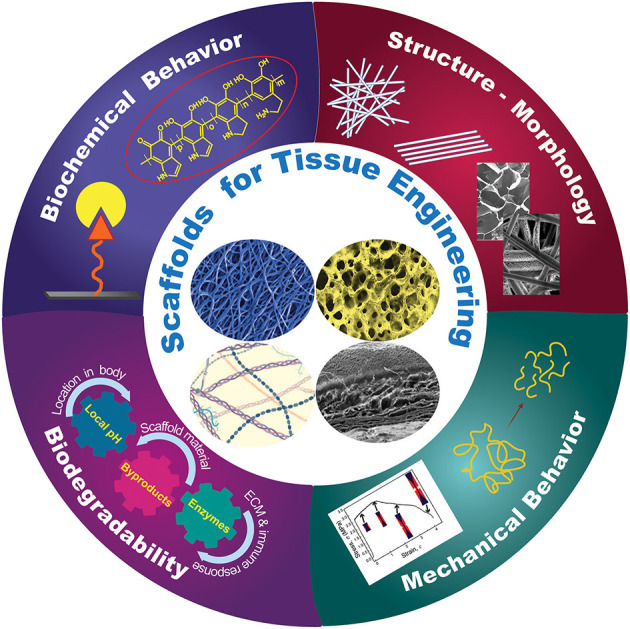
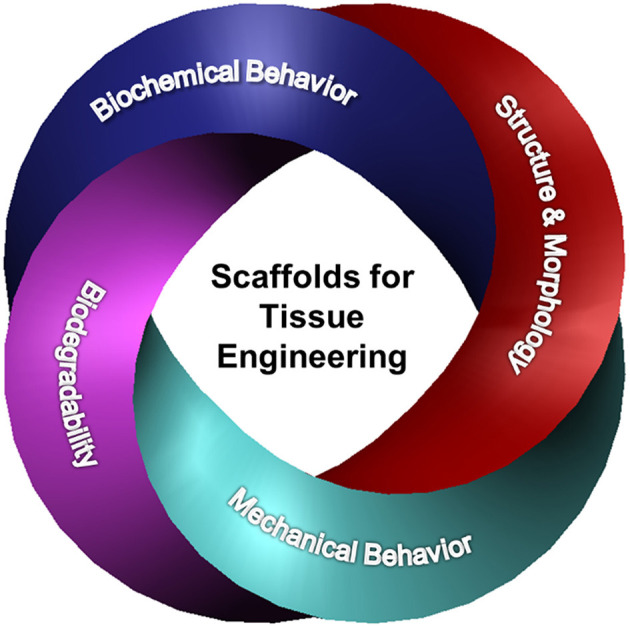
Numerous surgical procedures are daily performed worldwide to replace and repair damaged tissue. Tissue engineering is the field devoted to the regeneration of damaged tissue through the incorporation of cells in biocompatible and biodegradable porous constructs, known as scaffolds. The scaffolds act as host biomaterials of the incubating cells, guiding their attachment, growth, differentiation, proliferation, phenotype, and migration for the development of new tissue. Furthermore, cellular behavior and fate are bound to the biodegradation of the scaffold during tissue generation. This article provides a critical appraisal of how key biomaterial scaffold parameters, such as structure architecture, biochemistry, mechanical behavior, and biodegradability, impart the needed morphological, structural, and biochemical cues for eliciting cell behavior in various tissue engineering applications. Particular emphasis is given on specific scaffold attributes pertaining to skin and brain tissue generation, where further progress is needed (skin) or the research is at a relatively primitive stage (brain), and the enumeration of some of the most important challenges regarding scaffold constructs for tissue engineering.
Overview
The claims and statistics of this paper haven’t been checked yet.
Run the check — free, no account needed. It reads the open-access text and checks the sources it cites.
Integrity signals
Registry
Cites
Statistics
Figures
Verification
Claims the paper makes
The claims and statistics of this paper haven’t been checked yet.
Run the check — free, no account needed. It reads the open-access text and checks the sources it cites.
Claims other papers make about this one
Each is checked against this paper’s own text: does it say what the citing paper says it does?
The source backs part of the claim, not all of it — or backs it for a different population, condition or comparison.
In the citing paper
“This can be related to the fact that fabricated materials were mainly developed as biologically inert, so they would not have provoked any reaction from the recipient’s side [199].”
From Resorbable Biomaterials Used for 3D Scaffolds in Tissue Engineering: A Review (2023) · cites this paper as [199]
Experimental — accuracy not yet measuredThe source backs part of the claim, not all of it — or backs it for a different population, condition or comparison.
In the citing paper
“Although many scaffolds have been successfully applied in vivo or utilized in clinical medicine to restore damaged tissues, adverse effects such as extensive inflammatory response leading to transplant rejection were often observed.”
From Resorbable Biomaterials Used for 3D Scaffolds in Tissue Engineering: A Review (2023) · cites this paper as [199]
Experimental — accuracy not yet measuredThe source backs part of the claim, not all of it — or backs it for a different population, condition or comparison.
In the citing paper
“Furthermore, the synthetic material’s prolonged presence causes an inflammatory response mediated by phagocytes and foreign body giant cells.”
From Resorbable Biomaterials Used for 3D Scaffolds in Tissue Engineering: A Review (2023) · cites this paper as [199]
Experimental — accuracy not yet measuredThe cited source says what the claim attributes to it.
In the citing paper
“By-effects of this phenomenon include fibrous encapsulation of the implanted scaffold [199].”
From Resorbable Biomaterials Used for 3D Scaffolds in Tissue Engineering: A Review (2023) · cites this paper as [199]
The check wasn’t confident either way, so it gives no verdict — never disputed.
In the citing paper
“The implantation site, as well as the procedure of scaffold implantation itself, affect the recruitment and composition of adjacent cell populations.”
From Resorbable Biomaterials Used for 3D Scaffolds in Tissue Engineering: A Review (2023) · cites this paper as [199]
Experimental — accuracy not yet measured
Self-check
Percentages, sums and reported differences re-computed from the paper’s own numbers.
The self-check needs the paper’s full text.
Citations
Cites
Mussel-inspired surface chemistry for multifunctional coatings
Lee, H., Dellatore, S. M., Miller, W. M., & Messersmith, P. B. (2007) · Science · doi:10.1126/science.1147241 · Cited by 10,965
Origin and physiological roles of inflammation
Medzhitov, R. (2008) · Nature · doi:10.1038/nature07201 · Cited by 6,618
Factors affecting wound healing
Guo, S., & DiPietro, L. A. (2010) · Journal of Dental Research · doi:10.1177/0022034509359125 · Cited by 5,792
Astrocyte-endothelial interactions at the blood-brain barrier
Abbott, N. J., Rönnbäck, L., & Hansson, E. (2006) · Nature Reviews Neuroscience · doi:10.1038/nrn1824 · Cited by 5,595
Hydrogels for Tissue Engineering
Lee, K. Y., & Mooney, D. J. (2001) · Chemical Reviews · doi:10.1021/cr000108x · Cited by 5,295
Astrocytes: Biology and pathology
Sofroniew, M. V., & Vinters, H. V. (2010) · Acta Neuropathologica · doi:10.1007/s00401-009-0619-8 · Cited by 5,196
Structure and function of the blood–brain barrier
Abbott, N. J., Patabendige, A. A. K., Dolman, D. E. M., Yusof, S. R., & Begley, D. J. (2010) · Neurobiology of Disease · doi:10.1016/j.nbd.2009.07.030 · Cited by 5,185
Foreign body reaction to biomaterials
Anderson, J. M., Rodriguez, A., & Chang, D. T. (2008) · Seminars in Immunology · doi:10.1016/j.smim.2007.11.004 · Cited by 5,138
Hydrogels for tissue engineering: scaffold design variables and applications
Drury, J. L., & Mooney, D. J. (2003) · Biomaterials · doi:10.1016/s0142-9612(03)00340-5 · Cited by 5,136
Cu-Catalyzed Azide−Alkyne Cycloaddition
Meldal, M., & Tornøe, C. W. (2008) · Chemical Reviews · doi:10.1021/cr0783479 · Cited by 4,775
Research works printed but not linked: 2
- 2020, Tissue Engineering Market Size, Share & Trends Analysis Report by Application (Cord Blood & Cell Banking, Cancer, GI & Gynecology, Dental, Orthopedics, Musculoskeletal, & Spine), by Region, and Segment Forecasts, 2020-2027
- Janeway, 2001, Part V - The immune system in health and disease
Cited by
Sorted by citations
Optimizing scaffold pore size for tissue engineering: insights across various tissue types
Mukasheva, F., Adilova, L., Dyussenbinov, A., Yernaimanova, B., Аbilev, М., & Akilbekova, D. (2024) · Frontiers in Bioengineering and Biotechnology · doi:10.3389/fbioe.2024.1444986 · Cited by 492
Salthouse, D., Novakovic, K., Hilkens, C. M. U., & Ferreira, A. M. (2022) · Acta Biomaterialia · doi:10.1016/j.actbio.2022.11.003 · Cited by 196
Drug Delivery Systems in Regenerative Medicine: An Updated Review
Mansour, A., Romani, M., Acharya, A. B., Rahman, B., Verron, É., & Badran, Z. (2023) · Pharmaceutics · doi:10.3390/pharmaceutics15020695 · Cited by 135
Viscoelastic Biomaterials for Tissue Regeneration
Wu, D. T. S., Jeffreys, N. C., Diba, M., & Mooney, D. J. (2022) · Tissue Engineering Part C Methods · doi:10.1089/ten.tec.2022.0040 · Cited by 126
Polycaprolactone Composites/Blends and Their Applications Especially in Water Treatment
Kayan, G. Ö., & Kayan, A. (2023) · ChemEngineering · doi:10.3390/chemengineering7060104 · Cited by 120
Metadata
- Authors
- Echeverria Molina, M. I., Malollari, K. G., & Komvopoulos, K.
- Affiliations
- University of California, Berkeley (US)
- Corresponding author
- Komvopoulos, Kyriakos
- Venue
- Frontiers in Bioengineering and Biotechnology
- Publisher
- Frontiers Media SA
- Published
- 2021-06-14
- Volume
- 9
- Pages
- 617141-617141
- ISSN
- 2296-4185 (ISSN-L)
- PMC
- PMC8236583
- OpenAlex
- W3171498185
- Cited by
- 397
- References
- 318
- Citations by year
- 2026: 103 · 2025: 124 · 2024: 89 · 2023: 49 · 2022: 30 · 2021: 2
- FWCI
- 3.59
- Type
- journal article
- Language
- en
- Open access
- gold
- doi.org
- Licence
- Locations
- Frontiers in Bioengineering and Biotechnology (publishedVersion, cc-by)
- PubMed Central (publishedVersion, cc-by)
- PubMed (publishedVersion)
- DOAJ (DOAJ: Directory of Open Access Journals) (submittedVersion, cc-by-sa)
- eScholarship (California Digital Library) (submittedVersion)
- eScholarship (California Digital Library) (submittedVersion, cc-by)
- Topics
- Physical Sciences › Engineering › Biomedical Engineering › Bone Tissue Engineering Materials
- Health Sciences › Medicine › Surgery › Tissue Engineering and Regenerative Medicine
- Physical Sciences › Materials Science › Biomaterials › Hydrogels: synthesis, properties, applications
- Keywords
- polymer scaffolds, tissue engineering, biodegradable biomaterials, scaffold design, biodegradation, cell behavior, scaffold architecture, mechanical properties, skin regeneration, brain tissue regeneration
About these checks
Registry, retraction, Cites and statistics results are computed, not judged, with one exception: a printed reference that no index lists is read once by a model before it counts as a citation error. Claims are extracted by a model and kept only when their quote appears verbatim in the text; each cited source is then checked, with a model’s help, for whether it says what the claim relies on. Those verdicts can be wrong — read the claim’s quote and the cited source before relying on one.
Statistics and arithmetic are recomputed, not judged.
Confidence bands are shown only for fields calibrated on our annotated test set. None is calibrated yet, so no band is shown.
What counts as a claim ›How we measure confidence ›How we check this ›
Are you an author, or do you see a problem with this page? Request a review
