

Decentralized autonomous organization design for the commons and the common good
The DOI matches its Crossref record; 18 of the 18 references it cites were found in a registry or an index.
Abstract
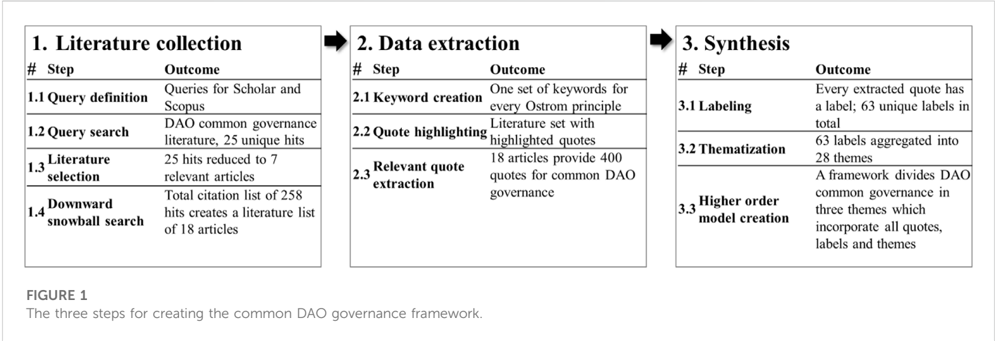
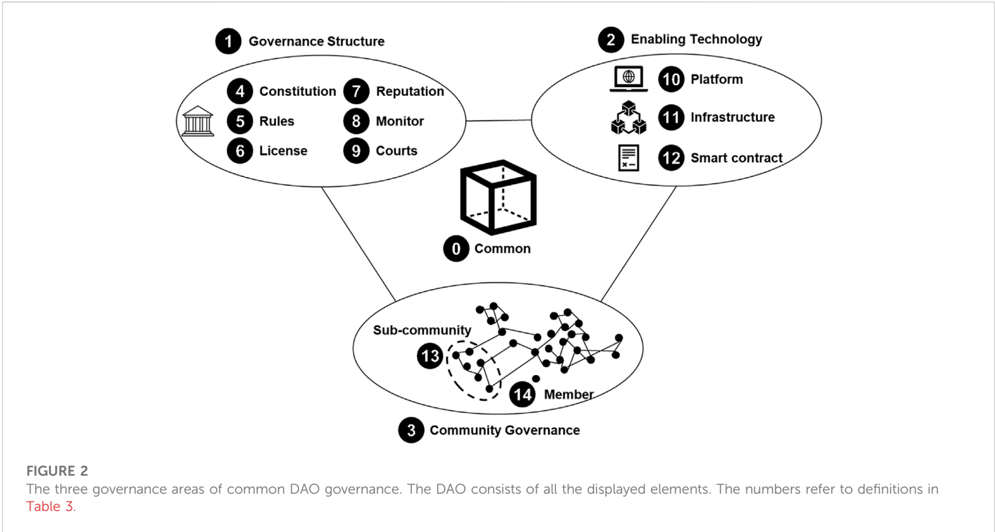
The current internet economy is characterised by a historically unprecedented bundling of private sector power over infrastructures. This situation is harmful for overcoming problems where collective action is needed, such as for governing digital commons. Organisations that run on collectively owned decentralised infrastructure are able to overcome this centralisation of power. These common decentralised autonomous organisations (DAOs) could help in fostering digitally enabled collective action. However, currently we have no clear view of how a DAO designed for commons governance would operate and be governed. By creating a conceptual prototype of a DAO governing a common, we provide a clear path of how common DAOs should mature and which tools are needed to create them. In this research, we created a governance framework for common DAOs by combining 16 works on technology for commons governance. The framework reveals that common DAO governance consists of three areas: 1) Governance structure, 2) Enabling technology, and 3) Community governance. We provide governance mechanisms that together describe an implementation of Ostrom’s common governance principles in a DAO. This work is a synthesis of previous research on technology for collective action. The proposed framework aids in standardising DAO governance for the common good and may contribute to a large scale roll-out of commons DAOs.
Overview
The claims and statistics of this paper haven’t been checked yet.
Free: it reads the open-access text and checks the first 5 claims that cite a source we can check. Create a free account to check every claim.
Integrity signals
Registry
Cites
Statistics
Figures

Verification
Claims the paper makes
The claims and statistics of this paper haven’t been checked yet.
Free: it reads the open-access text and checks the first 5 claims that cite a source we can check. Create a free account to check every claim.
Claims other papers make about this one
Each is checked against this paper’s own text: does it say what the citing paper says it does?
In the citing paper
“Most examples of digital commons governance through blockchain networks have occurred in the realm of fi nance (Vulpen and Jansen, 2023).”
From Decentralizing governance: exploring the dynamics and challenges of digital commons and DAOs (2025) · cites this paper as Vulpen and Jansen, 2023
Self-check
Percentages, sums and reported differences re-computed from the paper’s own numbers.
The self-check needs the paper’s full text.
Citations
Cites
Wohlin, C. (2014) · Proceedings of the 18th International Conference on Evaluation and Assessment in Software Engineering · doi:10.1145/2601248.2601268 · Cited by 4,234
A Review of Design Principles for Community-based Natural Resource Management
Cox, M., Arnold, G., & Villamayor Tomás, S. (2010) · Ecology and Society · doi:10.5751/es-03704-150438 · Cited by 1,328
Recommended Steps for Thematic Synthesis in Software Engineering
Cruzes, D. S., & Dyba, T. (2011) · 2011 International Symposium on Empirical Software Engineering and Measurement · doi:10.1109/esem.2011.36 · Cited by 960
Corrupting the Cyber-Commons: Social Media as a Tool of Autocratic Stability
Gunitsky, S. (2015) · Perspectives on Politics · doi:10.1017/s1537592714003120 · Cited by 465
Clohessy, T., & Acton, T. (2019) · Industrial Management & Data Systems · doi:10.1108/imds-08-2018-0365 · Cited by 436
Decentralized autonomous organization
Hassan, S., & De Filippi, P. (2021) · Internet Policy Review · doi:10.14763/2021.2.1556 · Cited by 383
The invisible politics of Bitcoin: governance crisis of a decentralised infrastructure
De Filippi, P., & Loveluck, B. (2016) · Internet Policy Review · doi:10.14763/2016.3.427 · Cited by 298
When Ostrom Meets Blockchain: Exploring the Potentials of Blockchain for Commons Governance
Rozas, D., Tenorio-Fornés, A., Díaz-Molina, S., & Hassan, S. (2021) · Sage Open · doi:10.1177/21582440211002526 · Cited by 206
Mourão, E., Pimentel, J. F., Murta, L., Kalinowski, M., Mendes, E., & Wohlin, C. (2020) · Information and Software Technology · doi:10.1016/j.infsof.2020.106294 · Cited by 191
When Ostrom Meets Blockchain: Exploring the Potentials of Blockchain for Commons Governance
Rozas, D., Tenorio-Fornés, A., Díaz-Molina, S., & Hassan, S. (2018) · SSRN Electronic Journal · doi:10.2139/ssrn.3272329 · Cited by 185
Research works printed but not linked: 49
- Allessie, D., Sobolewski, M., Vaccari, L., and Pignatelli, F. (2019). Blockchain for digital government. Luxembourg: Publications Office of the European Union, 8-10.
- Almeida, V., Filgueiras, F., and Gaetani, F. (2020). Digital governance and the tragedy of the commons. IEEE Internet Comput. 24 (4), 41-46. doi:10.1109/mic.2020.2979639 · DOI
- Baninemeh, E., Farshidi, S., and Jansen, S. (2021). A decision model for decentralized autonomous organization platform selection: three industry case studies. arXiv preprint arXiv:2107.14093. · arXiv
- Bellavitis, C., Fisch, C., and Momtaz, P. P. (2022). The rise of decentralized autonomous organizations (daos): a first empirical glimpse. Venture Cap. 25, 187-203. doi:10.1080/13691066.2022.2116797 · DOI · Paper page
- Bettega, M., Masu, R., Hansen, N. B., and Teli, M. (2022). Off-the-shelf digital tools as a resource to nurture the commons. Proc. Participatory Des. Conf. 1, 133-146. doi:10. 1145/3536169.3537787 · DOI
- Biesmeijer, J. C., Roberts, S. P., Reemer, M., Ohlemuller, R., Edwards, M., Peeters, T., et al. (2006). Parallel declines in pollinators and insect-pollinated plants in britain and The Netherlands. Science 313 (5785), 351-354. doi:10.1126/science.1127863 · DOI · Paper page
- Cila, N., Ferri, G., De Waal, M., Gloerich, I., and Karpinski, T. (2020). "The blockchain and the commons: dilemmas in the design of local platforms," in Proceedings of the 2020 CHI conference on human factors in computing systems. Honolulu HI, United States (ACM). · DOI · Paper page
- Costenaro, D., and Duer, A. (2012). "The megawatts behind your megabytes: going from data-center to desktop," in Proceedings of the 2012 ACEEE summer study on energy efficiency in buildings (Washington: ACEEE).
- Curien, N., Fauchart, E., Laffond, G., and Moreau, F. (2006). Online consumer communities: escaping the tragedy of the digital commons. Cambridge University Press.
- Davidson, S., De Filippi, P., and Potts, J. (2016). Economics of blockchain. Available at: https://ssrn.com/abstract=2744751.
- De Filippi, P. (2019). Blockchain technology and decentralized governance: the pitfalls of a trustless dream Decentralized Thriving: governance and Community on the Web. Available at: https://ssrn.com/abstract=3524352.
- DeSantis, L., and Ugarriza, D. N. (2000). The concept of theme as used in qualitative nursing research. West. J. Nurs. Res. 22 (3), 351-372. doi:10.1177/ 019394590002200308 · DOI · Paper page
- El Faqir El Rhazoui, Y. (2021). Decentralized autonomous organizations on blockchain: analysis and visualization. Madrid, Spain. E-prints Complutense.
- Feichtinger, R., Fritsch, R., Vonlanthen, Y., and Wattenhofer, R. (2023). The hidden shortcomings of (d) aos-an empirical study of on-chain governance. arXiv preprint arXiv:2302.12125. · arXiv
- Fritsch, F., Emmett, J., Friedman, E., Kranjc, R., Manski, S., Zargham, M., et al. (2021). Challenges and approaches to scaling the global commons. Front. Blockchain 4, 578721. doi:10.3389/fbloc.2021.578721 · DOI
- Fuster-Morell, M. (2014). Governance of online creation communities for the building of digital commons: viewed through the framework of the institutional analysis and development. Governing knowledge commons. Cambridge University Press.
- Grafton, R. Q. (2000). Governance of the commons: a role for the state? Land Econ. 76, 504-517. doi:10.2307/3146949 · DOI
- Grant, G., and Tan, F. B. (2013). Governing it in inter-organizational relationships: issues and future research. Eur. J. Inf. Syst. 22 (5), 493-497. doi:10.1057/ejis.2013. · doi:10.1057/ejis.2013
- Greco, G. M., and Floridi, L. (2004). The tragedy of the digital commons. Ethics Inf. Technol. 6 (2), 73-81. doi:10.1007/s10676-004-2895-2 · DOI
- Halaburda, H. (2018). Blockchain revolution without the blockchain? Commun. ACM 61 (7), 27-29. doi:10.1145/3225619 · DOI
- Hardin, G. (1968). The tragedy of the commons. Science 162, 1243-1248. doi:10.1126/ science.162.3859.1243 · DOI · Paper page
- Howell, B. E., and Potgieter, P. H. (2019). "Governance of blockchain and distributed ledger technology projects: a common-pool resource view," in Workshop on the Ostrom workshop (WOW6) conference (Indiana University Bloomington).
- Hunhevicz, J. J., Brasey, P.-A., Bonanomi, M. M., Hall, D. M., and Fischer, M. (2022). Applications of blockchain for the governance of integrated project delivery: a crypto commons approach. arXiv preprint arXiv:2207.07002. · arXiv
- Jain, G., Shrivastava, A., Paul, J., and Batra, R. (2022). Blockchain for sme clusters: an ideation using the framework of ostrom commons governance. Inf. Syst. Front. 24, 1125-1143. doi:10.1007/s10796-022-10288-z · DOI
- Kitchenham, B., and Charters, S. (2007). Guidelines for performing systematic literature reviews in software engineering. United Kingdom Keele University and Durham University Joint Report.
- Kondova, G., and Barba, R. (2019). Governance of decentralized autonomous organizations. J. Mod. Account. Auditing 15 (8), 406-411. doi:10.17265/1548-6583/ 2019.08.003 · DOI
- Levy, M., Loebbecke, C., and Powell, P. (2003). Smes, co-opetition and knowledge sharing: the role of information systems. Eur. J. Inf. Syst. 12 (1), 3-17. doi:10.1057/ palgrave.ejis.3000439 · DOI · Paper page
- Lustenberger, M., Malešević, S., and Spychiger, F. (2021). Ecosystem readiness: blockchain adoption is driven externally. Front. Blockchain 4, 720454. doi:10.3389/ fbloc.2021.720454 · DOI
- Malafosse, M., Pascal, A., and Amabile, S. (2022). Commoning with blockchain. The Ğ1 libre currency/Duniter case. Systèmes d'information Manag. 27 (2), 7-34. doi:10. 3917/sim.222.0007 · DOI
- Miller, E. (2020). A tale of two regulators: antitrust implications of progressive decentralization in blockchain platforms. Wash.
- Mueller-Bloch, C., Andersen, J. V., Spasovski, J., and Hahn, J. (2022). Understanding decentralization of decision-making power in proof-of-stake blockchains: an agent- based simulation approach. Eur. J. Inf. Syst. 2022, 1-20. doi:10.1080/0960085x.2022. 2125840 · DOI
- Murtazashvili, I., Murtazashvili, J. B., Weiss, M. B., and Madison, M. J. (2022). Blockchain networks as knowledge commons. Int. J. Commons 16 (1), 108-119. doi:10. 5334/ijc.1146 · DOI · Paper page
- Ostrom, E. (1990). Governing the commons: the evolution of institutions for collective action. United Kingdom Cambridge University Press. · DOI · Paper page
- Park, S., Specter, M., Narula, N., and Rivest, R. L. (2021). Going from bad to worse: from internet voting to blockchain voting. J. Cybersecurity 7 (1), tyaa025. doi:10.1093/ cybsec/tyaa025 · DOI · Paper page
- Pavlov, O. V., Melville, N. P., and Plice, R. K. (2005). Mitigating the tragedy of the digital commons: the problem of unsolicited commercial e-mail. Commun. Assoc. Inf. Syst. 16, 73-90. doi:10.17705/1cais.01604 · doi:10.17705/1cais.01604
- Petersen, D. (2022). Automating governance: blockchain delivered governance for business networks. Ind. Mark. Manag. 102, 177-189. doi:10.1016/j.indmarman.2022.01.017 · DOI
- Poblet, M., and Sierra, C. (2020). Understanding help as a commons. Int. J. Commons 14 (1), 481-493. doi:10.5334/ijc.1029 · DOI
- Poux, P. (2022). A unified framework for the governance of the commons with blockchain-based tools: an application to customary land commons in Ghana. Available at: https://ssrn.com/abstract=4077127.
- Poux, P., De Filippi, P., and Deffains, B. (2022). Maximal extractable value and the blockchain commons. Available at: https://ssrn.com/abstract=4198139.
- Poux, P., De Filippi, P., and Ramos, S. (2020). "Blockchains for the governance of common goods," in Proceedings of the 1st international workshop on distributed infrastructure for common good. Delft, Netherlands (ACM). · DOI
- Rikken, O., Janssen, M., and Kwee, Z. (2021). The ins and outs of decentralized autonomous organizations (daos). Available at: https://ssrn.com/abstract=3989559.
- Santana, C., and Albareda, L. (2022). Blockchain and the emergence of decentralized autonomous organizations (daos): an integrative model and research agenda. Technol. Forecast. Soc. Change 182, 121806. doi:10.1016/j. techfore.2022.121806 · DOI · Paper page
- Schot, J., Jansen, S., and Espana, S. (2022). Setting up a decentralized autonomous organization. J. Internet Serv. Appl. https://secureseco.org/wp-content/uploads/2022/ 09/OZP-Juri-Schot-Setting-up-a-Decentralized-Autonomous-Organization-3.pdf.
- Schrape, J.-F. (2019). The promise of technological decentralization. a brief reconstruction. Society 56 (1), 31-37. doi:10.1007/s12115-018-00321-w · DOI
- Sjøberg, D., and Bergersen, G. (2021). Construct validity in software engineering. IEEE Trans. Softw. Eng. 49, 1374-1396. doi:10.1109/TSE.2022.3176725 · DOI
- Thierer, A. (2016). Permissionless innovation: the continuing case for comprehensive technological freedom. Virginia, United States
- Valdivia, A. D., and Balcell, M. P. (2022). Connecting the grids: a review of blockchain governance in distributed energy transitions. Energy Res. Soc. Sci. 84, 102383. doi:10. 1016/j.erss.2021.102383 · DOI
- van Vulpen, P., Siu, J., and Jansen, S. (2022). Governance of decentralized autonomous organizations that produce open source software. Available at: https:// ssrn.com/abstract=4305208.
- Wright, A., and De Filippi, P. (2015). Decentralized blockchain technology and the rise of lex cryptographia. Available at: https://ssrn.com/abstract=2580664.
Cited by
Decentralizing governance: exploring the dynamics and challenges of digital commons and DAOs
Esposito, M., Tse, T., & Goh, D. (2025) · Frontiers in Blockchain · doi:10.3389/fbloc.2025.1538227 · Cited by 31
Metadata
- Authors
- Van Vulpen, P., & Jansen, S.
- Venue
- Frontiers in Blockchain
- Publisher
- Frontiers Media SA
- Published
- 2023-12-07
- Volume
- 6
- ISSN
- 2624-7852
- Cited by
- 15
- References
- 18
About these checks
Registry, retraction, Cites and statistics results are computed, not judged, with one exception: a printed reference that no index lists is read once by a model before it counts as a citation error. Claims are extracted by a model and kept only when their quote appears verbatim in the text; each cited source is then checked, with a model’s help, for whether it says what the claim relies on. Those verdicts can be wrong — read the claim’s quote and the cited source before relying on one.
Statistics and arithmetic are recomputed, not judged.
Confidence bands are shown only for fields calibrated on our annotated test set. None is calibrated yet, so no band is shown.
What counts as a claim ›How we measure confidence ›How we check this ›
Are you an author, or do you see a problem with this page? Request a review
How to cite
Cite CoChat for the checks on this page, and the paper for its own findings.
- This page
- CoChat. (2026). Citation check: Decentralized autonomous organization design for the commons and the common good. https://app.cochat.ai/papers/10.3389/fbloc.2023.1287249
- The paper
- Van Vulpen, P., & Jansen, S. (2023). Decentralized autonomous organization design for the commons and the common good. Frontiers in Blockchain. https://doi.org/10.3389/fbloc.2023.1287249
Data sources
Bibliographic data: Semantic Scholar, OpenAlex, Crossref.
Contains information from the Semantic Scholar Academic Graph Datasets, made available under the ODC Attribution License (ODC-BY 1.0).
Semantic Scholar’s data is described in: Kinney, R., et al. (2023). The Semantic Scholar Open Data Platform. arXiv:2301.10140.
