

The DOI matches its Crossref record; 58 of the 58 references it cites were found in a registry or an index.
A chatbot for mental health support: exploring the impact of Emohaa on reducing mental distress in China
Open accessAbstract
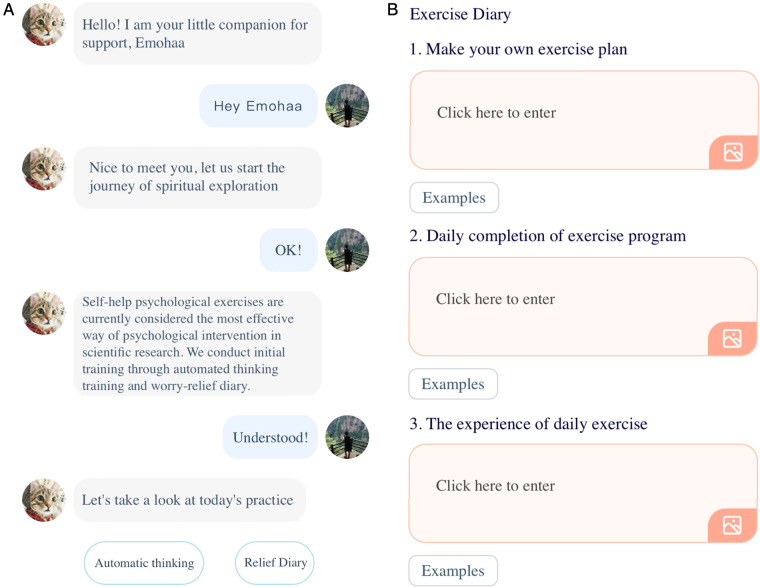
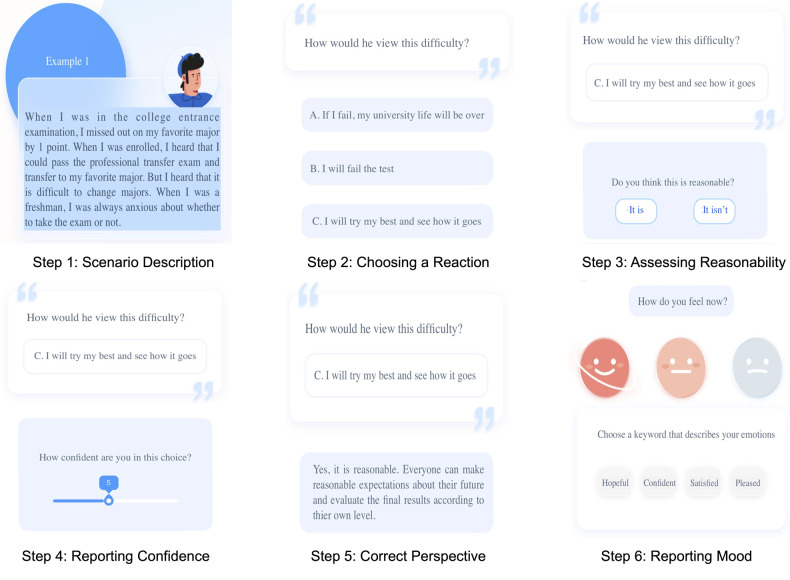
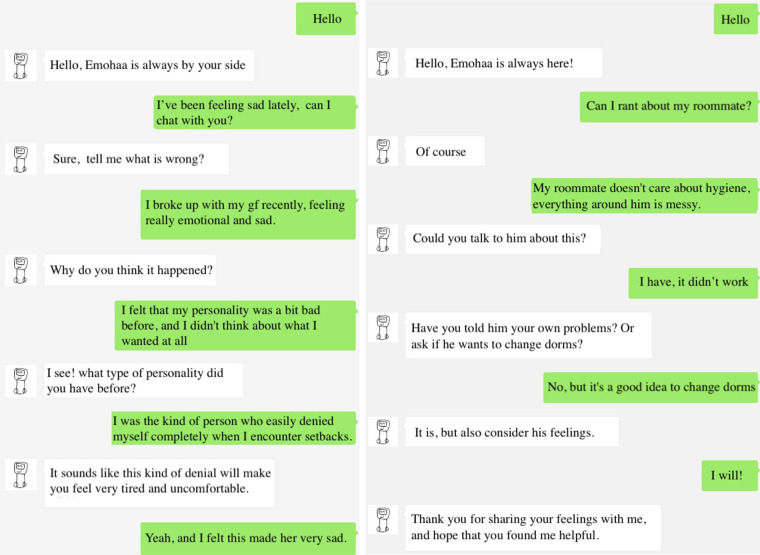
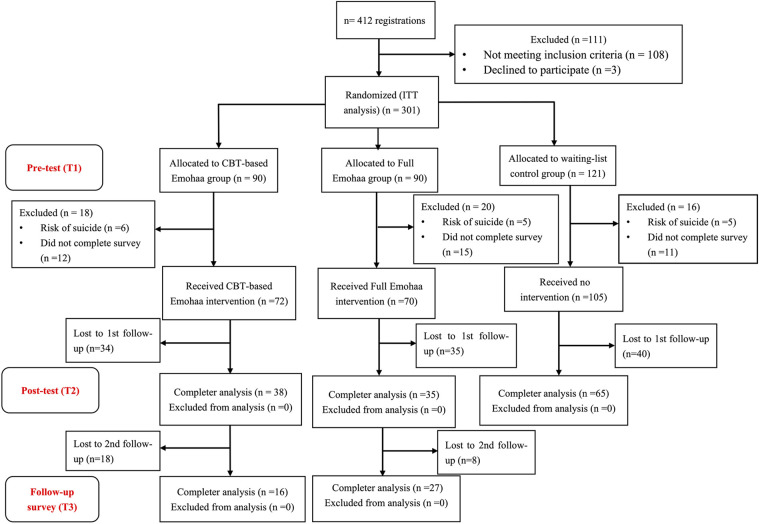
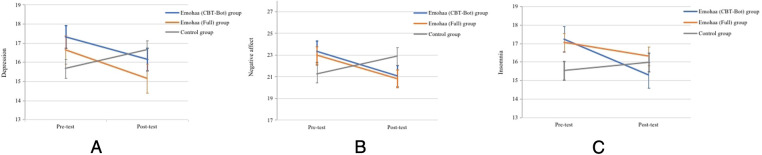
Introduction The growing demand for mental health support has highlighted the importance of conversational agents as human supporters worldwide and in China. These agents could increase availability and reduce the relative costs of mental health support. The provided support can be divided into two main types: cognitive and emotional. Existing work on this topic mainly focuses on constructing agents that adopt Cognitive Behavioral Therapy (CBT) principles. Such agents operate based on pre-defined templates and exercises to provide cognitive support. However, research on emotional support using such agents is limited. In addition, most of the constructed agents operate in English, highlighting the importance of conducting such studies in China. To this end, we introduce Emohaa, a conversational agent that provides cognitive support through CBT-Bot exercises and guided conversations. It also emotionally supports users through ES-Bot, enabling them to vent their emotional problems. In this study, we analyze the effectiveness of Emohaa in reducing symptoms of mental distress. Methods and Results Following the RCT design, the current study randomly assigned participants into three groups: Emohaa (CBT-Bot), Emohaa (Full), and control. With both Intention-To-Treat ( N = 247 ) and PerProtocol ( N = 134 ) analyses, the results demonstrated that compared to the control group, participants who used two types of Emohaa experienced considerably more significant improvements in symptoms of mental distress, including depression ( F [ 2 , 244 ] = 6.26 , p = 0.002 ), negative affect ( F [ 2 , 244 ] = 6.09 , p = 0.003 ), and insomnia ( F [ 2 , 244 ] = 3.69 , p = 0.026 ). Discussion Based on the obtained results and participants’ satisfaction with the platform, we concluded that Emohaa is a practical and effective tool for reducing mental distress.
Overview
The claims and statistics of this paper haven’t been checked yet.
Run the check — free, no account needed. It reads the open-access text and checks the sources it cites.
Integrity signals
Registry
Cites
Statistics
Figures
Verification
Claims the paper makes
The claims and statistics of this paper haven’t been checked yet.
Run the check — free, no account needed. It reads the open-access text and checks the sources it cites.
Claims other papers make about this one
Each is checked against this paper’s own text: does it say what the citing paper says it does?
The cited source says what the claim attributes to it.
In the citing paper
“For example, Jeong [99] reported 0.30 SD for depression, McFadyen et al [61] reported 0.26 SD for anxiety, Sabour [64] reported 0.33 SD for depression.”
From Generative AI Mental Health Chatbots as Therapeutic Tools: Systematic Review and Meta-Analysis of Their Role in Reducing Mental Health Issues (2025) · cites this paper as [64]
Self-check
Percentages, sums and reported differences re-computed from the paper’s own numbers.
The self-check needs the paper’s full text.
Citations
Cites
Statistical Power Analysis for the Behavioral Sciences
Muller, K. E., & Cohen, J. (1989) · Technometrics · doi:10.2307/1270020 · Cited by 99,603
Development and validation of brief measures of positive and negative affect: The PANAS scales.
Watson, D., Clark, L. A., & Tellegen, A. (1988) · Journal of Personality and Social Psychology · doi:10.1037/0022-3514.54.6.1063 · Cited by 32,433
A Brief Measure for Assessing Generalized Anxiety Disorder: The GAD-7
Spitzer, R. L., Kroenke, K., Williams, J. B. W., & Löwe, B. (2006) · Archives of Internal Medicine · doi:10.1001/archinte.166.10.1092 · Cited by 31,765
RoBERTa: A Robustly Optimized BERT Pretraining Approach
Liu, Y., Ott, M., Goyal, N., Du, J., Joshi, M., Chen, D., Levy, O., Lewis, M., Zettlemoyer, L., & Stoyanov, V. (2019) · arXiv · doi:10.48550/arxiv.1907.11692 · Cited by 16,515
Back-translation for cross-cultural research.
Brislin, R. W. (1970) · Journal of Cross-Cultural Psychology · doi:10.1177/135910457000100301 · Cited by 14,091
Statistical Analysis with Missing Data
Little, R. J. A., & Rubin, D. B. (2002) · Wiley Series in Probability and Statistics · doi:10.1002/9781119013563 · Cited by 8,473
The PHQ-9: A New Depression Diagnostic and Severity Measure
Kroenke, K., & Spitzer, R. L. (2002) · Psychiatric Annals · doi:10.3928/0048-5713-20020901-06 · Cited by 5,898 · cited 10×
“Compared to the control group, there was a significant decrease in depression and anxiety of the participants who used Emohaa, as measured by the PHQ-9 and the GAD-7 questionnaires, respectively.”
MethodInfluentialFitzpatrick, K. K., Darcy, A., & Vierhile, M. (2017) · JMIR Mental Health · doi:10.2196/mental.7785 · Cited by 2,730 · cited 4×
“PHQ-9 Participants’ depressionwasmeasuredwith the Patient Health Questionnaire (PHQ-9) (Kroenke and Spitzer, 2002), the most widely used measure in psychological depression trials (Fitzpatrick et al., 2017; von Glischinski et al., 2021).”
BackgroundMethodInfluentialPrevalence of mental disorders in China: a cross-sectional epidemiological study
Huang, Y., Wang, Y., Wang, H., Liu, Z., Yu, X., Yan, J., Yu, Y., Kou, C., Xu, X., Lu, J., et al. (2019) · The Lancet Psychiatry · doi:10.1016/s2215-0366(18)30511-x · Cited by 2,335
(1993) · Medical Entomology and Zoology · Cited by 2,324
Emotion Elicits the Social Sharing of Emotion: Theory and Empirical Review
Rimé, B. (2009) · Emotion Review · doi:10.1177/1754073908097189 · Cited by 1,546 · cited 1×
“As proposed by Rimé (2009), there are two main types of support to reduce mental distress: cognitive and emotional.”
BackgroundCognitive self-statements in depression: Development of an automatic thoughts questionnaire
Hollon, S. D., & Kendall, P. C. (1980) · Cognitive Therapy and Research · doi:10.1007/bf01178214 · Cited by 1,482
The World Mental Health Report: Transforming mental health for all
Freeman, M. (2022) · World Psychiatry · doi:10.1002/wps.21018 · Cited by 1,472
Progression of Mental Health Services during the COVID-19 Outbreak in China
Li, W., Yang, Y., Liu, Z.-H., Zhao, Y.-J., Zhang, Q., Zhang, L., Cheung, T., & Xiang, Y.-T. (2020) · International Journal of Biological Sciences · doi:10.7150/ijbs.45120 · Cited by 1,213
Inkster, B., Sarda, S., & Subramanian, V. (2018) · doi:10.2196/preprints.12106 · Cited by 1,063
Pelau, C., Dabija, D.-C., & Ene, I. (2021) · Computers in Human Behavior · doi:10.1016/j.chb.2021.106855 · Cited by 889
Understanding the Intention-to-treat Principle in Randomized Controlled Trials
McCoy, E. (2017) · Western Journal of Emergency Medicine · doi:10.5811/westjem.2017.8.35985 · Cited by 767
Ho, A., Hancock, J., & Miner, A. S. (2018) · Journal of Communication · doi:10.1093/joc/jqy026 · Cited by 629 · cited 2×
“Previous work has shown that individuals are willing to self-disclose their emotional problems with machines (Gratch et al., 2013; Ho et al., 2018; Liang et al., 2021), which is significant as users’ self-disclosure is essential for providing support.”
BackgroundResultLustman, P. J., Griffith, L. S., Freedland, K. E., Kissel, S. S., & Clouse, R. E. (1998) · Annals of Internal Medicine · doi:10.7326/0003-4819-129-8-199810150-00005 · Cited by 562
Emotional and physical health benefits of expressive writing
Baikie, K. A., & Wilhelm, K. (2005) · Advances in Psychiatric Treatment · doi:10.1192/apt.11.5.338 · Cited by 517
Social Sharing of Emotion: New Evidence and New Questions
Rimé, B., Finkenauer, C., Luminet, O., Zech, E., & Philippot, P. (1998) · European Review of Social Psychology · doi:10.1080/14792779843000072 · Cited by 506
Prevalence of Depression, Anxiety, and Stress during COVID-19 Pandemic
Lakhan, R., Agrawal, A., & Sharma, M. (2020) · Journal of Neurosciences in Rural Practice · doi:10.1055/s-0040-1716442 · Cited by 421
(2011) · Cited by 412
Helping Skills: Facilitating Exploration, Insight, and Action
Hill, C. E. (1999) · Cited by 409
Expressive Writing: Connections to Physical and Mental Health
Pennebaker, J. W., & Chung, C. K. (2012) · The Oxford Handbook of Health Psychology · doi:10.1093/oxfordhb/9780195342819.013.0018 · Cited by 337
Perceptions and opinions of patients about mental health chatbots: scoping review
Abd-Alrazaq, A. A., Alajlani, M., Ali, N., Denecke, K., Bewick, B. M., & Househ, M. (2021) · Journal of Medical Internet Research · doi:10.2196/17828 · Cited by 301
Liu, H., Peng, H., Song, X., Xu, C., & Zhang, M. (2022) · Internet Interventions · doi:10.1016/j.invent.2022.100495 · Cited by 296 · cited 2×
“Notably, the majority felt that this platform could understand their emotions, an essential feature of conversational agents for support and a crucial trait for establishing a therapeutic connection (Liu et al., 2022).”
BackgroundTowards Emotional Support Dialog Systems
Liu, S., Zheng, C., DeMasi, O., Sabour, S., Yu, L., Yu, Z., Jiang, Y., & Huang, M. (2021) · Annual Meeting of the Association for Computational Linguistics · doi:10.18653/v1/2021.acl-long.269 · Cited by 286
Self-citationMental health stigma and mental health knowledge in Chinese population: a cross-sectional study
Yin, H., Wardenaar, K. J., Xu, G., Tian, H., & Schoevers, R. A. (2020) · BMC Psychiatry · doi:10.1186/s12888-020-02705-x · Cited by 224
Hanna, M., & Strober, L. B. (2020) · Multiple Sclerosis and Related Disorders · doi:10.1016/j.msard.2020.102261 · Cited by 202
CEM: Commonsense-Aware Empathetic Response Generation
Sabour, S., Zheng, C., & Huang, M. (2022) · Proceedings of the AAAI Conference on Artificial Intelligence · doi:10.1609/aaai.v36i10.21373 · Cited by 167
Self-citationInsomnia and Mental Health in College Students
Taylor, D. J., Gardner, C. E., Bramoweth, A. D., Williams, J. M., Roane, B. M., Grieser, E., & Tatum, J. (2011) · Behavioral Sleep Medicine · doi:10.1080/15402002.2011.557992 · Cited by 162
Harrison, C. N., Schaap, N. P., Vannucchi, A. M., Kiladjian, J., Jourdan, É., Silver, R. T., Schouten, H. C., Passamonti, F., Zweegman, S., Talpaz, M., et al. (2020) · American Journal of Hematology · doi:10.1002/ajh.25777 · Cited by 154
Beyond Goldfish Memory: Long-Term Open-Domain Conversation
Xu, J., Szlam, A., & Weston, J. (2021) · arXiv · doi:10.48550/arxiv.2107.07567 · Cited by 148
Rethinking progress and challenges of mental health care in China
Xiang, Y., Ng, C. H., Yu, X., & Wang, G. (2018) · World Psychiatry · doi:10.1002/wps.20500 · Cited by 133
Alshurafa, M., Briel, M., Akl, E. A., Haines, T., Moayyedi, P., Gentles, S. J., Rios, L., Tran, C., Bhatnagar, N., Lamontagne, F., et al. (2012) · PLoS ONE · doi:10.1371/journal.pone.0049163 · Cited by 126
Development and challenges of mental health in China
Que, J., Lü, L., & Shi, L. (2019) · General Psychiatry · doi:10.1136/gpsych-2019-100053 · Cited by 115
Preliminary Evaluation of the Engagement and Effectiveness of a Mental Health Chatbot
Daley, K., Hungerbuehler, I., Cavanagh, K., Claro, H. G., Swinton, P. A., & Kapps, M. (2020) · Frontiers in Digital Health · doi:10.3389/fdgth.2020.576361 · Cited by 101 · cited 1×
“Recent work has mainly focused on delivering cognitive support through conversational agents adopting Cognitive Behavioral Therapy (CBT) principles and has demonstrated the efficacy of such interventions in reducing users’ mental distress, mainly depression and anxiety (Fitzpatrick et al., 2017; Daley et al., 2020; In…”
BackgroundMental Health in China: Stigma, Family Obligations, and the Potential of Peer Support
Yu, S., Kowitt, S. D., Fisher, E. B., & Li, G. (2017) · Community Mental Health Journal · doi:10.1007/s10597-017-0182-z · Cited by 91
The avatar will see you now: Support from a virtual human provides socio-emotional benefits
Pauw, L. S., Sauter, D. A., Kleef, G. A. V., Lucas, G., Gratch, J. S., & Fischer, A. H. (2022) · Computers in Human Behavior · doi:10.1016/j.chb.2022.107368 · Cited by 91
Personalized Dialogue Generation with Diversified TraitsPreprint
Zheng, Y., Chen, G., Huang, M., Liu, S., & Zhu, X. (2019) · arXiv (Cornell University) · doi:10.48550/arxiv.1901.09672 · Cited by 79
Self-citationPAL: Persona-Augmented Emotional Support Conversation Generation
Cheng, J., Sabour, S., Sun, H., Chen, Z., & Huang, M. (2022) · Annual Meeting of the Association for Computational Linguistics · doi:10.48550/arxiv.2212.09235 · Cited by 71
Self-citationDigital mental health in China: a systematic review
Zhang, X., Lewis, S. W., Firth, J., Xu, C., & Bucci, S. (2021) · Psychological Medicine · doi:10.1017/s0033291721003731 · Cited by 62
Yeung, A., Wang, F., Feng, F., Zhang, J., Cooper, A. R., Hong, L., Wang, W., Griffiths, K. M., Bennett, K., Bennett, A., et al. (2017) · Asian Journal of Psychiatry · doi:10.1016/j.ajp.2017.11.007 · Cited by 61
The AI Doctor Is In: A Survey of Task-Oriented Dialogue Systems for Healthcare Applications
Valizadeh, M., & Parde, N. (2022) · Proceedings of the conference - Association for Computational Linguistics. Meeting · doi:10.18653/v1/2022.acl-long.458 · Cited by 41
China’s mental health support in response to COVID-19: progression, challenges and reflection
Ju, Y., Zhang, Y., Wang, X., Li, W., Ng, R., & Li, L. (2020) · Globalization and Health · doi:10.1186/s12992-020-00634-8 · Cited by 39
Self-citationvon Glischinski, M., von Brachel, R., Thiele, C., & Hirschfeld, G. H. F. (2021) · Journal of Affective Disorders · doi:10.1016/j.jad.2021.05.041 · Cited by 29
Fang, M., Hu, S. X., & Hall, B. J. (2020) · Asian Journal of Psychiatry · doi:10.1016/j.ajp.2020.102265 · Cited by 21
Lin, L.-Y., Wang, K., Kishimoto, T., Rodriguez, M. A., Qian, M., Yang, Y., Zhao, Q., Berger, T., & Tian, C.-H. (2020) · Journal of Cross-Cultural Psychology · doi:10.1177/0022022120920720 · Cited by 18
Xu, C., Zhang, X., Zhu, X., & Wang, G. (2021) · Frontiers in Psychiatry · doi:10.3389/fpsyt.2020.585920 · Cited by 12
Emily: Developing An Emotion-affective Open-Domain Chatbot with Knowledge Graph-based PersonaPreprint
Wang, W., Cai, X., Huang, C. H., Wang, H., Lu, H., Liu, X., & Peng, W. (2021) · arXiv (Cornell University) · doi:10.48550/arxiv.2109.08875 · Cited by 5
PoKE: Prior Knowledge Enhanced Emotional Support Conversation with Latent VariablePreprint
Xu, X., Meng, X., & Wang, Y. (2022) · arXiv (Cornell University) · doi:10.48550/arxiv.2210.12640 · Cited by 4
Skills for facilitating insight.
Hill, C. E. (n.d.) · Helping skills: Facilitating exploration, insight, and action (4th ed.). · doi:10.1037/14345-013
On the State of Social Media Data for Mental Health Research
Harrigian, K., Aguirre, C., & Dredze, M. (2020) · arXiv · doi:10.48550/arxiv.2011.05233
Peng, W., Hu, Y., Xing, L., Xie, Y., Sun, Y., & Li, Y. (2022) · arXiv · doi:10.48550/arxiv.2204.12749
AugESC: Dialogue Augmentation with Large Language Models for Emotional Support Conversation
Zheng, C., Sabour, S., Wen, J., Zhang, Z., & Huang, M. (2022) · arXiv · doi:10.48550/arxiv.2202.13047
Self-citationImproving Multi-turn Emotional Support Dialogue Generation with Lookahead Strategy Planning
Cheng, Y., Liu, W., Li, W., Wang, J., Zhao, R., Liu, B., Liang, X., & Zheng, Y. (2022) · arXiv · doi:10.48550/arxiv.2210.04242
Self-citationEVA2.0: Investigating Open-Domain Chinese Dialogue Systems with Large-Scale Pre-Training
Gu, Y., Wen, J., Sun, H., Song, Y., Ke, P., Zheng, C., Zhang, Z., Yao, J., Liu, L., Zhu, X., et al. (2022) · arXiv · doi:10.48550/arxiv.2203.09313
Self-citation
Cited by
Sorted by citations
Li, H., Zhang, R., Lee, Y.-C., Kraut, R. E., & Mohr, D. C. (2023) · npj Digital Medicine · doi:10.1038/s41746-023-00979-5 · Cited by 598
“In contrast, generative CAs, such as ChatGPT and Replika, leverage machine learning algorithms to learn and auto-generate responses based on a large amount of training data 71 .”
BackgroundMethodInfluentialEnhancing mental health with Artificial Intelligence: Current trends and future prospects
Olawade, D. B., Wada, O. Z., Odetayo, A., David-Olawade, A. C., Asaolu, F. T., & Eberhardt, J. (2024) · Journal of Medicine Surgery and Public Health · doi:10.1016/j.glmedi.2024.100099 · Cited by 667
Roles, Users, Benefits, and Limitations of Chatbots in Health Care: Rapid Review (Preprint)
Laymouna, M., Ma, Y., Lessard, D., Schuster, T., Engler, K., & Lebouché, B. (2024) · doi:10.2196/preprints.56930 · Cited by 302
Roles, Users, Benefits, and Limitations of Chatbots in Health Care: Rapid Review
Laymouna, M., Ma, Y., Lessard, D., Schuster, T., Engler, K., & Lebouché, B. (2024) · Journal of Medical Internet Research · doi:10.2196/56930 · Cited by 305
Chakraborty, C., Bhattacharya, M., Pal, S., & Lee, S. (2023) · Current Research in Biotechnology · doi:10.1016/j.crbiot.2023.100164 · Cited by 311
Metadata
- Authors
- Sabour, S., Zhang, W., Xiao, X., Zhang, Y., Zheng, Y., Wen, J., Zhao, J., & Huang, M.
- Affiliations
- State Key Laboratory of Intelligent Technology and Systems (CN)
- Beijing Normal University (CN)
- Tsinghua University (CN)
- Corresponding author
- Sabour, Sahand
- Huang, Minlie
- Venue
- Frontiers in Digital Health
- Publisher
- Frontiers Media SA
- Published
- 2023-05-04
- Volume
- 5
- Pages
- 1133987-1133987
- ISSN
- 2673-253X (ISSN-L)
- PMC
- PMC10193040
- OpenAlex
- W4377565325
- Cited by
- 102
- References
- 44
- Citations by year
- 2026: 31 · 2025: 36 · 2024: 25 · 2023: 10
- FWCI
- 26.33
- Type
- journal article
- Language
- en
- Open access
- gold
- doi.org
- Licence
- Locations
- Frontiers in Digital Health (publishedVersion, cc-by)
- PubMed Central (publishedVersion, cc-by)
- PubMed (publishedVersion)
- DOAJ (DOAJ: Directory of Open Access Journals) (submittedVersion, cc-by-sa)
- Topics
- Social Sciences › Psychology › Applied Psychology › Digital Mental Health Interventions
- Social Sciences › Psychology › Social Psychology › Social Robot Interaction and HRI
- Physical Sciences › Computer Science › Artificial Intelligence › Emotion and Mood Recognition
- Keywords
- chatbots, mental health support, cognitive behavioral therapy, depression, negative affect, insomnia, emotional support, psychological distress, China
About these checks
Registry, retraction, Cites and statistics results are computed, not judged, with one exception: a printed reference that no index lists is read once by a model before it counts as a citation error. Claims are extracted by a model and kept only when their quote appears verbatim in the text; each cited source is then checked, with a model’s help, for whether it says what the claim relies on. Those verdicts can be wrong — read the claim’s quote and the cited source before relying on one.
Statistics and arithmetic are recomputed, not judged.
Confidence bands are shown only for fields calibrated on our annotated test set. None is calibrated yet, so no band is shown.
What counts as a claim ›How we measure confidence ›How we check this ›
Are you an author, or do you see a problem with this page? Request a review
