

The DOI matches its Crossref record; 6 of the 6 references it cites were found in a registry or an index.
Lockdown Learning: Changes in Online Foreign-Language Study Activity and Performance of Dutch Secondary School Students During the COVID-19 Pandemic
Published version of a preprint
Abstract
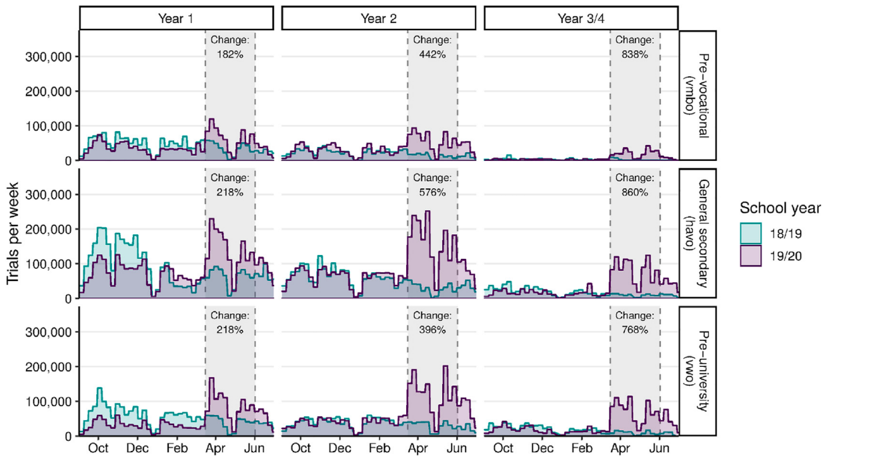
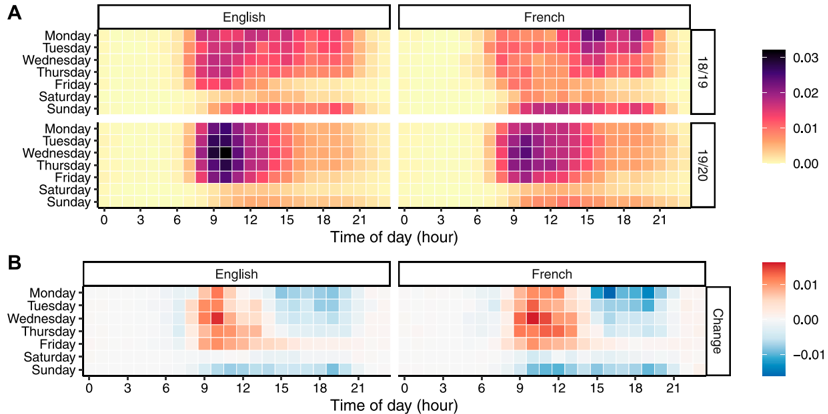
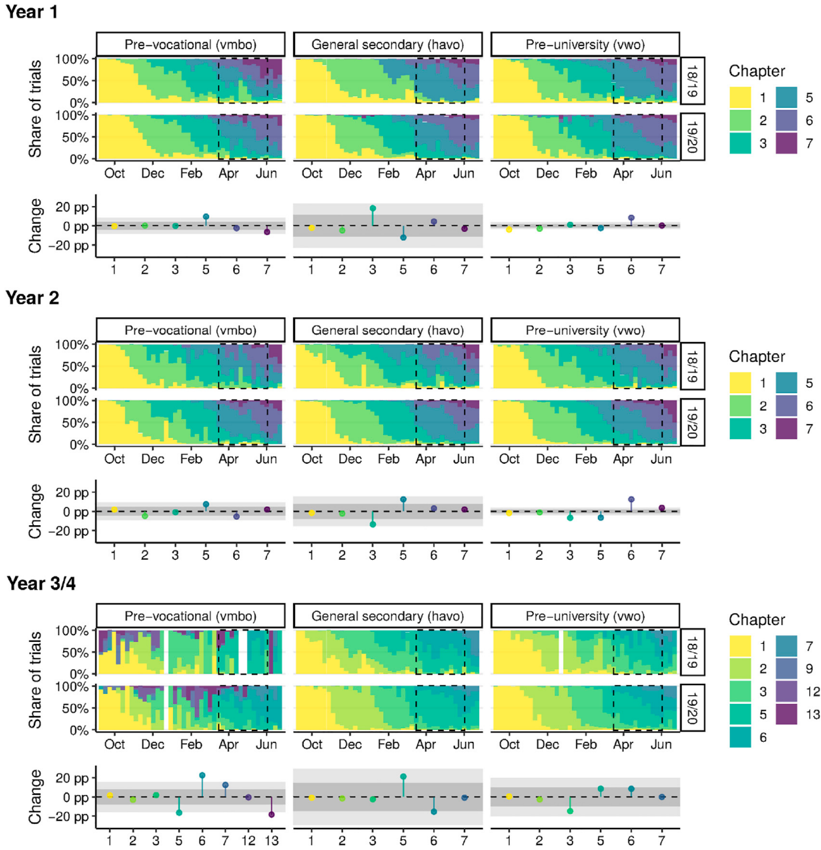
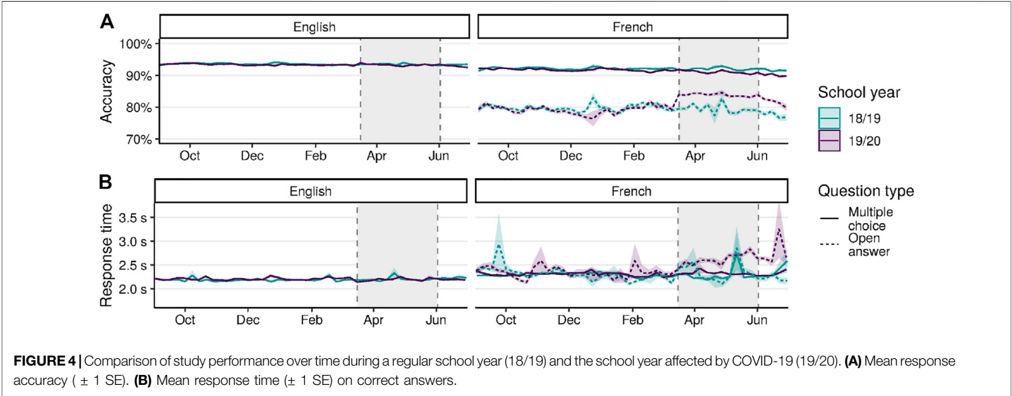
The COVID-19 pandemic caused lockdowns and sudden school closures around the world in spring 2020, significantly impacting the education of students. Here, we investigate how the switch to distance learning affected study activity and performance in an online retrieval practice tool used for language learning in Dutch secondary education. We report insights from a rich data set consisting of over 115 million retrieval practice trials completed by more than 133 thousand students over the course of two consecutive school years. Our findings show that usage of the tool increased substantially at the start of lockdown, with the bulk of study activity occurring on weekday mornings. In general, students’ progress through the material was largely unaffected by lockdown, although students from the highest educational track were somewhat more likely to be on or ahead of schedule than students from lower tracks, compared to the previous year. Performance on individual study trials was generally stable, but accuracy and response time on open answer questions went up, perhaps as a result of students being more focused at home. These encouraging findings contribute to a growing literature on the educational ramifications of distance learning during lockdown.
Overview
The claims and statistics of this paper haven’t been checked yet.
Run the check — free, no account needed. It reads the open-access text and checks the sources it cites.
Integrity signals
Registry
Cites
Statistics
Figures
Verification
Claims the paper makes
The claims and statistics of this paper haven’t been checked yet.
Run the check — free, no account needed. It reads the open-access text and checks the sources it cites.
Claims other papers make about this one
Each is checked against this paper’s own text: does it say what the citing paper says it does?
In the citing paper
“Positive effects of the COVID-19-related school closures on student achievement were almost exclusively reported by studies using data from learning apps or online learning environments (Meeter, 2021;Spitzer & Musslick, 2021;van der Velde et al., 2021).”
From The Impact of COVID‐19‐Related School Closures on Student Achievement—A Meta‐Analysis (2022) · cites this paper as van der Velde et al., 2021
Self-check
Percentages, sums and reported differences re-computed from the paper’s own numbers.
The self-check needs the paper’s full text.
Citations
Cites
The critical role of retrieval practice in long-term retention
Roediger, H. L., & Butler, A. C. (2011) · Trends in Cognitive Sciences · doi:10.1016/j.tics.2010.09.003 · Cited by 1,796 · cited 2×
“Retrieval practice is a well-established and effective study method in which learners are prompted to actively recall the learning material (Roediger and Butler, 2011; Rowland, 2014).”
MethodLearning loss due to school closures during the COVID-19 pandemic
Engzell, P., Frey, A., & Verhagen, M. D. (2020) · doi:10.31235/osf.io/ve4z7 · Cited by 1,739
The effect of testing versus restudy on retention: A meta-analytic review of the testing effect.
Rowland, C. A. (2014) · Psychological Bulletin · doi:10.1037/a0037559 · Cited by 1,066 · cited 1×
“Retrieval practice is a well-established and effective study method in which learners are prompted to actively recall the learning material (Roediger and Butler, 2011; Rowland, 2014).”
MethodThe effect of school closures on standardised student test outcomes
Maldonado, J. E., & De Witte, K. (2022) · British Educational Research Journal · doi:10.1002/berj.3754 · Cited by 499
Meeter, M. (2021) · doi:10.31234/osf.io/8un6x · Cited by 16 · cited 3×
“Offering online adaptive practice software as part of the curriculum could even benefit students, as a study of Dutch primary schools showed that including such software in mathematics education led to students performing better, not worse, than they would otherwise have (Meeter, 2021).”
Self-citation
Research works printed but not linked: 37
- Alvi, 2020, Learning in Times of Lockdown: How Covid-19 Is Affecting Education and Food Security in India, Food Secur, 12, 1, 10.1007/s12571-020-01065-4 · DOI
- Anger, 2020, School Closings during the COVID-19 Pandemic: Findings from German High School Students
- Assunção Flores, 2020, Teacher Education in Times of COVID-19 Pandemic in Portugal: National, Institutional and Pedagogical Responses, J. Educ. Teach., 46, 507, 10.1080/02607476.2020.1799709 · DOI · Paper page
- Bates, 2015, Fitting Linear Mixed-Effects Models Using Lme4, J. Stat. Softw., 67, 10.18637/jss.v067.i01 · DOI · Paper page
- Bignardi, 2020, Longitudinal Increases in Childhood Depression Symptoms during the COVID-19 Lockdown, Arch. Dis. Child., 106, 791, 10.1136/archdischild-2020-320372 · DOI
- Crawford, 2020, COVID-19: 20 Countries’ Higher Education Intra-period Digital Pedagogy Responses, J. Appl. Learn. Teach., 3, 10.37074/jalt.2020.3.1.7 · DOI
- de Haas, 2020, How COVID-19 and the Dutch 'intelligent Lockdown' Change Activities, Work and Travel Behaviour: Evidence from Longitudinal Data in the Netherlands, Transp Res. Interdiscip. Perspect., 6, 100150, 10.1016/j.trip.2020.100150 · DOI · Paper page
- Dietrich, 2020, Social Inequality in the Homeschooling Efforts of German High School Students during a School Closing Period, Eur. Societies, 23, S348, 10.1080/14616696.2020.1826556 · DOI
- Doyle, 2020, COVID-19: Exacerbating Educational Inequalities? Report
- Ferri, 2020, Online Learning and Emergency Remote Teaching: Opportunities and Challenges in Emergency Situations, Societies, 10, 86, 10.3390/soc10040086 · DOI
- Gonzalez, 2020, Influence of COVID-19 Confinement in Students' Performance in Higher Education, EdArXiv, 10.35542/osf.io/9zuac · DOI
- Grätz, 2021, Large Loss in Studying Time during the Closure of Schools in Switzerland in 2020, Res. Soc. Stratif Mobil, 71, 100554, 10.1016/j.rssm.2020.100554 · DOI
- Hall, 2020, Education in Precarious Times: A Comparative Study across Six Countries to Identify Design Priorities for mobile Learning in a Pandemic, Info. Learn. Sci., 121, 433, 10.1108/ILS-04-2020-0089 · DOI
- Jacques, 2020, Remote Knowledge Acquisition and Assessment during the COVID-19 Pandemic, Int. J. Eng. Ped., 10, 120, 10.3991/ijep.v10i6.16205 · DOI
- Klapproth, 2020, Teachers Experiences of Stress and Their Coping Strategies during COVID - 19 Induced Distance Teaching, J. Pedadalogical. Res., 4, 444, 10.33902/JPR.2020062805 · DOI
- Kuhfeld, 2020, Initial Findings on Students’ Reading and Math Achievement and Growth
- Kuznetsova, 2017, lmerTest Package: Tests in Linear Mixed Effects Models, J. Stat. Soft., 82, 10.18637/jss.v082.i13 · DOI · Paper page
- Lek, 2020, Het Effect Van Afstandsonderwijs Op Leerresultaten in Het PO. Report
- Loima, 2020, Socio-Educational Policies and Covid-19 - A Case Study on Finland and Sweden in the Spring 2020, I. J. Edu. Lit. Studies., 8, 59, 10.7575/aiac.ijels.v.8n.3p.59 · DOI
- Lorente, 2020, The Right to Education and ICT during COVID-19: An International Perspective, Sustainability, 12, 9091, 10.3390/su12219091 · DOI
- Meeter, 2020, College Students' Motivation and Study Results after COVID-19 Stay-At-home Orders, PsyArXiv, 10.31234/osf.io/kn6v9 · DOI
- Mohan, 2020, Learning for All? Second-Level Education in Ireland during COVID-19, 10.26504/sustat92.pdf · DOI
- Paris, 1990, Development Aspects of Self-Regulated Learning, Educ. Psychol., 25, 87, 10.1207/s15326985ep2501_7 · DOI · Paper page
- Pearcey, 2020, Changes in Children and Young People’s Mental Health Symptoms from March to October 2020
- 2020, R: A Language and Environment for Statistical Computing
- Sense, 2016, An Individual's Rate of Forgetting Is Stable over Time but Differs across Materials, Top. Cogn. Sci., 8, 305, 10.1111/tops.12183 · DOI
- Sevilla, 2020, Learning during the Lockdown: Real-Time Data on Children's Experiences during home Learning Briefing Note BN288, 10.1920/BN.IFS.2020.BN0288 · DOI
- Toquero, 2020, Challenges and Opportunities for Higher Education amid the COVID-19 Pandemic: The Philippine Context, Pedagogical Res., 5, em0063, 10.29333/pr/7947 · DOI
- 2020, Averting a Lost COVID Generation: A Six-Point Plan to Respond, Recover and Reimagine a Post-Pandemic World for Every Child
- van de Werfhorst, 2020, The Digital Divide in Online Education. Inequality in Digital Preparedness of Students and Schools before the Start of the COVID-19 Pandemic, SocArXiv, 10.31235/osf.io/58d6p · DOI
- van der Spoel, 2020, Teachers' Online Teaching Expectations and Experiences during the Covid19-Pandemic in the Netherlands, Eur. J. Teach. Educ., 43, 623, 10.1080/02619768.2020.18211855 · DOI
- van der Velde, 2021, Alleviating the Cold Start Problem in Adaptive Learning Using Data-Driven Difficulty Estimates, Comput. Brain Behav., 4, 231, 10.1007/s42113-021-00101-6 · DOI
- Voogel, 2020, Lockdownleservaringen bij Frans, Duits en Engels:‘Wat leuk dat Ik je zie!’, Levende Talen Mag., 107, 4
- Watermeyer, 2021, COVID-19 and Digital Disruption in UK Universities: Afflictions and Affordances of Emergency Online Migration, High Educ., 81, 623, 10.1007/s10734-020-00561-y · DOI
- 2020, The COVID-19 Pandemic: Shocks to Education and Policy ResponsesPolicy Note
- Wright, 2020, Impact of COVID-19 on Young Adolescent Mental Health: Comparison of Depression, Anxiety and Behaviour Problems in 12 Year Olds Immediately before and during the Pandemic in a UK Birth Cohort
- Wu, 2021, How Teachers Conduct Online Teaching during the COVID-19 Pandemic: A Case Study of Taiwan, Front. Educ., 6, 675434, 10.3389/feduc.2021.675434 · DOI
Cited by
Sorted by citations
Effects of COVID-19-Related School Closures on Student Achievement-A Systematic Review
Hammerstein, S., König, C., Dreisörner, T., & Frey, A. (2021) · Frontiers in Psychology · doi:10.3389/fpsyg.2021.746289 · Cited by 588
The Impact of COVID‐19‐Related School Closures on Student Achievement—A Meta‐Analysis
König, C., & Frey, A. (2022) · Educational Measurement: Issues and Practice · doi:10.1111/emip.12495 · Cited by 147
A meta-analysis of the impact of COVID-19 on student achievement
Storey, N., & Zhang, Q. (2024) · Educational Research Review · doi:10.1016/j.edurev.2024.100624 · Cited by 18
Metadata
- Authors
- van der Velde, M., Sense, F., Spijkers, R., Meeter, M., & van Rijn, H.
- Venue
- Frontiers in Education
- Publisher
- Frontiers Media SA
- Published
- 2021-08-03
- Volume
- 6
- ISSN
- 2504-284X
- Cited by
- 25
- References
- 6
About these checks
Registry, retraction, Cites and statistics results are computed, not judged, with one exception: a printed reference that no index lists is read once by a model before it counts as a citation error. Claims are extracted by a model and kept only when their quote appears verbatim in the text; each cited source is then checked, with a model’s help, for whether it says what the claim relies on. Those verdicts can be wrong — read the claim’s quote and the cited source before relying on one.
Statistics and arithmetic are recomputed, not judged.
Confidence bands are shown only for fields calibrated on our annotated test set. None is calibrated yet, so no band is shown.
What counts as a claim ›How we measure confidence ›How we check this ›
Are you an author, or do you see a problem with this page? Request a review
