

The DOI matches its Crossref record; 218 of the 220 references it cites were found in a registry or an index.
The pathophysiology of osteoporosis in obesity and type 2 diabetes in aging women and men: The mechanisms and roles of increased bone marrow adiposity
Open accessAbstract
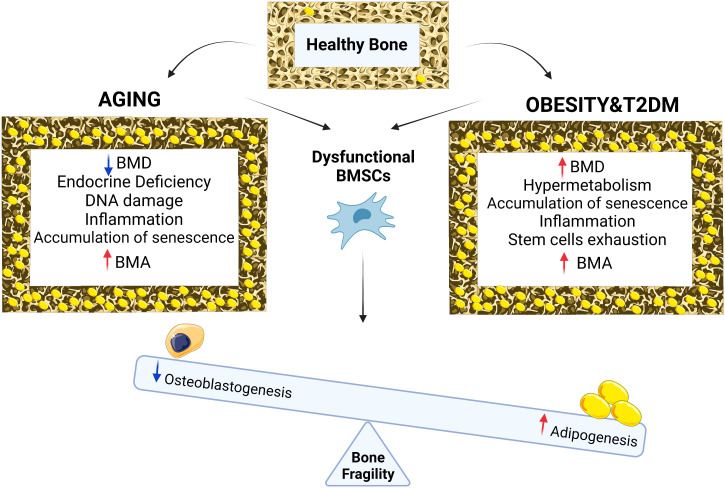
Osteoporosis is defined as a systemic skeletal disease characterized by decreased bone mass and micro-architectural deterioration leading to increased fracture risk. Osteoporosis incidence increases with age in both post-menopausal women and aging men. Among other important contributing factors to bone fragility observed in osteoporosis, that also affect the elderly population, are metabolic disturbances observed in obesity and Type 2 Diabetes (T2D). These metabolic complications are associated with impaired bone homeostasis and a higher fracture risk. Expansion of the Bone Marrow Adipose Tissue (BMAT), at the expense of decreased bone formation, is thought to be one of the key pathogenic mechanisms underlying osteoporosis and bone fragility in obesity and T2D. Our review provides a summary of mechanisms behind increased Bone Marrow Adiposity (BMA) during aging and highlights the pre-clinical and clinical studies connecting obesity and T2D, to BMA and bone fragility in aging osteoporotic women and men.
Overview
The claims and statistics of this paper haven’t been checked yet.
Run the check — free, no account needed. It reads the open-access text and checks the sources it cites.
Integrity signals
Registry
Cites
Statistics
Figures
Verification
Claims the paper makes
The claims and statistics of this paper haven’t been checked yet.
Run the check — free, no account needed. It reads the open-access text and checks the sources it cites.
Claims other papers make about this one
Each is checked against this paper’s own text: does it say what the citing paper says it does?
The cited source says what the claim attributes to it.
In the citing paper
“As aging-related osteoporosis typically features low bone mass, microarchitectural alterations and bone marrow adipose tissue expansion40–42, our findings suggest that AD mice at a younger age recapitulate an aged skeletal phenotype.”
From Serum amyloid P secreted by bone marrow adipocytes drives skeletal amyloidosis (2025) · cites this paper as [40]
Self-check
Percentages, sums and reported differences re-computed from the paper’s own numbers.
The self-check needs the paper’s full text.
Citations
Cites
López-Otín, C., Blasco, M. A., Partridge, L., Serrano, M., & Kroemer, G. (2013) · Cell · doi:10.1016/j.cell.2013.05.039 · Cited by 14,982 · cited 1×
“Aging is defined as a gradual loss of normal tissue homeostasis and progressive deterioration of the organ functions, due to accumulation of cellular/DNA damage and senescence throughout aging (11).”
BackgroundThe senescence-associated secretory phenotype: the dark side of tumor suppression
Coppé, J.-P., Desprez, P.-Y., Krtolica, A., & Campisi, J. (2010) · Annual Review of Pathology: Mechanisms of Disease · doi:10.1146/annurev-pathol-121808-102144 · Cited by 5,206
An estimate of the worldwide prevalence and disability associated with osteoporotic fractures
Johnell, O., & Kanis, J. (2006) · Osteoporosis International · doi:10.1007/s00198-006-0172-4 · Cited by 4,770 · cited 1×
“It is the most common bone disease worldwide, affecting more than 200 million people and causing more than 9 million fractures in the year 2000 (2).”
BackgroundJohnston, C., & Slemenda, C. (1992) · Southern medical journal (Birmingham, Ala. Print) · doi:10.1097/00007611-199208001-00002 · Cited by 3,785
Adipose tissue, adipokines, and inflammation
Fantuzzi, G. (2005) · Journal of Allergy and Clinical Immunology · doi:10.1016/j.jaci.2005.02.023 · Cited by 2,606
Kanis, J. А., & Kanis, J. А. (1994) · Osteoporosis International · doi:10.1007/bf01622200 · Cited by 2,532
Cellular senescence in aging and age-related disease: from mechanisms to therapy
Childs, B. G., Durik, M., Baker, D. J., & van Deursen, J. M. (2015) · Nature Medicine · doi:10.1038/nm.4000 · Cited by 2,363
Lips, P. (2001) · Endocrine reviews · doi:10.1210/edrv.22.4.0437 · Cited by 2,203
Obesity-induced inflammatory changes in adipose tissue
Wellen, K. E., & Hotamisligil, G. S. (2003) · Journal of Clinical Investigation · doi:10.1172/jci200320514 · Cited by 1,823
Cellular senescence and the senescent secretory phenotype: therapeutic opportunities
Tchkonia, T., Zhu, Y., van Deursen, J., Campisi, J., & Kirkland, J. L. (2013) · Journal of Clinical Investigation · doi:10.1172/jci64098 · Cited by 1,774
Research works printed but not linked: 4
- Rozman, 1989, Age-related variations of fat tissue fraction in normal human bone marrow depend both on size and number of adipocytes: a stereological study, Exp Hematol, 17
- Kearns, 2008, Receptor activator of nuclear factor kappaB ligand and osteoprotegerin regulation of bone remodeling in health and disease, Endocr Rev, 29, 10.1210/er.2007-0014 · DOI · Paper page
- Carter, 2014, Physical activity and bone health, Mo Med, 111, 59
- Karimifar, 2012, Evaluation of bone loss in diabetic postmenopausal women, J Res Med Sci, 17
Cited by
Sorted by citations
Items 101–115 of 115
Amalia, R., Harqad, T., Epsilawati, L., Damayanti, M., & Nursin, R. (2025) · Majalah Kedokteran Gigi Indonesia · doi:10.22146/majkedgiind.103504
“23,24,25,26 Metabolic disturbances are a hallmark of type 2 DM and may manifest as decreased bone density.”
Kam, M.-L., Yap, Y. T., Kok, H. K., Seevasoothy, K. R., Lim, Y., Hong, M.-Y., Ibrahim, M. I., & Thiruselvam, T. (2025) · Cureus · doi:10.7759/cureus.85708
“This hormonal influence may contribute to the higher prevalence of osteoporosis observed in women with DM and Charcot foot [16].”
Feng, D., Liu, J., Bai, N., Chen, S., Zhou, L., He, X., Zhao, K., Wang, S., Wan, J.-Y., Ouyang, S., et al. (2025) · Diabetology & Metabolic Syndrome · doi:10.1186/s13098-025-01740-6
“Menopause also induces phenotypic changes in bone marrow mesenchymal stem cells, favoring adipogenesis over osteogenesis, thereby promoting an osteoporotic phenotype [52–54].”
Tebeneva, P. A., & Makulova, A. A. (2025) · Journal of Clinical Practice · doi:10.17816/clinpract676866
Liu, Q., Pan, S., Tang, M., & Yin, S.-W. (2025) · Therapeutic Advances in Endocrinology and Metabolism · doi:10.1177/20420188251332055
“7 Additionally, corticosteroid administration is a risk factor contributing to osteoporosis development.”
Physiopathologie de l’atteinte osseuse du diabète
Bouvard, B. (2025) · Médecine des Maladies Métaboliques · doi:10.1016/j.mmm.2025.03.005
Johnson, T., Su, J., Henning, A., & Ren, J.-M. (2025) · Diagnostics · doi:10.3390/diagnostics15050564
Mao, Y.-X., Ye, Q., Zhao, S.-F., Sun, X.-Y., Li, B., Ping, Y.-F., Jiang, T.-L., Gao, J., Chen, W., Jiang, H.-F., et al. (2024) · Biochemical and Biophysical Research Communications - BBRC · doi:10.1016/j.bbrc.2024.150910
Rest Pauses Between Strength Training Series and Changes In Bone Density in Athletes – A Pilot Study
Caha, J., Babula, P., Cacek, J., & Vanderka, M. (2024) · Studia sportiva · doi:10.5817/sts2024-1-18
Daflaoui, M., Azzouzi, H., Boutaibi, H., Chennouf, F., & Ichchou, L. (2024) · Rheumatology Advances in Practice · doi:10.1093/rap/rkae071
“Metabolic abnormalities present in both diabetes and obesity are likely responsible for the expansion of bone marrow fat and decreased bone formation [41] that explain low TBS values.”
BackgroundOsteoporosis Risk Factors in a Sample of Patients Attending Baghdad Teaching Hospital
Abbas, F. A., Al-Hafidh, A. H., & Ahmed, S. (2024) · April-May 2024 · doi:10.55529/jnrpsp.43.17.30
Li, J., Zhou, X., Wen, J., Liu, S.-P., & Fan, X.-F. (2024) · Scientific Reports · doi:10.1038/s41598-024-56127-w
“In older women, ovarian function decreases and the level of estrogen in the body decreases abruptly, which is involved in molecular signaling in bone through activation of the estrogen receptor 10 .”
BackgroundMethodZhang, K.-G. (2025) · Journal of Clinical Personalized Medicine · doi:10.12677/jcpm.2025.42163
Emiroğlu, C., Görpelioğlu, S., Demır, P., & Aypak, C. (2023) · Turkiye Klinikleri Journal of Health Sciences · doi:10.5336/healthsci.2022-94178
Metadata
- Authors
- Ali, D., Tencerova, M., Figeac, F., Kassem, M., & Jafari, A.
- Affiliations
- University of Southern Denmark (DK)
- University of Copenhagen (DK)
- Corresponding author
- Ali, Dalia
- Jafari, Abbas
- Venue
- Frontiers in Endocrinology
- Publisher
- Frontiers Media SA
- Published
- 2022-09-15
- Volume
- 13
- Pages
- 981487-981487
- ISSN
- 1664-2392 (ISSN-L)
- PMC
- PMC9520254
- OpenAlex
- W4295942629
- Cited by
- 122
- References
- 220
- Citations by year
- 2026: 25 · 2025: 42 · 2024: 43 · 2023: 10 · 2022: 2
- FWCI
- 5.32
- Type
- journal article
- Language
- en
- Open access
- gold
- doi.org
- Licence
- Locations
- Frontiers in Endocrinology (publishedVersion, cc-by)
- PubMed Central (publishedVersion, cc-by)
- PubMed (publishedVersion)
- Research at the University of Copenhagen (University of Copenhagen) (publishedVersion, cc-by)
- DOAJ (DOAJ: Directory of Open Access Journals) (submittedVersion, cc-by-sa)
- University of Southern Denmark Research Portal (University of Southern Denmark) (submittedVersion, cc-by)
- Funders
- Olav Thon Stiftelsen
- Grantová Agentura České Republiky
- Novo Nordisk Fonden
- Topics
- Health Sciences › Medicine › Orthopedics and Sports Medicine › Bone health and osteoporosis research
- Life Sciences › Biochemistry, Genetics and Molecular Biology › Molecular Biology › Bone Metabolism and Diseases
- Health Sciences › Medicine › Cardiology and Cardiovascular Medicine › Cardiovascular Disease and Adiposity
- Keywords
- osteoporosis, bone marrow adipose tissue, bone marrow adiposity, obesity, type 2 diabetes, aging, bone fragility, bone homeostasis, bone formation, fracture risk, postmenopausal women, older men
- MeSH terms
- Aged, Aging, Bone Marrow, Diabetes Mellitus, Type 2, Female, Humans, Male, Obesity, Osteoporosis, Adiposity, Fractures, Bone
About these checks
Registry, retraction, Cites and statistics results are computed, not judged, with one exception: a printed reference that no index lists is read once by a model before it counts as a citation error. Claims are extracted by a model and kept only when their quote appears verbatim in the text; each cited source is then checked, with a model’s help, for whether it says what the claim relies on. Those verdicts can be wrong — read the claim’s quote and the cited source before relying on one.
Statistics and arithmetic are recomputed, not judged.
Confidence bands are shown only for fields calibrated on our annotated test set. None is calibrated yet, so no band is shown.
What counts as a claim ›How we measure confidence ›How we check this ›
Are you an author, or do you see a problem with this page? Request a review
