

Mechanisms of action and therapeutic applications of GLP-1 and dual GIP/GLP-1 receptor agonists
Open accessThe DOI matches its Crossref record; 271 of the 279 references it cites were found in a registry or an index.
Abstract
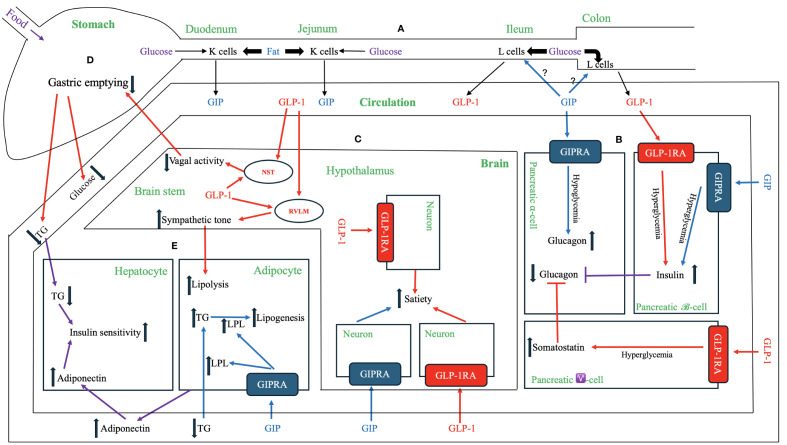
Glucose-dependent insulinotropic polypeptide (GIP) and glucagon-like peptide-1 (GLP-1) are two incretins that bind to their respective receptors and activate the downstream signaling in various tissues and organs. Both GIP and GLP-1 play roles in regulating food intake by stimulating neurons in the brain’s satiety center. They also stimulate insulin secretion in pancreatic β-cells, but their effects on glucagon production in pancreatic α-cells differ, with GIP having a glucagonotropic effect during hypoglycemia and GLP-1 exhibiting glucagonostatic effect during hyperglycemia. Additionally, GIP directly stimulates lipogenesis, while GLP-1 indirectly promotes lipolysis, collectively maintaining healthy adipocytes, reducing ectopic fat distribution, and increasing the production and secretion of adiponectin from adipocytes. Together, these two incretins contribute to metabolic homeostasis, preventing both hyperglycemia and hypoglycemia, mitigating dyslipidemia, and reducing the risk of cardiovascular diseases in individuals with type 2 diabetes and obesity. Several GLP-1 and dual GIP/GLP-1 receptor agonists have been developed to harness these pharmacological effects in the treatment of type 2 diabetes, with some demonstrating robust effectiveness in weight management and prevention of cardiovascular diseases. Elucidating the underlying cellular and molecular mechanisms could potentially usher in the development of new generations of incretin mimetics with enhanced efficacy and fewer adverse effects. The treatment guidelines are evolving based on clinical trial outcomes, shaping the management of metabolic and cardiovascular diseases.
Overview
The claims and statistics of this paper haven’t been checked yet.
Free: it reads the open-access text and checks the first 5 claims that cite a source we can check. Create a free account to check every claim.
Integrity signals
Registry
Cites
Statistics
Figures
Verification
Claims the paper makes
The claims and statistics of this paper haven’t been checked yet.
Free: it reads the open-access text and checks the first 5 claims that cite a source we can check. Create a free account to check every claim.
Claims other papers make about this one
Each is checked against this paper’s own text: does it say what the citing paper says it does?
The source backs part of the claim, not all of it — or backs it for a different population, condition or comparison.
In the citing paper
“In addition, GLP-1 inhibits gastric emptying and reduces bowel motility through a vagally mediated gastric braking mechanism [29,30].”
From Adherence and Persistence with GLP-1-Based Therapies: International Real-World Evidence and the Role of Nutritional and Lifestyle Support—A Narrative Review (2026) · cites this paper as [29]
Experimental — accuracy not yet measuredThe source backs part of the claim, not all of it — or backs it for a different population, condition or comparison.
In the citing paper
“Furthermore, GLP-1 enhances glucose-dependent insulin secretion from pancreatic beta cells and suppresses glucagon secretion from alpha cells, thereby reducing hepatic glucose output [29,30].”
From Adherence and Persistence with GLP-1-Based Therapies: International Real-World Evidence and the Role of Nutritional and Lifestyle Support—A Narrative Review (2026) · cites this paper as [29]
Experimental — accuracy not yet measuredThe cited source says what the claim attributes to it.
In the citing paper
“Therapeutic GLP-1 RAs are resistant to this enzymatic degradation, providing supraphysiological levels of receptor activation over extended periods [29,30].”
From Adherence and Persistence with GLP-1-Based Therapies: International Real-World Evidence and the Role of Nutritional and Lifestyle Support—A Narrative Review (2026) · cites this paper as [29]
Self-check
Percentages, sums and reported differences re-computed from the paper’s own numbers.
The self-check needs the paper’s full text.
Citations
Cites
Liraglutide and Cardiovascular Outcomes in Type 2 Diabetes
Marso, S. P., Daniels, G. H., Brown-Frandsen, K., Kristensen, P., Mann, J. F. E., Nauck, M. A., Nissen, S. E., Pocock, S., Poulter, N. R., Ravn, L. S., et al. (2016) · New England Journal of Medicine · doi:10.1056/nejmoa1603827 · Cited by 7,629
Semaglutide and Cardiovascular Outcomes in Patients with Type 2 Diabetes
Marso, S. P., Bain, S. C., Consoli, A., Eliaschewitz, F. G., Jódar, E., Leiter, L. A., Lingvay, I., Rosenstock, J., Seufert, J., Warren, M. L., et al. (2016) · New England Journal of Medicine · doi:10.1056/nejmoa1607141 · Cited by 6,900 · cited 1×
“…lixisenatide (250), the EXSCEL trial of exenatide ER (251), the LEARDER trial of liraglutide (252), the SUSTAIN-6 trial of subcutaneous semaglutide (253), the HARMONY trial of albiglutide (228), the REWIND trial of dulaglutide (254), the PIONEER trial of oral semaglutide (255), and the SELECT…”
BackgroundOnce-Weekly Semaglutide in Adults with Overweight or Obesity
Wilding, J. P. H., Batterham, R. L., Calanna, S., Davies, M., Van Gaal, L. F., Lingvay, I., McGowan, B. M., Rosenstock, J., Tran, M. T. D., Wadden, T. A., et al. (2021) · New England Journal of Medicine · doi:10.1056/nejmoa2032183 · Cited by 5,205
(2019) · doi:10.1161/cir.0000000000000677 · Cited by 4,501
β-Cell Deficit and Increased β-Cell Apoptosis in Humans With Type 2 Diabetes
Butler, A. E., Janson, J., Bonner-Weir, S., Ritzel, R., Rizza, R. A., & Butler, P. C. (2003) · Diabetes · doi:10.2337/diabetes.52.1.102 · Cited by 4,011
Tirzepatide Once Weekly for the Treatment of Obesity
Jastreboff, A. M., Aronne, L. J., Ahmad, N. N., Wharton, S., Connery, L., Alves, B., Kiyosue, A., Zhang, S., Liu, B., Bunck, M. C., et al. (2022) · New England Journal of Medicine · doi:10.1056/nejmoa2206038 · Cited by 3,838
Biology of Incretins: GLP-1 and GIP
Baggio, L. L., & Drucker, D. J. (2007) · Gastroenterology · doi:10.1053/j.gastro.2007.03.054 · Cited by 3,639 · cited 1×
“…of the postprandial insulin responses in healthy individuals and may be substantially reduced to 20% – 30% in individuals with type 2 diabetes mellitus (T2DM) (6, 7), a complex disorder arising from inadequate compensation of insulin secretion by pancreas to counter peripheral insulin resistance.”
BackgroundWeyer, C., Funahashi, T., Tanaka, S., Hotta, K., Matsuzawa, Y., Pratley, R. E., & Tataranni, P. A. (2001) · The Journal of Clinical Endocrinology & Metabolism · doi:10.1210/jcem.86.5.7463 · Cited by 3,541
Semaglutide and Cardiovascular Outcomes in Obesity without Diabetes
Lincoff, A. M., Brown-Frandsen, K., Colhoun, H. M., Deanfield, J., Emerson, S. S., Esbjerg, S., Hardt-Lindberg, S., Hovingh, G. K., Kahn, S. E., Kushner, R. F., et al. (2023) · New England Journal of Medicine · doi:10.1056/nejmoa2307563 · Cited by 3,236
Cited by
Items 301–341 of 341
GLP-1 RECEPTOR AGONISTS IN HUMAN CANCERS: A NARRATIVE LITERATURE REVIEW
Rizopoulos, T. (2026) · World Journal of Advanced Research and Reviews · doi:10.30574/wjarr.2026.31.3.2484
Durmus, A. B., & YÜCEL, G. S. (2026) · Gynecologic Oncology · doi:10.1016/j.ygyno.2026.09.004
Bigda, P., Rafałowska, Z., Rutz, S., Wojtala, A., Kret, J., Wyrostkiewicz, A., Sadkowski, A., Gdula, J., Zielińska, L., Szpunar, M., et al. (2026) · International Journal of Innovative Technologies in Social Science · doi:10.31435/ijitss.3(51).2026.6153
Knapik, J., Fic, W., & Polak-Szczybyło, E. (2026) · Nutrients · doi:10.3390/nu18193247
“In addition, GLP-1 suppresses glucagon secretion, delays gastric emptying, and promotes satiety, thereby reducing energy intake [24].”
Orosomucoid Enhances Insulin Sensitivity via the C–C Chemokine Receptor Type 5/Protein Kinase B Axis
Wang, P., Sun, Y., & Liu, X. (2026) · Experimental and Clinical Endocrinology & Diabetes · doi:10.1055/a-2958-3521
The eye in the era of GLP-1 receptor agonists ‒ a narrative review of current evidence
Rusinek, H., Korniluk, J., Milusz, N., Dmoch, W., & Maciejewicz, P. (2026) · European Journal of Clinical and Experimental Medicine · doi:10.15584/ejcem.2026.3.8
Uso de los agonistas de los GLP-1 en obesidad infantil.
Salvador, A. R. (2026) · Rovira & Virgili repository
Uso de los agonistas de los GLP-1 en obesidad infantil.
Termens, P. M. (2026) · Rovira & Virgili repository
GLP-1 as a Regulator of Oxidative Signalling in Metabolic Health and Disease
Kurhaluk, N., Kołodziejska, R., & Ткаченко, Г. М. (2026) · Antioxidants · doi:10.3390/antiox15101283 · Cited by 1
Alopecia no cicatricial durante el tratamiento con tirzepatida: Revisión sistemática.
García, L. J. M., Santos, G. M. A., & Cantos, M. C. (2026) · Brazilian Journal of Implantology and Health Sciences · doi:10.36557/2674-8169.2026v8n10p258-288
Kownacki, J. K., Uchacz, J., Drzymała, P., Skwarek, N. A., Schmidt, A., Gehrke, M. G., Śliwińska, M., Majczak, K. T., Wieczorek, M., & Śmiechowicz, O. Z. (2026) · African Journal of Biomedical Research · doi:10.53555/ajbr.v29i1s.9343
Zhang, Q., Chen, Y., Wang, D., Pereira, S., & Kurtyk, M. J. B. (2026) · Frontiers in Medicine · doi:10.3389/fmed.2026.1951400
GLP-1 receptor agonists for obstructive sleep apnea: a meta-analysis of randomized controlled trials
Carvalhal, G., Mora, M. M. R., Peralta-Jiménez, G. A., Ayasa, L. A., Barrera, V. C., Advani, K., & Aljazeeri, J. (2026) · Sleep And Breathing · doi:10.1007/s11325-026-03826-5 · Cited by 1
“GLP-1 receptor (GLP-1R) mediates effects includ - ing increased glucose-dependent insulin secretion, reduced appetite, and delayed gastric emptying, similarly GIP receptor (GIPR) represents a distinct incretin pathway involved in metabolic regulation [21].”
Kanu, C., Clucas, C., Gibble, T. H., Samuelson, A., & Karn, H. (2026) · Obesity Pillars · doi:10.1016/j.obpill.2026.100342
“These agents regulate appetite, impact eating behavior, and reduce obesity [19 – 21].”
Bone health in diabetes mellitus
Hoffmanová, P., Galuška, D., Kaňková, K., & Goldbergová, M. P. (2026) · Reviews in Endocrine and Metabolic Disorders · doi:10.1007/s11154-026-10091-0
Chen, Z., Zhou, Y., Li, G., MUTHANNA, A., d’Arqom, A., Tham, C. L., Ho, Y.-C., & Lee, M. T. (2026) · Journal of Diabetes & Metabolic Disorders · doi:10.1007/s40200-026-02110-3
“Preclinical studies demonstrate that GIP receptor activation in hypothalamic nuclei (arcuate and ventromedial nuclei) enhances neuronal activity (c-FOS expression), modulating neuropeptide Y/POMC signalling to promote satiety [143–145 ].”
Alshehri, A. A., Al-Osaimi, M. K., Al-Saeedi, N. N., Al-Wagdani, O. M., Al-Zahrani, S. S., Alharthi, F. A., Alshehri, G. H., Baali, F. H., Alghamdi, S. S. A., & Khawagi, W. Y. (2026) · Frontiers in Pharmacology · doi:10.3389/fphar.2026.1912202
“These medications exert their therapeutic effects through multiple mechanisms, including delayed gastric emptying, appetite suppression, enhanced satiety, and improved insulin secretion (Nauck et al., 2026; Liu, 2024).”
Tauekelova, A., Karipova, B., Zholdybaeva, A., Khamitov, S., Jetybayeva, S., Tuyakova, G., Samatkyzy, D., Sarbassov, D. D., Akilzhanova, A. R., & Asanova, A. (2026) · Journal of Clinical Medicine of Kazakhstan · doi:10.23950/jcmk/19277
Alves, P. H., Santana, R. R., Oliveira, K. C., de Avelar, I. S., Ribeiro, J. P., Souza, Á. P. S., dos Santos, M. C., de Souza, B. K. B., de Lima, L. G. N., da Silva, N. M., et al. (2026) · Brazilian Journal of Implantology and Health Sciences · doi:10.36557/2674-8169.2026v8n10p1107-1142
Nelson, A. E., Callahan, L. F., Schnitzer, T. J., & Batsis, J. A. (2026) · Current Medical Research and Opinion · doi:10.1080/03007995.2026.2741495
Balbino, K. P., Cândido, F. G., Coelho, O. G. L., & Hermsdorff, H. H. M. (2026) · Nutrition Reviews · doi:10.1093/nutrit/nuag145
Treatment of hyperphagia and obesity in Prader–Willi syndrome
Höybye, C., Forster, J. L., Goldstone, A. H., Gourash, L. M., Miller, J., & Tauber, M. (2026) · Journal of Internal Medicine · doi:10.1111/joim.70173
SANTANA, L. G. F., de Lima, J. L. V., de Oliveira, L. A. R., & Naziazeno, S. D. D. S. (2026) · Revista JRG de Estudos Acadêmicos · doi:10.55892/jrg.v9i21.3850
Mao, J., & Hu, R. (2026) · Frontiers in Pharmacology · doi:10.3389/fphar.2026.1988828
“The complementary mechanisms of these receptors offer a molecular basis for using dual agonists like tirzepatide to broaden the therapeutic applications of incretin-based strategies for obesity (Liu, 2024).”
Wakil, L., Xia, L., & Jun-li, L. (2026) · Discovery Medicine · doi:10.24976/discov.med.202638213.238
Liu, F., Xu, Z., Wang, W., Gao, J., Changgeng, F. U., & Liu, P. (2026) · Frontiers in Cell and Developmental Biology · doi:10.3389/fcell.2026.1996288
Akbay, H. İ. (2026) · Bidge Yayınları eBooks · doi:10.70269/10.70269/8854661381
Oral Health–Related Adverse Events of GLP-1 Receptor Agonists
Massarotto, F. C., Mahmoud, A. H., Watson, G. E., & Arany, S. (2026) · JDR Clinical & Translational Research · doi:10.1177/23800844261491724
Xie, Z.-Y., Qian, Y., Liu, T.-T., 项平, Mu, Y., & Zhang, W. (2026) · Frontiers in Pharmacology · doi:10.3389/fphar.2026.1978397
Kamrul-Hasan, A. B. M., Mondal, S., Nagendra, L., Khalil, I., Dutta, D., & Pappachan, J. M. (2026) · Endocrine · doi:10.1007/s12020-026-04857-4
“Combining basal insulin (BI) with glucagon-like peptide-1 receptor agonists (GLP1RAs) offers a comple - mentary strategy that targets multiple pathophysiological mechanisms underlying T2D [ 2 ].”
Correia, K. M., & Belfort, M. G. S. (2026) · Revista Tópicos · doi:10.70773/revistatopicos/793411916
Tang, H., Zhang, B., Lu, Y., Lu, Y., Wang, H., Davis, C. N., Kranzler, H. R., & Chen, Y. (2026) · Diabetes Obesity and Metabolism · doi:10.1111/dom.71470
GLP-1 Receptor Agonists and Gout: A Narrative Review
Flint, C., Merriman, T. R., & Solomon, D. H. (2026) · Gout Urate and Crystal Deposition Disease · doi:10.3390/gucdd4040020
Camajani, E., Frigerio, F., Quattrini, C., Franzese, V., Armani, A., Gorini, S., Filardi, T., Feraco, A., Caprio, M., & Lombardo, M. (2026) · Nutrients · doi:10.3390/nu18213675
ANÁLOGOS DE GLP-1: MECANISMOS DE AÇÃO E IMPACTO NO TRATAMENTO DA OBESIDADE
Santos, E. V. B. D., Lopes, E. A., Lima, B. M., de Morais, M. C. M., & Silva, R. P. D. S. (2026) · Revista Tópicos · doi:10.70773/revistatopicos/793857432
McKee, C. E., Price, R. K., & Miras, A. D. (2026) · Proceedings of The Nutrition Society · doi:10.1017/s0029665126106193
A Nature-Derived Peptide Promotes Satiety Hormone Response and Weight Loss In Vivo
Abramov, M. M., Goldfarb, E., Haham, D., Akiva, E., van Klinken, B. J., & Barbash, Z. (2026) · Journal of Dietary Supplements · doi:10.1080/19390211.2026.2752609
de van der Schueren, M. A. E., Prado, C. M. M., Stanford, F. C., Almandoz, J. P., Karn, H., Clucas, C., Kanu, C., & Neff, L. M. (2026) · Diabetes Obesity and Metabolism · doi:10.1111/dom.71526
GLP-1R/GIPR Interactions in Central Energy Balance and Implications for Obesity Pharmacotherapy
Hamza, A., Farooq, N., Zhou, X., & Bu, S. (2026) · Biomolecules · doi:10.3390/biom16111623
Yue, D., Xu, B., Lai, H., Qian, Y., Guo, J., Zhou, D., Shen, B., & Zha, X. (2026) · Frontiers in Endocrinology · doi:10.3389/fendo.2026.1981282
Metadata
- Authors
- Liu, Q. K.
- Affiliations
- Montgomery General Hospital (US)
- Corresponding author
- Liu, Qiyuan Keith
- Venue
- Frontiers in Endocrinology
- Publisher
- Frontiers Media SA
- Published
- 2024-07-24
- Volume
- 15
- Pages
- 1431292-1431292
- ISSN
- 1664-2392 (ISSN-L)
- PMC
- PMC11304055
- OpenAlex
- W4400956092
- Cited by
- 265
- References
- 279
- Citations by year
- 2026: 156 · 2025: 107 · 2024: 2
- FWCI
- 15.55
- Type
- journal article
- Language
- en
- Open access
- gold
- doi.org
- Licence
- Locations
- Frontiers in Endocrinology (publishedVersion, cc-by)
- PubMed Central (publishedVersion, cc-by)
- PubMed (publishedVersion)
- DOAJ (DOAJ: Directory of Open Access Journals) (submittedVersion, cc-by-sa)
- Topics
- Health Sciences › Medicine › Endocrinology, Diabetes and Metabolism › Diabetes Treatment and Management
- Life Sciences › Neuroscience › Endocrine and Autonomic Systems › Regulation of Appetite and Obesity
- Health Sciences › Medicine › Endocrinology, Diabetes and Metabolism › Adipokines, Inflammation, and Metabolic Diseases
- Keywords
- glucagon-like peptide-1, glucose-dependent insulinotropic polypeptide, GIP/GLP-1 receptor agonist, incretin mimetics, type 2 diabetes, obesity, insulin secretion, satiety, lipogenesis, lipolysis, adiponectin, cardiovascular disease prevention, weight management, dyslipidemia, metabolic homeostasis
- MeSH terms
- Glucagon-Like Peptide-1 Receptor, Glucagon-Like Peptide-1 Receptor Agonists, Animals, Diabetes Mellitus, Type 2, Gastric Inhibitory Polypeptide, Humans, Hypoglycemic Agents, Receptors, Gastrointestinal Hormone, Glucagon-Like Peptide 1, Incretins
About these checks
Registry, retraction, Cites and statistics results are computed, not judged, with one exception: a printed reference that no index lists is read once by a model before it counts as a citation error. Claims are extracted by a model and kept only when their quote appears verbatim in the text; each cited source is then checked, with a model’s help, for whether it says what the claim relies on. Those verdicts can be wrong — read the claim’s quote and the cited source before relying on one.
Statistics and arithmetic are recomputed, not judged.
Confidence bands are shown only for fields calibrated on our annotated test set. None is calibrated yet, so no band is shown.
What counts as a claim ›How we measure confidence ›How we check this ›
Are you an author, or do you see a problem with this page? Request a review
Data sources
Bibliographic data: Semantic Scholar, OpenAlex, Crossref.
Contains information from the Semantic Scholar Academic Graph Datasets, made available under the ODC Attribution License (ODC-BY 1.0).
Semantic Scholar’s data is described in: Kinney, R., et al. (2023). The Semantic Scholar Open Data Platform. arXiv:2301.10140.
