

The DOI matches its Crossref record; 14 of the 14 references it cites were found in a registry or an index.
Circular RNA (circRNA) in Alzheimer’s disease (AD)
Open accessAbstract
GENERAL COMMENTARY article Front. Genet., 31 December 2013 | https://doi.org/10.3389/fgene.2013.00307
Overview
The claims and statistics of this paper haven’t been checked yet.
Run the check — free, no account needed. It reads the open-access text and checks the sources it cites.
Integrity signals
Registry
Cites
Statistics
Figures
Verification
Claims the paper makes
The claims and statistics of this paper haven’t been checked yet.
Run the check — free, no account needed. It reads the open-access text and checks the sources it cites.
Claims other papers make about this one
Each is checked against this paper’s own text: does it say what the citing paper says it does?
In the citing paper
“In addition, dysregulation of ciRS-7 has been found in zebrafish with an impaired midbrain [71] and in the hippocampus of AD patients [45].”
From Circular RNAs in depression: Biogenesis, function, expression, and therapeutic potential (2021) · cites this paper as [45]
Self-check
Percentages, sums and reported differences re-computed from the paper’s own numbers.
The self-check needs the paper’s full text.
Citations
Cites
Circular RNAs are a large class of animal RNAs with regulatory potency
Memczak, S., Jens, M., Elefsinioti, A., Torti, F., Krueger, J., Rybak, A., Maier, L., Mackowiak, S. D., Gregersen, L. H., Munschauer, M., et al. (2013) · Nature · doi:10.1038/nature11928 · Cited by 7,990 · cited 1×
“Intrinsically resistant to exonucleolytic RNA decay, circRNAs appear to be enriched in mammalian brain tissues (Hansen et al., 2013; Memczak et al., 2013).”
BackgroundNatural RNA circles function as efficient microRNA sponges
Hansen, T. B., Jensen, T. I., Clausen, B. H., Bramsen, J. B., Finsen, B., Damgaard, C. K., & Kjems, J. (2013) · Nature · doi:10.1038/nature11993 · Cited by 7,985
Salzman, J., Gawad, C., Wang, P. L., Lacayo, N., & Brown, P. O. (2012) · PLoS ONE · doi:10.1371/journal.pone.0030733 · Cited by 2,239 · cited 1×
“Recently characterized, traditional methods of RNA detection and analysis requiring a free 5′ or 3′ ribonucleotide terminus may have significantly underestimated circRNA abundance and significance in eukaryotic cells (Salzman et al., 2012; Wilusz and Sharp, 2013; unpublished observations).”
Cogswell, J. P., Ward, J., Taylor, I. A., Waters, M., Shi, Y., Cannon, B., Kelnar, K., Kemppainen, J., Brown, D., Chen, C., et al. (2008) · Journal of Alzheimer s Disease · doi:10.3233/jad-2008-14103 · Cited by 943 · cited 1×
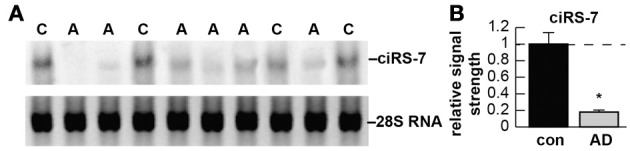
“…or AD groups (p > 0.05, ANOVA); a dashed horizontal line at 1.0 indicates homeostatic (control) ciRS-7 levels for ease of comparison; ∗p < 0.001 (ANOVA). contribute to the down-regulation of selective miRNA-7-sensitive messenger RNA (mRNA) targets (Cogswell et al., 2008; unpublished observations).”
BackgroundInfluentialA Circuitous Route to Noncoding RNA
Wilusz, J. E., & Sharp, P. A. (2013) · Science · doi:10.1126/science.1238522 · Cited by 531 · cited 1×
“Recently characterized, traditional methods of RNA detection and analysis requiring a free 5′ or 3′ ribonucleotide terminus may have significantly underestimated circRNA abundance and significance in eukaryotic cells (Salzman et al., 2012; Wilusz and Sharp, 2013; unpublished observations).”
Colangelo, V., Schurr, J., Ball, M. J., Pelaez, R. P., Bazan, N. G., & Lukiw, W. J. (2002) · Journal of Neuroscience Research · doi:10.1002/jnr.10351 · Cited by 517
A Gene Expression Profile of Alzheimer's Disease
Loring, J. F., Wen, X., Lee, J. M., Seilhamer, J. J., & Somogyi, R. (2001) · DNA and Cell Biology · doi:10.1089/10445490152717541 · Cited by 300 · cited 2×
“…systems” and ambient up-regulation of specific inducible miRNAs may help explain the widely observed, generalized and progressive down-regulation of gene expression that is characteristic of the sporadic AD brain (Loring et al., 2001; Colangelo et al., 2002; Ginsberg et al., 2012; Lukiw, 2013).”
BackgroundInfluentialDeconstruction for Reconstruction: The Role of Proteolysis in Neural Plasticity and Disease
Bingol, B., & Sheng, M. (2011) · Neuron · doi:10.1016/j.neuron.2010.11.006 · Cited by 275
Lukiw, W. J., Handley, P., Wong, L. J., & McLachlan, D. R. C. (1992) · Neurochemical Research · doi:10.1007/bf00968788 · Cited by 125 · cited 2×
“, 2013); detection was performed using a nonisotopic BrightStar BioDetect Kit (Ambion, Austin, TX; detection limit ∼100 fg) or by standard autoradiography (Lukiw et al., 1992); (B) AD ciRS-7 is significantly reduced to about 0.”
MethodInfluentialMicroRNA in schizophrenia: Genetic and expression analysis of miR-130b (22q11)
Burmistrova, O., Goltsov, A. Y., Abramova, L. I., Каледа, В. Г., Александровна, О. В., & Rogaev, E. I. (2007) · Biochemistry (Moscow) · doi:10.1134/s0006297907050161 · Cited by 101 · cited 1×
“…but are also associated with a circRNA for miRNA-7 (ciRS-7), in the same tissues; ciRS-7 contains multiple, tandem anti-miRNA-7 sequences (Burmistrova et al., 2007; Hansen et al., 2013; Lukiw et al., 2013). ciRS-7 thereby acts as a kind of endogenous, competing, anti-complementary miRNA…”
Background
Cited by
Sorted by citations
Items 301–400 of 647
The Role of Circular RNAs in Pancreatic Ductal Adenocarcinoma and Biliary-Tract Cancers
Limb, C., Liu, D., Venø, M. T., Rees, E., Krell, J., Bagwan, I., Giovannetti, E., Pandha, H., Strobel, O., Rockall, T., et al. (2020) · Cancers · doi:10.3390/cancers12113250 · Cited by 31
Circular RNAs in the Central Nervous System
Li, M., Wang, W., & Jin, Z. (2021) · Frontiers in Molecular Biosciences · doi:10.3389/fmolb.2021.629593 · Cited by 31
Wei, S., Hu, W., Feng, J., & Geng, Y. (2022) · Cell Communication and Signaling · doi:10.1186/s12964-022-00960-x · Cited by 31
Small circular interfering RNAs (sciRNAs) as a potent therapeutic platform for gene-silencing
Jahns, H., Degaonkar, R., Podbevšek, P., Gupta, S., Bisbe, A., Aluri, K. C., Szeto, J., Kumar, P., LeBlanc, S., Racie, T., et al. (2021) · Nucleic Acids Research · doi:10.1093/nar/gkab724 · Cited by 33
Circular RNAS: novel biomarkers of disease activity in systemic lupus erythematosus?
Cortés, R., & Forner, M. J. (2019) · Clinical Science · doi:10.1042/cs20180826 · Cited by 29
The Circular RNome of Developmental Retina in Mice
Chen, X., Zhang, Z., Wang, X.-Y., Zhao, H., Li, M., Ma, Y., Ji, Y., Zhang, C.-J., Wu, K., Xiang, L., et al. (2019) · Molecular Therapy — Nucleic Acids · doi:10.1016/j.omtn.2019.11.016 · Cited by 30
Predicting circRNA-disease associations based on autoencoder and graph embedding
Yang, J., & Lei, X. (2021) · Information Sciences · doi:10.1016/j.ins.2021.04.073 · Cited by 30
D’Ambra, E., Santini, T., Vitiello, E., D’Uva, S., Silenzi, V., Morlando, M., & Bozzoni, I. (2021) · iScience · doi:10.1016/j.isci.2021.103504 · Cited by 30
Alzheimer’s Disease-Related Epigenetic Changes: Novel Therapeutic Targets
Paniri, A., Hosseini, M. M., & Akhavan‐Niaki, H. (2023) · Molecular Neurobiology · doi:10.1007/s12035-023-03626-y · Cited by 34
“C The same histone type is continuously substituting for a new copy of the same variant through a mechanism known as histone variants turnover AD [233, 234].”
Profile and clinical implication of circular RNAs in human papillary thyroid carcinoma
Ren, H., Liu, Z., Liu, S., Zhou, X., Wang, H., Xu, J., Wang, D. W., & Yuan, G. (2018) · PeerJ · doi:10.7717/peerj.5363 · Cited by 29
Li, Y., Ashraf, U., Chen, Z., Zhou, D., Imran, M., Ye, J., Chen, H., & Cao, S. (2020) · BMC Genomics · doi:10.1186/s12864-020-06822-5 · Cited by 29
“The circRNA ciRS-7 by sponging miR-7 [22] regulates the onset of Alzheimer’s disease [29].”
BackgroundYao, Y., Wang, J., He, T., Li, H., Hu, J., Zheng, M., Ding, Y., Chen, Y., Shen, Y., Wang, L., et al. (2020) · Brain Research Bulletin · doi:10.1016/j.brainresbull.2020.08.004 · Cited by 29
“…Received 4 January 2020; Received in revised form 8 May 2020; Accepted 7 August 2020 Brain Research Bulletin 164 (2020) 157–171 ischemia, stroke, and neurodegenerative diseases (Hansen et al., 2013; Kumar et al., 2017; Lukiw, 2013; Mehta et al., 2017).”
Zhang, Q., Chen, B., Yang, P., Wu, J., Pang, X., & Pang, C.-Y. (2022) · Frontiers in Genetics · doi:10.3389/fgene.2022.1049786 · Cited by 31
“…AD brain (Loring et al., 2001), Defects in ciRS-7 and “sponge activity”, Frontiers in Genetics frontiersin.org12 for example, may increase ambient miRNA-7 levels in ADaffected brain cells, ultimately leading to downregulation of messenger RNAs (mRNAs) that selectively bind miRNA-7 (Lukiw, 2013b).”
BackgroundPierouli, K., Papakonstantinou, E., Papageorgiou, L., Diakou, I., Mitsis, Τ., Dragoumani, K., Spandidos, D. A., Bacopoulou, F., Chrousos, G. P., Goulielmos, G. N., et al. (2022) · International Journal of Molecular Medicine · doi:10.3892/ijmm.2022.5208 · Cited by 29
Circular RNA as a biomarker for cancer: A systematic meta‑analysis
Li, Y., Zeng, X., He, J., Gui, Y., Zhao, S., Chen, H., Sun, Q., Jia, N., & Yuan, H. (2018) · Oncology Letters · doi:10.3892/ol.2018.9125 · Cited by 28
“These observations resulted in the consideration that circRNAs could serve as potential biomarkers for the non-invasive diagnosis of numerous diseases, including disorders of the central nervous system (15), cancer (16) and a number of forms of cardiovascular diseases (17).”
RNA-Seq profiling of circular RNAs in human small cell lung cancer
Zhang, C., Zhang, B., Yuan, B., Chen, C., Zhou, Y., Zhang, Y., Sheng, Z., Sun, N., & Wu, X. (2020) · Epigenomics · doi:10.2217/epi-2019-0382 · Cited by 28
Xu, J., Shu, Y., Xu, T., Zhu, W., Qiu, T., Li, J., Zhang, M., Xu, J., Guo, R., Lu, K., et al. (2018) · PubMed Central · Cited by 28
MicroRNA (miRNA) Complexity in Alzheimer’s Disease (AD)
Lukiw, W. J. (2023) · Biology · doi:10.3390/biology12060788 · Cited by 28
Xu, S., Xiao, S., Qiu, C., & Wang, Z. (2017) · Marine Genomics · doi:10.1016/j.margen.2016.12.004 · Cited by 28
The Yin and Yang of nucleic acid-based therapy in the brain
Gustincich, S., Zucchelli, S., & Mallamaci, A. (2016) · Progress in Neurobiology · doi:10.1016/j.pneurobio.2016.11.001 · Cited by 27
“As an example, CiRS-7 has been shown to adsorb miR-7, thus releasing its target mRNAs, including Parkinson’s disease-associated a-synuclein, from inhibition (Hansen et al., 2013; Lukiw, 2013; Salzman, 2016).”
An Overview of Circular RNAs and Their Implications in Myotonic Dystrophy
Czubak, K., Sedehizadeh, S., Kozłowski, P., & Wojciechowska, M. (2019) · International Journal of Molecular Sciences · doi:10.3390/ijms20184385 · Cited by 27
Circular RNAs and cancer: Opportunities and challenges
Solé, C., & Lawrie, C. H. (2020) · Advances in clinical chemistry · doi:10.1016/bs.acc.2020.02.008 · Cited by 27
Differential Profile of Plasma Circular RNAs in Type 1 Diabetes Mellitus
Li, Y., Zhou, Y., Zhao, M., Zou, J., Zhu, Y., Yuan, X., Liu, Q., Cai, H., Chu, C., & Liu, Y. (2020) · Diabetes & Metabolism Journal · doi:10.4093/dmj.2019.0151 · Cited by 28
Expression and function of circular RNAs in the mammalian brain
Xu, K., Zhang, Y., & Li, J. (2021) · Cellular and Molecular Life Sciences · doi:10.1007/s00018-021-03780-3 · Cited by 29
“Brain-enriched CDR1as (ciRS7), acting as a miR-7 sponge due to the abundant binding sites for miRNAs, is downregulated in AD hippocampus [90, 91].”
BackgroundTang, M., Bai, L., Wan, Z., Wan, S., Xiang, Y., Qian, Y., Cui, L., You, J., Hu, X., Qu, F., et al. (2021) · Molecular Therapy — Nucleic Acids · doi:10.1016/j.omtn.2021.06.012 · Cited by 27
Vornholt, E., Drake, J. W., Mamdani, M., McMichael, G. O., Taylor, Z. N., Bacanu, S., Miles, M. F., & Vladimirov, V. I. (2021) · Addiction Biology · doi:10.1111/adb.13071 · Cited by 26
Circular RNAs in Embryogenesis and Cell Differentiation With a Focus on Cancer Development
Agostino, S. D., Riccioli, A., Cesaris, P. D., Fontemaggi, G., Blandino, G., Filippini, A., & Fazi, F. (2020) · Frontiers in Cell and Developmental Biology · doi:10.3389/fcell.2020.00389 · Cited by 28
“Dysregulation of miR7-ciRS-7 interaction has been reported in the hippocampus of AD patients, where the expression of ciRS-7 is low and, therefore, the level of miR-7 is increased, with consequent down-regulation of miR-7 target mRNAs (Lukiw, 2013; Floris et al., 2017; Figure 3B).”
BackgroundJia, C., Yao, Z., Lin, Z., Zhao, L., Cai, X., Chen, S., Deng, M., & Zhang, Q. (2020) · Journal of Cellular Physiology · doi:10.1002/jcp.29931 · Cited by 27
“circRNAs have been proven to be potential biomarkers in many diseases, especially in cancer (Lukiw, 2013; Veno et al., 2015).”
BackgroundFan, S., Hu, K., Zhang, D., & Liu, F. (2020) · Annals of Translational Medicine · doi:10.21037/atm-20-5306 · Cited by 25
Zhang, Y., Lei, X., Pan, Y. F., & Pedrycz, W. (2020) · Knowledge-Based Systems · doi:10.1016/j.knosys.2020.106694 · Cited by 26
Circular RNAs: Potential Applications as Therapeutic Targets and Biomarkers in Breast Cancer
Sarkar, D., & Diermeier, S. D. (2021) · Non-Coding RNA · doi:10.3390/ncrna7010002 · Cited by 27
Bigarré, I. M., Trombetta, B. A., Guo, Y., Arnold, S. E., & Carlyle, B. C. (2021) · Brain and Behavior · doi:10.1002/brb3.2048 · Cited by 26
“The “microRNA sponge” hypothesis of circRNA function suggests they inactivate corresponding microRNAs, indirectly upregulating protein expression (Lukiw, 2013; Piwecka et al., 2017).”
BackgroundLi, Y., Wang, H., Chen, L., Wei, K., Liu, Y., Han, Y., & Xia, X. (2022) · Metabolic Brain Disease · doi:10.1007/s11011-022-01051-z · Cited by 26
“Such as ciRS-7 adsorbs miR-7 to regulate AD patients’ hippocampal CA1 region (Lukiw 2013).”
BackgroundThe novel roles of circular RNAs in metabolic organs
Zhang, Z., Guo, X., & Li, X. (2017) · Genes & Diseases · doi:10.1016/j.gendis.2017.12.002 · Cited by 26
Possible epigenetic regulatory effect of dysregulated circular RNAs in Alzheimer’s disease model
Lee, W. J., Moon, J., Jeon, D., Shin, Y., Yoo, J.-S., Park, D.-K., Lee, S., Jung, K., Park, K., Jung, K., et al. (2019) · Scientific Reports · doi:10.1038/s41598-019-48471-z · Cited by 26
Lou, Y.-Y., Wang, Q., Lu, Y., Tu, M., Xu, X., Xia, Y., Peng, Y., Lai, M., & Zheng, X. (2018) · Physiological Genomics · doi:10.1152/physiolgenomics.00096.2018 · Cited by 25
Wei, W., Mo, X., Yan, L., Huang, M., Yang, Y., Jin, Q., Zhong, H., Cao, W., Wu, K., Wu, L., et al. (2020) · Cancer Management and Research · doi:10.2147/cmar.s219307 · Cited by 25
RetractedGao, R., Chen, C., Zhao, Q., Li, M., Wang, Q., Zhou, L., Chen, E., Chen, H., Zhang, Y., Cai, X., et al. (2020) · Frontiers in Aging Neuroscience · doi:10.3389/fnagi.2020.00165 · Cited by 25
“Up to now, circRNAs were demonstrated to play vital roles in various conditions, including cancers, cardiovascular diseases, neurodegenerative diseases, and so on (Lukiw, 2013; Hancock, 2014; You et al., 2015; Wang et al., 2016; Zhou and Yu, 2017).”
BackgroundMa, N., Pan, J., Wen, Y., Wu, Q., Yu, B., Chen, X., Wan, J., & Zhang, W. (2021) · Molecular Therapy · doi:10.1016/j.ymthe.2021.02.008 · Cited by 25
RetractedA tripartite circRNA/mRNA/miRNA interaction regulates glutamatergic signaling in the mouse brain
Silenzi, V., D’Ambra, E., Santini, T., D’Uva, S., Setti, A., Salvi, N., Nicoletti, C., Scarfò, R., Cordella, F., Mongiardi, B., et al. (2024) · Cell Reports · doi:10.1016/j.celrep.2024.114766 · Cited by 25
Unique expression signatures of circular RNAs in response to DNA tumor virus SV40 infection
Shi, J., Hu, N., Li, J., Zeng, Z., Mo, L., Sun, J., Wu, M., & Hu, Y. (2017) · Oncotarget · doi:10.18632/oncotarget.21694 · Cited by 24
“Other recent studies have suggested that circRNAs may be involved in the initiation and development of cancer and neurodegenerative diseases, and can potentially become new diagnostic or predictive biomarkers of both physiological and pathological processes [23, 24, 25].”
Circular RNAs constitute an inherent gene regulatory axis in the mammalian eye and brain
George, A. K., Master, K., Majumder, A., Homme, R. P., Laha, A., Sandhu, H. S., Tyagi, S. C., & Singh, M. (2018) · Canadian Journal of Physiology and Pharmacology · doi:10.1139/cjpp-2018-0505 · Cited by 24
Expression profiling and in situ screening of circular RNAs in human tissues
Zaghlool, A., Ameur, A., Wu, C., Westholm, J. O., Niazi, A., Manivannan, M., Bramlett, K. S., Nilsson, M. F., & Feuk, L. (2018) · Scientific Reports · doi:10.1038/s41598-018-35001-6 · Cited by 26
Chaâbane, M. A., Andreeva, K., Hwang, J. Y., Kook, T. L., Park, J. W., & Cooper, N. G. F. (2020) · PLoS Computational Biology · doi:10.1371/journal.pcbi.1008338 · Cited by 22
Zhang, R., Gao, Y., Li, Y., Geng, D., Liang, Y., He, Q., Wang, L., & Cui, H. (2022) · Experimental Neurology · doi:10.1016/j.expneurol.2022.113998 · Cited by 24
“The expression of ciRS-7 is reduced in AD, and its overexpression can reduce the accumulation of β-amyloid peptide (Aβ), thus improving the symptoms of AD (Lukiw, 2013).”
Wan, Q., Wu, D., & Ye, Q. (2017) · Biochemical and Biophysical Research Communications · doi:10.1016/j.bbrc.2017.08.131 · Cited by 24
Circular RNAs and Neuronal Development
Constantin, L. (2018) · Advances in experimental medicine and biology · doi:10.1007/978-981-13-1426-1_16 · Cited by 24
Zhang, C., Xiong, J., Yang, Q., Wang, Y., Shi, H., Tian, Q., Huang, H., Kong, D.-P., Lv, J., Liu, D., et al. (2018) · Future Science OA · doi:10.4155/fsoa-2018-0046 · Cited by 24
Alteration of circular RNA expression in rat dental follicle cells during osteogenic differentiation
Du, Y., Li, J., Hou, Y., Chen, C., Long, W., & Jiang, H. (2019) · Journal of Cellular Biochemistry · doi:10.1002/jcb.28603 · Cited by 24
“Furthermore, circRNAs are thought to be involved in atherosclerotic vascular disease(18) and Alzheimer's disease.(19) A recent study revealed that 24 circRNAs were frequently altered at each stage of osteoclast differentiation, revealing potential functions for circRNAs during osteoclastogenesis.”
BackgroundGasparini, S., Vecchio, G. D., Gioiosa, S., Flati, T., Castrignanò, T., Legnini, I., Licursi, V., Ricceri, L., Scattoni, M. L., Rinaldi, A., et al. (2020) · Molecular Neurobiology · doi:10.1007/s12035-020-01878-6 · Cited by 22
Hu, Y., Zhu, Y., Liu, G., Yao, X., Yan, X., Yang, Y., Wang, W., Zou, X., & Li, X. (2021) · Journal of Clinical Laboratory Analysis · doi:10.1002/jcla.23788 · Cited by 23
circRNA from APP Gene Changes in Alzheimer’s Disease Human Brain
Urdánoz‐Casado, A., de Gordoa, J. S., Robles, M., Roldán, M., Macías, M., Acha, B., Blanco‐Luquin, I., & Mendióroz, M. (2023) · International Journal of Molecular Sciences · doi:10.3390/ijms24054308 · Cited by 23
Wang, J., Sun, H., Zhou, Y., Huang, K., Que, J., Peng, Y., Wang, J., Lin, C., Xue, Y., & Ji, K. (2019) · Journal of Cellular Biochemistry · doi:10.1002/jcb.28333 · Cited by 23
Wang, Y., Nie, C., Zang, T., & Wang, Y. (2019) · Frontiers in Genetics · doi:10.3389/fgene.2019.00832 · Cited by 23
“2 September 2019 | Volume 10 | Article 832Frontiers in Genetics | www.frontiersin.org Researchers found that the circRNA ciRS-7 may be a promising target for neurodegenerative disorder (Lukiw, 2013) and myocardial infarction (Lin et al., 2018).”
BackgroundProgress in Understanding the Relationship Between Circular RNAs and Neurological Disorders
Wang, Q., Qu, L., Chen, X., Zhao, Y., & Luo, Q. (2018) · Journal of Molecular Neuroscience · doi:10.1007/s12031-018-1125-z · Cited by 22
A genome-wide map of circular RNAs in adult zebrafish
Sharma, D., Sehgal, P., Mathew, S., Vellarikkal, S. K., Singh, A. R., Kapoor, S. S., Jayarajan, R., Scaria, V., & Sivasubbu, S. (2019) · Scientific Reports · doi:10.1038/s41598-019-39977-7 · Cited by 22
Circular RNA expression profiles in cisplatin-induced acute kidney injury in mice
Li, C., Li, M., Ye, Z., Huang, J., Li, Y., Yao, Z., Peng, H., & Lou, T. (2019) · Epigenomics · doi:10.2217/epi-2018-0167 · Cited by 22
Du, Q., Zhang, W., Feng, Q., Bo, H., Cheng, C., Cheng, Y., Li, Y., Fan, X., & Chen, Z. (2020) · Brain Research Bulletin · doi:10.1016/j.brainresbull.2020.04.018 · Cited by 22
Practical guide for circular RNA analysis: Steps, tips, and resources
Tsitsipatis, D., & Gorospe, M. (2020) · Wiley Interdisciplinary Reviews - RNA · doi:10.1002/wrna.1633 · Cited by 22
“…1 of 11 https://doi.org/10.1002/wrna.1633 can affect the decay, translation, and/or transcription of prominent mRNAs and thereby influence gene expression programs that govern health and disease (Haque & Harries, 2017; Lukiw, 2013; Vo et al., 2019; Zhou, Sun, Huang, & Zhao, 2019).”
BackgroundInfluentialResearch Progress on circRNA in Nervous System Diseases
Ma, N., Zhang, W., & Wan, J. (2020) · Current Alzheimer Research · doi:10.2174/1567205017666201111114928 · Cited by 22
Cerina: systematic circRNA functional annotation based on integrative analysis of ceRNA interactions
Cardenas, J., Balaji, U., & Gu, J. (2020) · Scientific Reports · doi:10.1038/s41598-020-78469-x · Cited by 21
The role of exosomal non‐coding RNAs in aging‐related diseases
Dolati, S., Shakouri, S. K., Dolatkhah, N., Yousefi, M., Jadidi‐Niaragh, F., & Sanaie, S. (2021) · BioFactors · doi:10.1002/biof.1715 · Cited by 23
The Prognostic and Predictive Significance of circRNA CDR1as in Tumor Progression
Jian, F., Yangyang, R., Xu, W., Jiadan, X., Na, L., Peng, Y., Maohong, B., Guoping, N., & Pan, Z. (2021) · Frontiers in Oncology · doi:10.3389/fonc.2020.549982 · Cited by 21
Wang, Y., Wu, Y., & Xie, S. (2022) · Bioengineered · doi:10.1080/21655979.2021.2024321 · Cited by 21
Mahmoudi, E., & Cairns, M. J. (2023) · Sub-cellular biochemistry/Subcellular biochemistry · doi:10.1007/978-3-031-21410-3_10 · Cited by 21
Differential methylation of circRNA m6A in an APP/PS1 Alzheimer's disease mouse model
Zhang, X., Yang, S., Han, S. H., Sun, Y., Han, M., Zheng, X., Li, F., Yan, W., Wang, Y., & Bi, J. (2023) · Molecular Medicine Reports · doi:10.3892/mmr.2023.12942 · Cited by 21
Hill, W. J. L. J. M. (2014) · Journal of Aging Science · doi:10.4172/2329-8847.1000119 · Cited by 23
“While secondary and tertiary structures may also be conserved among multiple miRNAs, and internal stems, loops and mis-paired RNA ‘bulges’ very commonly appear at specifically conserved positions in many pre-miRNA sequences, the actual number of possible miRNA structural configurations may be somewhat limited by the s…”
BackgroundYavropoulou, M. P., Poulios, C., Michalopoulos, N., Gatzou, A., Chrisafi, S., Mantalovas, S., Papavramidis, T. S., Daskalaki, E., Sofou, E., Kotsa, K., et al. (2018) · Cells · doi:10.3390/cells8010015 · Cited by 21
Comprehensive transcriptional profiling of porcine brain aging
Chen, J., Zou, Q., Lv, D., Raza, M. A., Wang, X., Li, P., Chen, Y., Xi, X., Wen, A., Zhu, L., et al. (2019) · Gene · doi:10.1016/j.gene.2019.01.019 · Cited by 21
Circular RNA expression alterations in colon tissues of Crohn's disease patients
Qiao, Y., Cai, C., Shen, J., Zheng, Q., & Ran, Z. H. (2019) · Molecular Medicine Reports · doi:10.3892/mmr.2019.10070 · Cited by 22
Li, Y., Jin, W., Zhai, B., Chen, Y., Li, G., Zhang, Y., Guo, Y., Sun, G., Han, R., Li, Z., et al. (2021) · BMC Genomics · doi:10.1186/s12864-020-07356-6 · Cited by 21
“Noncoding RNAs, including miRNAs [22], lncRNAs [23, 24], and circRNAs [25], play different roles in complex biological processes.”
BackgroundYao, J., Hu, L., Li, X., Shan, K. Y., Zhou, R., Ge, H., Yao, M.-D., Jiang, Q., Zhao, C., & Yan, B. (2018) · Biomedicine & Pharmacotherapy · doi:10.1016/j.biopha.2018.12.044 · Cited by 20
Deng, W., Peng, W., Wang, T., Chen, J., Qiu, X., Fu, L., & Zhu, S. (2019) · Oncology Reports · doi:10.3892/or.2019.7369 · Cited by 20
Circular RNAs as potential theranostics in the cardiac fibrosis
Yousefi, F., & Soltani, B. M. (2020) · Heart Failure Reviews · doi:10.1007/s10741-019-09908-9 · Cited by 21
Chen, X., Zhou, R., Shan, K. Y., Sun, Y., Yan, B., Sun, X., & Wang, J. (2020) · Frontiers in Genetics · doi:10.3389/fgene.2020.556712 · Cited by 19
“Owing to the ability of circRNAs to sequester microRNAs (miRNAs), especially in the nervous system, circRNAs have pivotal roles in the finetuning of posttranscriptional regulation of gene expression in neurological diseases (Lukiw, 2013).”
BackgroundRoles of Non-Coding RNAs as Novel Diagnostic Biomarkers in Parkinson’s Disease
Manna, I., Quattrone, A., Benedittis, S. D., Iaccino, E., & Quattrone, A. (2021) · Journal of Parkinson s Disease · doi:10.3233/jpd-212726 · Cited by 19
Yang, J., Hao, J., Lin, Y., Guo, Y., Liao, K., Yang, M., Cheng, H., Yang, M., & Chen, K. (2022) · Frontiers in Genetics · doi:10.3389/fgene.2022.810974 · Cited by 19
“CircRNAs have been reported to be involved in the progression of many diseases, including Alzheimer’s disease (Lukiw, 2013), cardiovascular diseases (Du et al., 2017a; Jiang et al., 2019), atherosclerosis (Burd et al., 2010), stroke (Peng et al., 2019; Li et al., 2021), and various cancers (Li et…”
BackgroundCircular RNAs in Organ Fibrosis
Yao, J., Dai, Q., Liu, Z., Zhou, L., & Xu, J. (2018) · Advances in experimental medicine and biology · doi:10.1007/978-981-13-1426-1_21 · Cited by 19
Zhang, S., Ding, Y., He, J., Zhang, J., Liu, X., Chen, X., Yan, S., Wang, Y., & Gao, R. (2018) · Journal of Cellular Physiology · doi:10.1002/jcp.27675 · Cited by 19
“As a highlight of noncoding RNA areas, circRNAs have been reported to be involved in a series of pathological and physiological processes (Chen, Li, Tan, & Liu, 2016; Fan et al., 2017; Floris, Zhang, Follesa, & Sun, 2016; He, Xie, Xu, Li, & Li, 2017; Lukiw, 2013), especially in cancer (Wan et al.”
BackgroundZheng, L., Liu, L., Lin, L., Tang, H., Fan, X., Lin, H., & Li, X. (2019) · Frontiers in Immunology · doi:10.3389/fimmu.2019.01186 · Cited by 18
Cheng, X., Pan, T., Zheng, W., & Yan, X. (2020) · Cancer Medicine · doi:10.1002/cam4.3043 · Cited by 19
Ma, N., Tie, C., Yu, B., Zhang, W., & Wan, J. (2020) · The FASEB Journal · doi:10.1096/fj.201903157r · Cited by 19
circUSP42 Is Downregulated in Triple-Negative Breast Cancer and Associated With Poor Prognosis
Yu, J., Shen, W., Xu, J., Gong, B., Gao, B., & Zhu, J. (2020) · Technology in Cancer Research & Treatment · doi:10.1177/1533033820950827 · Cited by 19
Circular RNAs in the Brain: A Possible Role in Memory?
Zajaczkowski, E. L., & Bredy, T. W. (2020) · The Neuroscientist · doi:10.1177/1073858420963028 · Cited by 19
Canonical and Interior Circular RNAs Function as Competing Endogenous RNAs in Psoriatic Skin
Liu, X., Frost, J., Bowcock, A. M., & Zhang, W. (2021) · International Journal of Molecular Sciences · doi:10.3390/ijms22105182 · Cited by 19
Wang, C., Yang, Y., Xu, M., Mao, F., Yang, P., Shan, Y., Gao, R., & Gan, S. (2021) · Neural Plasticity · doi:10.1155/2021/9942537 · Cited by 19
Noncoding RNAs in Cancer Diagnosis
Zeng, M. (2016) · Advances in experimental medicine and biology · doi:10.1007/978-981-10-1498-7_15 · Cited by 18
Liu, Y., Hu, C., Sun, Y., Wu, H.-Q., Chen, X., & Liu, Q. (2019) · Pathogens and Disease · doi:10.1093/femspd/ftz062 · Cited by 18
“Recently, increasing numbers of studies have indicated that circRNAs are related to numerous diseases, including breast cancer (Lü et al. 2017), hepatocellular carcinoma (Chen et al. 2018), colorectal cancer (Guo et al. 2016), gastric cancer (Chen et al. 2017) and Alzheimer’s disease (Lukiw 2013).”
BackgroundChen, L., Sun, Y., Tang, M. M., Wu, D., Xiang, Z., Huang, C., You, B., Xie, D., Ye, Q., Yu, D., et al. (2022) · Cell Death Discovery · doi:10.1038/s41420-022-00898-6 · Cited by 19
“Early studies demonstrated that a circRNA can function as an endogenous, competing miRNA “sponge” to absorb and degrade miRNAs, thus affect disease progression [48].”
BackgroundMeng, F., Chen, Q., Gu, S., Cui, R., Ma, Q., Cao, R.-H., & Zhao, M. F. (2022) · Renal Failure · doi:10.1080/0886022x.2022.2032746 · Cited by 18
Circular RNAs: Promising Treatment Targets and Biomarkers of Ischemic Stroke
Xu, G., Liu, G., Wang, Z., Li, Y., & Fang, W. (2023) · International Journal of Molecular Sciences · doi:10.3390/ijms25010178 · Cited by 18
“The above reminds us to focus on the question of whether circRNAs could be used as highly specific markers for ischemic stroke (Figure 2).”
BackgroundXie, F., Zhao, Y. F., Wang, S., Ma, J., Wang, X., & Qian, L. (2018) · Journal of Cellular Biochemistry · doi:10.1002/jcb.27614 · Cited by 18
Zhang, Y., Song, J. T., Shen, L., & Shao, J. (2019) · Biotechnic & Histochemistry · doi:10.1080/10520295.2019.1622782 · Cited by 18
Zhang, R., Li, Y., Liu, Q., Gao, Y., Du, J., Ma, J., Sun, S.-G., & Wang, L. (2019) · Frontiers in Molecular Neuroscience · doi:10.3389/fnmol.2019.00196 · Cited by 19
“Additionally, the specific expression of circRNAs and their stability indicate their potential as molecular diagnostic biomarkers for neurodegenerative diseases, such as CDR1 in AD (Lukiw, 2013).”
BackgroundFan, L., An, G., Wang, S., Chen, X., Liu, Y., Liu, Z., Ma, Q., & Wang, J. (2019) · Frontiers in Physiology · doi:10.3389/fphys.2019.01112 · Cited by 18
“Expressions of them were upregulated during HA (Maloyan et al., 1999; Arieli et al., 2003; Horowitz and Assadi, 2010).”
CircRNA expression profiles in human dental pulp stromal cells undergoing oxidative stress
Zhang, J., Li, D., Wang, D., Man, K., & Yang, X. (2019) · Journal of Translational Medicine · doi:10.1186/s12967-019-2078-x · Cited by 18
“Research has demonstrated that ciRS-7, a circular miR-7 inhibitor, comprises > 60 popular miR-7 binding sites [14], a number substantially higher than reported for any known linear sponge.”
BackgroundDexmedetomidine alleviates postoperative cognitive dysfunction through circular RNA in aged rats
Cao, C., Deng, F., & Hu, Y. (2020) · 3 Biotech · doi:10.1007/s13205-020-2163-0 · Cited by 18
“Additionally, circRNA is less abundant in sporadic Alzheimer’s disease CA1 hippocampal regions relative to age-matched controls (Lukiw 2013).”
BackgroundInfluentialHuang, X., Zhang, J., Liu, Z., Wang, M., Fan, X., Wang, L., Zhou, H., Jiang, Y., Cui, W., Qiao, X., et al. (2020) · BMC Genomics · doi:10.1186/s12864-020-07129-1 · Cited by 18
Zeng, W., Guo, M., Lin, Y., & Zhang, D. (2021) · Bioengineered · doi:10.1080/21655979.2021.1953214 · Cited by 18
Li, X., Ge, H., Yao, J., Zhou, Y., Yao, M., Liu, C., Hu, H., Zhu, Y., Shan, K. Y., Yan, B., et al. (2018) · Cellular Physiology and Biochemistry · doi:10.1159/000490982 · Cited by 18
Metadata
- Authors
- Lukiw, W. J.
- Affiliations
- Louisiana State University (US)
- Corresponding author
- Lukiw, Walter J.
- ORCID
- Lukiw, Walter J.
- Venue
- Frontiers in Genetics
- Publisher
- Frontiers Media SA
- Published
- 2013
- Volume
- 4
- Pages
- 307-307
- ISSN
- 1664-8021 (ISSN-L)
- PMC
- PMC3875874
- OpenAlex
- W2095799789
- Cited by
- 636
- References
- 14
- Citations by year
- 2026: 9 · 2025: 12 · 2024: 25 · 2023: 48 · 2022: 57 · 2021: 85 · 2020: 103 · 2019: 88 · 2018: 89 · 2017: 66 · 2016: 32 · 2015: 14 · 2014: 6
- FWCI
- 7.76
- Type
- journal article
- Language
- en
- Open access
- gold
- doi.org
- Licence
- cc-by
- Locations
- Frontiers in Genetics (publishedVersion, cc-by)
- Europe PMC (PubMed Central) (publishedVersion, cc-by)
- PubMed Central (publishedVersion, cc-by)
- PubMed (publishedVersion)
- DOAJ (DOAJ: Directory of Open Access Journals) (submittedVersion, cc-by-sa)
- Funders
- Instytut Medycyny Doswiadczalnej i Klinicznej im. M. Mossakowskiego, Polskiej Akademii Nauk
- National Institute on Aging (AG038834, NIA AG038834, R01AG038834)
- National Eye Institute (NEI-EY-006311, R01EY006311, EY-006311)
- Topics
- Life Sciences › Biochemistry, Genetics and Molecular Biology › Molecular Biology › Circular RNAs in diseases
- Life Sciences › Neuroscience › Cellular and Molecular Neuroscience › Alzheimer's disease research and treatments
- Health Sciences › Medicine › Psychiatry and Mental health › Dementia and Cognitive Impairment Research
- Keywords
- circular RNA, Alzheimer's disease, non-coding RNA, RNA circularization
About these checks
Registry, retraction, Cites and statistics results are computed, not judged, with one exception: a printed reference that no index lists is read once by a model before it counts as a citation error. Claims are extracted by a model and kept only when their quote appears verbatim in the text; each cited source is then checked, with a model’s help, for whether it says what the claim relies on. Those verdicts can be wrong — read the claim’s quote and the cited source before relying on one.
Statistics and arithmetic are recomputed, not judged.
Confidence bands are shown only for fields calibrated on our annotated test set. None is calibrated yet, so no band is shown.
What counts as a claim ›How we measure confidence ›How we check this ›
Are you an author, or do you see a problem with this page? Request a review
