

The DOI matches its Crossref record; 6 of the 6 references it cites were found in a registry or an index.
Prime Editing: Genome Editing for Rare Genetic Diseases Without Double-Strand Breaks or Donor DNA
Overview
The claims and statistics of this paper haven’t been checked yet.
Run the check — free, no account needed. It reads the open-access text and checks the sources it cites.
Integrity signals
Registry
Cites
Statistics
Figures
Verification
Claims the paper makes
The claims and statistics of this paper haven’t been checked yet.
Run the check — free, no account needed. It reads the open-access text and checks the sources it cites.
Claims other papers make about this one
Each is checked against this paper’s own text: does it say what the citing paper says it does?
In the citing paper
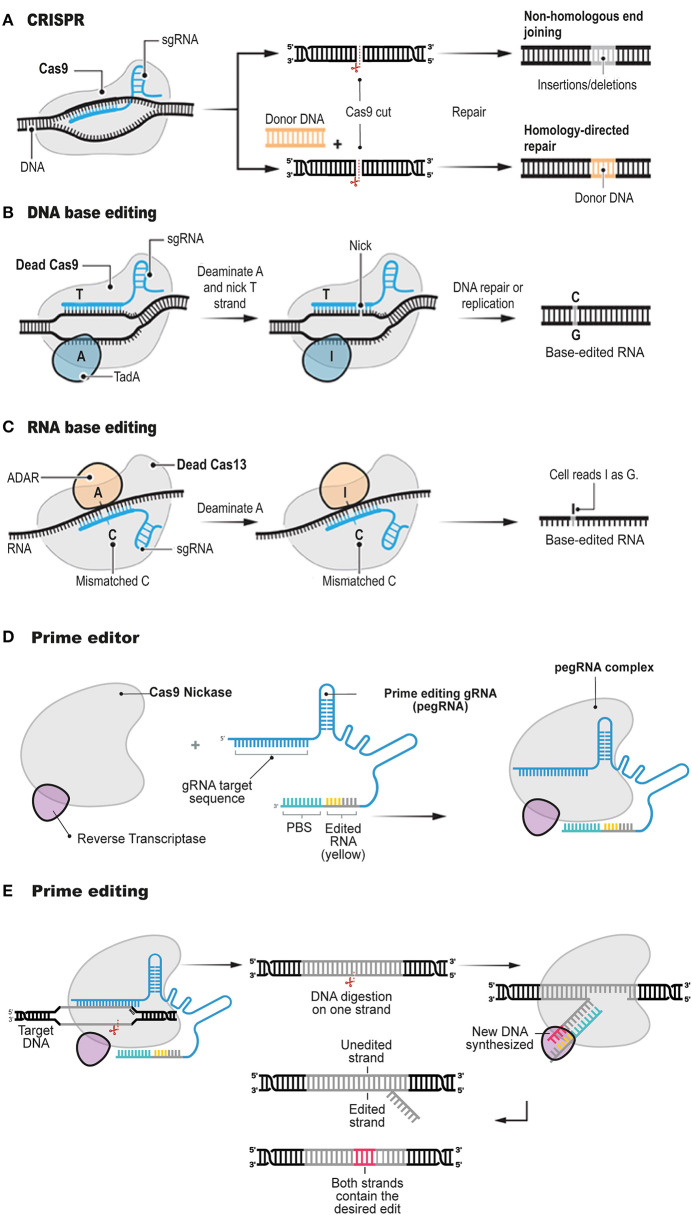
“To overcome this shortcoming, the most recent member of the CRISPR genome editing toolkit called Prime Editor (PE) has been developed to extend the scope of DNA editing beyond the four types of transition mutations.43”
From Mechanism and Applications of CRISPR/Cas-9-Mediated Genome Editing (2021) · cites this paper as [43]
Self-check
Percentages, sums and reported differences re-computed from the paper’s own numbers.
The self-check needs the paper’s full text.
Citations
Cites
The new frontier of genome engineering with CRISPR-Cas9
Doudna, J. A., & Charpentier, E. (2014) · Science · doi:10.1126/science.1258096 · Cited by 7,062
Programmable editing of a target base in genomic DNA without double-stranded DNA cleavage
Komor, A. C., Kim, Y. B., Packer, M. S., Zuris, J. A., & Liu, D. R. (2016) · Nature · doi:10.1038/nature17946 · Cited by 5,437
Programmable base editing of A•T to G•C in genomic DNA without DNA cleavage
Gaudelli, N. M., Komor, A. C., Rees, H. A., Packer, M. S., Badran, A. H., Bryson, D. I., & Liu, D. R. (2017) · Nature · doi:10.1038/nature24644 · Cited by 4,184
Targeted nucleotide editing using hybrid prokaryotic and vertebrate adaptive immune systems
Nishida, K., Arazoe, T., Yachie, N., Banno, S., Kakimoto, M., Tabata, M., Mochizuki, M., Miyabe, A., Araki, M., Hara, K. Y., et al. (2016) · Science · doi:10.1126/science.aaf8729 · Cited by 1,349
Vakulskas, C. A., Dever, D. P., Rettig, G. R., Turk, R., Jacobi, A. M., Collingwood, M. A., Bode, N. M., McNeill, M. S., Yan, S., Camarena, J., et al. (2018) · Nature Medicine · doi:10.1038/s41591-018-0137-0 · Cited by 782
A Novel Protective Prion Protein Variant that Colocalizes with Kuru Exposure
Mead, S., Whitfield, J., Poulter, M., Shah, P., Uphill, J., Campbell, T., Al-Dujaily, H., Hummerich, H., Beck, J., Mein, C. A., et al. (2009) · New England Journal of Medicine · doi:10.1056/nejmoa0809716 · Cited by 206 · cited 1×
“(2019) also succeeded in introducing a mutation that imparts resistance to prion disease in humans (Mead et al., 2009) and mice (Asante et al.”
Background
Research works printed but not linked: 33
- Anzalone, 2019, Search-and-replace genome editing without double-strand breaks or donor DNA, Nature, 576, 149, 10.1038/s41586-019-1711-4 · DOI · Paper page
- Asante, 2015, A naturally occurring variant of the human prion protein completely prevents prion disease, Nature, 522, 478, 10.1038/nature14510 · DOI
- Bollen, 2018, How to create state-of-the-art genetic model systems: strategies for optimal CRISPR-mediated genome editing, Nucleic Acids Res, 46, 6435, 10.1093/nar/gky571 · DOI
- Charpentier, 2013, Rewriting a genome, Nature, 495, 50, 10.1038/495050a · DOI
- Cong, 2013, Multiplex genome engineering using CRISPR/Cas systems, Science, 339, 819, 10.1126/science.1231143 · DOI · Paper page
- Cox, 2017, RNA editing with CRISPR-Cas13, Science, 358, 1019, 10.1126/science.aaq0180 · DOI · Paper page
- Cox, 2015, Therapeutic genome editing: Prospects and challenges, Nat. Med, 21, 121, 10.1038/nm.3793 · DOI · Paper page
- Davis, 2013, DNA double strand break repair via non-homologous end-joining, Transl. Cancer Res, 2, 130, 10.3978/j.issn.2218-676X.2013.04.02 · DOI
- Gehrke, 2018, An apobec3a-cas9 base editor with minimized bystander and off-target activities, Nat. Biotechnol, 36, 77, 10.1038/nbt.4199 · DOI
- Hilton, 2015, Enabling functional genomics with genome engineering, Genome Res, 25, 1442, 10.1101/gr.190124.115 · DOI
- Hsu, 2014, Development and applications of CRISPR-Cas9 for genome engineering, Cell, 157, 1262, 10.1016/j.cell.2014.05.010 · DOI · Paper page
- Jinek, 2013, RNA-programmed genome editing in human cells, Elife, 2, e00471, 10.7554/eLife.00471 · DOI · Paper page
- Kamens, 2015, The addgene repository: an international nonprofit plasmid and data resource, Nucleic Acids Res, 43, D1152, 10.1093/nar/gku893 · DOI
- Kim, 2019, Adenine base editors catalyze cytosine conversions in human cells, Nat. Biotechnol, 37, 1145, 10.1038/s41587-019-0254-4 · DOI
- Kim, 2017, Increasing the genome-targeting scope and precision of base editing with engineered Cas9-cytidine deaminase fusions, Nat. Biotechnol, 35, 371, 10.1038/nbt.3803 · DOI · Paper page
- Komor, 2017, Improved base excision repair inhibition and bacteriophage Mu Gam protein yields C:G-to-T: a base editors with higher efficiency and product purity, Sci. Adv., 3, eaao4774, 10.1126/sciadv.aao4774 · DOI · Paper page
- Kügler, 2003, Human synapsin 1 gene promoter confers highly neuron-specific long-term transgene expression from an adenoviral vector in the adult rat brain depending on the transduced area, Gene Ther, 10, 337, 10.1038/sj.gt.3301905 · DOI
- Li, 2008, Homologous recombination in DNA repair and DNA damage tolerance, Cell Res, 18, 99, 10.1038/cr.2008.1 · DOI
- Li, 2018, Base editing with a Cpf1-cytidine deaminase fusion, Nat. Biotechnol, 36, 324, 10.1038/nbt.4102 · DOI
- Lukacs, 2012, CFTR: folding, misfolding and correcting the ΔF508 conformational defect, Trends Mol. Med, 18, 81, 10.1016/j.molmed.2011.10.003 · DOI · Paper page
- Mali, 2013, RNA-guided human genome engineering via Cas9, Science, 339, 823, 10.1126/science.1232033 · DOI · Paper page
- Matsoukas, Commentary: programmable base editing of A·T to G·C in genomic DNA without DNA cleavage, Front. Genet, 9, 21, 10.3389/fgene.2018.00021 · DOI
- Matsoukas, Commentary: RNA editing with CRISPR-Cas13, Front. Genet, 9, 134, 10.3389/fgene.2018.00134 · DOI
- McGinniss, 2002, Eight novel mutations in the HEXA gene, Genet. Med, 4, 158, 10.1097/00125817-200205000-00010 · DOI
- Molla, 2019, CRISPR/Cas-mediated base editing: technical considerations and practical applications, Trends Biotechnol, 37, 1121, 10.1016/j.tibtech.2019.03.008 · DOI
- Rees, 2018, Base editing: precision chemistry on the genome and transcriptome of living cells, Nat. Rev. Genet, 19, 770, 10.1038/s41576-018-0059-1 · DOI · Paper page
- Savic, 2018, Covalent linkage of the DNA repair template to the CRISPR-Cas9 nuclease enhances homology-directed repair, Elife, 7, e33761, 10.7554/eLife.33761 · DOI
- Sharon, 2018, Functional genetic variants revealed by massively parallel precise genome editing, Cell, 175, 544, 10.1016/j.cell.2018.08.057 · DOI · Paper page
- Song, 2017, Optimizing the DNA donor template for homology-directed repair of double-strand breaks, Mol. Ther. Nucleic Acids, 7, 53, 10.1016/j.omtn.2017.02.006 · DOI
- Sternberg, 2015, Expanding the biologist's toolkit with CRISPR-Cas9, Mol. Cell, 58, 568, 10.1016/j.molcel.2015.02.032 · DOI
- Wang, 2018, Efficient base editing in methylated regions with a human apobec3a-cas9 fusion, Nat. Biotechnol, 36, 946, 10.1038/nbt.4198 · DOI
- Yang, 2019, Development and application of base editors, Cris. J, 2, 91, 10.1089/crispr.2019.0001 · DOI
- Yang, 2014, CRISPR/Cas9-directed genome editing of cultured cells, Curr. Protoc. Mol. Biol, 107, 31.1.1, 10.1002/0471142727.mb3101s107 · DOI
Cited by
Sorted by citations
Mechanism and Applications of CRISPR/Cas-9-Mediated Genome Editing
Mengstie, M. A., & Wondimu, B. Z. (2021) · Biologics: Targets and Therapy · doi:10.2147/btt.s326422 · Cited by 478
Recent advancements in reducing the off-target effect of CRISPR/Cas9 genome editing
Asmamaw Mengstie, M., Teshome Azezew, M., Asmamaw Dejenie, T., Teshome, A. A., Tadele Admasu, F., Behaile Teklemariam, A., Tilahun Mulu, A., Mekonnen Agidew, M., Adugna, D. G., Geremew, H., et al. (2024) · Biologics: Targets and Therapy · doi:10.2147/btt.s429411 · Cited by 91
Metadata
- Authors
- Matsoukas, I. G.
- Venue
- Frontiers in Genetics
- Publisher
- Frontiers Media SA
- Published
- 2020-06-09
- Volume
- 11
- ISSN
- 1664-8021
- PMC
- PMC7296174
- Cited by
- 65
- References
- 6
About these checks
Registry, retraction, Cites and statistics results are computed, not judged, with one exception: a printed reference that no index lists is read once by a model before it counts as a citation error. Claims are extracted by a model and kept only when their quote appears verbatim in the text; each cited source is then checked, with a model’s help, for whether it says what the claim relies on. Those verdicts can be wrong — read the claim’s quote and the cited source before relying on one.
Statistics and arithmetic are recomputed, not judged.
Confidence bands are shown only for fields calibrated on our annotated test set. None is calibrated yet, so no band is shown.
What counts as a claim ›How we measure confidence ›How we check this ›
Are you an author, or do you see a problem with this page? Request a review
