

The DOI matches its Crossref record; 211 of the 211 references it cites were found in a registry or an index.
CRISPR for accelerating genetic gains in under-utilized crops of the drylands: Progress and prospects
Open accessAbstract
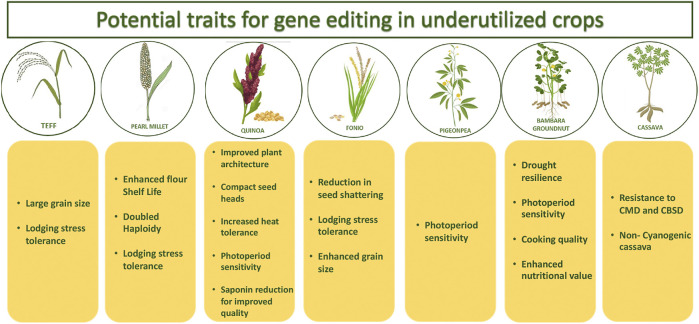
Technologies and innovations are critical for addressing the future food system needs where genetic resources are an essential component of the change process. Advanced breeding tools like "genome editing" are vital for modernizing crop breeding to provide game-changing solutions to some of the "must needed" traits in agriculture. CRISPR/Cas-based tools have been rapidly repurposed for editing applications based on their improved efficiency, specificity and reduced off-target effects. Additionally, precise gene-editing tools such as base editing, prime editing, and multiplexing provide precision in stacking of multiple traits in an elite variety, and facilitating specific and targeted crop improvement. This has helped in advancing research and delivery of products in a short time span, thereby enhancing the rate of genetic gains. A special focus has been on food security in the drylands through crops including millets, teff, fonio, quinoa, Bambara groundnut, pigeonpea and cassava. While these crops contribute significantly to the agricultural economy and resilience of the dryland, improvement of several traits including increased stress tolerance, nutritional value, and yields are urgently required. Although CRISPR has potential to deliver disruptive innovations, prioritization of traits should consider breeding product profiles and market segments for designing and accelerating delivery of locally adapted and preferred crop varieties for the drylands. In this context, the scope of regulatory environment has been stated, implying the dire impacts of unreasonable scrutiny of genome-edited plants on the evolution and progress of much-needed technological advances.
Overview
The claims and statistics of this paper haven’t been checked yet.
Run the check — free, no account needed. It reads the open-access text and checks the sources it cites.
Integrity signals
Registry
Cites
Statistics
Figures
Verification
Claims the paper makes
The claims and statistics of this paper haven’t been checked yet.
Run the check — free, no account needed. It reads the open-access text and checks the sources it cites.
Claims other papers make about this one
Each is checked against this paper’s own text: does it say what the citing paper says it does?
The cited source says what the claim attributes to it.
In the citing paper
“Research is exploring the potential of multiplex-CRISPR gene editing constructs to accelerate genetic gains in underutilized crops, focusing on traits that enhance tolerance to abiotic stresses (Sharma et al., 2022).”
From Emerging applications of gene editing technologies for the development of climate-resilient crops (2025) · cites this paper as Sharma et al., 2022
Self-check
Percentages, sums and reported differences re-computed from the paper’s own numbers.
The self-check needs the paper’s full text.
Citations
Cites
Multiplex Genome Engineering Using CRISPR/Cas Systems
Cong, L., Ran, F. A., Cox, D., Lin, S., Barretto, R., Habib, N., Hsu, P. D., Wu, X., Jiang, W., Marraffini, L. A., et al. (2013) · Science · doi:10.1126/science.1231143 · Cited by 15,339
Programmable editing of a target base in genomic DNA without double-stranded DNA cleavage
Komor, A. C., Kim, Y. B., Packer, M. S., Zuris, J. A., & Liu, D. R. (2016) · Nature · doi:10.1038/nature17946 · Cited by 5,437
Search-and-replace genome editing without double-strand breaks or donor DNA
Anzalone, A. V., Randolph, P. B., Davis, J. R., Sousa, A. A., Koblan, L. W., Levy, J. M., Chen, P. J., Wilson, C., Newby, G. A., Raguram, A., et al. (2019) · Nature · doi:10.1038/s41586-019-1711-4 · Cited by 4,767
ZFN, TALEN, and CRISPR/Cas-based methods for genome engineering
Gaj, T., Gersbach, C. A., & Barbas, C. F. (2013) · Trends in Biotechnology · doi:10.1016/j.tibtech.2013.04.004 · Cited by 3,820
Breaking the Code of DNA Binding Specificity of TAL-Type III Effectors
Boch, J., Scholze, H., Schornack, S., Landgraf, A., Hahn, S., Kay, S., Lahaye, T., Nickstadt, A., & Bonas, U. (2009) · Science · doi:10.1126/science.1178811 · Cited by 2,470
Evolutionary classification of CRISPR–Cas systems: a burst of class 2 and derived variants
Makarova, K. S., Wolf, Y. I., Iranzo, J., Shmakov, S. A., Alkhnbashi, O. S., Brouns, S. J. J., Charpentier, E., Cheng, D., Haft, D. H., Horvath, P., et al. (2020) · Nature Reviews Microbiology · doi:10.1038/s41579-019-0299-x · Cited by 2,445
RNA-guided editing of bacterial genomes using CRISPR-Cas systems
Jiang, W., Bikard, D., Cox, D., Zhang, F., & Marraffini, L. A. (2013) · Nature Biotechnology · doi:10.1038/nbt.2508 · Cited by 2,429
‘Green revolution’ genes encode mutant gibberellin response modulators
Peng, J., Richards, D. E., Hartley, N. M., Murphy, G. P., Devos, K. M., Flintham, J. E., Beales, J., Fish, L. J., Worland, A. J., Pelica, F., et al. (1999) · Nature · doi:10.1038/22307 · Cited by 2,237
RNA targeting with CRISPR–Cas13
Abudayyeh, O. O., Gootenberg, J. S., Essletzbichler, P., Han, S., Joung, J., Belanto, J. J., Verdine, V., Cox, D. B. T., Kellner, M. J., Regev, A., et al. (2017) · Nature · doi:10.1038/nature24049 · Cited by 2,093
Hilton, I. B., D’Ippolito, A. M., Vockley, C. M., Thakore, P. I., Crawford, G. E., Reddy, T. E., & Gersbach, C. A. (2015) · Nature Biotechnology · doi:10.1038/nbt.3199 · Cited by 1,931
Research works printed but not linked: 6
- Chang, 2018, Genomic data of the Bambara groundnut (Vigna subterranea), GigaScience, 10, 1055
- Preliminary report -Review of food derived using new breeding techniques –consultation outcomes2018
- Laaninen, 2019, New plant-breeding techniques Applicability of EU GMO rules
- Ngalamu, 2015, Cowpea production handbook
- Rojas-Vasquez, 2020, Use of genome editing technologies for genetic improvement of crops of tropical origin, Plant Cell, Tissue and Organ Culture (PCTOC), 140, 215, 10.1111/pbi.13635 · DOI · Paper page
- Sharma, 2015, Biochemical characterization of pearl millet
Cited by
Sorted by citations
Genome editing in food and agriculture: from regulations to consumer perspectives
Atimango, A. O., Wesana, J., Kalule, S. W., Verbeke, W., & Steur, H. D. (2024) · Current Opinion in Biotechnology · doi:10.1016/j.copbio.2024.103127 · Cited by 48
Emerging applications of gene editing technologies for the development of climate-resilient crops
Chavhan, R. L., Jaybhaye, S. G., Hinge, V. R., Deshmukh, A. S., Shaikh, U. S., Jadhav, P. K., Kadam, U. S., & Hong, J. C. (2025) · Frontiers in Genome Editing · doi:10.3389/fgeed.2025.1524767 · Cited by 55
Current trends and prospects in quinoa research: An approach for strategic knowledge areas
Martínez, D. H. F., Cortina, J. R., Chavez‐Oliveros, L. F., Aguilera‐Arango, G. A., & Castañeda, A. M. (2023) · Food Science & Nutrition · doi:10.1002/fsn3.3891 · Cited by 26
Chawla, R., Poonia, A., Samantara, K., Mohapatra, S. R., Naik, S. B., Ashwath, M. N., Djalović, I. G., & Prasad, P. V. V. (2023) · Frontiers in Genetics · doi:10.3389/fgene.2023.1204585 · Cited by 23
Devkota, K. P., Devkota, M., Mabhaudhi, T., Nangia, V., Attaher, S. M., Boroto, R. J., Timsina, J., & Siddique, K. H. M. (2025) · Food and Energy Security · doi:10.1002/fes3.70046 · Cited by 16
Tahakik, R., Deshmukh, A. G., Moharil, M. P., Jadhav, P. V., Kogade, V., More, K. D., & Shinde, V. P. (2024) · Bulletin of the National Research Centre/Bulletin of the National Research Center · doi:10.1186/s42269-024-01281-4 · Cited by 11
Millet biofortification for enhanced iron content: Roadmap for combating hidden hunger
Chaudhary, R., Sharma, C., Kumar, V., Rajput, V. S., Naik, B., Prasad, R., Sharma, S., & Kumar, V. (2025) · Journal of Agriculture and Food Research · doi:10.1016/j.jafr.2025.101654 · Cited by 11
Gelaye, Y., & Luo, H. (2025) · Crop Science · doi:10.1002/csc2.70145 · Cited by 10
Advancements in Genetic Enhancement: CRISPR/Cas-Mediated Genome Editing in Leguminous Crops
Roy, A., & Sandhu, R. (2024) · Journal of Advances in Biology & Biotechnology · doi:10.9734/jabb/2024/v27i6927 · Cited by 9
Wang, Y., Tang, Q., Kang, Y., Wang, X., Zhang, H., & Li, X. (2022) · Cells · doi:10.3390/cells11213471 · Cited by 9
Gene editing tool kit in millets: present status and future directions
Sapara, V., Khisti, M., Yogendra, K. N., & Reddy, P. S. (2024) · The Nucleus · doi:10.1007/s13237-024-00485-3 · Cited by 8
Steps to transform African opportunity crops into reality crops
Rutsaert, P., Achigan-Dako, E. G., Ayenan, M. A. T., Chamberlin, J., Daudi, H., Houdegbe, A. C., Kresovich, S., Mbugua-Gitonga, A., Nas, T. M. S., Ojiewo, C. O., et al. (2026) · Nature Communications · doi:10.1038/s41467-026-70990-3 · Cited by 5
Aher, R. R., & Reddy, P. S. (2025) · Journal of Plant Biochemistry and Biotechnology · doi:10.1007/s13562-025-00982-9 · Cited by 5
Bu, G., Ma, X., Jin, H., & Wang, L. (2025) · International Journal of Biological Macromolecules · doi:10.1016/j.ijbiomac.2025.144785 · Cited by 4
RetractedMapping the plant genome: CRISPR/Cas9 as a toolkit for functional genomics
Thabet, S. G., Elkelish, A., Dawood, M. F. A., Safhi, F. A., Alhudhaibi, A. M., Börner, A., & Alqudah, A. M. (2025) · Acta Physiologiae Plantarum · doi:10.1007/s11738-025-03872-8 · Cited by 4
Swain, S., Debnath, S., Khamassi, K., Samantara, K., Ram, P., Kumar, A., Mahawer, A. K., & Kaul, T. (2025) · Plant Gene · doi:10.1016/j.plgene.2025.100534 · Cited by 4
Mazumder, S., Bhattacharya, D., Lahiri, D., & Nag, M. (2026) · Journal of Crop Science and Biotechnology · doi:10.1007/s12892-025-00337-9 · Cited by 1
Kavitha, N. K. R., Suyambu, R., Parthiban, P., Balasubramani, G., & Pandian, A. (2026) · Journal of environmental chemical engineering · doi:10.1016/j.jece.2026.122389 · Cited by 1
Crop wild relatives of legumes: evolutionary resources for climate-responsive pre-breeding
Avasiloaiei, D. I., Calara, M., Brezeanu, P. M., Burzo, I., & Brezeanu, C. (2026) · Frontiers in Plant Science · doi:10.3389/fpls.2026.1892793 · Cited by 1
Current status and development trend of cassava breeding
Chen, S., Cai, J., An, F., Zhu, W., Luo, X., Xue, J., Xue, M., HanFeng, L. I., Wei, Z., Huang, S., et al. (2024) · Scientia Sinica Vitae · doi:10.1360/ssv-2024-0256 · Cited by 1
Application of Genome Editing Technologies to Improve Grain Quality of Pulses
Khezri, M., Zakaria, R. A., & Zare, N. (2025) · Sustainable landscape planning and natural resources management · doi:10.1007/978-3-031-81639-0_14
Waktola, M., & Dabalo, A. (2025) · Journal of Plant Sciences · doi:10.11648/j.jps.20251303.16
Resistance of Common Bean (Phaseolus vulgaris L.) Varieties to Bruchid Infestation in Burundi
Nsabimana, A., Shechambo, L. F., & Lyimo, P. J. (2025) · Journal of Current Opinion in Crop Science · doi:10.62773/jcocs.v6i4.351
ADVANCES IN TISSUE CULTURE FOR LEGUME IMPROVEMENT
Rawte, S., Jha, Z., Sahu, H. K., Nandedkar, K., & Xalxo, M. S. (2026) · Genetics and Molecular Research · doi:10.4238/b1k7wy73
Appraising the potential of gene editing in Zimbabwe’s crop improvement programmes: a review
Mativavarira, M., ZİMUTO, T., Chingwaru, W., Manhokwe, S., Chitsiku, R. L., Murashiki, T. C., Bhusvumani, S., Njanji, R., Mubani, M. A., Chirilele, P., et al. (2026) · Cogent Food & Agriculture · doi:10.1080/23311932.2026.2719964
Current status and challenges of food biotechnology in Africa
Mmbando, G. S. (2026) · Discover Biotechnology · doi:10.1007/s44340-026-00063-0
Metadata
- Authors
- Sharma, K. K., Palakolanu, S. R., Bhattacharya, J., Shankhapal, A. R., & Bhatnagar-Mathur, P.
- Affiliations
- Energy and Resources Institute (IN)
- International Crops Research Institute for the Semi-Arid Tropics (IN)
- University of Nottingham (GB)
- Corresponding author
- Sharma, Kiran K.
- Venue
- Frontiers in Genetics
- Publisher
- Frontiers Media SA
- Published
- 2022-10-06
- Volume
- 13
- Pages
- 999207-999207
- ISSN
- 1664-8021 (ISSN-L)
- PMC
- PMC9582247
- OpenAlex
- W4303192285
- Cited by
- 24
- References
- 209
- Citations by year
- 2026: 6 · 2025: 10 · 2024: 5 · 2023: 2 · 2022: 1
- FWCI
- 0.47
- Type
- journal article
- Language
- en
- Open access
- gold
- doi.org
- Licence
- Locations
- Frontiers in Genetics (publishedVersion, cc-by)
- PubMed Central (publishedVersion, cc-by)
- PubMed (publishedVersion)
- Open Access Repository of ICRISAT (International Crops Research Institute for the Semi-Arid Tropics) (acceptedVersion)
- Rothamsted Repository (Rothamsted Repository) (acceptedVersion, other-oa)
- DOAJ (DOAJ: Directory of Open Access Journals) (submittedVersion, cc-by-sa)
- Funders
- Consortium of International Agricultural Research Centers
- Topics
- Life Sciences › Biochemistry, Genetics and Molecular Biology › Molecular Biology › CRISPR and Genetic Engineering
- Life Sciences › Agricultural and Biological Sciences › Plant Science › Genetically Modified Organisms Research
- Life Sciences › Agricultural and Biological Sciences › Agronomy and Crop Science › Agricultural Productivity and Crop Improvement
- Keywords
- CRISPR/Cas genome editing, rainfed agriculture, genetic gain, base editing, prime editing, multiplex genome editing, millet, Eragrostis tef, fonio, quinoa, Vigna subterranea, Cajanus cajan, cassava, stress tolerance, nutritional improvement, yield improvement, food security
About these checks
Registry, retraction, Cites and statistics results are computed, not judged, with one exception: a printed reference that no index lists is read once by a model before it counts as a citation error. Claims are extracted by a model and kept only when their quote appears verbatim in the text; each cited source is then checked, with a model’s help, for whether it says what the claim relies on. Those verdicts can be wrong — read the claim’s quote and the cited source before relying on one.
Statistics and arithmetic are recomputed, not judged.
Confidence bands are shown only for fields calibrated on our annotated test set. None is calibrated yet, so no band is shown.
What counts as a claim ›How we measure confidence ›How we check this ›
Are you an author, or do you see a problem with this page? Request a review
