

The DOI matches its Crossref record; 23 of the 23 references it cites were found in a registry or an index; 8 of the 11 sources its claims cite were checked for support.
Mediating memory through immersive technologies and artificial intelligence: revisiting individual and collectively co-created pasts and futures
Open accessAbstract
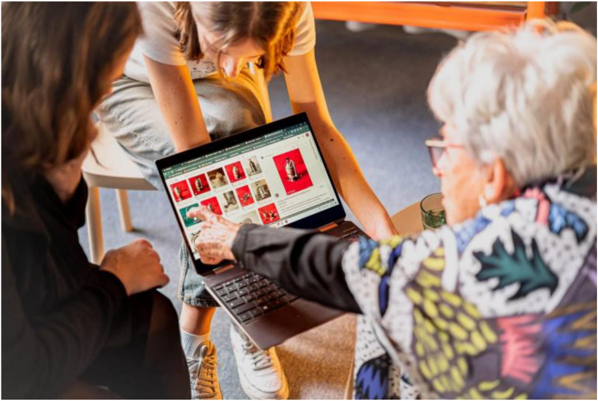
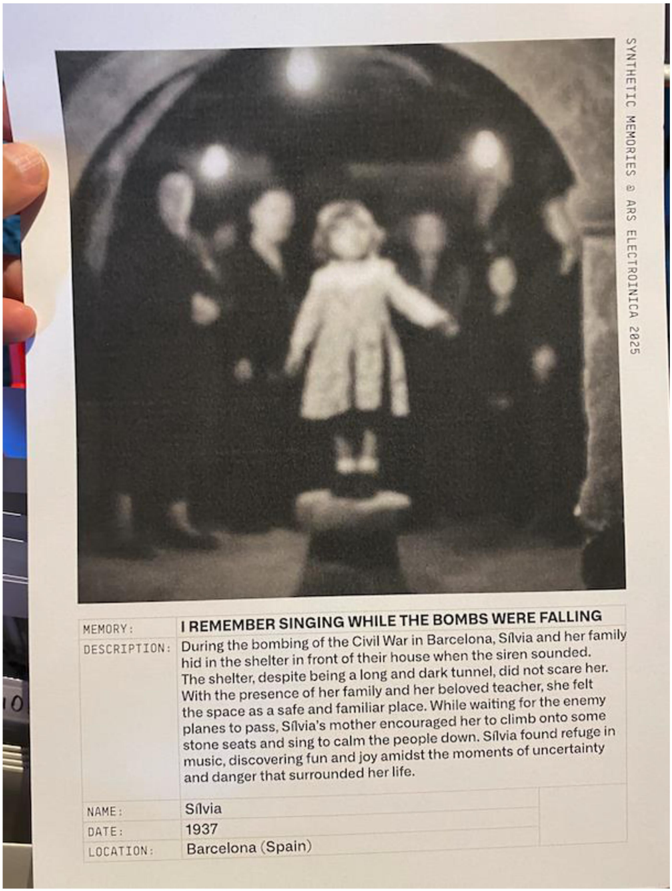
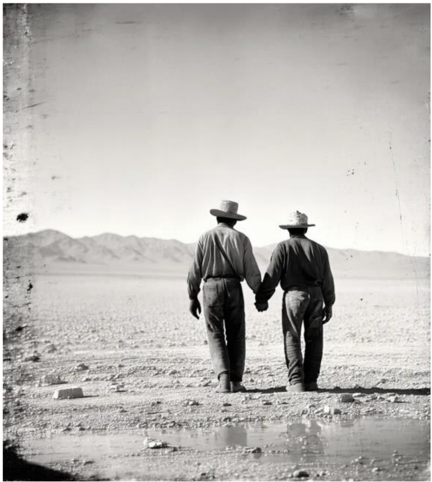
Extended Reality (XR) is transforming the ways in which memory, identity, and history are mediated and preserved, creating new possibilities for decentralised storytelling and inclusivity. In recent years, new ways of engaging with memory reconstruction through XR and Artificial Intelligence (AI) have emerged via collective, participatory, and co-creative design processes. These practices open new pathways for collectively rethinking and re-enacting the past. Through this lens, memory becomes both a mediated artifact and a living process, inviting individual and community participation in constructing shared pasts and speculative future realities. This perspective piece investigates how, through XR and AI, memory becomes both a mediated artifact and a living process, enabling new co-creative methodologies for reframing, reconstructing, and safeguarding individual and collective past. We propose a three-level conceptual framework—therapeutic-personal, community-cultural, and socio-political—to categorize these mediated memory practices. Our analysis draws on illustrative qualitative case studies integrating AI, XR, and participatory design, including Stay Alive, My Son VR (Ume Studios, 2024), Synthetic Memories: Live Reconstruction (Domestic Data Streamers, 2024), How to Find the Soul of a Sailor (Molga, 2025), and Un archivo inexistente (Rivas San Martín, 2022). These projects are examined for their approaches to co-authorship, affective memory reconstruction, archival absence, data ethics, and the translation of individual memory into collective narrative forms. Our critical reading of these projects suggests how AI-XR functions as an expanded format enabling diverse approaches to memory preservation and transmission across personal, political, and cultural contexts. These works demonstrate how projects that bring together XR and AI can democratise access to history and intimate past events, while also complicating ethical boundaries between remembrance, simulation, and spectacle.
Overview
CoChat Summary
TL;DR
This perspective article proposes a three-level framework—therapeutic-personal, community-cultural, and socio-political—for understanding how AI and XR mediate individual and collective memory. Through four illustrative case studies, it argues that AI-XR can democratise memory work and support co-created pasts and futures, while raising ethical risks around simulation, bias, consent, and spectacle.
Key findings
- The paper proposes a three-level conceptual framework for AI-XR memory practices: therapeutic-personal, community-cultural, and socio-political, each with distinct affordances and ethical stakes.
- It analyses four projects—*Stay Alive, My Son VR* (Ume Studios, 2024), *Synthetic Memories: Live Reconstruction* (Domestic Data Streamers, 2024), *How to Find the Soul of a Sailor* (Molga, 2025), and *Un archivo inexistente* (Rivas San Martín, 2022)—showing how AI-XR can reconstruct undocumented, fragmented, or absent memories.
- The paper reports that VR can actively intervene in memory formation, citing Iriye and St. Jacques (2021) that third-person avatar encoding produces less vivid, less accurate, and less spatially rich memories, with effects persisting after a one-week delay.
- It identifies design commitments including dynamic ongoing consent, visibly imperfect synthetic images to avoid false recall, prioritising user agency over hyper-realistic simulation, and community governance over prompts, models, and data outputs.
Methods
- Perspective article using a conceptual framework and illustrative qualitative case studies rather than original empirical data collection.
- Four purposively selected AI-XR projects were chosen because they map onto the framework’s levels and represent diverse digital heritage and artistic practice.
- Main analysis is a critical cross-case reading of co-authorship, affective memory reconstruction, archival absence, data ethics, and translation of individual memory into collective narrative forms, summarised in a cross-case table.
Limitations
- The paper states it is a Perspective article and that the extension of “states of memory” into collective and community-based contexts remains underexplored; it also warns that positioning AI-XR as co-creative and speculative risks techno-optimistic overreach unless tempered by participatory ethics and community governance.
- Evident from the text: the analysis relies on four illustrative cases and secondary literature, with no primary empirical evaluation, participant sample, or quantitative outcome measures reported.
- Evident from the text: the case selection is purposive and framework-driven, so findings are not presented as generalisable to all AI-XR memory practices.
Model-written summary. Check it against the paper before relying on it.
Integrity signals
Registry
Cites
Statistics
Figures
Verification
Claims the paper makes
5 Valid · 1 Not valid · 1 Not checked · 21 Own results and interpretations
At least one cited source doesn’t support this claim or points to a different paper, and none confirmed it — see the verdicts below.
In the paper
“Iriye and St. Jacques (2021) demonstrated that encoding events from a third-person avatar perspective produces measurably less vivid, less accurate, and less spatially rich memories, with effects persisting after a one-week delay.”
§ Mediating memory through immersive technologies and artificial intelligence: revisiting individual and collectively co-created pasts and futures > Mediating memory with XR
What the sources say
- Disputedcites Iriye and St. Jacques (2021) sourceExperimental — accuracy not yet measured
The General discussion reports no reliable difference between perspectives in visual accuracy or vividness, including after the one-week delay. It reports higher spatial accuracy for third-person events in Study One, not less spatially rich memories; that advantage did not persist in Study Two. (LLM, conf=0.90)
Checked by a reasoning model — may be wrong.
boostedstates a cause- Asserted: passes — The authors put it forward as true.
- Checkable: passes — It can be checked against evidence.
- Load-bearing: passes — The paper’s conclusions depend on it.
- Based: passes — The paper gives a reason why it holds.
- Disputed
Every source the paper cites for this claim was checked and supports it.
In the paper
“XR enables conditions that are simultaneously controlled and ecologically validthat is, realistic enough to resemble the settings in which memories actually formthrough embodied, first-person enactment in space and time (Lenormand et al., 2024;Penaud et al., 2023).”
§ Mediating memory through immersive technologies and artificial intelligence: revisiting individual and collectively co-created pasts and futures > Mediating memory with XR
What the sources say
- Supportedcites Lenormand et al., 2024 source
The Introduction says VR combines ecological, immersive experiences with experimental control, bringing memory encoding closer to real-life conditions. The Encoding protocol describes participants exploring a virtual city and encountering realistic events in specific spatial and temporal contexts, some of which they interacted with. These passages support the citing sentence’s characterization of controlled, realistic, first-person experience. (LLM, conf=0.88)
- Supportedcites Penaud et al., 2023 source
The Introduction says VR can create self-involving, ecologically valid environments for studying memory while maintaining a high degree of experimental control. The Methods describe participants navigating everyday-life events in a first-person virtual environment, supporting the embodied enactment aspect of the claim. (LLM, conf=0.92)
plainstates a cause- Asserted: passes — The authors put it forward as true.
- Checkable: passes — It can be checked against evidence.
- Load-bearing: passes — The paper’s conclusions depend on it.
- Based: passes — The paper gives a reason why it holds.
- Supported
The cited sources support only part of this claim — read each source’s verdict below.
In the paper
“Bonnail et al. (2023).argue XR's capacity to leverage perceptual richness also renders it a potential instrument for what they term XR Memory Manipulations (XRMMs)deliberate or inadvertent interventions in encoding, consolidation, and retrieval that can distort, suppress, or artificially strengthen personal memories.”
§ Mediating memory through immersive technologies and artificial intelligence: revisiting individual and collectively co-created pasts and futures > Mediating memory with XR
What the sources say
- Partly supportedcites Bonnail et al. (2023) sourceExperimental — accuracy not yet measured
Split into 2 atoms — 0 confirmed, 2 partially supported, 0 disputed, 0 misattributed, 0 unverifiable. Expand the claim to see per-atom verdicts.
hedgedstates a possible cause- Asserted: passes — The authors put it forward as true.
- Checkable: passes — It can be checked against evidence.
- Load-bearing: passes — The paper’s conclusions depend on it.
- Based: passes — The paper gives a reason why it holds.
- Partly supported
None of the sources cited for this claim have been checked yet.
In the paper
“The project demonstrated that spatial immersion amplifies the affective impact of synthetic memory reconstruction.”
§ Mediating memory through immersive technologies and artificial intelligence: revisiting individual and collectively co-created pasts and futures > AI-XR and the collective mediation of memory
boostedstates a cause- Asserted: passes — The authors put it forward as true.
- Checkable: passes — It can be checked against evidence.
- Load-bearing: passes — The paper’s conclusions depend on it.
- Based: passes — The paper gives a reason why it holds.
A conclusion the paper draws from its own results — it cites no other source for it, so there is none to check. The quote shows it is in the paper.
In the paper
“Today, the convergence of XR and AI is shifting how individuals and communities engage with personal and social histories.”
§ Mediating memory through immersive technologies and artificial intelligence: revisiting individual and collectively co-created pasts and futures > AI-XR and the collective mediation of memory
plainstates a cause- Asserted: passes — The authors put it forward as true.
- Checkable: passes — It can be checked against evidence.
- Load-bearing: passes — The paper’s conclusions depend on it.
- Based: passes — The paper gives a reason why it holds.
9 more claims
Create a free account to see all 28 claims and every source verdict.
- It may state two separate claims as one. 12
- Probably not a substantial claim. 4
Self-check
Percentages, sums and reported differences re-computed from the paper’s own numbers.
Each contradiction between two passages listed here was confirmed by an independent check.
Rated minor: it would not touch a result — a value no result rests on, a p-value that stays on the same side of the significance level, or a conflict that is clerical, resolved elsewhere in the paper, or outside its own findings.
In the paper
§ Mediating memory through immersive technologies and artificial intelligence: revisiting individual and collectively co-created pasts and futures > Introduction
“As Hoskins (2011, p. 78) observes”
§ Mediating memory through immersive technologies and artificial intelligence: revisiting individual and collectively co-created pasts and futures > References
“Hoskins, A. (2011). 7/7 And connective memory: interactional trajectories of remembering in post-scarcity culture. Mem. Stud. 4 (3), 269-280.”
Citations
Cites
Camera Lucida: Reflections on Photography
Barthes, R. (2001) · Reading Images · doi:10.1007/978-1-137-08886-4_6 · Cited by 5,456
Halbwachs, M., & Coser, L. A. (1992) · doi:10.7208/chicago/9780226774497.001.0001 · Cited by 4,939
At the Heart of It All: The Concept of Presence
Lombard, M., & Ditton, T. (2006) · Journal of Computer-Mediated Communication · doi:10.1111/j.1083-6101.1997.tb00072.x · Cited by 3,706
Place illusion and plausibility can lead to realistic behaviour in immersive virtual environments
Slater, M. (2009) · Philosophical Transactions of the Royal Society B: Biological Sciences · doi:10.1098/rstb.2009.0138 · Cited by 2,691
Data colonialism: rethinking big data’s relation to the contemporary subject
Couldry, N., & Mejias, U. A. (2019) · Television & New Media · doi:10.1177/1527476418796632 · Cited by 1,617
Recommendations for Good Scientific Practice and the Consumers of VR-Technology
Madary, M., & Metzinger, T. K. (2016) · Frontiers in Robotics and AI · doi:10.3389/frobt.2016.00003 · Cited by 435
7/7 and connective memory: Interactional trajectories of remembering in post-scarcity culture
Hoskins, A. (2011) · Memory Studies · doi:10.1177/1750698011402570 · Cited by 200
Virtual reality witness: exploring the ethics of mediated presence
Nash, K. (2018) · Studies in Documentary Film · doi:10.1080/17503280.2017.1340796 · Cited by 188
AI as a co-creator and a design material: Transforming the design process
Yu, W. F. (2025) · Design Studies · doi:10.1016/j.destud.2025.101303 · Cited by 130
Problematising reality: the promises and perils of synthetic media
Kalpokas, I. (2020) · SN Social Sciences · doi:10.1007/s43545-020-00010-8 · Cited by 53
Research works printed but not linked: 2
- Ávila Pinto, 2018, Digital sovereignty or digital colonialism?, Sur., 15, 15
- Kapur, 2026, Synthetic realities: audience and creator perspectives on AI-integrated documentaries, 203
Metadata
- Authors
- Kapur, A., & Sora-Domenjó, C.
- Affiliations
- CINEMAD
- Image Processing and Multimedia Technology Centre, Polytechnic University of Catalonia
- Corresponding author
- Kapur, Anandana
- Venue
- Frontiers in Human Dynamics
- Publisher
- Frontiers Media SA
- Published
- 2026-08-27
- Volume
- 8
- ISSN
- 2673-2726 (ISSN-L)
- OpenAlex
- W7204445785
- Cited by
- 0
- References
- 17
- FWCI
- 0.00
- Type
- journal article
- Language
- en
- Open access
- gold
- doi.org
- Licence
- Locations
- Frontiers in Human Dynamics (publishedVersion, cc-by)
- UPCommons institutional repository (Universitat Politècnica de Catalunya) (publishedVersion, cc-by)
- Topics
- Social Sciences › Cultural Studies › Memory, Trauma, and Commemoration
- Physical Sciences › Computer Science › Human-Computer Interaction › Virtual Reality Applications and Impacts
- Social Sciences › Cultural Studies › Memory, History, Trauma, Identity
- Keywords
- mediated memory, extended reality, artificial intelligence, collective memory, memory reconstruction, participatory design, co-creative design, memory preservation, emotional memory, data ethics, speculative futures, co-authorship, history and identity, democratization of history
About these checks
Registry, retraction, Cites and statistics results are computed, not judged, with one exception: a printed reference that no index lists is read once by a model before it counts as a citation error. Claims are extracted by a model and kept only when their quote appears verbatim in the text; each cited source is then checked, with a model’s help, for whether it says what the claim relies on. Those verdicts can be wrong — read the claim’s quote and the cited source before relying on one.
The claim verdicts this report counts are experimental: their accuracy is not yet measured.
A language model drew the claims from the paper on 2026-09-30, under version 3 of the claim definition (model deepseek-v4.1-flash, prompt extract-v3).
A second model labelled each claim on 2026-09-30 (model jev-1.13-20260917, definition revision gold-guideline-v0.2).
Cited sources are checked with a language model’s help (gpt-6-sol).
Statistics and arithmetic are recomputed, not judged.
Confidence bands are shown only for fields calibrated on our annotated test set. None is calibrated yet, so no band is shown.
What counts as a claim ›How we measure confidence ›How we check this ›
Are you an author, or do you see a problem with this page? Request a review
How to cite
Cite CoChat for the checks on this page, and the paper for its own findings.
- This page
- CoChat. (2026). Citation check: Mediating memory through immersive technologies and artificial intelligence: revisiting individual and collectively co-created pasts and futures. https://app.cochat.ai/papers/10.3389/fhumd.2026.1891875
- The paper
- Kapur, A., & Sora-Domenjó, C. (2026). Mediating memory through immersive technologies and artificial intelligence: revisiting individual and collectively co-created pasts and futures. Frontiers in Human Dynamics. https://doi.org/10.3389/fhumd.2026.1891875
Data sources
Bibliographic data: Semantic Scholar, OpenAlex, Crossref.
Contains information from the Semantic Scholar Academic Graph Datasets, made available under the ODC Attribution License (ODC-BY 1.0).
Semantic Scholar’s data is described in: Kinney, R., et al. (2023). The Semantic Scholar Open Data Platform. arXiv:2301.10140.
