

The DOI matches its Crossref record; 149 of the 149 references it cites were found in a registry or an index.
Decoding episodic autobiographical memory in naturalistic virtual reality
Open accessAbstract
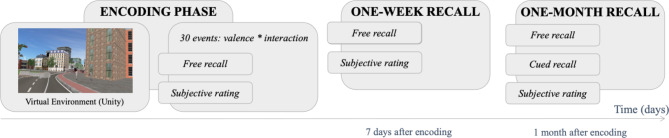
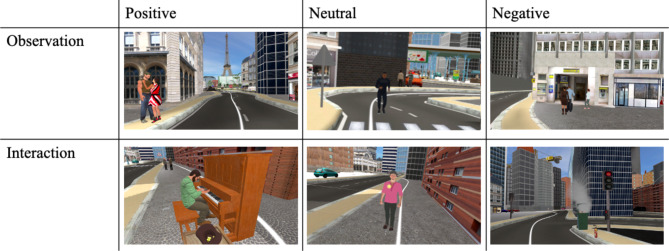
Episodic autobiographical memory (EAM) is a long-term memory system of personally experienced events with their context – what, where, when – and subjective elements, e.g., emotions, thoughts, or self-reference. EAM formation has rarely been studied in a controlled, real-life-like paradigm, and there is no predictive model of long-term retrieval from self-rated subjective experience at encoding. The present longitudinal study, with three surprise free recall memory tests immediately, one-week and one-month after encoding, investigated incidental encoding of EAM in an immersive virtual environment where 30 participants either interacted with or observed specific events of varying emotional valences with simultaneous physiological recordings. The predictive analyses highlight the temporal dynamics of the predictors of EAM from subjective ratings at encoding: common characteristics related to sense of remembering and infrequency of real-life encounter of the event were identified over time, but different variables become relevant at different time points, such as the emotion and mental imagery or prospective aspects. This dynamic and time-dependent role of memory predictors challenges traditional views of a uniform influence of encoding factors over time. Current evidence for the multiphasic nature of memory formation points to the role of different mechanisms at play during encoding but also consolidation and subsequent retrieval.
Overview
The claims and statistics of this paper haven’t been checked yet.
Free: it reads the open-access text and checks the first 5 claims that cite a source we can check. Create a free account to check every claim.
Integrity signals
Registry
Cites
Statistics
Figures


Verification
Claims the paper makes
The claims and statistics of this paper haven’t been checked yet.
Free: it reads the open-access text and checks the first 5 claims that cite a source we can check. Create a free account to check every claim.
Claims other papers make about this one
Each is checked against this paper’s own text: does it say what the citing paper says it does?
The cited source says what the claim attributes to it.
In the citing paper
“XR enables conditions that are simultaneously controlled and ecologically validthat is, realistic enough to resemble the settings in which memories actually formthrough embodied, first-person enactment in space and time (Lenormand et al., 2024;Penaud et al., 2023).”
From Mediating memory through immersive technologies and artificial intelligence: revisiting individual and collectively co-created pasts and futures (2026) · cites this paper as Lenormand et al., 2024
Self-check
Percentages, sums and reported differences re-computed from the paper’s own numbers.
The self-check needs the paper’s full text.
Citations
Cites
lmerTest Package: Tests in Linear Mixed Effects Models
Kuznetsova, A., Brockhoff, P. B., & Christensen, R. H. B. (2017) · Journal of Statistical Software · doi:10.18637/jss.v082.i13 · Cited by 24,346
Russell, J. A. (1980) · Journal of Personality and Social Psychology · doi:10.1037/h0077714 · Cited by 16,334
Simulator Sickness Questionnaire: An Enhanced Method for Quantifying Simulator Sickness
Kennedy, R. S., Lane, N. E., Berbaum, K. S., & Lilienthal, M. G. (1993) · The International Journal of Aviation Psychology · doi:10.1207/s15327108ijap0303_3 · Cited by 5,457
Tulving, E. (1985) · Canadian Psychology / Psychologie canadienne · doi:10.1037/h0080017 · Cited by 4,638
The construction of autobiographical memories in the self-memory system
Conway, M. A., & Pleydell-Pearce, C. W. (2000) · Psychological Review · doi:10.1037/0033-295x.107.2.261 · Cited by 4,089
State-Trait Anxiety Inventory for Adults
Spielberger, C. D. (2012) · PsycTESTS Dataset · doi:10.1037/t06496-000 · Cited by 3,479 · cited 1×
“Exclusion criteria were signs of depression (score > 15 on the Beck Depression Inventory 97 ), high travel sickness (score > 7 on the Simulator Sickness Questionnaire 98 ), and anxiety (score > 65 on the State-Trait Anxiety Inventory-Form Y 99 ).”
Looking at pictures: Affective, facial, visceral, and behavioral reactions
LANG, P. J., GREENWALD, M. K., BRADLEY, M. M., & HAMM, A. O. (1993) · Psychophysiology · doi:10.1111/j.1469-8986.1993.tb03352.x · Cited by 3,190
POSNER, J., RUSSELL, J. A., & PETERSON, B. S. (2005) · Development and Psychopathology · doi:10.1017/s0954579405050340 · Cited by 2,602
Emotion and motivation I: Defensive and appetitive reactions in picture processing.
Bradley, M. M., Codispoti, M., Cuthbert, B. N., & Lang, P. J. (2001) · Emotion · doi:10.1037/1528-3542.1.3.276 · Cited by 2,224 · cited 1×
“Furthermore, the EDA amplitude is enhanced for emotional pictures compared with neutral ones 75 and changes in the EDA famously correlate with the emotional intensity 76,77 .”
Conway, M. A. (2005) · Journal of Memory and Language · doi:10.1016/j.jml.2005.08.005 · Cited by 2,155
Research works printed but not linked: 5
- Plancher, G. & Piolino, P. In the Role of Technology in Clinical Neuropsychology 237–262 (Oxford University Press, 2017).
- Allen, P. A., Kaut, K. P. & Lord, R. R. in Handbook of Behavioral Neuroscience Vol. 18 (eds Ekrem Dere, Alexander Easton, Lynn Nadel, & Joseph P. Huston) 115–132 (Elsevier, 2008).
- Beck, A. T., Steer, R. A. & Brown, G. K. Beck depression inventory-II. San Antonio. 78, 490–498 (1996).
- Cermak, L. S. In In Neuropsychology of Memory. (eds Squire, L. R. & Butters, N.) (Guilford Press, 1984).
- Glenberg, A. M., Bradley, M. M., Kraus, T. A. & Renzaglia G. J. 231–255American Psychological Association, (1983). · doi:10.1037//0278-7393.9.2.231
Cited by
Toward embodied, ecological cognition with ambulatory virtual reality
Hill, P. F., & Ekstrom, A. D. (2026) · Trends in Cognitive Sciences · doi:10.1016/j.tics.2026.01.007 · Cited by 2
Yeh, D., Mam-Lam-Fook, C., Penaud, S., Santos, M. D., Martínez, G., Bourgin, J., Lucarini, V., Orriols, É., Berthoz, A., Krebs, M., et al. (2025) · Journal of Environmental Psychology · doi:10.1016/j.jenvp.2025.102712 · Cited by 1
Self-citationvan Berlo, Z. M. C., Belleman, R. G., van der Kaaij, J., Lehmann, B. A., Gielen, A. T. S., & Meijers, M. H. C. (2025) · Environmental Communication · doi:10.1080/17524032.2025.2584171 · Cited by 1
Episodic-autobiographical memory and functional amnesia
Markowitsch, H. J., & Staniloiu, A. (2025) · Translational Neuroscience · doi:10.1515/tnsci-2025-0387 · Cited by 1
Kapur, A., & Sora-Domenjó, C. (2026) · Frontiers in Human Dynamics · doi:10.3389/fhumd.2026.1891875
Metadata
- Authors
- Lenormand, D., Mentec, I., Gaston-Bellegarde, A., Orriols, E., & Piolino, P.
- Affiliations
- Université Paris Cité (FR)
- Université Libre de Bruxelles (BE)
- Corresponding author
- Lenormand, Diane
- Venue
- Scientific Reports
- Published
- 2024-10-27
- Volume
- 14
- Issue
- 1
- Pages
- 25639-25639
- ISSN
- 2045-2322 (ISSN-L)
- PMC
- PMC11514229
- OpenAlex
- W4403844194
- Semantic Scholar
- faa3ebcb07c47a1449bb1dc15d0ac8b8abc30634
- Cited by
- 12
- References
- 149
- Citations by year
- 2026: 7 · 2025: 5
- FWCI
- 2.92
- Type
- journal article
- Language
- en
- Open access
- gold
- doi.org
- Licence
- cc-by
- creativecommons.org/licenses/by/4.0 (tdm)
- creativecommons.org/licenses/by/4.0 (vor)
- Locations
- Scientific Reports (publishedVersion, cc-by)
- PubMed Central (publishedVersion, cc-by)
- PubMed (publishedVersion)
- Dépôt institutionnel de l'Université libre de Bruxelles (Université Libre de Bruxelles) (submittedVersion, other-oa)
- HAL (submittedVersion)
- DOAJ (DOAJ: Directory of Open Access Journals) (submittedVersion)
- Funders
- Fondation de l’École Polytechnique (AMX)
- Agence Nationale de la Recherche (ANR-17-CE36-0009-01)
- Topics
- Life Sciences › Neuroscience › Cognitive Neuroscience › Memory Processes and Influences
- Life Sciences › Neuroscience › Cognitive Neuroscience › Memory and Neural Mechanisms
- Social Sciences › Psychology › Developmental and Educational Psychology › Identity, Memory, and Therapy
- Keywords
- episodic autobiographical memory, memory encoding, memory consolidation, memory retrieval, virtual reality, emotional valence, mental imagery
- MeSH terms
- Virtual Reality, Adult, Emotions, Female, Humans, Longitudinal Studies, Male, Mental Recall, Young Adult, Memory, Episodic
About these checks
Registry, retraction, Cites and statistics results are computed, not judged, with one exception: a printed reference that no index lists is read once by a model before it counts as a citation error. Claims are extracted by a model and kept only when their quote appears verbatim in the text; each cited source is then checked, with a model’s help, for whether it says what the claim relies on. Those verdicts can be wrong — read the claim’s quote and the cited source before relying on one.
Statistics and arithmetic are recomputed, not judged.
Confidence bands are shown only for fields calibrated on our annotated test set. None is calibrated yet, so no band is shown.
What counts as a claim ›How we measure confidence ›How we check this ›
Are you an author, or do you see a problem with this page? Request a review
How to cite
Cite CoChat for the checks on this page, and the paper for its own findings.
- This page
- CoChat. (2026). Citation check: Decoding episodic autobiographical memory in naturalistic virtual reality. https://app.cochat.ai/papers/10.1038/s41598-024-76944-3
- The paper
- Lenormand, D., Mentec, I., Gaston-Bellegarde, A., Orriols, E., & Piolino, P. (2024). Decoding episodic autobiographical memory in naturalistic virtual reality. Scientific Reports. https://doi.org/10.1038/s41598-024-76944-3
Data sources
Bibliographic data: Semantic Scholar, OpenAlex, Crossref.
Contains information from the Semantic Scholar Academic Graph Datasets, made available under the ODC Attribution License (ODC-BY 1.0).
Semantic Scholar’s data is described in: Kinney, R., et al. (2023). The Semantic Scholar Open Data Platform. arXiv:2301.10140.
