

The DOI matches its Crossref record; 81 of the 81 references it cites were found in a registry or an index.
P2X7 on Mouse T Cells: One Channel, Many Functions
Open accessAbstract
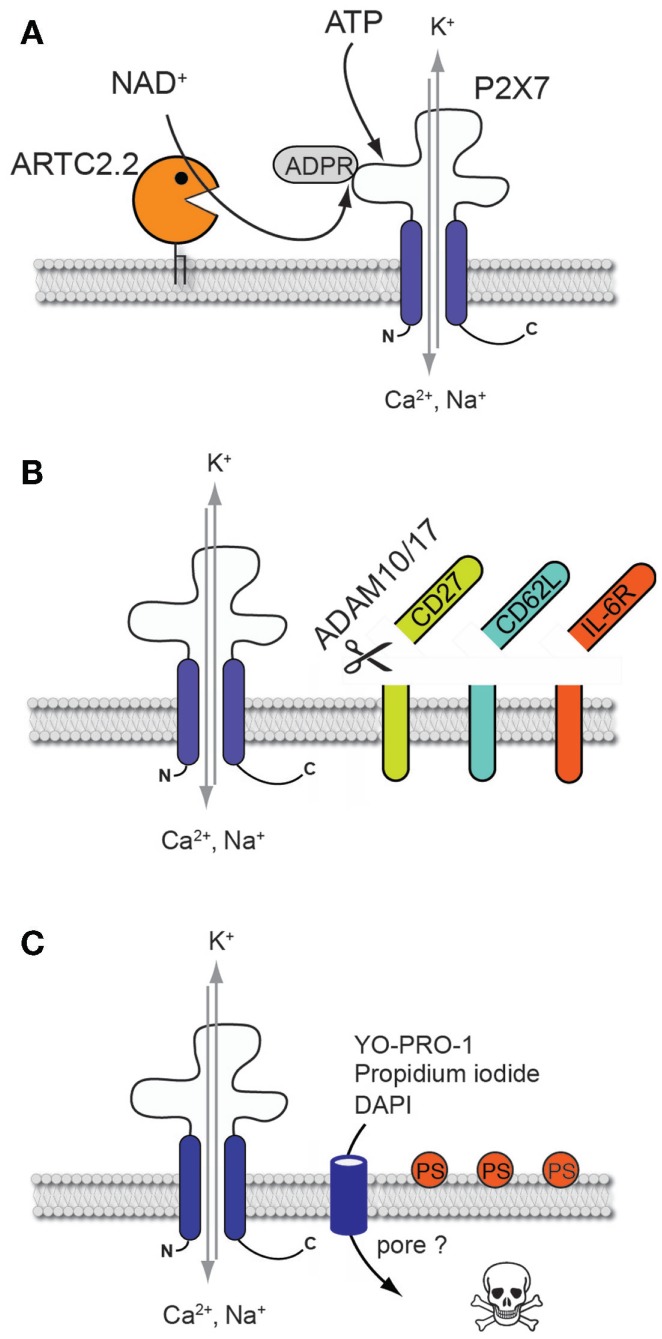
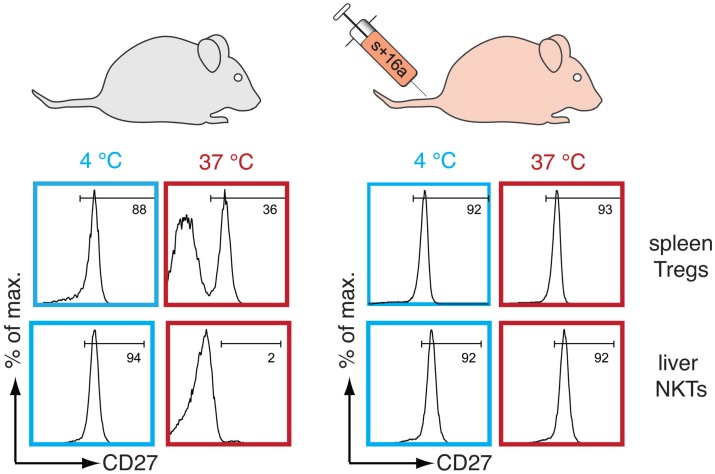
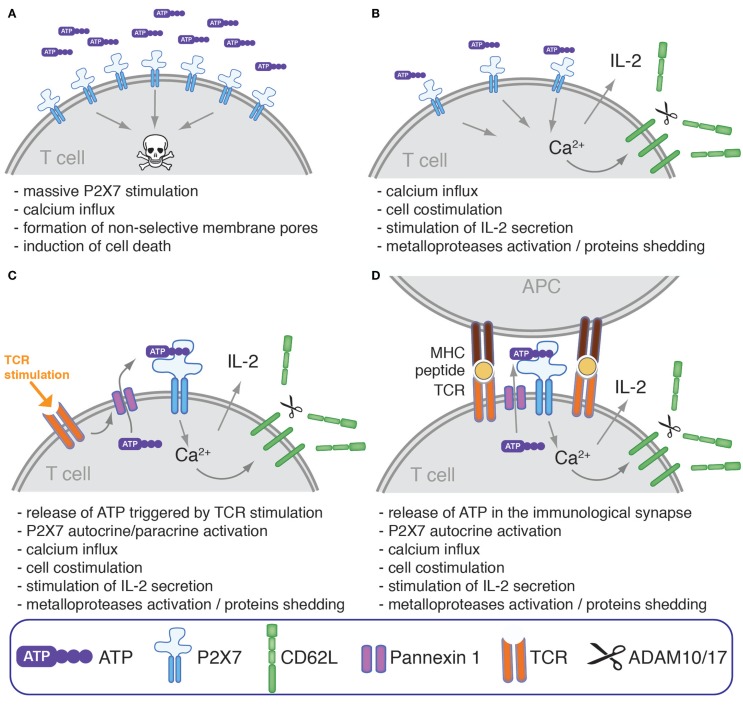
The P2X7 receptor is an adenosine triphosphate (ATP)-gated cation channel that is expressed by several cells of the immune system. P2X7 is best known for its proinflammatory role in promoting inflammasome formation and release of mature interleukin (IL)-1β by innate immune cells. Mounting evidence indicates that P2X7 is also an important regulatory receptor of murine and human T cell functions. Murine T cells express a sensitive splice variant of P2X7 that can be activated either by non-covalent binding of ATP or, in the presence of nicotinamide adenine dinucleotide, by its covalent ADP-ribosylation catalyzed by the ecto-ADP-ribosyltransferase ARTC2.2. Prolonged activation of P2X7 by either one of these pathways triggers the induction of T cell death. Conversely, lower concentrations of ATP can activate P2X7 to enhance T cell proliferation and production of IL-2. In this review, we will highlight the molecular and cellular consequences of P2X7 activation on mouse T cells and its versatile role in T cell homeostasis and activation. Further, we will discuss important differences in the function of P2X7 on human and murine T cells.
Overview
The claims and statistics of this paper haven’t been checked yet.
Run the check — free, no account needed. It reads the open-access text and checks the sources it cites.
Integrity signals
Registry
Cites
Statistics
Figures
Verification
Claims the paper makes
The claims and statistics of this paper haven’t been checked yet.
Run the check — free, no account needed. It reads the open-access text and checks the sources it cites.
Claims other papers make about this one
Each is checked against this paper’s own text: does it say what the citing paper says it does?
The source backs part of the claim, not all of it — or backs it for a different population, condition or comparison.
In the citing paper
“For example, activation of the danger receptor P2RX7 by extracellular NAD or ATP, released by dying cells during processing, can lead to shedding of surface molecules such as CD62L and CD27, the masking of CD8β and the induction of cell death in susceptible cells like Treg, NKT, and Trm cells [286-288].”
From Guidelines for the use of flow cytometry and cell sorting in immunological studies (third edition) (2021) · cites this paper as [286]
Experimental — accuracy not yet measured
Self-check
Percentages, sums and reported differences re-computed from the paper’s own numbers.
The self-check needs the paper’s full text.
Citations
Cites
Coombes, J. L., Siddiqui, K. R. R., Arancibia-Cárcamo, C. V., Hall, J. A., Sun, C., Belkaid, Y., & Powrie, F. M. (2007) · The Journal of Experimental Medicine · doi:10.1084/jem.20070590 · Cited by 2,708
Deaglio, S., Dwyer, K. M., Gao, W., Friedman, D. J., Usheva, A., Erat, A., Chen, J., Enjyoji, K., Linden, J. M., Oukka, M., et al. (2007) · The Journal of Experimental Medicine · doi:10.1084/jem.20062512 · Cited by 2,613
Ghiringhelli, F., Apetoh, L., Tesniere, A., Aymeric, L., Ma, Y., Ortiz, C., Vermaelen, K., Panaretakis, T., Mignot, G., Ullrich, E., et al. (2009) · Nature Medicine · doi:10.1038/nm.2028 · Cited by 1,898
Retinoic acid imprints gut-homing specificity on T cells
Iwata, M., Hirakiyama, A., Eshima, Y., Kagechika, H., Kato, C., & Song, S.-Y. (2004) · Immunity · doi:10.1016/j.immuni.2004.08.011 · Cited by 1,541
Altered Cytokine Production in Mice Lacking P2X7Receptors
Solle, M., Labasi, J. M., Perregaux, D. G., Stam, E. J., Petrushova, N., Koller, B. H., Griffiths, R., & Gabel, C. A. (2001) · Journal of Biological Chemistry · doi:10.1074/jbc.m006781200 · Cited by 924
Immune cell regulation by autocrine purinergic signalling
JUNGER, W. G. (2011) · Nature reviews. Immunology · doi:10.1038/nri2938 · Cited by 855
Pannexin membrane channels are mechanosensitive conduits for ATP
Bao, L., Locovei, S., & Dahl, G. (2004) · FEBS Letters · doi:10.1016/j.febslet.2004.07.009 · Cited by 837
Disruption of the P2X7 purinoceptor gene abolishes chronic inflammatory and neuropathic pain
Chessell, I. P., Hatcher, J. P., Bountra, C., Michel, A. D., Hughes, J. P., Green, P., Egerton, J., Murfin, M., Richardson, J. C., Peck, W. L., et al. (2005) · Pain · doi:10.1016/j.pain.2005.01.002 · Cited by 807
A novel pathway combining calreticulin exposure and ATP secretion in immunogenic cancer cell death
Garg, A. D., Krysko, D. V., Verfaillie, T., Kaczmarek, A., Ferreira, G. B., Marysael, T., Rubio, N., Firczuk, M., Mathieu, C., Roebroek, A. J. M., et al. (2012) · The EMBO Journal · doi:10.1038/emboj.2011.497 · Cited by 800
Critical contribution of liver natural killer T cells to a murine model of hepatitis
Takeda, K., Hayakawa, Y., Kaer, L. V., Matsuda, H., Yagita∥, H., & Okumura, K. (2000) · Proceedings of the National Academy of Sciences · doi:10.1073/pnas.040566697 · Cited by 538
Bratton, D. L., Fadok, V. A., Richter, D., Kailey, J. M., Guthrie, L. A., & Henson, P. M. (1997) · Journal of Biological Chemistry · doi:10.1074/jbc.272.42.26159 · Cited by 485
Connexin 43 hemichannels mediate Ca2+‐regulated transmembrane NAD+ fluxes in intact cells
Bruzzone, S., Guida, L., Zocchi, E., Franco, L., & FLORA, A. D. (2000) · The FASEB Journal · doi:10.1096/fj.00-0566fje · Cited by 464
Purinergic Control of T Cell Activation by ATP Released Through Pannexin-1 Hemichannels
Schenk, U., Westendorf, A. M., Radaelli, E., Casati, A., Ferro, M., Fumagalli, M., Verderio, C., Buer, J., Scanziani, E., & Grassi, F. (2008) · Science Signaling · doi:10.1126/scisignal.1160583 · Cited by 410
The P2X7 Receptor Channel: Recent Developments and the Use of P2X7 Antagonists in Models of Disease
Bartlett, R., Stokes, L., & Sluyter, R. (2014) · Pharmacological Reviews · doi:10.1124/pr.113.008003 · Cited by 409
Tumor Cell Death and ATP Release Prime Dendritic Cells and Efficient Anticancer Immunity
Aymeric, L., Apétoh, L., Ghiringhelli, F., Tesnière, A., Martins, I., Kroemer, G., Smyth, M. J., & Zitvogel, L. (2010) · Cancer Research · doi:10.1158/0008-5472.can-09-3566 · Cited by 401
Sorge, R. E., Trang, T., Dorfman, R., Smith, S. B., Beggs, S., Ritchie, J., Austin, J., Zaykin, D. V., Meulen, H. V., Costigan, M., et al. (2012) · Nature Medicine · doi:10.1038/nm.2710 · Cited by 360
Woehrle, T., Yip, L., Elkhal, A., Sumi, Y., Chen, Y., Yao, Y., Insel, P. A., & JUNGER, W. G. (2010) · Blood · doi:10.1182/blood-2010-04-277707 · Cited by 331
Séman, M., Adriouch, S., Scheuplein, F., Krebs, C. F., Freese, D., Glowacki, G., Deterre, P., Haag, F., & Koch‐Nolte, F. (2003) · Immunity · doi:10.1016/s1074-7613(03)00266-8 · Cited by 330
Self-citationPurinergic signalling and immune cells
Burnstock, G., & Boeynaems, J. M. (2014) · Purinergic Signalling · doi:10.1007/s11302-014-9427-2 · Cited by 320
Autocrine regulation of T‐cell activation by ATP release and P2X 7 receptors
Yip, L., Woehrle, T., Corriden, R., Hirsh, M., Chen, Y., Inoue, Y., Ferrari, V., Insel, P. A., & JUNGER, W. G. (2009) · The FASEB Journal · doi:10.1096/fj.08-126458 · Cited by 303
Ke, H. Z., Qi, H., Weidema, A. F., Zhang, Q. H., Panupinthu, N., Crawford, D. T., GRASSER, W. A., Paralkar, V. M., Li, M., Audoly, L., et al. (2003) · Molecular Endocrinology · doi:10.1210/me.2003-0021 · Cited by 283
Reanalysis of P2X7Receptor Expression in Rodent Brain
Sim, J. A., Young, M. T., Sung, H.-Y., North, R. A., & Surprenant, A. (2004) · The Journal of Neuroscience · doi:10.1523/jneurosci.1469-04.2004 · Cited by 264
ATP release from non-excitable cells
Prætorius, H. A., & Leipziger, J. (2009) · Purinergic Signalling · doi:10.1007/s11302-009-9146-2 · Cited by 247
Phospholipid scramblase: An update
Bevers, E. M., & Williamson, P. L. (2010) · FEBS Letters · doi:10.1016/j.febslet.2010.03.020 · Cited by 241
Extracellular NAD+ shapes the Foxp3+ regulatory T cell compartment through the ART2–P2X7 pathway
Hubert, S., Rissiek, B., Klages, K., Huehn, J., Sparwasser, T. D., Haag, F., Koch‐Nolte, F., Boyer, O., Séman, M., & Adriouch, S. (2010) · The Journal of Experimental Medicine · doi:10.1084/jem.20091154 · Cited by 215
Self-citationGarbers, C., Jänner, N., Chalaris, A., Moss, M. L., Floss, D. M., Meyer, D., Koch-Nolte, F., Rose-John, S., & Scheller, J. (2011) · Journal of Biological Chemistry · doi:10.1074/jbc.m111.229393 · Cited by 201
Self-citationAdriouch, S., Dox, C., Welge, V., Séman, M., Koch‐Nolte, F., & Haag, F. (2002) · The Journal of Immunology · doi:10.4049/jimmunol.169.8.4108 · Cited by 196
Self-citationNicke, A., Kuan, Y., Masin, M., Rettinger, J., Marquez-Klaka, B., Bender, O., Górecki, D. C., Murrell‐Lagnado, R. D., & Soto, F. (2009) · Journal of Biological Chemistry · doi:10.1074/jbc.m109.033134 · Cited by 187
An ATP-activated channel is involved in mitogenic stimulation of human T lymphocytes
Baricordi, O., Ferrari, D., Melchiorri, L., Chiozzi, P., Hanau, S., Chiari, E., Rubini, M., & Virgilio, F. D. (1996) · Blood · doi:10.1182/blood.v87.2.682.bloodjournal872682 · Cited by 185
Aswad, F., Kawamura, H., & Dennert, G. (2005) · The Journal of Immunology · doi:10.4049/jimmunol.175.5.3075 · Cited by 183
Proietti, M., Cornacchione, V., Rezzonico Jost, T., Romagnani, A., Faliti, C. E., Perruzza, L., Rigoni, R., Radaelli, E., Caprioli, F., Preziuso, S., et al. (2014) · Immunity · doi:10.1016/j.immuni.2014.10.010 · Cited by 181
Accelerated Tumor Progression in Mice Lacking the ATP Receptor P2X7
Adinolfi, E., Capece, M., Franceschini, A., Falzoni, S., Giuliani, A. L., Rotondo, A., Sarti, A. C., Bonora, M., Syberg, S., Corigliano, D. M., et al. (2014) · Cancer Research · doi:10.1158/0008-5472.can-14-1259 · Cited by 177
Pseudoapoptosis Induced by Brief Activation of ATP-gated P2X7 Receptors
Mackenzie, A. B., Young, M. T., Adinolfi, E., & Surprenant, A. (2005) · Journal of Biological Chemistry · doi:10.1074/jbc.m502705200 · Cited by 174
Extracellular NAD and ATP: Partners in immune cell modulation
Haag, F., Adriouch, S., Braß, A., Jung, C., Möller, S., Scheuplein, F., Bannas, P., Séman, M., & Koch‐Nolte, F. (2007) · Purinergic Signalling · doi:10.1007/s11302-006-9038-7 · Cited by 169
Self-citationP2x7 deficiency suppresses development of experimental autoimmune encephalomyelitis
Sharp, A. J., Polak, P. E., Simonini, M. V., Lin, S. X., Richardson, J. C., Bongarzone, E. R., & Feinstein, D. L. (2008) · Journal of Neuroinflammation · doi:10.1186/1742-2094-5-33 · Cited by 167
Adriouch, S., Hubert, S., Pechberty, S., Koch‐Nolte, F., Haag, F., & Séman, M. (2007) · The Journal of Immunology · doi:10.4049/jimmunol.179.1.186 · Cited by 158
Self-citationGu, B. J., Bendall, L. J., & Wiley, J. S. (1998) · Blood · doi:10.1182/blood.v92.3.946 · Cited by 157
Ousingsawat, J., Wanitchakool, P., Kmit, A. H. P., Romão, A. M., Jantarajit, W., Schreiber, R., & Kunzelmann, K. (2015) · Nature Communications · doi:10.1038/ncomms7245 · Cited by 155
Gu, B. J., Bendall, L. J., & Wiley, J. S. (1998) · Blood · doi:10.1182/blood.v92.3.946.415a24_946_951 · Cited by 148
Significance of P2X7 Receptor Variants to Human Health and Disease
Sluyter, R., & Stokes, L. (2011) · Recent Patents on DNA & Gene Sequences · doi:10.2174/187221511794839219 · Cited by 147
Scheuplein, F., Schwarz, N., Adriouch, S., Krebs, C. F., Bannas, P., Rissiek, B., Séman, M., Haag, F., & Koch‐Nolte, F. (2009) · The Journal of Immunology · doi:10.4049/jimmunol.0801711 · Cited by 138
Self-citationAdinolfi, E., Pizzirani, C., Idzko, M., Panther, E., Norgauer, J., Virgilio, F. D., & Ferrari, D. (2005) · Purinergic Signalling · doi:10.1007/s11302-005-6322-x · Cited by 137
Chen, L., & Brosnan, C. F. (2006) · The Journal of Immunology · doi:10.4049/jimmunol.176.5.3115 · Cited by 135
Sarukhan, A., Cordier, C., Lanoue, A., & von Boehmer, H. (1998) · Immunity · doi:10.1016/s1074-7613(00)80561-0 · Cited by 132
Trabanelli, S., Očadlíková, D., Gulinelli, S., Curti, A., Salvestrini, V., Vieira, R. P., Idzko, M., Virgilio, F. D., Ferrari, D., & Lemoli, R. M. (2012) · The Journal of Immunology · doi:10.4049/jimmunol.1103800 · Cited by 132
Adriouch, S., Bannas, P., Schwarz, N., Fliegert, R., Guse, A. H., Séman, M., Haag, F., & Koch‐Nolte, F. (2007) · The FASEB Journal · doi:10.1096/fj.07-9294com · Cited by 123
Self-citationExtracellular nucleotides as negative modulators of immunity
Virgilio, F. D., Boeynaems, J., & Robson, S. C. (2009) · Current Opinion in Pharmacology · doi:10.1016/j.coph.2009.06.021 · Cited by 121
Koch‐Nolte, F., Reyelt, J., Schößow, B., Schwarz, N., Scheuplein, F., Rothenburg, S., Haag, F., Alzogaray, V., Cauerhff, A., & Goldbaum, F. A. (2007) · The FASEB Journal · doi:10.1096/fj.07-8661com · Cited by 119
Self-citationLoomis, W. H., Namiki, S., Ostrom, R. S., Insel, P. A., & JUNGER, W. G. (2003) · Journal of Biological Chemistry · doi:10.1074/jbc.m207868200 · Cited by 117
Hofman, P. M., Cherfils‐Vicini, J., Bazin, M., Ilié, M., Juhel, T., Hébuterne, X., Gilson, É., Schmid‐Alliana, A., Boyer, O., Adriouch, S., et al. (2015) · Cancer Research · doi:10.1158/0008-5472.can-14-1778 · Cited by 116
Self-citationNTPDase1 governs P2X7‐dependent functions in murine macrophages
Lévesque, S. A., Kukulski, F., Enjyoji, K., Robson, S. C., & Sévigny, J. (2010) · European Journal of Immunology · doi:10.1002/eji.200939741 · Cited by 112
P2X7 Receptors Regulate NKT Cells in Autoimmune Hepatitis
Kawamura, H., Aswad, F., Minagawa, M., Govindarajan, S., & Dennert, G. (2006) · The Journal of Immunology · doi:10.4049/jimmunol.176.4.2152 · Cited by 98
CD38 Controls ADP-Ribosyltransferase-2-Catalyzed ADP-Ribosylation of T Cell Surface Proteins
Krebs, C. F., Adriouch, S., Braasch, F., Koestner, W., Leiter, E. H., Séman, M., Lund, F. E., Oppenheimer, N. J., Haag, F., & Koch‐Nolte, F. (2005) · The Journal of Immunology · doi:10.4049/jimmunol.174.6.3298 · Cited by 90
Self-citationHypertonic stress regulates T cell function via pannexin-1 hemichannels and P2X receptors
Woehrle, T., Yip, L., Manohar, M., Sumi, Y., Yao, Y., Chen, Y., & JUNGER, W. G. (2010) · Journal of Leukocyte Biology · doi:10.1189/jlb.0410211 · Cited by 90
Stunff, H. L., Auger, R., Kanellopoulos, J., & Raymond, M. (2004) · Journal of Biological Chemistry · doi:10.1074/jbc.m313064200 · Cited by 88
CIIV, MIIC and other compartments for MHC class II loading
Neefjes, J. (1999) · European Journal of Immunology · doi:10.1002/(sici)1521-4141(199905)29:05 · Cited by 84
Premature Stop Codons Inactivate the RT6 Genes of the Human and Chimpanzee Species
Haag, F., Koch‐Nolte, F., Kühl, M., Lorenzen, S., & Thiele, H. (1994) · Journal of Molecular Biology · doi:10.1006/jmbi.1994.1680 · Cited by 82
Self-citationTaylor, S. R. J., González–Begne, M., Dewhurst, S., Chimini, G., Higgins, C. F., Melvin, J. E., & Elliott, J. I. (2008) · The Journal of Immunology · doi:10.4049/jimmunol.180.1.300 · Cited by 75
Xu, X. J., Boumechache, M., Robinson, L. E., Marschall, V., Górecki, D. C., Masin, M., & Murrell‐Lagnado, R. D. (2012) · Journal of Cell Science · doi:10.1242/jcs.099374 · Cited by 71
The P2X7 Carboxyl Tail Is a Regulatory Module of P2X7 Receptor Channel Activity
Becker, D., Woltersdorf, R., Boldt, W., Schmitz, S., Braam, U., Schmalzing, G., & Markwárdt, F. (2008) · Journal of Biological Chemistry · doi:10.1074/jbc.m803855200 · Cited by 67
Magnone, M., Bauer, I., Poggi, A. D., Mannino, E., Sturla, L., Brini, M., Zocchi, E., FLORA, A. D., Nencioni, A., & Bruzzone, S. (2012) · Journal of Biological Chemistry · doi:10.1074/jbc.m111.324269 · Cited by 65
Adriouch, S., Ohlrogge, W., Haag, F., Koch‐Nolte, F., & Séman, M. (2001) · The Journal of Immunology · doi:10.4049/jimmunol.167.1.196 · Cited by 64
Self-citationHong, S., Schwarz, N., Braß, A., Séman, M., Haag, F., Koch‐Nolte, F., Schilling, W. P., & Dubyak, G. (2009) · The Journal of Immunology · doi:10.4049/jimmunol.0900120 · Cited by 63
Self-citationP2X receptor-dependent ATP-induced shedding of CD27 in mouse lymphocytes
Moon, H., NA, H., CHONG, K., & Kim, T. J. (2005) · Immunology Letters · doi:10.1016/j.imlet.2005.08.004 · Cited by 63
Aswad, F., & Dennert, G. (2006) · Cellular Immunology · doi:10.1016/j.cellimm.2006.12.003 · Cited by 60
Heiss, K., Jänner, N., Mähnß, B., Schumacher, V., Koch-Nolte, F., Haag, F., & Mittrücker, H. (2008) · Journal of Immunology · doi:10.4049/jimmunol.181.6.3861 · Cited by 58
Self-citationKahl, S., Nissen, M., Girisch, R., Duffy, T., Leiter, E. H., Haag, F., & Koch‐Nolte, F. (2000) · The Journal of Immunology · doi:10.4049/jimmunol.165.8.4463 · Cited by 58
Self-citationNanobodies as modulators of inflammation: potential applications for acute brain injury
Rissiek, B., Koch‐Nolte, F., & Magnus, T. U. (2014) · Frontiers in Cellular Neuroscience · doi:10.3389/fncel.2014.00344 · Cited by 57
Self-citationSchwarz, N., Drouot, L., Nicke, A., Fliegert, R., Boyer, O., Guse, A. H., Haag, F., Adriouch, S., & Koch‐Nolte, F. (2012) · PLoS ONE · doi:10.1371/journal.pone.0041269 · Cited by 56
Self-citationRissiek, B., Danquah, W., Haag, F., & Koch‐Nolte, F. (2013) · Journal of Leukocyte Biology · doi:10.1189/jlb.0713407 · Cited by 55
Self-citationRissiek, B., Haag, F., Boyer, O., Koch‐Nolte, F., & Adriouch, S. (2014) · Current topics in microbiology and immunology · doi:10.1007/82_2014_420 · Cited by 53
Self-citationPannexin1 channels act downstream of P2X 7 receptors in ATP-induced murine T-cell death
Shoji, K. F., Sáez, P. J., Harcha, P. A., Aguila, H. L., & Sáez, J. C. (2014) · Channels · doi:10.4161/chan.28122 · Cited by 51
Lymphocytes from P2X7-deficient mice exhibit enhanced P2X7 responses
Taylor, S. R. J., González–Begne, M., Sojka, D. K., Richardson, J. C., Sheardown, S. A., Harrison, S. M., Pusey, C. D., Tam, F. W. K., & Elliott, J. I. (2009) · Journal of Leukocyte Biology · doi:10.1189/jlb.0408251 · Cited by 49
Identification of Thr283 as a key determinant of P2X7 receptor function
Young, M. T., Pelegrı́n, P., & Surprenant, A. (2006) · British Journal of Pharmacology · doi:10.1038/sj.bjp.0706880 · Cited by 46
Genetic Background Strongly Influences the Bone Phenotype of P2X7 Receptor Knockout Mice
Syberg, S., Petersen, S., Jensen, J. B., Gartland, A., Teilmann, J., Chessell, I. P., Steinberg, T. H., Schwarz, P., & Jørgensen, N. R. (2012) · Journal of Osteoporosis · doi:10.1155/2012/391097 · Cited by 41
Activation of the P2X7 ion channel by soluble and covalently bound ligands
Schwarz, N., Fliegert, R., Adriouch, S., Séman, M., Guse, A. H., Haag, F., & Koch‐Nolte, F. (2009) · Purinergic Signalling · doi:10.1007/s11302-009-9135-5 · Cited by 38
Self-citationPurinergic P2X7 Receptor Drives T Cell Lineage Choice and Shapes Peripheral γδ Cells
Frascoli, M., Marcandalli, J., Schenk, U., & Grassi, F. (2012) · The Journal of Immunology · doi:10.4049/jimmunol.1101582 · Cited by 38
Scheuplein, F., Rissiek, B., Driver, J. P., Chen, Y., Koch‐Nolte, F., & SERREZE, D. V. (2009) · Journal of Autoimmunity · doi:10.1016/j.jaut.2009.08.012 · Cited by 36
Self-citationCD39 is a negative regulator of P2X7-mediated inflammatory cell death in mast cells
Kuhny, M., Hochdörfer, T., Ayata, C. K., Idzko, M., & Huber, M. (2014) · Cell Communication and Signaling · doi:10.1186/s12964-014-0040-3 · Cited by 33
Courageot, M.-P., Lépine, S., Hours, M. C., Giraud, F., & Sulpice, J. (2004) · Journal of Biological Chemistry · doi:10.1074/jbc.m401426200 · Cited by 32
Haag, F., Freese, D., Scheublein, F., Ohlrogge, W., Adriouch, S., Séman, M., & Koch‐Nolte, F. (2002) · Journal of Immunology Research · doi:10.1080/10446670310001593514 · Cited by 19
Self-citation
Research works printed but not linked: 1
- Freedman, 1999, ATP-evoked Ca2+ transients and currents in murine thymocytes: possible role for P2X receptors in death by neglect, Eur J Immunol, 29, 1635, 10.1002/(SICI)1521-4141(199905)29:051635::AID-IMMU16353.3.CO;2-2 · DOI
Cited by
Sorted by citations
Guidelines for the use of flow cytometry and cell sorting in immunological studies (second edition)
Cossarizza, A., Chang, H., Radbruch, A., Acs, A., Adam, D., Adam‐Klages, S., Agace, W. W., Aghaeepour, N., Akdiş, M., Allez, M., et al. (2019) · European Journal of Immunology · doi:10.1002/eji.201970107 · Cited by 1,007
CD8+ T cell metabolism in infection and cancer
Reina‐Campos, M., Scharping, N. E., & Goldrath, A. W. (2021) · Nature reviews. Immunology · doi:10.1038/s41577-021-00537-8 · Cited by 657
Guidelines for the use of flow cytometry and cell sorting in immunological studies (third edition)
Cossarizza, A., Chang, H., Radbruch, A., Abrignani, S., Addo, R., Akdis, M., Andrä, I., Andreata, F., Annunziato, F., Arranz, E., et al. (2021) · European Journal of Immunology · doi:10.1002/eji.202170126 · Cited by 531
Danger signals in stroke and their role on microglia activation after ischemia
Gülke, E., Gelderblom, M., & Magnus, T. (2018) · Therapeutic Advances in Neurological Disorders · doi:10.1177/1756286418774254 · Cited by 321
Lüscher, B., Bütepage, M., Eckei, L., Krieg, S., Verheugd, P., & Shilton, B. H. (2017) · Chemical Reviews · doi:10.1021/acs.chemrev.7b00122 · Cited by 264
Metadata
- Authors
- Rissiek, B., Haag, F., Boyer, O., Koch-Nolte, F., & Adriouch, S.
- Affiliations
- Universität Hamburg (DE)
- Inserm (FR)
- Corresponding author
- Adriouch, Sahil
- Venue
- Frontiers in Immunology
- Publisher
- Frontiers Media SA
- Published
- 2015-05-19
- Volume
- 6
- Pages
- 204-204
- ISSN
- 1664-3224 (ISSN-L)
- PMC
- PMC4436801
- OpenAlex
- W1564355150
- Cited by
- 116
- References
- 81
- Citations by year
- 2026: 4 · 2025: 7 · 2024: 7 · 2023: 10 · 2022: 8 · 2021: 15 · 2020: 13 · 2019: 14 · 2018: 15 · 2017: 11 · 2016: 12
- FWCI
- 1.62
- Type
- journal article
- Language
- en
- Open access
- gold
- doi.org
- Licence
- cc-by
- Locations
- Frontiers in Immunology (publishedVersion, cc-by)
- Europe PMC (PubMed Central) (publishedVersion, cc-by)
- PubMed Central (publishedVersion, cc-by)
- PubMed (publishedVersion)
- HAL (submittedVersion, other-oa)
- HAL (submittedVersion)
- DOAJ (DOAJ: Directory of Open Access Journals) (submittedVersion)
- Funders
- Deutsche Forschungsgemeinschaft (SFB 877, HA2369/5)
- Institut National de la Santé et de la Recherche Médicale
- Normandie Université
- Topics
- Life Sciences › Biochemistry, Genetics and Molecular Biology › Physiology › Adenosine and Purinergic Signaling
- Life Sciences › Biochemistry, Genetics and Molecular Biology › Physiology › Calcium signaling and nucleotide metabolism
- Life Sciences › Biochemistry, Genetics and Molecular Biology › Molecular Biology › Biochemical and Molecular Research
- Keywords
- P2X7 receptor, T cells, ATP-gated cation channels, ADP-ribosylation, T cell death, T cell proliferation, interleukin-2, T cell homeostasis, T cell activation, splice variants
About these checks
Registry, retraction, Cites and statistics results are computed, not judged, with one exception: a printed reference that no index lists is read once by a model before it counts as a citation error. Claims are extracted by a model and kept only when their quote appears verbatim in the text; each cited source is then checked, with a model’s help, for whether it says what the claim relies on. Those verdicts can be wrong — read the claim’s quote and the cited source before relying on one.
Statistics and arithmetic are recomputed, not judged.
Confidence bands are shown only for fields calibrated on our annotated test set. None is calibrated yet, so no band is shown.
What counts as a claim ›How we measure confidence ›How we check this ›
Are you an author, or do you see a problem with this page? Request a review
