

The DOI matches its Crossref record; 154 of the 154 references it cites were found in a registry or an index.
Psychedelics and Immunomodulation: Novel Approaches and Therapeutic Opportunities
Open accessAbstract
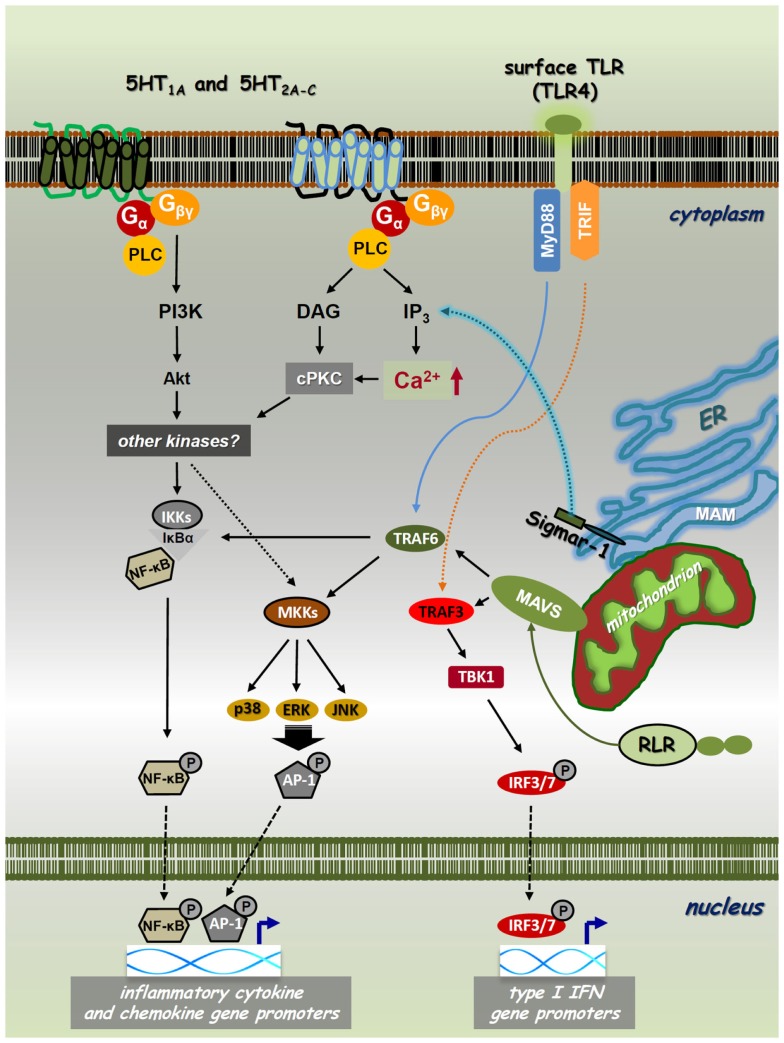
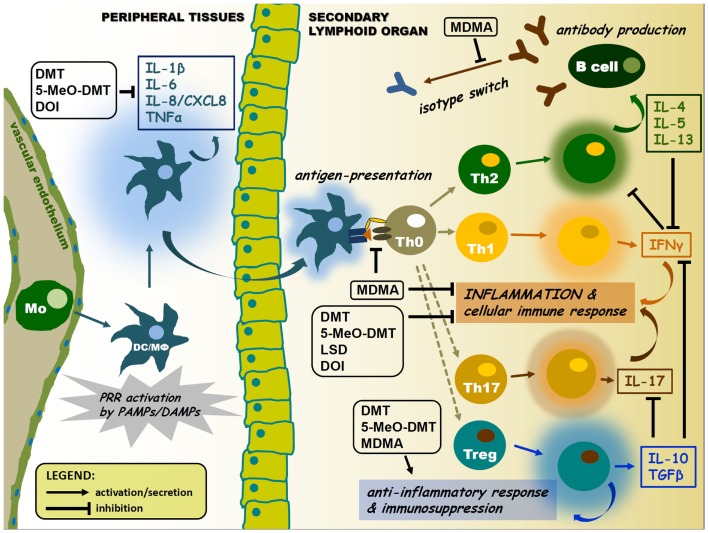
Classical psychedelics are psychoactive substances, which, besides their psychopharmacological activity, have also been shown to exert significant modulatory effects on immune responses by altering signaling pathways involved in inflammation, cellular proliferation, and cell survival via activating NF-κB and mitogen-activated protein kinases. Recently, several neurotransmitter receptors involved in the pharmacology of psychedelics, such as serotonin and sigma-1 receptors, have also been shown to play crucial roles in numerous immunological processes. This emerging field also offers promising treatment modalities in the therapy of various diseases including autoimmune and chronic inflammatory conditions, infections, and cancer. However, the scarcity of available review literature renders the topic unclear and obscure, mostly posing psychedelics as illicit drugs of abuse and not as physiologically relevant molecules or as possible agents of future pharmacotherapies. In this paper, the immunomodulatory potential of classical serotonergic psychedelics, including N,N-dimethyltryptamine (DMT), 5-methoxy-N,N-dimethyltryptamine (5-MeO-DMT), lysergic acid diethylamide (LSD), 2,5-dimethoxy-4-iodoamphetamine, and 3,4-methylenedioxy-methamphetamine will be discussed from a perspective of molecular immunology and pharmacology. Special attention will be given to the functional interaction of serotonin and sigma-1 receptors and their cross-talk with toll-like and RIG-I-like pattern-recognition receptor-mediated signaling. Furthermore, novel approaches will be suggested feasible for the treatment of diseases with chronic inflammatory etiology and pathology, such as atherosclerosis, rheumatoid arthritis, multiple sclerosis, schizophrenia, depression, and Alzheimer's disease.
Overview
The claims and statistics of this paper haven’t been checked yet.
Run the check — free, no account needed. It reads the open-access text and checks the sources it cites.
Integrity signals
Registry
Cites
Statistics
Figures
Verification
Claims the paper makes
The claims and statistics of this paper haven’t been checked yet.
Run the check — free, no account needed. It reads the open-access text and checks the sources it cites.
Claims other papers make about this one
Each is checked against this paper’s own text: does it say what the citing paper says it does?
The cited source says what the claim attributes to it.
In the citing paper
“DMT and 5-MeO-DMT have also been shown to exert potent anti-inflammatory effects through the modulation of innate and adaptive immune processes (Szabo 2015; Szabo et al. 2014).”
From Prospective examination of synthetic 5-methoxy-N,N-dimethyltryptamine inhalation: effects on salivary IL-6, cortisol levels, affect, and non-judgment (2020) · cites this paper as Szabo 2015
Self-check
Percentages, sums and reported differences re-computed from the paper’s own numbers.
The self-check needs the paper’s full text.
Citations
Cites
Yaşlı Kadınlarda Üreme Sağlığı
Kokanalı, D., & Engin Üstün, Y. (n.d.) · DergiPark (Istanbul University) · Cited by 170,090
Two new Later Stone Age sites from the Final Pleistocene in the Falémé Valley, eastern Senegal
Ndiaye, M., Lespez, L., Tribolo, C., Rassé, M., Hadjas, I., Davidoux, S., Huysecom, É., & Douze, K. (2024) · Monash University Research Portal (Monash University) · doi:10.3929/ethz-b-000667478 · Cited by 24,214
Differentiation of Effector CD4 T Cell Populations
Zhu, J., Yamane, H., & Paul, W. E. (2010) · Annual Review of Immunology · doi:10.1146/annurev-immunol-030409-101212 · Cited by 3,452
A review of central 5-HT receptors and their function
Barnes, N. M., & Sharp, T. (1999) · Neuropharmacology · doi:10.1016/s0028-3908(99)00010-6 · Cited by 3,211
Systematic review and meta-analysis
Gillies, A. (2019) · CRC Press eBooks · doi:10.1201/9781315377315-19 · Cited by 2,876
Predicting new molecular targets for known drugs
Keiser, M. J., Setola, V., Irwin, J. J., Laggner, C., Abbas, A. I., Hufeisen, S. J., Jensen, N. H., Kuijer, M. B., Matos, R. C., Tran, T. B., et al. (2009) · Nature · doi:10.1038/nature08506 · Cited by 1,667
Functional Selectivity and Classical Concepts of Quantitative Pharmacology
Urban, J. D., Clarke, W. P., von Zastrow, M., Nichols, D. E., Kobilka, B. K., Weinstein, H., Javitch, J. A., Roth, B. L., Christopoulos, A., Sexton, P. M., et al. (2006) · Journal of Pharmacology and Experimental Therapeutics · doi:10.1124/jpet.106.104463 · Cited by 1,131
Toll‐like Receptor and RIG‐1‐like Receptor Signaling
Kawai, T., & Akira, S. (2008) · Annals of the New York Academy of Sciences · doi:10.1196/annals.1443.020 · Cited by 1,014
Gutkind, J. S. (1998) · Journal of Biological Chemistry · doi:10.1074/jbc.273.4.1839 · Cited by 812
MAM: more than just a housekeeper
Hayashi, T., Rizzuto, R., Hajnoczky, G., & Su, T.-P. (2009) · Trends in Cell Biology · doi:10.1016/j.tcb.2008.12.002 · Cited by 787
Research works printed but not linked: 1
- [97]Holister L Some general thoughts about endogenous psychotogens. In: Usdin E Hamburg DA Barchas JD, editors. Neuroregulators and Psychiatric Disorders. New York, NY: Oxford University Press (1977). p. 550– 6.
Cited by
Sorted by citations
Nichols, D. E. (2016) · Pharmacological Reviews · doi:10.1124/pr.115.011478 · Cited by 1,762
Trace Amines and Their Receptors
Gainetdinov, R. R., Hoener, M. C., & Berry, M. D. (2018) · Pharmacological Reviews · doi:10.1124/pr.117.015305 · Cited by 398
The therapeutic potentials of Ayahuasca: possible effects against various diseases of civilization
Frecska, E., Bokor, P., & Winkelman, M. (2016) · Frontiers in Pharmacology · doi:10.3389/fphar.2016.00035 · Cited by 242
Clinical applications of hallucinogens: a review
Garcia-Romeu, A., Kersgaard, B., & Addy, P. H. (2016) · Experimental and Clinical Psychopharmacology · doi:10.1037/pha0000084 · Cited by 201
Hamill, J., Hallak, J. E. C., Dursun, S. M., & Baker, G. B. (2018) · Current Neuropharmacology · doi:10.2174/1570159x16666180125095902 · Cited by 201
Metadata
- Authors
- Szabo, A.
- Venue
- Frontiers in Immunology
- Publisher
- Frontiers Media SA
- Published
- 2015-07-14
- Volume
- 6
- Pages
- 358-358
- ISSN
- 1664-3224 (ISSN-L)
- PMC
- PMC4500993
- OpenAlex
- W1522923028
- Cited by
- 150
- References
- 154
- Citations by year
- 2026: 13 · 2025: 16 · 2024: 16 · 2023: 35 · 2022: 17 · 2021: 17 · 2020: 7 · 2019: 6 · 2018: 8 · 2017: 3 · 2016: 11
- FWCI
- 1.06
- Type
- journal article
- Language
- en
- Open access
- gold
- doi.org
- Licence
- cc-by
- Locations
- Frontiers in Immunology (publishedVersion, cc-by)
- PubMed Central (publishedVersion, cc-by)
- PubMed (publishedVersion)
- DOAJ (DOAJ: Directory of Open Access Journals) (submittedVersion, cc-by-sa)
- University of Debrecen Electronic Archive (University of Debrecen) (submittedVersion, other-oa)
- University of Debrecen Electronic Archive (University of Debrecen) (submittedVersion, cc-by)
- Funders
- European Commission (-2012-0001, A/2-11-1-2012-0001, TÁMOP‐4.2.4.A/2‐11/1‐2012‐0001, 4.2.4.A/2-11-1-2012-0001)
- European Social Fund (A/2–11/1-2012-0001, TÁMOP 4.2.4, -2012-0001)
- Topics
- Social Sciences › Psychology › Clinical Psychology › Psychedelics and Drug Studies
- Life Sciences › Neuroscience › Biological Psychiatry › Tryptophan and brain disorders
- Life Sciences › Pharmacology, Toxicology and Pharmaceutics › Pharmacology › Pharmacological Receptor Mechanisms and Effects
- Keywords
- psychedelics, immunomodulation, serotonergic psychedelics, serotonin receptors, sigma-1 receptor, N,N-dimethyltryptamine, 5-MeO-DMT, LSD, MDMA, NF-κB signaling, MAPK signaling, pattern recognition receptors, Toll-like receptors, RIG-I-like receptors, autoimmune disease, chronic inflammation, atherosclerosis, rheumatoid arthritis, multiple sclerosis, schizophrenia, depression, Alzheimer's disease, cancer immunotherapy
About these checks
Registry, retraction, Cites and statistics results are computed, not judged, with one exception: a printed reference that no index lists is read once by a model before it counts as a citation error. Claims are extracted by a model and kept only when their quote appears verbatim in the text; each cited source is then checked, with a model’s help, for whether it says what the claim relies on. Those verdicts can be wrong — read the claim’s quote and the cited source before relying on one.
Statistics and arithmetic are recomputed, not judged.
Confidence bands are shown only for fields calibrated on our annotated test set. None is calibrated yet, so no band is shown.
What counts as a claim ›How we measure confidence ›How we check this ›
Are you an author, or do you see a problem with this page? Request a review
