

The DOI matches its Crossref record; 129 of the 138 references it cites were found in a registry or an index.
CD22: A Regulator of Innate and Adaptive B Cell Responses and Autoimmunity
Open accessAbstract
CD22 (Siglec 2) is a receptor predominantly restricted to B cells. It was initially characterized over 30 years ago and named "CD22" in 1984 at the 2nd International workshop in Boston (1). Several excellent reviews have detailed CD22 functions, CD22-regulated signaling pathways and B cell subsets regulated by CD22 or Siglec G (2-4). This review is an attempt to highlight recent and possibly forgotten findings. We also describe the role of CD22 in autoimmunity and the great potential for CD22-based immunotherapeutics for the treatment of autoimmune diseases such as systemic lupus erythematosus (SLE).
Overview
The claims and statistics of this paper haven’t been checked yet.
Run the check — free, no account needed. It reads the open-access text and checks the sources it cites.
Integrity signals
Registry
Cites
Statistics
Figures
Verification
Claims the paper makes
The claims and statistics of this paper haven’t been checked yet.
Run the check — free, no account needed. It reads the open-access text and checks the sources it cites.
Claims other papers make about this one
Each is checked against this paper’s own text: does it say what the citing paper says it does?
The source backs part of the claim, not all of it — or backs it for a different population, condition or comparison.
In the citing paper
“In addition, SYK has been identified as the central kinase that instructs signaling and effector functions downstream of TREM2, CD33, and CD22 receptors (Clark and Giltiay, 2018; Wissfeld et al., 2021; Yao et al., 2019).”
From SYK coordinates neuroprotective microglial responses in neurodegenerative disease (2022) · cites this paper as Clark and Giltiay, 2018
Experimental — accuracy not yet measured
Self-check
Percentages, sums and reported differences re-computed from the paper’s own numbers.
The self-check needs the paper’s full text.
Citations
Cites
Fry, T. J., Shah, N. N., Orentas, R. J., Stetler‐Stevenson, M., Yuan, C. M., Ramakrishna, S., Wolters, P. L., Martin, S. C., Delbrook, C., Yates, B., et al. (2017) · Nature Medicine · doi:10.1038/nm.4441 · Cited by 1,363 · cited 1×
“Recently, the use of chimeric antigen receptor (CAR) T-cell therapy, specific for CD22 was reported to provide high response rates for patients with B-cell acute lymphoblastic leukemia (B-ALL) who had failed chemotherapy and/or a CD19-targeted CAR T-cell treatment (119).”
BackgroundSiglec-mediated regulation of immune cell function in disease
Macauley, M. S., Crocker, P. R., & Paulson, J. C. (2014) · Nature Reviews Immunology · doi:10.1038/nri3737 · Cited by 1,122 · cited 1×
“The enzyme α 2,6 sialyltransferase 1 (ST6Gal1) synthesizes this ligand, and ST6Gal1 mice phenocopy many but not all of the defects seen in CD22 mice (12, 13).”
BackgroundChristensen, S. R., Shupe, J., Nickerson, K., Kashgarian, M., Flavell, R. A., & Shlomchik, M. J. (2006) · Immunity · doi:10.1016/j.immuni.2006.07.013 · Cited by 1,090 · cited 1×
“TLR7 and TLR9 in particular have been implicated in the activation of autoreactive cells and antinuclear auto-Ab production inmouse models of lupus (78, 79, 102, 103).”
BackgroundAutoreactive B Cell Responses to RNA-Related Antigens Due to TLR7 Gene Duplication
Pisitkun, P., Deane, J. A., Difilippantonio, M. J., Tarasenko, T., Satterthwaite, A. B., & Bolland, S. M. (2006) · Science · doi:10.1126/science.1124978 · Cited by 922 · cited 2×
“Similar egress of MZ B cells can be found in other autoimmune models, particularly those associated with TLR7 overexpression (78, 79).”
BackgroundEvolutionary considerations in relating oligosaccharide diversity to biological function
Gagneux, P., & Varki, A. (1999) · Glycobiology · doi:10.1093/glycob/9.8.747 · Cited by 495 · cited 1×
“Thus, they can be regarded as “self-structures” (100).”
BackgroundCD22 is a negative regulator of B-cell receptor signalling.
Nitschke, L., Carsetti, R., Ocker, B., Köhler, G., & Lamers, M. (1997) · Current Biology · doi:10.1016/s0960-9822(06)00057-1 · Cited by 473 · cited 3×
“Other studies show that CD22 mice generated using C57BL/6 ES cells do not develop an autoimmune phenotype spontaneously (9).”
BackgroundCornall, R., Cyster, J., Hibbs, M., Dunn, A., Otipoby, K., Clark, E., & Goodnow, C. (1998) · Immunity · doi:10.1016/s1074-7613(00)80554-3 · Cited by 472 · cited 1×
“Mice with a combination of half doses of Lyn, CD22 and SHP-1 have a defective phenotype found in homozygous parents (16).”
BackgroundSelf-citationSato, S., Miller, A. S., Inaoki, M., Bock, C., Jansen, P. J., Tang, M., & Tedder, T. F. (1996) · Immunity · doi:10.1016/s1074-7613(00)80270-8 · Cited by 470
CD22 regulates thymus-independent responses and the lifespan of B cells
Otipoby, K., Andersson, K., Draves, K. E., Klaus, S. J., Farr, A., Kerner, J. D., Perlmutter, R., Law, C., & Clark, E. (1996) · Nature · doi:10.1038/384634a0 · Cited by 421 · cited 9×
“Although B cell development in the BM is not affected in CD22 mice, numbers of recirculating B220hisIgMlo B cells (or IgDhi B cells) are reduced in CD22 mice (9, 10) as well as CD22L deficient ST6Gal1 mice (58).”
BackgroundInfluentialSelf-citationImmune regulation by the ST6Gal sialyltransferase.
Hennet, T., Chui, D., Paulson, J., & Marth, J. (1998) · Proceedings of the National Academy of Sciences of the United States of America · doi:10.1073/pnas.95.8.4504 · Cited by 366 · cited 2×
“The enzyme α 2,6 sialyltransferase 1 (ST6Gal1) synthesizes this ligand, and ST6Gal1 mice phenocopy many but not all of the defects seen in CD22 mice (12, 13).”
BackgroundXu, X., Sun, Q., Liang, X., Chen, Z., Zhang, X., Zhou, X., Li, M., Tu, H., Liu, Y., Tu, S., et al. (2019) · Frontiers in Immunology · doi:10.3389/fimmu.2019.02664 · Cited by 360
Stamenkovic, I., Sgroi, D., Aruffo, A., Sy, M., & Anderson, T. (1991) · Cell · doi:10.1016/0092-8674(91)90036-x · Cited by 345
O'Keefe, T. L., Williams, G. T., Batista, F., & Neuberger, M. (1999) · Journal of Experimental Medicine · doi:10.1084/jem.189.8.1307 · Cited by 332 · cited 1×
“An initial study showed that aged CD22 mice have increases in auto-Ab production (73).”
BackgroundB-cell tolerance checkpoints in health and autoimmunity
Meffre, E., & Wardemann, H. (2008) · Current Opinion in Immunology · doi:10.1016/j.coi.2008.09.001 · Cited by 304 · cited 2×
“We found that in healthy conditions newly-formed transitional (TR) B cells in both human and mice express relatively high levels of CD22 (Giltiay NV, unpublished data), which might function to prevent unwanted activation, as a number of studies have shown that TR B cells express BCRs that are polyreactive and can bind…”
BackgroundJacobi, A., Reiter, K., Mackay, M., Aranow, C., Hiepe, F., Radbruch, A., Hansen, A., Burmester, G., Diamond, B., Lipsky, P., et al. (2008) · Arthritis & Rheumatism · doi:10.1002/art.23498 · Cited by 300
Khalil, A., Cambier, J., & Shlomchik, M. (2012) · Science · doi:10.1126/science.1213368 · Cited by 269 · cited 1×
“SHP-1, which can be recruited to bind CD22, plays a role in GC maintenance and memory cell development (51, 52).”
BackgroundToll-like receptor 7-dependent loss of B cell tolerance in pathogenic autoantibody knockin mice.
Berland, R., Fernandez, L., Kari, E., Han, J.-H., Lomakin, I., Akira, S., Wortis, H., Kearney, J., Ucci, A., & Imanishi-Kari, T. (2006) · Immunity · doi:10.1016/j.immuni.2006.07.014 · Cited by 269 · cited 1×
“TLR7 and TLR9 in particular have been implicated in the activation of autoreactive cells and antinuclear auto-Ab production inmouse models of lupus (78, 79, 102, 103).”
BackgroundPhase I/II trial of epratuzumab (humanized anti-CD22 antibody) in indolent non-Hodgkin's lymphoma.
Leonard, J., Coleman, M., Ketas, J. C., Chadburn, A., Ely, S., Furman, R., Wegener, W., Hansen, H., Ziccardi, H., Eschenberg, M., et al. (2003) · Journal of Clinical Oncology · doi:10.1200/jco.2003.01.082 · Cited by 248 · cited 1×
“While Emab is not very potent in killing malignant B cells as a single agent, positive results were reported when it was used in a combination with Rituximab and different types of chemotherapy (114, 116).”
BackgroundClowse, M. E. B., Wallace, D. J., Furie, R. A., Petri, M. A., Pike, M. C., Leszczyński, P., Neuwelt, C. M., Hobbs, K., Keiserman, M., Duca, L., et al. (2017) · Arthritis & Rheumatology · doi:10.1002/art.39856 · Cited by 235
Natural killer cells: DNA damage link to innate immunity
Bell, E. (2005) · Nature reviews. Immunology · doi:10.1038/nri1676 · Cited by 216 · cited 2×
“in a different approach used in situ photoaffnity crosslinking of glycan ligands to CD22 (28).”
BackgroundAntigenic liposomes displaying CD22 ligands induce antigen-specific B cell apoptosis.
Macauley, M. S., Pfrengle, F., Rademacher, C., Nycholat, C. M., Gale, A., von Drygalski, A., & Paulson, J. (2013) · Journal of Clinical Investigation · doi:10.1172/jci69187 · Cited by 206 · cited 2×
“The administration of these SIGLEC-engaging Ag-liposomes (STALs) in mice decreased Ab responses upon a second challenge with the same particles without CD22L, suggesting the induction of Ag-specific immunogenic tolerance (128, 129).”
BackgroundMethodToll-like receptor driven B cell activation in the induction of systemic autoimmunity
Green, N. M., & Marshak‐Rothstein, A. (2011) · Seminars in Immunology · doi:10.1016/j.smim.2011.01.016 · Cited by 201 · cited 2×
“Many studies suggest that B cells that recognize self-Ags, especially nuclear Ags, receive second signals from TLRs that recognize DNA or RNA motifs and drive their activation (68).”
BackgroundBurshtyn, D. N., Yang, W., Yi, T., & Long, E. O. (1997) · Journal of Biological Chemistry · doi:10.1074/jbc.272.20.13066 · Cited by 195
Tuning antigen receptor signaling by CD22: integrating cues from antigens and the microenvironment.
Cyster, J. G., & Goodnow, C. C. (1997) · Immunity · doi:10.1016/s1074-7613(00)80339-8 · Cited by 192 · cited 1×
“A model proposed by Cyster and Goodnow (97) suggested that lower levels of sialylated proteins in non-lymphoid tissues promote CD22-sIg associations that “dampen the BCR signaling”; however, when B cells enter a lymphoid environment which is richer in α2,6-sialylated proteins, CD22might be “drawn…”
BackgroundCD22: A Multifunctional Receptor That Regulates B Lymphocyte Survival and Signal Transduction
Tedder, T. F., Poe, J. C., & Haas, K. M. (2005) · Advances in immunology · doi:10.1016/s0065-2776(05)88001-0 · Cited by 188
Siegrist, C., Barrios, C. S., Martínez, X., Brandt, C., Berney, M., Córdova, M., Kovařík, J., & Lambert, P. (1998) · European Journal of Immunology · doi:10.1002/(sici)1521-4141(199812)28:12 · Cited by 184
Carnahan, J., Stein, R., Qu, Z., Hess, K., Cesano, A., Hansen, H. J., & Goldenberg, D. M. (2007) · Molecular Immunology · doi:10.1016/j.molimm.2006.05.007 · Cited by 175 · cited 1×
“Unlike Rituximab, which depletes circulating B cells, Emab does not induce complement-dependent cytotoxicity or Abdependent cellular cytotoxicity (115).”
BackgroundPoe, J., Fujimoto, Y., Hasegawa, M., Haas, K. M., Miller, A. S., Sanford, I. G., Bock, C., Fujimoto, M., & Tedder, T. (2004) · Nature Immunology · doi:10.1038/ni1121 · Cited by 174 · cited 1×
“Mice expressing all of CD22 except the extracellular domains 1 and 2 (CD2211-2 mice) have reduced MZ B cells but normal TI-2 Ab responses (15, 36, 37), so a MZ B cell deficiency alone is not sufficient to lead to impaired TI2 Ab responses.”
BackgroundMasking of CD22 by cis ligands does not prevent redistribution of CD22 to sites of cell contact.
Collins, B. E., Blixt, O., Desieno, A., Bovin, N., Marth, J., & Paulson, J. (2004) · Proceedings of the National Academy of Sciences of the United States of America · doi:10.1073/pnas.0400851101 · Cited by 174 · cited 1×
“Thus, CD22may engage CD22 ligands in trans on T cells and affect T cell activation (14, 44).”
BackgroundDuong, B. H., Tian, H., Ota, T., Completo, G. C. J., Han, S., Vela, J. L., Ota, M., Kubitz, M., Bovin, N. V., Paulson, J. C., et al. (2009) · The Journal of Experimental Medicine · doi:10.1084/jem.20091873 · Cited by 174 · cited 2×
“However, what happens when a B cell binds self-Ag? Some studies proposed that engagement of CD22 may provide a signal to distinguish between self-Ags and non-self, foreign Ags and to prevent self-reactivity (43, 98, 99).”
BackgroundFunctionally defective germline variants of sialic acid acetylesterase in autoimmunity
Surolia, I., Pirnie, S. P., Chellappa, V., Taylor, K. N., Cariappa, A., Moya, J., Liu, H., Bell, D. W., Driscoll, D. R., Diederichs, S., et al. (2010) · Nature · doi:10.1038/nature09115 · Cited by 161
Molecular basis of human CD22 function and therapeutic targeting
Ereño‐Orbea, J., Sicard, T., Cui, H., Mazhab‐Jafari, M. T., Benlekbir, S., Guarné, A., Rubinstein, J. L., & Julien, J. (2017) · Nature Communications · doi:10.1038/s41467-017-00836-6 · Cited by 161 · cited 2×
“Analysis of CD22 molecules including a full length CD22 ECD revealed that CD22 is relatively inflexible and behaves as a tilted “elongated rod,” which does not change its conformation much after ligand binding (33).”
BackgroundGerlach, K., Hwang, Y., Nikolaev, A., Atreya, R., Dornhoff, H., Steiner, S., Lehr, H. A., Wirtz, S., Vieth, M., Waisman, A., et al. (2015) · Nature Immunology · doi:10.1038/ni0215-214a · Cited by 159 · cited 2×
“CD22-deficiency not only leads to increased susceptibility toWNV (55), but also accelerates murine AIDS MAIDS induced by a murine leukemia virus (67), CD22 mice had a more rapid onset of splenomegaly and lymphadenopathy 4 weeks after infection.”
BackgroundIVIg modulates BCR signaling through CD22 and promotes apoptosis in mature human B lymphocytes
Séïté, J.-F., Cornec, D., Renaudineau, Y., Youinou, P., Mageed, R. A., & Hillion, S. (2010) · Blood · doi:10.1182/blood-2009-12-261461 · Cited by 154 · cited 1×
“recently showed that SApositive IgG, but not SA-negative IgG from IVIg binds to CD22 and can inhibit B cell activation (101).”
BackgroundHorikawa, K., Martin, S., Pogue, S., Silver, K. L., Peng, K.-M., Takatsu, K., & Goodnow, C. (2007) · Journal of Experimental Medicine · doi:10.1084/jem.20061923 · Cited by 152 · cited 1×
“CD22 also affects intracellular free calcium released by IgG B cells (46, 47), again implying that CD22-CD22L interactions may influence TD B cell responses.”
BackgroundJellusova, J., Wellmann, U., Amann, K., Winkler, T., & Nitschke, L. (2010) · Journal of Immunology · doi:10.4049/jimmunol.0902711 · Cited by 150
CD24-Siglec G/10 discriminates danger- from pathogen-associated molecular patterns
Liu, Y., Chen, G.-Y., & Zheng, P. (2009) · Trends in Immunology · doi:10.1016/j.it.2009.09.006 · Cited by 147 · cited 1×
“Siglec-G/10 has been shown to suppress TLR4 signaling and NFkB activation by forming a complex with CD24, which binds endogenous TLR ligands such as HSP and HMGB1, but not LPS, providing selective repression of the inflammatory responses to Danger-Associated Molecular Patterns (DAMPs), but not pathogen-associated mole…”
BackgroundTargeting CD22 Reprograms B-Cells and Reverses Autoimmune Diabetes
Fiorina, P., Vergani, A., Dada, S., Jurewicz, M. M., Wong, M., Law, K., Wu, E., Tian, Z., Abdi, R., Guleria, I., et al. (2008) · Diabetes · doi:10.2337/db08-0420 · Cited by 144 · cited 1×
“Targeting anti-CD22 was also shown to partly deplete and reprogram B-cells in autoimmune NOD mice, thereby reversing the development of autoimmune diabetes (131).”
BackgroundWaisman, A., Kraus, M., Seagal, J., Ghosh, S., Melamed, D., Song, J., Sasaki, Y., Classen, S., Lutz, C., Brombacher, F., et al. (2007) · Journal of Experimental Medicine · doi:10.1084/jem.20062024 · Cited by 144
Collins, B. E., Blixt, O., Han, S.-F., Duong, B., Li, H.-Y., Nathan, J., Bovin, N., & Paulson, J. (2006) · Journal of Immunology · doi:10.4049/jimmunol.177.5.2994 · Cited by 144 · cited 1×
“Other approaches for targeting CD22 in B cell malignancies have utilized high-affinity CD22 ligands (117, 118).”
BackgroundWu, Y.-J., Nadler, M. J. S., Brennan, L., Gish, G., Timms, J., Fusaki, N., Jongstra-Bilen, J., Tada, N., Pawson, T., Wither, J., et al. (1998) · Current Biology · doi:10.1016/s0960-9822(07)00421-6 · Cited by 143 · cited 1×
“Using a catalytically inactive trapping mutant of SHP-1, the Hozumi group showed that after BCR ligation both myosin and CD72 are substrates for SHP-1 (21, 22).”
Binding of Human Plasma Sialoglycoproteins by the B Cell-specific Lectin CD22
Hanasaki, K., Powell, L. D., & Varki, A. (1995) · Journal of Biological Chemistry · doi:10.1074/jbc.270.13.7543 · Cited by 143 · cited 3×
“Ligands for CD22 have been identified on CD22 itself and on T cells (28, 30, 43).”
BackgroundEdwards, A. D., Chaussabel, D., Tomlinson, S. R., Schulz, O., Sher, A., & Sousa, C. R. E. (2003) · The Journal of Immunology · doi:10.4049/jimmunol.171.1.47 · Cited by 137
Walker, J., & Smith, K. G. C. (2008) · Immunology · doi:10.1111/j.1365-2567.2007.02752.x · Cited by 131
Regulation of B Cell Functions by the Sialic Acid-Binding Receptors Siglec-G and CD22
Jellusova, J., & Nitschke, L. (2012) · Frontiers in Immunology · doi:10.3389/fimmu.2011.00096 · Cited by 127 · cited 2×
“The fact that deletion of Cd22 alone might not be sufficient to drive autoimmune disease in some mice can be explained by some functional redundancy between CD22 and SiglecG, another Siglec family member, expressed on B cells also implicated in the regulation of BCR signaling (2, 76, 77).”
BackgroundChappell, C. P., Draves, K. E., Giltiay, N. V., & Clark, E. A. (2012) · The Journal of Experimental Medicine · doi:10.1084/jem.20120774 · Cited by 127 · cited 1×
“DCs can directly regulate and activate B cells (60), and CD22 can bind to ligands expressed on DCs.”
BackgroundSelf-citationOtipoby, K., Draves, K. E., & Clark, E. (2001) · Journal of Biological Chemistry · doi:10.1074/jbc.m105446200 · Cited by 126
Self-citationCariappa, A., Takematsu, H., Liu, H., Diaz, S. L., Haider, K., Boboilă, C., Kalloo, G., Connole, M., Shi, H. N., Varki, N. M., et al. (2008) · The Journal of Experimental Medicine · doi:10.1084/jem.20081399 · Cited by 124 · cited 1×
“Furthermore, Siae mutant mice display defects in B cell tolerance and spontaneously develop autoantibodies, further supporting the link to autoimmunity (85).”
BackgroundTLR‐mediated STAT3 and ERK activation controls IL‐10 secretion by human B cells
Liu, B.-S., Cao, Y., Huizinga, T., Hafler, D., & Toes, R. (2014) · European Journal of Immunology · doi:10.1002/eji.201344341 · Cited by 123 · cited 4×
“Thus, targeting CD22 may restore IL-10 production by regulatory B cells, reported to be impaired in SLE patients (126).”
BackgroundInfluentialCTLA-4 regulates cell cycle progression during a primary immune response
Greenwald, R. J., Oosterwegel, M. A., van der Woude, D., Kubal, A., Mandelbrot, D. A., Boussiotis, V. A., & Sharpe, A. H. (2002) · European Journal of Immunology · doi:10.1002/1521-4141(200202)32:2 · Cited by 120
The role of CD22 and Siglec-G in B-cell tolerance and autoimmune disease
Müller, J., & Nitschke, L. (2014) · Nature Reviews Rheumatology · doi:10.1038/nrrheum.2014.54 · Cited by 120 · cited 1×
“The fact that deletion of Cd22 alone might not be sufficient to drive autoimmune disease in some mice can be explained by some functional redundancy between CD22 and SiglecG, another Siglec family member, expressed on B cells also implicated in the regulation of BCR signaling (2, 76, 77).”
BackgroundCD22 Forms a Quaternary Complex with SHIP, Grb2, and Shc
Poe, J. C., Fujimoto, M., Jansen, P. J., Miller, A. S., & Tedder, T. F. (2000) · Journal of Biological Chemistry · doi:10.1074/jbc.m001892200 · Cited by 119
Decrease of sialic acid residues as aneat-mesignal on the surface of apoptotic lymphocytes
Meesmann, H. M., Fehr, E.-M., Kierschke, S., i, M. H., Bilyy, R. O., Heyder, P., Blank, N., Krienke, S., Lorenz, H., & Schiller, M. R. (2010) · Journal of Cell Science · doi:10.1242/jcs.066696 · Cited by 119 · cited 1×
“Some studies suggest that cells undergoing apoptosis have a reduced surface expression of α2,3- and α2,6-linked sialic acids, which could affect CD22-trans binding and possibly-limit the ability of CD22 to regulate BCR and/or TLR7 responses (108).”
BackgroundNitschke, L., Floyd, H., Ferguson, D. J. P., & Crocker, P. R. (1999) · Journal of Experimental Medicine · doi:10.1084/jem.189.9.1513 · Cited by 119 · cited 1×
“The endothelial cells in BM sinusoids express the α2,6-linked sialic acid ligand for CD22 (59).”
BackgroundGiltiay, N., Chappell, C. P., Sun, X.-Z., Kolhatkar, N. S., Teal, T. H., Wiedeman, A., Kim, J., Tanaka, L., Buechler, M., Hamerman, J., et al. (2013) · Journal of Experimental Medicine · doi:10.1084/jem.20122798 · Cited by 116 · cited 3×
“Similar egress of MZ B cells can be found in other autoimmune models, particularly those associated with TLR7 overexpression (78, 79).”
BackgroundSelf-citationO’Reilly, M. K., Tian, H., & Paulson, J. C. (2010) · The Journal of Immunology · doi:10.4049/jimmunol.1003005 · Cited by 116 · cited 1×
“CD22 is an endocytic receptor that recycles between the cell surface and the endosomes, where endosomal TLRs resides (41).”
BackgroundSiglecs as sensors of self in innate and adaptive immune responses
Paulson, J. C., Macauley, M. S., & Kawasaki, N. (2012) · Annals of the New York Academy of Sciences · doi:10.1111/j.1749-6632.2011.06362.x · Cited by 113 · cited 2×
“Siglec-G/10 has been shown to suppress TLR4 signaling and NFkB activation by forming a complex with CD24, which binds endogenous TLR ligands such as HSP and HMGB1, but not LPS, providing selective repression of the inflammatory responses to Danger-Associated Molecular Patterns (DAMPs), but not pathogen-associated mole…”
BackgroundCD22 attenuates calcium signaling by potentiating plasma membrane calcium-ATPase activity
Chen, J., Mclean, P., Neel, B., Okunade, G. W., Shull, G., & Wortis, H. (2004) · Nature Immunology · doi:10.1038/ni1072 · Cited by 104 · cited 2×
“(25) found that CD22 can associate with plasma membrane calcium ATPase (PMCA) to enhance calcium efflux after BCR ligation; this association only occurs if CD22 is tyrosine phosphorylated.”
BackgroundZhao, Z.-Z., Shen, S.-H., & Fischer, E. H. (1993) · Proceedings of the National Academy of Sciences of the United States of America · doi:10.1073/pnas.90.9.4251 · Cited by 103 · cited 1×
“1C) to the plasma membrane may increase its enzymatic activity more than a 1,000 fold (17).”
BackgroundPreclinical and clinical evaluation of epratuzumab (anti-CD22 IgG) in B-cell malignancies
Leonard, J. P., & Goldenberg, D. (2007) · Oncogene · doi:10.1038/sj.onc.1210370 · Cited by 101 · cited 4×
“The first fullyhumanized anti-CD22 IgG1 antibody, Epratuzumab (Emab) has been evaluated in clinical trials of B-cell NHL and ALL (113).”
BackgroundInfluentialGasparrini, F., Feest, C., Bruckbauer, A., Mattila, P. K., Müller, J., Nitschke, L., Bray, D., & Batista, F. D. (2015) · EMBO Journal · doi:10.15252/embj.201593027 · Cited by 95 · cited 2×
“(29) used super-resolution microscopy to examine the interactions of CD22 with the actin cytoskeleton.”
BackgroundLaw, C.-L., Aruffo, A., Chandran, K. A., Doty, R., & Clark, E. A. (1995) · Journal of Immunology · doi:10.4049/jimmunol.155.7.3368 · Cited by 95 · cited 3×
“Ligands for CD22 have been identified on CD22 itself and on T cells (28, 30, 43).”
BackgroundSelf-citationTuscano, J., Riva, A., Toscano, S. N., Tedder, T. F., & Kehrl, J. (1999) · Blood · doi:10.1182/blood.v94.4.1382.416k14_1382_1392 · Cited by 91
Tuscano, J., Engel, P., Tedder, T. F., & Kehrl, J. (1996) · Blood · doi:10.1182/blood.v87.11.4723.bloodjournal87114723 · Cited by 91 · cited 1×
“Thus, CD22may engage CD22 ligands in trans on T cells and affect T cell activation (14, 44).”
BackgroundB-cell selection and the development of autoantibodies
Giltiay, N. V., Chappell, C. P., & Clark, E. A. (2012) · Arthritis Research & Therapy · doi:10.1186/ar3918 · Cited by 87 · cited 1×
“We found that in healthy conditions newly-formed transitional (TR) B cells in both human and mice express relatively high levels of CD22 (Giltiay NV, unpublished data), which might function to prevent unwanted activation, as a number of studies have shown that TR B cells express BCRs that are polyreactive and can bind…”
BackgroundSelf-citationMary, C., Laporte, C., Parzy, D., Santiago, M.-L., Stefani, F., Lajaunias, F., Parkhouse, R., O'Keefe, T. L., Neuberger, M., Izui, S., et al. (2000) · Journal of Immunology · doi:10.4049/jimmunol.165.6.2987 · Cited by 82
Wang, Y., Lloyd, K. A., Melas, I. N., Zhou, D., Thyagarajan, R., Lindqvist, J., Hansson, M., Svärd, A., Mathsson‐Alm, L., Kastbom, A., et al. (2019) · Scientific Reports · doi:10.1038/s41598-019-56279-0 · Cited by 80
Targeting CD22 in B-cell Malignancies: Current Status and Clinical Outlook
Sullivan-Chang, L., O'Donnell, R., & Tuscano, J. (2013) · BioDrugs · doi:10.1007/s40259-013-0016-7 · Cited by 79
Kimura, N., Ohmori, K., Miyazaki, K., Izawa, M., Matsuzaki, Y., Yasuda, Y., Takematsu, H., Kozutsumi, Y., Moriyama, A., & Kannagi, R. (2007) · Journal of Biological Chemistry · doi:10.1074/jbc.m702341200 · Cited by 74
Ghosh, S., Bandulet, C., & Nitschke, L. (2006) · International Immunology · doi:10.1093/intimm/dxh402 · Cited by 74
Bone, H., Dechert, U., Jirik, F. R., Schrader, J. W., & Welham, M. (1997) · Journal of Biological Chemistry · doi:10.1074/jbc.272.22.14470 · Cited by 72
CD22, a B cell-specific receptor, mediates adhesion and signal transduction.
Clark, E. A. (1993) · Journal of Immunology · doi:10.4049/jimmunol.150.11.4715 · Cited by 71 · cited 1×
“CD22 has long been known to be an adhesion molecule (1).”
BackgroundSelf-citationYohannan, J., Wienands, J., Coggeshall, K., & Justement, L. (1999) · Journal of Biological Chemistry · doi:10.1074/jbc.274.26.18769 · Cited by 70 · cited 3×
“is a non-conservative amino acid substitution (G745D) within the cytoplasmic domain, proximal to a YXXM motif that is a binding site for PI3K (7).”
BackgroundInfluentialColonna, L., Lood, C., & Elkon, K. B. (2014) · Current Opinion in Rheumatology · doi:10.1097/bor.0000000000000083 · Cited by 69 · cited 1×
“This might occur in SLE where the accumulation of necrotic/apoptotic cells and improper clearance play a major role in promoting immune cell activation (109).”
BackgroundStork, B., Neumann, K., Goldbeck, I., Alers, S., Kähne, T., Naumann, M., Engelke, M., & Wienands, J. (2007) · The EMBO Journal · doi:10.1038/sj.emboj.7601557 · Cited by 69 · cited 1×
“Grb2 has been previously implicated in the negative regulation of Ca2+ in B cells through its localization by the adaptor protein Dok-3 to the plasma membrane and subsequent inhibition of Btk (27).”
BackgroundMacauley, M. S., Kawasaki, N., Peng, W., Wang, S.-H., He, Y., Arlian, B. M., McBride, R., Kannagi, R., Khoo, K., & Paulson, J. C. (2015) · Journal of Biological Chemistry · doi:10.1074/jbc.m115.691337 · Cited by 69 · cited 2×
“This model fits well with a study that showed changes in the glycosylation patterns due to altered enzyme activity in the GC, leading to unmasking of CD22 on GC B cells compared naive and memory B-cells, (54).”
BackgroundResultDörner, T., Shock, A., Goldenberg, D., & Lipsky, P. (2015) · Autoimmunity Reviews · doi:10.1016/j.autrev.2015.07.013 · Cited by 67
REFINEMENT OF THE CLINICAL PHENOTYPE IN MUSK-RELATED CONGENITAL MYASTHENIC SYNDROMES
Mihaylova, V., Salih, M. A., Mukhtar, M., Abuzeid, H., El-Sadig, S., von der Hagen, M., Huebner, A., Nürnberg, G., Abicht, A., Müller, J., et al. (2009) · Neurology · doi:10.1212/wnl.0b013e3181c3fce9 · Cited by 67 · cited 1×
“This triple chimera targeted selectively autoreactive B cells and the simultaneous engagement of the BCR, CD22 and, FcgRIIb inhibited antiDNA Ab production and delayed the development of disease (130).”
BackgroundCD22 Regulates Adaptive and Innate Immune Responses of B Cells
Kawasaki, N., Rademacher, C., & Paulson, J. C. (2010) · Journal of Innate Immunity · doi:10.1159/000322375 · Cited by 66 · cited 4×
“Kawasaki et al. concluded that this hyperresponsiveness to TLR agonists was not due to CD22−/− B cells expressing higher levels of TLRs; rather their results suggest that CD22 may normally function during TLR signaling of B cells to activate suppressors of cytokine signaling (SOCS) SOCS1 and SOCS3 proteins that are kn…”
BackgroundInfluentialIdentification of the gene variations in human CD22
Hatta, Y., Tsuchiya, N., Matsushita, M., Shiota, M., Hagiwara, K., & Tokunaga, K. (1999) · Immunogenetics · doi:10.1007/s002510050494 · Cited by 62 · cited 3×
“(81) performed a systematic variation screening of the humanCD22 gene and studied possible associations between CD22 polymorphisms and susceptibility to RA and SLE.”
BackgroundDendritic Cell-Dependent Inhibition of B Cell Proliferation Requires CD221
Santos, L., Draves, K. E., Boton, M., Grewal, P., Marth, J., & Clark, E. (2008) · Journal of Immunology · doi:10.4049/jimmunol.180.7.4561 · Cited by 59 · cited 13×
“Surprisingly, ST6Gal1−/− DCs were just as efficient as wildtype DCs in inhibiting B cell responses to either BCR-ligation or LPS (35, 61), suggesting that CD22 may mediate inhibition of B cells through an interaction not dependent on ST6Gal1.”
BackgroundInfluentialSelf-citationReineks, E. Z., Osei, E., Rosenberg, A., Auletta, J., & Meyerson, H. (2009) · Cytometry. Part B, Clinical cytometry · doi:10.1002/cyto.b.20469 · Cited by 58 · cited 1×
“CD22 has also been reported to be expressed on human plasmacytoid DC tumors and follicular dendritic cells (63, 64).”
BackgroundGottenberg, J., Dörner, T., Bootsma, H., Devauchelle-Pensec, V., Bowman, S., Mariette, X., Bartz, H., Oortgiesen, M., Shock, A., Koetse, W., et al. (2018) · Arthritis & Rheumatology · doi:10.1002/art.40425 · Cited by 54
John, B., Herrin, B., Raman, C., Wang, Y.-N., Bobbitt, K., Brody, B., & Justement, L. (2003) · Journal of Immunology · doi:10.4049/jimmunol.170.7.3534 · Cited by 53
Organization of the murine Cd22 locus. Mapping to chromosome 7 and characterization of two alleles.
Law, C.-L., Torres, R. M., Sundberg, H., Parkhouse, R., Brannan, C., Copeland, N., Jenkins, N., & Clark, E. A. (1993) · Journal of Immunology · doi:10.4049/jimmunol.151.1.175 · Cited by 51 · cited 2×
“This brings us back to the original isolation of genomic clones of mouse Cd22 which demonstrated the presence of at least two (or more) Cd22 alleles (71).”
BackgroundSelf-citationPillai, S., Cariappa, A., & Pirnie, S. P. (2009) · Trends in immunology · doi:10.1016/j.it.2009.07.006 · Cited by 49
Akatsu, C., Shinagawa, K., Numoto, N., Liu, Z., Ucar, A. K., Aslam, M., Phoon, S., Adachi, T., Furukawa, K., Ito, N., et al. (2016) · The Journal of Experimental Medicine · doi:10.1084/jem.20160560 · Cited by 49 · cited 1×
“A recent study showed that CD72 binds to endogenous TLR7 ligand Sm/RNP and inhibits TLR7-driven B cell responses (110).”
BackgroundEpratuzumab for the treatment of systemic lupus erythematosus
Geh, D., & Gordon, C. (2018) · Expert Review of Clinical Immunology · doi:10.1080/1744666x.2018.1450141 · Cited by 47 · cited 2×
“The safety and efficacy of Emab in SLE have been evaluated in several clinical trials (120).”
BackgroundImmune Complex-Mediated Enhancement of Secondary Antibody Responses
Goins, C. L., Chappell, C. P., Shashidharamurthy, R., Selvaraj, P., & Jacob, J. (2010) · Journal of Immunology · doi:10.4049/jimmunol.0902530 · Cited by 46 · cited 1×
“Thus, both CGG-specific Tfh cells and CGG-anti-CGG immune complexes that can be taken up by FcγR cells may have contributed to the rapid hyperproliferative and extrafollicular B cell responses observed, as has been reported (50).”
ResultDifferentially Regulated Expression and Function of CD22 in Activated B-1 and B-2 Lymphocytes1
Lajaunias, F., Nitschke, L., Moll, T., Martínez-Soria, E., Semac, I., Chicheportiche, Y., Parkhouse, R., & Izui, S. (2002) · Journal of Immunology · doi:10.4049/jimmunol.168.12.6078 · Cited by 46 · cited 5×
“In contrast, BCR crosslinking of CD5+ B1 B cells did not change the expression levels of CD22, and B1 cells downregulated CD22 in response to LPS or CpG (88).”
BackgroundInfluentialFleischer, V., Sieber, J., Fleischer, S. J., Shock, A., Heine, G., Daridon, C., & Dörner, T. (2015) · Arthritis Research & Therapy · doi:10.1186/s13075-015-0686-2 · Cited by 44
Targeting B lymphoma with nanoparticles bearing glycan ligands of CD22
Chen, W., Sigal, D., Saven, A., & Paulson, J. (2011) · Leukemia and Lymphoma · doi:10.3109/10428194.2011.604755 · Cited by 44 · cited 1×
“Other approaches for targeting CD22 in B cell malignancies have utilized high-affinity CD22 ligands (117, 118).”
BackgroundDanzer, C.-P., Collins, B. E., Blixt, O., Paulson, J., & Nitschke, L. (2003) · International Immunology · doi:10.1093/intimm/dxg114 · Cited by 43
Molecular interactions of SHP1 and SHP2 in IL-3-signalling.
Wheadon, H., Paling, N. R. D., & Welham, M. (2002) · Cellular Signalling · doi:10.1016/s0898-6568(01)00241-8 · Cited by 39 · cited 1×
“Yes, phosphorylated ITIMs can be dephosphorylated by SHP-1 in vitro (18, 19), but in vitro data do not necessarily reflect in vivo substrates.”
BackgroundAssociations of genetic polymorphisms of Siglecs with human diseases
Angata, T. (2014) · Glycobiology · doi:10.1093/glycob/cwu043 · Cited by 39 · cited 1×
“Genetic variants of CD22, or enzymes involved in the glycosylation of ligands of CD22 have been linked to susceptibility in human autoimmune diseases (80, 81).”
BackgroundAssociation of CD22 gene polymorphism with susceptibility to limited cutaneous systemic sclerosis.
Yuki, H., Tsuchiya, N., Hasegawa, M., Fujimoto, M., Takehara, K., Tokunaga, K., & Sato, S. (2007) · Tissue Antigens · doi:10.1111/j.1399-0039.2007.00801.x · Cited by 38 · cited 2×
“2304C > A (P768P, rs34826052) located within exon 13 of the CD22 gene (86).”
BackgroundBökers, S., Urbat, A., Daniel, C., Amann, K., Smith, K. G. C., Espéli, M., & Nitschke, L. (2014) · The Journal of Immunology · doi:10.4049/jimmunol.1303367 · Cited by 37 · cited 1×
“The fact that deletion of Cd22 alone might not be sufficient to drive autoimmune disease in some mice can be explained by some functional redundancy between CD22 and SiglecG, another Siglec family member, expressed on B cells also implicated in the regulation of BCR signaling (2, 76, 77).”
BackgroundGerlach, J., Ghosh, S., Jumaa, H., Reth, M. G., Wienands, J., Chan, A. C., & Nitschke, L. (2003) · European Journal of Immunology · doi:10.1002/eji.200324290 · Cited by 36 · cited 1×
“SLP-76 and BLNK may also be SHP-1 substrates in B cells (23, 24).”
BackgroundPoe, J. C., Haas, K. M., Uchida, J., Lee, Y., Fujimoto, M., & Tedder, T. F. (2004) · The Journal of Immunology · doi:10.4049/jimmunol.172.4.2100 · Cited by 33 · cited 2×
“B cell proliferation induced via the “T cell-help” CD40 receptor is elevated in CD22 B cells (37).”
BackgroundHuman CD22 Inhibits Murine B-cell Receptor Activation in a Human CD22 Transgenic Mouse Model
Bednar, K. J., Shanina, E., Ballet, R., Connors, E., Duan, S.-T., Juan, J., Arlian, B. M., Kulis, M., Butcher, E., Fung-Leung, W., et al. (2017) · Journal of Immunology · doi:10.4049/jimmunol.1700898 · Cited by 33 · cited 1×
“This new model may provide a valuable tool to study the function of human CD22 in vivo and for future preclinical studies (132).”
MethodMatsubara, N., Imamura, A., Yonemizu, T., Akatsu, C., Yang, H., Ueki, A., Watanabe, N., Abdu-Allah, H., Numoto, N., Takematsu, H., et al. (2018) · Frontiers in Immunology · doi:10.3389/fimmu.2018.00820 · Cited by 32 · cited 4×
“The natural ligands for CD22 apparently do not play a direct role in regulating proliferative responses to TLR agonists since CD22 ligand-deficient ST6Gal1−/− B cells have normal responses to LPS and CpG (40).”
BackgroundInfluentialGiltiay, N., Shu, G., Shock, A., & Clark, E. (2017) · Arthritis Research & Therapy · doi:10.1186/s13075-017-1284-2 · Cited by 32 · cited 8×
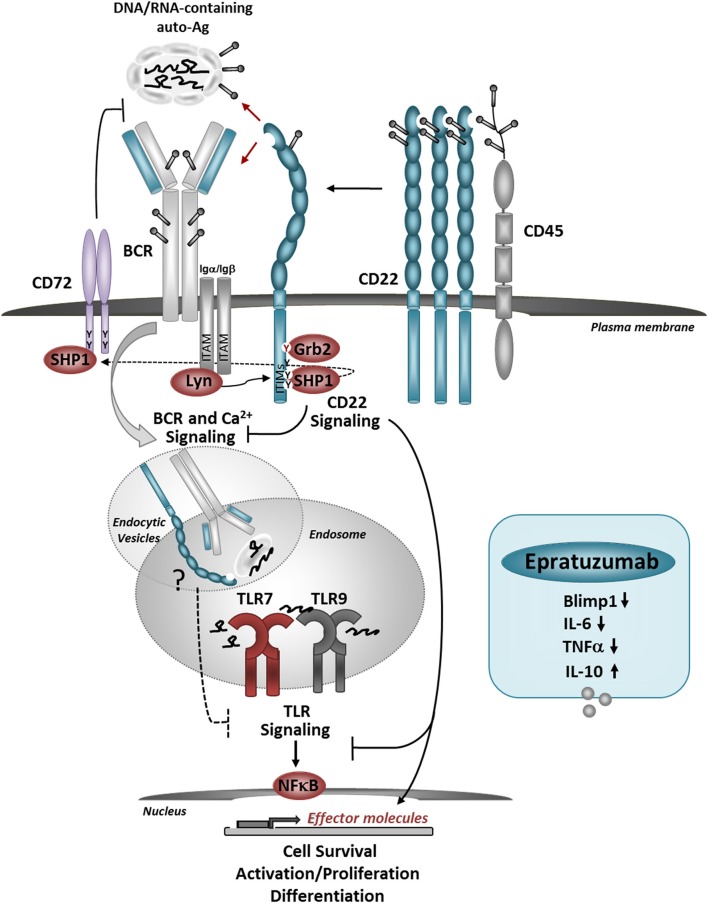
“Emab inhibits the activation and the expression of PRDM1/Blimp1 in response to BCR and TLR7 stimulation in a subset of CD27−IgD− double-negative (DN)memory B-cells (104), known to be elevated in SLE patients with more active disease (127).”
BackgroundInfluentialSelf-citationShp1 signalling is required to establish the long-lived bone marrow plasma cell pool
Li, Y.-F., Xu, S.-L., Ou, X.-J., & Lam, K.-P. (2014) · Nature Communications · doi:10.1038/ncomms5273 · Cited by 32 · cited 1×
“SHP-1, which can be recruited to bind CD22, plays a role in GC maintenance and memory cell development (51, 52).”
BackgroundAn extracatalytic function of CD45 in B cells is mediated by CD22
Coughlin, S. E., Noviski, M., Mueller, J., Chuwonpad, A., Raschke, W., Weiss, A., & Zikherman, J. (2015) · Proceedings of the National Academy of Sciences of the United States of America · doi:10.1073/pnas.1519925112 · Cited by 30 · cited 1×
“(32) also implicated extracellular CD45 in the regulation of CD22.”
BackgroundMizuno, K., Tagawa, Y., Watanabe, N., Ogimoto, M., & Yakura, H. (2005) · European Journal of Immunology · doi:10.1002/eji.200425465 · Cited by 27 · cited 1×
“SLP-76 and BLNK may also be SHP-1 substrates in B cells (23, 24).”
BackgroundCd72c Is a Modifier Gene that Regulates Faslpr-Induced Autoimmune Disease
Xu, M., Hou, R., Sato-Hayashizaki, A., Man, R., Zhu, C., Wakabayashi, C., Hirose, S., Adachi, T., & Tsubata, T. (2013) · Journal of Immunology · doi:10.4049/jimmunol.1203576 · Cited by 27
CD22 Is Required for Protection against West Nile Virus Infection
Ma, D. Y., Suthar, M., Kasahara, S., Gale, M., & Clark, E. (2013) · Journal of Virology · doi:10.1128/jvi.02368-12 · Cited by 27 · cited 4×
“CD22 mice are highly susceptible to infection by West Nile virus (WNV) and die within 10 days post-infection (57).”
BackgroundInfluentialSelf-citationOdaka, M., Hasegawa, M., Hamaguchi, Y., Ishiura, N., Kumada, S., Matsushita, T., Komura, K., Sato, S., Takehara, K., & Fujimoto, M. (2010) · Clinical and Experimental Immunology · doi:10.1111/j.1365-2249.2009.04059.x · Cited by 27 · cited 1×
“Interestingly, antiCD22 Abs capable of inhibiting tyrosine phosphorylation of CD22 have been found in both SSc and SLE patients, which might be another, yet-to-be-explored, mechanism for regulation of CD22 function (93).”
BackgroundTargeted Approaches to Inhibit Sialylation of Multiple Myeloma in the Bone Marrow Microenvironment
Natoni, A., Bohara, R., Pandit, A., & O'Dwyer, M. (2019) · Frontiers in Bioengineering and Biotechnology · doi:10.3389/fbioe.2019.00252 · Cited by 25
CD22 Regulates Time Course of Both B Cell Division and Antibody Response1
Onodera, T., Poe, J., Tedder, T., & Tsubata, T. (2008) · Journal of Immunology · doi:10.4049/jimmunol.180.2.907 · Cited by 25 · cited 1×
“(49) reported that after immunization CD22 B cells, including GC B cells, rapidly expand and generate short-lived AFCs and antibodies.”
BackgroundChellappa, V., Taylor, K. N., Pedrick, K., Donado, C., Netravali, I., Haider, K., Cariappa, A., Dalomba, N. F., & Pillai, S. (2013) · PLoS ONE · doi:10.1371/journal.pone.0053453 · Cited by 23
Fehr, T., López-Macías, C., Odermatt, B., Torres, R. M., Schubart, D. B., O'Keefe, T. L., Matthias, P., Hengartner, H., & Zinkernagel, R. (2000) · International Immunology · doi:10.1093/intimm/12.9.1275 · Cited by 23 · cited 1×
“For example, CD22 mice infected with lymphocytic choriomeningitis virus, vesicular stomatitis virus (65), or Staphylococcus aureus (66) have no differences in survival compared to wild-type (WT) mice.”
BackgroundFollicular dendritic cells adhere to fibronectin and laminin fibers via their respective receptors.
Ogata, T., Yamakawa, M., Imai, Y., & Takahashi, T. (1996) · Blood · doi:10.1182/blood.v88.8.2995.bloodjournal8882995 · Cited by 23 · cited 1×
“CD22 has also been reported to be expressed on human plasmacytoid DC tumors and follicular dendritic cells (63, 64).”
BackgroundLajaunias, F., Ida, A., Kikuchi, S., Fossati-Jimack, L., Martínez-Soria, E., Moll, T., Law, C., & Izui, S. (2003) · Arthritis & Rheumatism · doi:10.1002/art.11021 · Cited by 22 · cited 1×
“Cognate interactions between B and T cells are critical for GC initiation and maintenance, and CD22 ligands (CD22Ls) are expressed on T cells as well as B cells (30, 53).”
BackgroundCD22 is required for formation of memory B cell precursors within germinal centers
Chappell, C. P., Draves, K. E., & Clark, E. (2017) · PLoS ONE · doi:10.1371/journal.pone.0174661 · Cited by 20 · cited 3×
“Unlike SHP-1 deletion, however, GCs are not completely ablated in the absence of CD22; rather, a small subset of CXCR4CD38 PNA GC B cells fail to develop that normally appear early in the immune response (48).”
BackgroundInfluentialSelf-citationLumb, S., Fleischer, S. J., Wiedemann, A., Daridon, C., Maloney, A., Shock, A., & Dörner, T. (2016) · Journal of cell communication and signaling · doi:10.1007/s12079-016-0322-1 · Cited by 20 · cited 6×
“Grb2 has been previously implicated in the negative regulation of Ca2+ in B cells through its localization by the adaptor protein Dok-3 to the plasma membrane and subsequent inhibition of Btk (27).”
BackgroundInfluentialNitschke, L., Lajaunias, F., Moll, T., Ho, L.-Z., Martínez-Soria, E., Kikuchi, S., Santiago‐Raber, M., Dix, C., Parkhouse, R., & Izui, S. (2006) · International Immunology · doi:10.1093/intimm/dxh349 · Cited by 20 · cited 3×
“(72) showed that CD22 encoded by the Cd22a allele expressed on B cells in lupus-prone mice is less efficient in binding to CD22L as compared to the Cd22b counterparts.”
BackgroundResultInfluentialSim, J., Kim, H.-R., Chang, S., Kim, I., Lipsky, P., & Lee, J. (2015) · Arthritis Research & Therapy · doi:10.1186/s13075-015-0687-1 · Cited by 19 · cited 1×
“Thus, targeting CD22 may restore IL-10 production by regulatory B cells, reported to be impaired in SLE patients (126).”
BackgroundMyosin is an in vivo substrate of the protein tyrosine phosphatase (SHP-1) after mIgM cross-linking.
Baba, T., Fusaki, N., Shinya, N., Iwamatsu, A., & Hozumi, N. (2003) · Biochemical and Biophysical Research Communications - BBRC · doi:10.1016/s0006-291x(03)00542-4 · Cited by 19 · cited 1×
“Using a catalytically inactive trapping mutant of SHP-1, the Hozumi group showed that after BCR ligation both myosin and CD72 are substrates for SHP-1 (21, 22).”
CD22 Promotes B-1b Cell Responses to T Cell–Independent Type 2 Antigens
Haas, K. M., Johnson, K. L., Phipps, J. P., & Do, C. (2018) · The Journal of Immunology · doi:10.4049/jimmunol.1701578 · Cited by 16 · cited 3×
“found that CD22 mice have reduced primary Ab responses to NP-OVA in alum (36, 38).”
BackgroundBone marrow dendritic cell mediated regulation of TLR and BCR signaling in B cells
Sindhava, V., Tuna, H., Gachuki, B. W., DiLillo, D., Avdiushko, M. G., Onami, T. M., Tedder, T., Cohen, D., & Bondada, S. (2012) · Journal of Immunology · doi:10.4049/jimmunol.1101352 · Cited by 16 · cited 11×
“Surprisingly, ST6Gal1−/− DCs were just as efficient as wildtype DCs in inhibiting B cell responses to either BCR-ligation or LPS (35, 61), suggesting that CD22 may mediate inhibition of B cells through an interaction not dependent on ST6Gal1.”
BackgroundInfluentialEpratuzumab for Systemic Lupus Erythematosus*
Wallace, D. J., & Goldenberg, D. (2013) · Lupus · doi:10.1177/0961203312469692 · Cited by 15 · cited 2×
“There has been a significant interest in adopting CD22targeted agents, such as Emab as therapies for autoimmune diseases, and in particular, for SLE (120, 121).”
BackgroundMelissaropoulos, K., & Liossis, S. (2018) · Rheumatology International · doi:10.1007/s00296-018-4076-3 · Cited by 14 · cited 1×
“SSc patients may also have decreases in CD22 expression and reduced CD22 phosphorylation (92).”
BackgroundCD19 Signaling Pathways Play a Major Role for Murine AIDS Induction and Progression
Knoetig, S., Torrey, T., Naghashfar, Z., McCarty, T., & Morse, H. (2002) · Journal of Immunology · doi:10.4049/jimmunol.169.10.5607 · Cited by 14 · cited 1×
“CD22-deficiency not only leads to increased susceptibility toWNV (55), but also accelerates murine AIDS MAIDS induced by a murine leukemia virus (67), CD22 mice had a more rapid onset of splenomegaly and lymphadenopathy 4 weeks after infection.”
BackgroundChen, J., Wang, H., Xu, W.-P., Wei, S.-S., Li, H., Mei, Y., Li, Y.-G., & Wang, Y.-P. (2016) · OncoTarget · doi:10.18632/oncotarget.9794 · Cited by 13 · cited 2×
“(25, 26) propose that PMCA regulates Ca2+ in B cells through its interaction with CD22 via a SHP-1-independent pathway.”
BackgroundYarkoni, Y., Fischel, R., Kat, I., Yachimovich‐Cohen, N., & Eilat, D. (2006) · European Journal of Immunology · doi:10.1002/eji.200636190 · Cited by 12
The role of B cell CD22 expression in Staphylococcus aureus arthritis and sepsis
Gjertsson, I., Nitschke, L., & Tarkowski, A. (2004) · Microbes and Infection · doi:10.1016/j.micinf.2003.12.013 · Cited by 11 · cited 1×
“For example, CD22 mice infected with lymphocytic choriomeningitis virus, vesicular stomatitis virus (65), or Staphylococcus aureus (66) have no differences in survival compared to wild-type (WT) mice.”
BackgroundCD19/22 balance relates to improvement of disease activity in systemic lupus erythematosus
Suzuki, J., Nakano, S., Nakairi, Y., Mitsuo, A., Amano, H., Morimoto, S., Tokano, Y., & Takasaki, Y. (2006) · Modern Rheumatology · doi:10.3109/s10165-006-0497-z · Cited by 7 · cited 1×
“Relatively few studies have examined the expression of CD22 on B cells from SLE patients; one study reported a decrease in CD22 levels on B cells from SLE patients with active disease; another study showed an association between disease improvement and increased CD22 expression after treatment (90, 91).”
BackgroundSTALing B cell responses with CD22.
Chappell, C. P., & Clark, E. (2013) · Journal of Clinical Investigation · doi:10.1172/jci69670 · Cited by 4 · cited 1×
“The administration of these SIGLEC-engaging Ag-liposomes (STALs) in mice decreased Ab responses upon a second challenge with the same particles without CD22L, suggesting the induction of Ag-specific immunogenic tolerance (128, 129).”
BackgroundSelf-citation
Research works printed but not linked: 8
- Fujimoto, 2006, B cell antigen receptor and CD40 differentially regulate CD22 tyrosine phosphorylation, J Immunol., 176, 873, 10.4049/jimmunol.176.2.873 · DOI
- Han, 2005, Homomultimeric complexes of CD22 in B cells revealed by protein-glycan cross-linking, Nat Chem Biol., 1, 93, 10.1038/nchembio713 · DOI
- Zeng, 2009, The generation of influenza-specific humoral responses is impaired in ST6Gal I-deficient mice, J Immunol., 182, 4721, 10.4049/jimmunol.0802833 · DOI
- Lee, 2014, Transcriptional programs of lymphoid tissue capillary and high endothelium reveal control mechanisms for lymphocyte homing, Nat Immunol., 15, 982, 10.1038/ni.2983 · DOI
- Bygrave, 2004, Spontaneous autoimmunity in 129 and C57BL/6 mice-implications for autoimmunity described in gene-targeted mice, PLoS Biol., 2, E243, 10.1371/journal.pbio.0020243 · DOI
- Dawidowicz, 2011, Association study of B-cell marker gene polymorphisms in European Caucasian patients with systemic sclerosis, Clin Exp Rheumatol., 29, 839
- El-Sayed, 2009, Altered CD19/CD22 balance in Egyptian children and adolescents with systemic lupus erythematosus, Egypt J Immunol., 16, 27
- Lanoue, 2002, Interaction of CD22 with alpha2,6-linked sialoglycoconjugates: innate recognition of self to dampen B cell autoreactivity?, Eur J Immunol, 32, 348, 10.1002/1521-4141(200202)32:2<348::AID-IMMU348>3.0.CO;2-5 · DOI
Cited by
Sorted by citations
Glycosylation in health and disease
Reily, C., Stewart, T. J., Renfrow, M. B., & Novak, J. (2019) · Nature Reviews Nephrology · doi:10.1038/s41581-019-0129-4 · Cited by 2,075
Siglecs as Immune Cell Checkpoints in Disease
Duan, S., & Paulson, J. C. (2020) · Annual Review of Immunology · doi:10.1146/annurev-immunol-102419-035900 · Cited by 452
SYK coordinates neuroprotective microglial responses in neurodegenerative disease
Ennerfelt, H., Frost, E. L., Shapiro, D. A., Holliday, C., Zengeler, K. E., Voithofer, G., Bolte, A. C., Lammert, C. R., Kulas, J. A., Ulland, T. K., et al. (2022) · Cell · doi:10.1016/j.cell.2022.09.030 · Cited by 297
Xu, X., Sun, Q., Liang, X., Chen, Z., Zhang, X., Zhou, X., Li, M., Tu, H., Liu, Y., Tu, S., et al. (2019) · Frontiers in Immunology · doi:10.3389/fimmu.2019.02664 · Cited by 360
Xist ribonucleoproteins promote female sex-biased autoimmunity
Dou, D. R., Zhao, Y., Belk, J. A., Zhao, Y., Casey, K. M., Chen, D. C., Li, R., Yu, B., Srinivasan, S., Abe, B. T., et al. (2024) · Cell · doi:10.1016/j.cell.2023.12.037 · Cited by 233
Metadata
- Authors
- Clark, E. A., & Giltiay, N. V.
- Affiliations
- University of Washington (US)
- Corresponding author
- Clark, Edward A.
- Venue
- Frontiers in Immunology
- Publisher
- Frontiers Media SA
- Published
- 2018-09-28
- Volume
- 9
- Pages
- 2235-2235
- ISSN
- 1664-3224 (ISSN-L)
- PMC
- PMC6173129
- OpenAlex
- W2893525181
- Cited by
- 197
- References
- 138
- Citations by year
- 2026: 24 · 2025: 29 · 2024: 28 · 2023: 31 · 2022: 35 · 2021: 23 · 2020: 20 · 2019: 7
- FWCI
- 1.28
- Type
- journal article
- Language
- en
- Open access
- gold
- doi.org
- Locations
- Frontiers in Immunology (publishedVersion, cc-by)
- Europe PMC (PubMed Central) (publishedVersion, cc-by)
- PubMed Central (publishedVersion, cc-by)
- PubMed (publishedVersion)
- DOAJ (DOAJ: Directory of Open Access Journals) (submittedVersion)
- Funders
- National Institutes of Health
- Topics
- Life Sciences › Immunology and Microbiology › Immunology › T-cell and B-cell Immunology
- Life Sciences › Biochemistry, Genetics and Molecular Biology › Molecular Biology › Glycosylation and Glycoproteins Research
- Health Sciences › Medicine › Rheumatology › Systemic Lupus Erythematosus Research
- Keywords
- CD22, B cells, B cell signaling, innate immunity, adaptive immunity, autoimmunity, systemic lupus erythematosus, immunotherapeutics, Siglec-G
- MeSH terms
- Alleles, Animals, Autoantibodies, B-Lymphocytes, Humans, Receptors, Antigen, B-Cell, Autoimmunity, Polymorphism, Single Nucleotide, Toll-Like Receptor 7, Mice, Sialic Acid Binding Ig-like Lectin 2, Molecular Targeted Therapy
About these checks
Registry, retraction, Cites and statistics results are computed, not judged, with one exception: a printed reference that no index lists is read once by a model before it counts as a citation error. Claims are extracted by a model and kept only when their quote appears verbatim in the text; each cited source is then checked, with a model’s help, for whether it says what the claim relies on. Those verdicts can be wrong — read the claim’s quote and the cited source before relying on one.
Statistics and arithmetic are recomputed, not judged.
Confidence bands are shown only for fields calibrated on our annotated test set. None is calibrated yet, so no band is shown.
What counts as a claim ›How we measure confidence ›How we check this ›
Are you an author, or do you see a problem with this page? Request a review
