

Dysfunctional purinergic signaling correlates with disease severity in COVID-19 patients
Open accessThe DOI matches its Crossref record; 83 of the 83 references it cites were found in a registry or an index.
Abstract
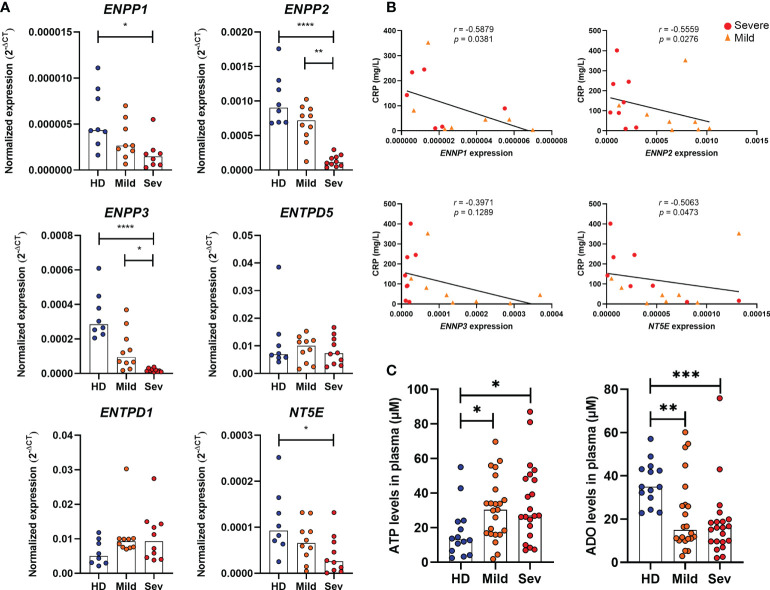
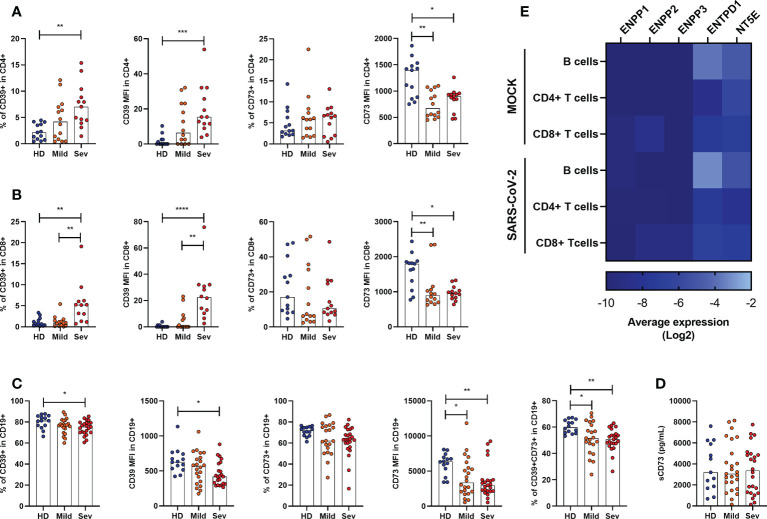
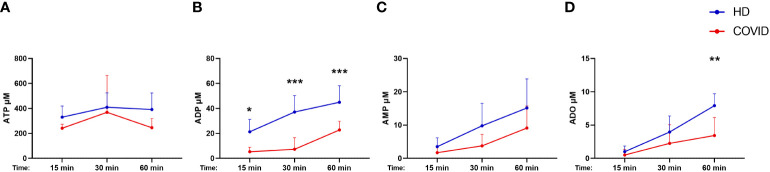
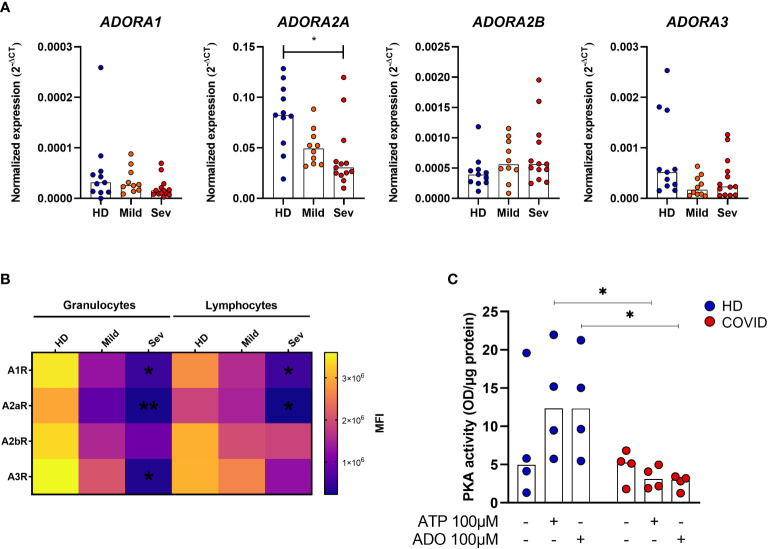
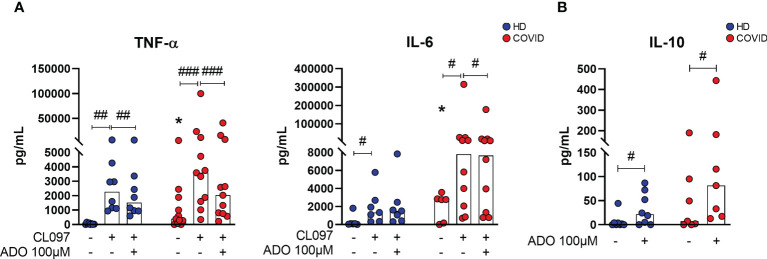
Ectonucleotidases modulate inflammatory responses by balancing extracellular ATP and adenosine (ADO) and might be involved in COVID-19 immunopathogenesis. Here, we explored the contribution of extracellular nucleotide metabolism to COVID-19 severity in mild and severe cases of the disease. We verified that the gene expression of ectonucleotidases is reduced in the whole blood of patients with COVID-19 and is negatively correlated to levels of CRP, an inflammatory marker of disease severity. In line with these findings, COVID-19 patients present higher ATP levels in plasma and reduced levels of ADO when compared to healthy controls. Cell type-specific analysis revealed higher frequencies of CD39+ T cells in severely ill patients, while CD4+ and CD8+ expressing CD73 are reduced in this same group. The frequency of B cells CD39+CD73+ is also decreased during acute COVID-19. Interestingly, B cells from COVID-19 patients showed a reduced capacity to hydrolyze ATP into ADP and ADO. Furthermore, impaired expression of ADO receptors and a compromised activation of its signaling pathway is observed in COVID-19 patients. The presence of ADO in vitro, however, suppressed inflammatory responses triggered in patients’ cells. In summary, our findings support the idea that alterations in the metabolism of extracellular purines contribute to immune dysregulation during COVID-19, possibly favoring disease severity, and suggest that ADO may be a therapeutic approach for the disease.
Overview
The claims and statistics of this paper haven’t been checked yet.
Free: it reads the open-access text and checks the first 5 claims that cite a source we can check. Create a free account to check every claim.
Integrity signals
Registry
Cites
Statistics
Figures
Verification
Claims the paper makes
The claims and statistics of this paper haven’t been checked yet.
Free: it reads the open-access text and checks the first 5 claims that cite a source we can check. Create a free account to check every claim.
Claims other papers make about this one
Each is checked against this paper’s own text: does it say what the citing paper says it does?
The source backs part of the claim, not all of it — or backs it for a different population, condition or comparison.
In the citing paper
“Ectonucleotidases CD39 and CD73 responsible for ATP cleavage to adenosine had reduced expression in severe COVID-19 patients’ blood.”
From NAD+ Precursors Nicotinamide Mononucleotide (NMN) and Nicotinamide Riboside (NR): Potential Dietary Contribution to Health (2023) · cites this paper as [110]
Experimental — accuracy not yet measuredThe source backs part of the claim, not all of it — or backs it for a different population, condition or comparison.
In the citing paper
“Unvaccinated severe COVID-19 patients presented higher ATP levels and lower levels of adenosine in plasma when compared to healthy controls.”
From NAD+ Precursors Nicotinamide Mononucleotide (NMN) and Nicotinamide Riboside (NR): Potential Dietary Contribution to Health (2023) · cites this paper as [110]
Experimental — accuracy not yet measuredThe source backs part of the claim, not all of it — or backs it for a different population, condition or comparison.
In the citing paper
“In addition, in vitro administration of exogenous adenosine prevented inflammatory responses in the leukocytes of patients [110]”
From NAD+ Precursors Nicotinamide Mononucleotide (NMN) and Nicotinamide Riboside (NR): Potential Dietary Contribution to Health (2023) · cites this paper as [110]
Experimental — accuracy not yet measuredThe cited source says what the claim attributes to it.
In the citing paper
“It was found that alterations in the purinergic metabolism contribute to immune dysregulation during COVID-19, possibly contributing to disease severity.”
From NAD+ Precursors Nicotinamide Mononucleotide (NMN) and Nicotinamide Riboside (NR): Potential Dietary Contribution to Health (2023) · cites this paper as [110]
The cited source says what the claim attributes to it.
In the citing paper
“Besides the impaired generation from ATP, the adenosine receptors were also less expressed, in a disease severity-dependent manner [110].”
From NAD+ Precursors Nicotinamide Mononucleotide (NMN) and Nicotinamide Riboside (NR): Potential Dietary Contribution to Health (2023) · cites this paper as [110]
Self-check
Percentages, sums and reported differences re-computed from the paper’s own numbers.
The self-check needs the paper’s full text.
Citations
Cites
Analysis of Relative Gene Expression Data Using Real-Time Quantitative PCR and the 2−ΔΔCT Method
Livak, K. J., & Schmittgen, T. D. (2001) · Methods · doi:10.1006/meth.2001.1262 · Cited by 180,860 · cited 1×
“6 (Applied Biosystems) according to the delta-CT method (26).”
MethodClinical features of patients infected with 2019 novel coronavirus in Wuhan, China
Huang, C., Wang, Y., Li, X., Ren, L., Zhao, J., Hu, Y., Zhang, L., Fan, G., Xu, J., Gu, X., et al. (2020) · The Lancet · doi:10.1016/s0140-6736(20)30183-5 · Cited by 48,884
Integrating single-cell transcriptomic data across different conditions, technologies, and species
Butler, A., Hoffman, P., Smibert, P., Papalexi, E., & Satija, R. (2018) · Nature Biotechnology · doi:10.1038/nbt.4096 · Cited by 13,174 · cited 1×
“4 package (29) and differentially expressed genes were analyzed using the 10x Genomics Loupe Browser (v.”
MethodClinical and immunological features of severe and moderate coronavirus disease 2019
Chen, G., Wu, D., Guo, W., Cao, Y., Huang, D., Wang, H., Wang, T., Zhang, X., Chen, H., Yu, H., et al. (2020) · Journal of Clinical Investigation · doi:10.1172/jci137244 · Cited by 4,750 · cited 1×
“Despite the preferential tropism to the lungs, SARS-CoV-2 can be detected in several organs, triggering exacerbated inflammatory responses not only in the target tissues but also systemically, which seems to be responsible for multi-organ failure (3, 4).”
BackgroundReceptors for Purines and Pyrimidines
Burnstock, G., & Verkhratsky, A. (2012) · Purinergic Signalling and the Nervous System · doi:10.1007/978-3-642-28863-0_5 · Cited by 3,958 · cited 1×
“Extracellular ATP (eATP) can act as a “danger” signal, p romot ing immune ce l l a c t i v a t ion and e l i c i t ing proinflammatory responses (6, 8).”
BackgroundMutation of the mouse klotho gene leads to a syndrome resembling ageing
Kuro-o, M., Matsumura, Y., Aizawa, H., Kawaguchi, H., Suga, T., Utsugi, T., Ohyama, Y., Kurabayashi, M., Kaname, T., Kume, E., et al. (1997) · Nature · doi:10.1038/36285 · Cited by 3,837
An inflammatory cytokine signature predicts COVID-19 severity and survival
Del Valle, D. M., Kim-Schulze, S., Huang, H.-H., Beckmann, N. D., Nirenberg, S., Wang, B., Lavin, Y., Swartz, T. H., Madduri, D., Stock, A., et al. (2020) · Nature Medicine · doi:10.1038/s41591-020-1051-9 · Cited by 2,605 · cited 1×
“Both cytokines are increased in the blood of COVID19 patients (76).”
BackgroundPathological inflammation in patients with COVID-19: a key role for monocytes and macrophages
Merad, M., & Martin, J. C. (2020) · Nature Reviews Immunology · doi:10.1038/s41577-020-0331-4 · Cited by 2,472
Muñoz-Planillo, R., Kuffa, P., Martínez-Colón, G., Smith, B. L., Rajendiran, T. M., & Núñez, G. (2013) · Immunity · doi:10.1016/j.immuni.2013.05.016 · Cited by 2,147 · cited 1×
“Indeed, the accumulation of ATP has been shown the trigger inflammatory responses such as the activation of the inflammasome pathway (64, 65).”
BackgroundMultiorgan and Renal Tropism of SARS-CoV-2
Puelles, V. G., Lütgehetmann, M., Lindenmeyer, M. T., Sperhake, J. P., Wong, M. N., Allweiss, L., Chilla, S., Heinemann, A., Wanner, N., Liu, S., et al. (2020) · New England Journal of Medicine · doi:10.1056/nejmc2011400 · Cited by 1,775 · cited 1×
“Despite the preferential tropism to the lungs, SARS-CoV-2 can be detected in several organs, triggering exacerbated inflammatory responses not only in the target tissues but also systemically, which seems to be responsible for multi-organ failure (3, 4).”
Background
Research works printed but not linked: 1
- WHO. COVID-19 therapeutic trial synopsis. (Switzerland: World Health Organization) (2020).
Cited by
Alegre, G. F. S., & Pastore, G. M. (2023) · Current Nutrition Reports · doi:10.1007/s13668-023-00475-y · Cited by 101
Elsaghir, A., El-Sabaa, E. M. W., Zahran, A. M., Mandour, S. A., Salama, E. H. A., Aboulfotuh, S., El-morshedy, R. M., Tocci, S., Mandour, A., Ali, W. E., et al. (2023) · International Journal of Molecular Sciences · doi:10.3390/ijms242417614 · Cited by 22
Chang, Y.-Y., & Wei, A. (2024) · PLoS ONE · doi:10.1371/journal.pone.0297664 · Cited by 16
Elsaghir, A., El-Sabaa, E. M. W., Ahmed, A. K., Abdelwahab, S. F., Sayed, I. M., & El‐Mokhtar, M. A. (2023) · Pathogens · doi:10.3390/pathogens12020279 · Cited by 14
Editorial: Hypoxia and inflammation: A two-way street
Saas, P., & Fan, G. (2023) · Frontiers in Immunology · doi:10.3389/fimmu.2023.1171116 · Cited by 13
“These results are recently confirmed by others (3, 4).”
ResultT Regulatory Cell Subsets Do Not Restore for One Year After Acute COVID-19
Aquino, A. D., Zaikova, E. K., Kalinina, O., Каронова, Т. Л., Rubinstein, A., Mikhaylova, A. A., Kudryavtsev, I., & Головкин, А. С. (2024) · International Journal of Molecular Sciences · doi:10.3390/ijms252111759 · Cited by 10
“Similarly, in one study, cell type-specific analysis revealed higher frequencies of CD39 + T cells in severe COVID-19 patients, while the expression of CD73 on CD4 + and CD8 + cells was reduced in the same group [51].”
ResultPurinergic signaling in the battlefield of viral infections
Barbosa, N. C., Zeidler, J. D., Savio, L. E. B., & Coutinho‐Silva, R. (2023) · Purinergic Signalling · doi:10.1007/s11302-023-09981-8 · Cited by 9
“Accordingly, serum from patients with COVID-19 has increased levels of eATP compared to control individuals [96–98].”
Heil, M. (2024) · Frontiers in Immunology · doi:10.3389/fimmu.2023.1259879 · Cited by 12
Immunology and Microbiology to the Article “SARS-CoV-2 Infection”
Budko, H., Івахнюк, Т. В., Sushchenko, S., & Kozyr, N. L. (2022) · Journal Of Biochemical Technology · doi:10.51847/44bvi7lvev · Cited by 7
“…of ectonucleotidase genes is negatively correlated with the level of C-reactive protein, an inflammatory marker of disease severity, and severely ill patients have higher plasma adenosine triphosphate and lower aspartate aminotransferase levels (Pietrobon et al ., 2022; Navarro et al ., 2023).”
The role of the P2X7 receptor in inactivated SARS-CoV-2-induced lung injury
Barbosa, N. C., Cristina‐Rodrigues, F., Temerozo, J. R., Souza, T. M. L., Gouvêa, A. L., Canetti, C. D. A., Kurtenbach, E., Bou‐Habib, D. C., Benjamim, C. F., Takiya, C. M., et al. (2024) · Purinergic Signalling · doi:10.1007/s11302-024-10062-7 · Cited by 9
“The ATP secretion induced by SARS-CoV-2 infection was confirmed by different groups showing serum ATP levels increase in patients with COVID-19 [46, 47].”
Xiang, F., Sun, L., Cao, X., Li, Y., Chen, X., Zhang, Z., Zou, J., Teng, J., Shen, B., & Ding, X. (2024) · Clinica Chimica Acta · doi:10.1016/j.cca.2024.117791 · Cited by 6
dos Santos, P. M. F., Acosta, C. C. D., Rosa, T. L. S. A., Ishiba, M. H., Dias, A. A., Pereira, A. M. R., Gutierres, L. D., Pereira, M. P., Rocha, M. D. S., Rosa, P. S., et al. (2024) · Frontiers in Pharmacology · doi:10.3389/fphar.2024.1399363 · Cited by 5
ATP-P2X7R pathway activation limits the Tfh cell compartment during pediatric RSV infection
Russo, C., Raiden, S., Algieri, S., Bruera, M. J., Carli, N. D., Sarli, M., Cairoli, H., Lillo, L. D., Morales, I., Seery, V., et al. (2024) · Frontiers in Immunology · doi:10.3389/fimmu.2024.1397098 · Cited by 5
Martins, D., Beckman, D., Loggia, M. L., Costanza, A., & Borsini, A. (2026) · Translational Psychiatry · doi:10.1038/s41398-026-04286-x · Cited by 4
“This has been observed in response to metabolic stress and adenosine accumulation - both of which are potentiated by in fl ammatory cytokines [104, 105].”
Purinergic signaling pathway in severe COVID-19
Arruvito, L., Sananez, I., Seery, V., Russo, C., & Geffner, J. R. (2023) · Current Opinion in Pharmacology · doi:10.1016/j.coph.2023.102379 · Cited by 5
Atif, M., Alsrhani, A., Naz, F., Ullah, S., Abdalla, A. E., Ullah, M. I., Mazhari, B. B. Z., Eltayeb, L. B., Hamad, İ., & Ejaz, H. (2024) · Molecular Biology Reports · doi:10.1007/s11033-024-09839-1 · Cited by 5
Characterization of Regulatory T Cells in Patients Infected by Leishmania Infantum
Peixoto, R. F., Gois, B. M., Martins, M., Palmeira, P. H. D. S., Rocha, J. C., Gomes, J. D. A. S., de Azevedo, F. D. L. A. A., Veras, R. C., de Medeiros, I. A., Grisi, T. C. S. D. L., et al. (2022) · Tropical Medicine and Infectious Disease · doi:10.3390/tropicalmed8010018 · Cited by 4
“These changes in ectonucleotidases levels can impact the purinergic metabolism reflecting in the adenosine availability [16].”
BackgroundHernandez, C. A., & Eugenín, E. A. (2023) · Current Opinion in Pharmacology · doi:10.1016/j.coph.2023.102404 · Cited by 4
Gambichler, T., Rüth, J., Goesmann, S., Höxtermann, S., Skrygan, M., Susok, L., Becker, J. C., Overheu, O., Schmidt, W. E., & Reinacher‐Schick, A. (2024) · Viruses · doi:10.3390/v16050810 · Cited by 4
“Moreover, Pietrobon et al. [39] observed that the percentage of CD39+ cells in CD4+ and CD8+ T cells was higher in patients with severe COVID-19 than in patients with mild infection and healthy controls.”
BackgroundMazzocco, Y. L., Bergero, G., Rosso, S. D., Eberhardt, N., Sola, C., Saka, H. A., Villada, S. M., Bocco, J. L., & Aoki, M. P. (2023) · Frontiers in Immunology · doi:10.3389/fimmu.2023.1227873 · Cited by 1
Altered CD73-Adenosine Signaling Linked to Infection in Patients undergoing hemodialysis
Xiang, F., Zhang, Z., Nie, Y., Cao, X., Li, Y., Chen, X., Gong, S., Zou, J., Teng, J., Ding, X., et al. (2025) · Journal of Inflammation Research · doi:10.2147/jir.s498575 · Cited by 1
Simões, J. L. B., Eichler, S. W., Siqueira, M. L. R., Braga, G. D. C., & Bagatini, M. D. (2024) · Brain Sciences · doi:10.3390/brainsci14020180
“They also observed reduced Ado production, with both conditions contributing to a proin fl ammatory state [29].”
BackgroundInfluentialYonamine, D. K. (2023) · Digital Library of Theses and Dissertations (Universidade de São Paulo) · doi:10.11606/t.59.2023.tde-30012024-145043
A Severe COVID-19-associated hNTPDase2 Variant is Enzymatically InactivePreprint
Dizaji, S. R., Mouhamed, M. B., Tafer, I., Pelletier, J., & Sévigny, J. (2026) · Research Square · doi:10.21203/rs.3.rs-11214673/v1
Metadata
- Authors
- Pietrobon, A. J., Andrejew, R., Custódio, R. W. A., Oliveira, L. D. M., Scholl, J. N., Teixeira, F. M. E., de Brito, C. A., Glaser, T., Kazmierski, J., Goffinet, C., Turdo, A. C., Yendo, T., Aoki, V., Figueiró, F., Battastini, A. M., Ulrich, H., Benard, G., Duarte, A. J. D. S., & Sato, M. N.
- Affiliations
- Universidade de São Paulo (BR)
- Universidade Federal do Rio Grande do Sul (BR)
- Berlin Institute of Health at Charité - Universitätsmedizin Berlin (DE)
- Corresponding author
- Sato, Maria Notomi
- ORCID
- Venue
- Frontiers in Immunology
- Publisher
- Frontiers Media SA
- Published
- 2022-09-30
- Volume
- 13
- Pages
- 1012027-1012027
- ISSN
- 1664-3224 (ISSN-L)
- PMC
- PMC9562777
- OpenAlex
- W4298140749
- Cited by
- 23
- References
- 81
- Citations by year
- 2026: 1 · 2025: 1 · 2024: 10 · 2023: 9 · 2022: 2
- FWCI
- 3.51
- Type
- journal article
- Language
- en
- Open access
- gold
- doi.org
- Licence
- Locations
- Frontiers in Immunology (publishedVersion, cc-by)
- PubMed Central (publishedVersion, cc-by)
- PubMed (publishedVersion)
- DOAJ (DOAJ: Directory of Open Access Journals) (submittedVersion, cc-by-sa)
- LA Referencia (Red Federada de Repositorios Institucionales de Publicaciones Científicas) (submittedVersion, cc-by-nc-sa)
- Funders
- Fundação de Amparo à Pesquisa do Estado de São Paulo (2020/13148-0, 2018/07366-4)
- Coordenação de Aperfeiçoamento de Pessoal de Nível Superior (88887.503842/2020-00)
- Conselho Nacional de Desenvolvimento Científico e Tecnológico
- Topics
- Life Sciences › Biochemistry, Genetics and Molecular Biology › Physiology › Adenosine and Purinergic Signaling
- Health Sciences › Medicine › Infectious Diseases › COVID-19 Clinical Research Studies
- Life Sciences › Biochemistry, Genetics and Molecular Biology › Molecular Biology › Biochemical and Molecular Research
- Keywords
- COVID-19 pandemic, disease severity, purinergic signaling, adenosine, extracellular ATP, ectonucleotidases, CD39, CD73, B cells, adenosine receptors, C-reactive protein, inflammation, immunopathogenesis, nucleotide metabolism
- MeSH terms
- COVID-19, Adenosine, Adenosine Diphosphate, Adenosine Triphosphate, Humans, Purines, Severity of Illness Index, Signal Transduction
About these checks
Registry, retraction, Cites and statistics results are computed, not judged, with one exception: a printed reference that no index lists is read once by a model before it counts as a citation error. Claims are extracted by a model and kept only when their quote appears verbatim in the text; each cited source is then checked, with a model’s help, for whether it says what the claim relies on. Those verdicts can be wrong — read the claim’s quote and the cited source before relying on one.
Statistics and arithmetic are recomputed, not judged.
Confidence bands are shown only for fields calibrated on our annotated test set. None is calibrated yet, so no band is shown.
What counts as a claim ›How we measure confidence ›How we check this ›
Are you an author, or do you see a problem with this page? Request a review
Data sources
Bibliographic data: Semantic Scholar, OpenAlex, Crossref.
Contains information from the Semantic Scholar Academic Graph Datasets, made available under the ODC Attribution License (ODC-BY 1.0).
Semantic Scholar’s data is described in: Kinney, R., et al. (2023). The Semantic Scholar Open Data Platform. arXiv:2301.10140.
