

The DOI matches its Crossref record; 101 of the 101 references it cites were found in a registry or an index.
A review of cardiorespiratory fitness-related neuroplasticity in the aging brain
Open accessAbstract
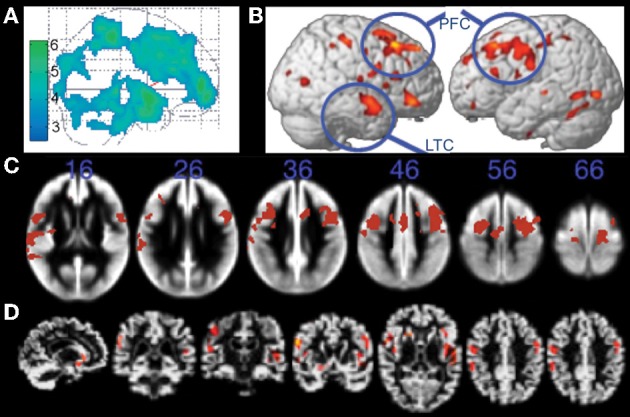
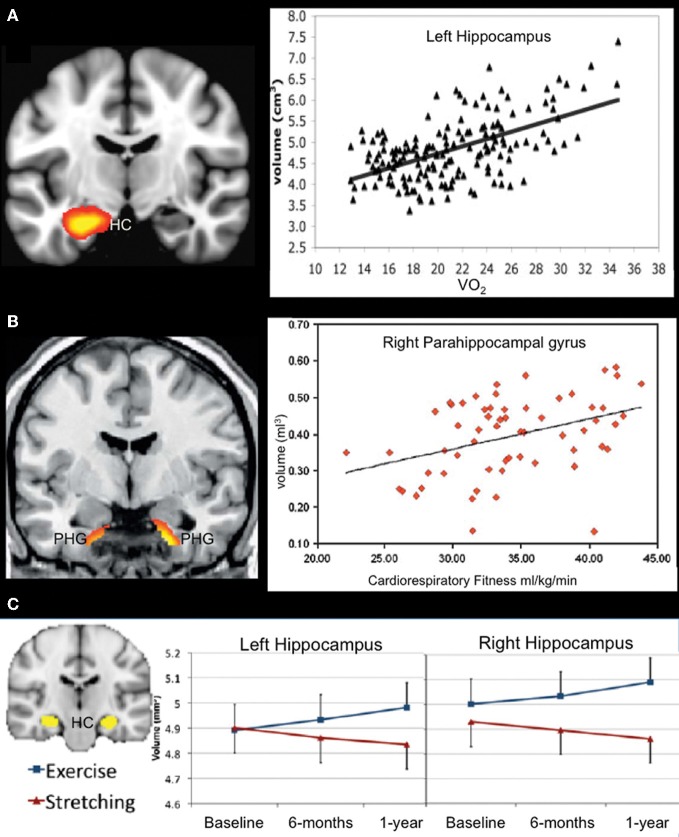
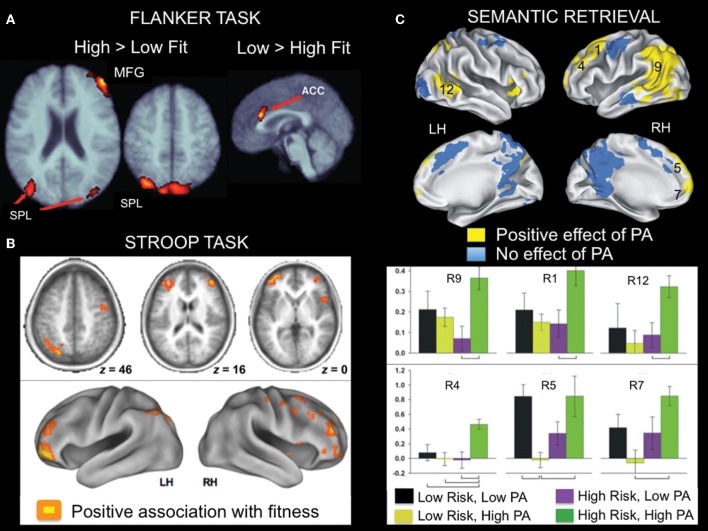
The literature examining the relationship between cardiorespiratory fitness and the brain in older adults has increased rapidly, with 30 of 34 studies published since 2008. Here we review cross-sectional and exercise intervention studies in older adults examining the relationship between cardiorespiratory fitness and brain structure and function, typically assessed using Magnetic Resonance Imaging (MRI). Studies of patients with Alzheimer's disease are discussed when available. The structural MRI studies revealed a consistent positive relationship between cardiorespiratory fitness and brain volume in cortical regions including anterior cingulate, lateral prefrontal, and lateral parietal cortex. Support for a positive relationship between cardiorespiratory fitness and medial temporal lobe volume was less consistent, although evident when a region-of-interest approach was implemented. In fMRI studies, cardiorespiratory fitness in older adults was associated with activation in similar regions as those identified in the structural studies, including anterior cingulate, lateral prefrontal, and lateral parietal cortex, despite heterogeneity among the functional tasks implemented. This comprehensive review highlights the overlap in brain regions showing a positive relationship with cardiorespiratory fitness in both structural and functional imaging modalities. The findings suggest that aerobic exercise and cardiorespiratory fitness contribute to healthy brain aging, although additional studies in Alzheimer's disease are needed.
Overview
The claims and statistics of this paper haven’t been checked yet.
Run the check — free, no account needed. It reads the open-access text and checks the sources it cites.
Integrity signals
Registry
Cites
Statistics
Figures
Verification
Claims the paper makes
The claims and statistics of this paper haven’t been checked yet.
Run the check — free, no account needed. It reads the open-access text and checks the sources it cites.
Claims other papers make about this one
Each is checked against this paper’s own text: does it say what the citing paper says it does?
In the citing paper
“However, there is overlap among the neural correlates of PTSD and the brain regions impacted by aerobic exercise (93), suggesting that exercise-induced brain changes may be a mechanism by which aerobic exercise positively impacts PTSD symptomatology.”
From Exercise Intervention in PTSD: A Narrative Review and Rationale for Implementation (2019) · cites this paper as [93]
Self-check
Percentages, sums and reported differences re-computed from the paper’s own numbers.
The self-check needs the paper’s full text.
Citations
Cites
Neuropathological stageing of Alzheimer-related changes.
Braak, H., & Braak, E. (1991) · Acta Neuropathologica · doi:10.1007/bf00308809 · Cited by 16,123
The Brain's Default Network: Anatomy, Function, and Relevance to Disease
Buckner, R. L., Andrews‐Hanna, J. R., & Schacter, D. L. (2008) · Annals of the New York Academy of Sciences · doi:10.1196/annals.1440.011 · Cited by 9,761
(1985) · Europe PMC (PubMed Central) · Cited by 9,143
Voxel-Based Morphometry—The Methods
Ashburner, J., & Friston, K. J. (2000) · NeuroImage · doi:10.1006/nimg.2000.0582 · Cited by 8,676
Neurophysiological investigation of the basis of the fMRI signal
Logothetis, N. K., Pauls, J., Augath, M., Trinath, T., & Oeltermann, A. (2001) · Nature · doi:10.1038/35084005 · Cited by 6,551
Exercise training increases size of hippocampus and improves memory
Erickson, K. I., Voss, M. W., Prakash, R. S., Basak, C., Szabo, A., Chaddock, L., Kim, J. S., Heo, S., Alves, H., White, S. M., et al. (2011) · Proceedings of the National Academy of Sciences · doi:10.1073/pnas.1015950108 · Cited by 4,855
Colman (2022) · doi:10.1073/pnas · Cited by 4,370
Basser, P. J., & Pierpaoli, C. (1996) · Journal of Magnetic Resonance, Series B · doi:10.1006/jmrb.1996.0086 · Cited by 4,306
Calibration of the Computer Science and Applications, Inc. accelerometer
FREEDSON, P. S., MELANSON, E., & SIRARD, J. (1998) · Medicine & Science in Sports & Exercise · doi:10.1097/00005768-199805000-00021 · Cited by 3,825
Fitness Effects on the Cognitive Function of Older Adults: A Meta-Analytic Study
Colcombe, S., & Kramer, A. F. (2003) · Psychological Science · doi:10.1111/1467-9280.t01-1-01430 · Cited by 3,782
Cited by
Sorted by citations
Wefel, J. S., Kesler, S. R., Noll, K. R., & Schagen, S. B. (2014) · CA A Cancer Journal for Clinicians · doi:10.3322/caac.21258 · Cited by 546
Biological mechanisms underlying the role of physical fitness in health and resilience
Silverman, M. N., & Deuster, P. A. (2014) · Interface Focus · doi:10.1098/rsfs.2014.0040 · Cited by 416
Physical Activity and Cognitive Vitality
Prakash, R. S., Voss, M. W., Erickson, K. I., & Kramer, A. F. (2015) · Annual Review of Psychology · doi:10.1146/annurev-psych-010814-015249 · Cited by 376
Aerobic exercise for Alzheimer's disease: A randomized controlled pilot trial
Morris, J. K., Vidoni, E. D., Johnson, D. K., Sciver, A. R. V., Mahnken, J. D., Honea, R. A., Wilkins, H., Brooks, W. M., Billinger, S. A., Swerdlow, R. H., et al. (2017) · PLoS ONE · doi:10.1371/journal.pone.0170547 · Cited by 364
Exercise-Induced Neuroplasticity: A Mechanistic Model and Prospects for Promoting Plasticity
El‐Sayes, J., Harasym, D., Turco, C. V., Locke, M. B., & Nelson, A. J. (2018) · The Neuroscientist · doi:10.1177/1073858418771538 · Cited by 335
Metadata
- Authors
- Hayes, S. M., Hayes, J. P., Cadden, M., & Verfaellie, M.
- Affiliations
- Boston University (US)
- Corresponding author
- Hayes, Scott M.
- Venue
- Frontiers in Aging Neuroscience
- Publisher
- Frontiers Media SA
- Published
- 2013
- Volume
- 5
- Pages
- 31-31
- ISSN
- 1663-4365 (ISSN-L)
- PMC
- PMC3709413
- OpenAlex
- W2125682808
- Cited by
- 154
- References
- 101
- Citations by year
- 2026: 3 · 2025: 14 · 2024: 12 · 2023: 7 · 2022: 7 · 2021: 14 · 2020: 11 · 2019: 16 · 2018: 8 · 2017: 11 · 2016: 12 · 2015: 20 · 2014: 16 · 2013: 3
- FWCI
- 11.84
- Type
- journal article
- Language
- en
- Open access
- gold
- doi.org
- Licence
- cc-by
- Locations
- Frontiers in Aging Neuroscience (publishedVersion, cc-by)
- Europe PMC (PubMed Central) (publishedVersion, cc-by)
- PubMed Central (publishedVersion, cc-by)
- PubMed (publishedVersion)
- DOAJ (DOAJ: Directory of Open Access Journals) (submittedVersion, cc-by-sa)
- Funders
- U.S. Department of Veterans Affairs
- National Institutes of Health
- National Institute of Mental Health (K23MH084013)
- Topics
- Health Sciences › Medicine › Public Health, Environmental and Occupational Health › Physical Activity and Health
- Health Sciences › Medicine › Psychiatry and Mental health › Dementia and Cognitive Impairment Research
- Health Sciences › Medicine › Physiology (medical) › Cardiovascular and exercise physiology
- Keywords
- cardiorespiratory fitness, neuroplasticity, brain aging, older adults, aerobic exercise, brain structure, brain function, cortical volume, anterior cingulate cortex, prefrontal cortex, parietal cortex, medial temporal lobe, Alzheimer's disease, exercise intervention
About these checks
Registry, retraction, Cites and statistics results are computed, not judged, with one exception: a printed reference that no index lists is read once by a model before it counts as a citation error. Claims are extracted by a model and kept only when their quote appears verbatim in the text; each cited source is then checked, with a model’s help, for whether it says what the claim relies on. Those verdicts can be wrong — read the claim’s quote and the cited source before relying on one.
Statistics and arithmetic are recomputed, not judged.
Confidence bands are shown only for fields calibrated on our annotated test set. None is calibrated yet, so no band is shown.
What counts as a claim ›How we measure confidence ›How we check this ›
Are you an author, or do you see a problem with this page? Request a review
