

The DOI matches its Crossref record; 258 of the 259 references it cites were found in a registry or an index.
Mesocorticolimbic Dopamine Pathways Across Adolescence: Diversity in Development
Open accessAbstract
Mesocorticolimbic dopamine circuity undergoes a protracted maturation during adolescent life. Stable adult levels of behavioral functioning in reward, motivational, and cognitive domains are established as these pathways are refined, however, their extended developmental window also leaves them vulnerable to perturbation by environmental factors. In this review, we highlight recent advances in understanding the mechanisms underlying dopamine pathway development in the adolescent brain, and how the environment influences these processes to establish or disrupt neurocircuit diversity. We further integrate these recent studies into the larger historical framework of anatomical and neurochemical changes occurring during adolescence in the mesocorticolimbic dopamine system. While dopamine neuron heterogeneity is increasingly appreciated at molecular, physiological, and anatomical levels, we suggest that a developmental facet may play a key role in establishing vulnerability or resilience to environmental stimuli and experience in distinct dopamine circuits, shifting the balance between healthy brain development and susceptibility to psychiatric disease.
Overview
The claims and statistics of this paper haven’t been checked yet.
Run the check — free, no account needed. It reads the open-access text and checks the sources it cites.
Integrity signals
Registry
Cites
Statistics
Figures
Verification
Claims the paper makes
The claims and statistics of this paper haven’t been checked yet.
Run the check — free, no account needed. It reads the open-access text and checks the sources it cites.
Claims other papers make about this one
Each is checked against this paper’s own text: does it say what the citing paper says it does?
The source backs part of the claim, not all of it — or backs it for a different population, condition or comparison.
In the citing paper
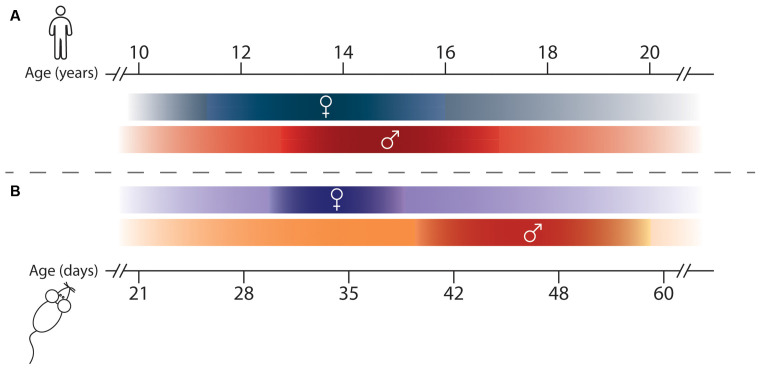
“The adolescent period can be further sub-divided into early (~PND 21–34), middle (~PND 35–45), and late (~PND 45–60) periods [39, 46]”
From Adolescent nicotine exposure and persistent neurocircuitry changes: unveiling lifelong psychiatric risks (2025) · cites this paper as [39]
Experimental — accuracy not yet measuredThe cited source says what the claim attributes to it.
In the citing paper
“adolescence in rodents is increasingly defined more in line with this larger age window in humans, by counting the period from weaning (~PND 21) where mice and rats gain begin to interact independently with their environments for the first time”
From Adolescent nicotine exposure and persistent neurocircuitry changes: unveiling lifelong psychiatric risks (2025) · cites this paper as [39]
The cited source says what the claim attributes to it.
In the citing paper
“it is increasingly recognized to be evolutionarily conserved, with animal species also showing distinct markers of an adolescent state [35–40].”
From Adolescent nicotine exposure and persistent neurocircuitry changes: unveiling lifelong psychiatric risks (2025) · cites this paper as [39]
The cited source says what the claim attributes to it.
In the citing paper
“As the dopamine system undergoes a period of profound and dynamic development in adolescence [39]”
From Adolescent nicotine exposure and persistent neurocircuitry changes: unveiling lifelong psychiatric risks (2025) · cites this paper as [39]
Self-check
Percentages, sums and reported differences re-computed from the paper’s own numbers.
The self-check needs the paper’s full text.
Citations
Cites
Items 201–258 of 258
Soto, P. L., Wilcox, K. M., Zhou, Y., Ator, N. A., Riddle, M. A., Wong, D. F., & Weed, M. R. (2012) · Neuropsychopharmacology · doi:10.1038/npp.2012.119 · Cited by 58
Glausier, J. R., Khan, Z. U., & Muly, E. (2008) · Cerebral Cortex · doi:10.1093/cercor/bhn212 · Cited by 58
Prefrontal Dopaminergic Mechanisms of Extinction in Adolescence Compared to Adulthood in Rats
Zbukvic, I. C., Park, C. H. J., Ganella, D. E., Lawrence, A. J., & Kim, J. H. (2017) · Frontiers in Behavioral Neuroscience · doi:10.3389/fnbeh.2017.00032 · Cited by 57
Making connections: the development of mesencephalic dopaminergic neurons
Riddle, R. D., & Pollock, J. D. (2003) · Developmental Brain Research · doi:10.1016/j.devbrainres.2003.09.010 · Cited by 56
Trophic factors differentiate dopamine neurons vulnerable to Parkinson's disease
Reyes, S., Fu, Y., Double, K. L., Cottam, V., Thompson, L. H., Kirik, D., Paxinos, G., WATSON, C. R. R., Cooper, H. M., & Halliday, G. M. (2012) · Neurobiology of Aging · doi:10.1016/j.neurobiolaging.2012.07.019 · Cited by 55
Differential effects of NGF and NT-3 on embryonic trigeminal axon growth patterns
Ulupınar, E., Jacquin, M. F., & Erzurumlu, R. S. (2000) · The Journal of Comparative Neurology · doi:10.1002/1096-9861(20000918)425:2 · Cited by 52
Establishing diversity in the dopaminergic system
Bodea, G. O., & Blaess, S. (2015) · FEBS Letters · doi:10.1016/j.febslet.2015.09.016 · Cited by 50
Adolescence, brain maturation and mental health
Galván, A. (2017) · Nature Neuroscience · doi:10.1038/nn.4530 · Cited by 48
Lieberman, O. J., Cartocci, V., Pigulevskiy, I., Molinari, M., Carbonell, J., Broseta, M. B., Post, M. R., Sulzer, D., Borgkvist, A., & Santini, E. (2020) · Frontiers in Cellular Neuroscience · doi:10.3389/fncel.2020.00070 · Cited by 48
Vassilev, P., Pantoja-Urbán, A. H., Giroux, M., Nouel, D., Hernández, G., Orsini, T., & Flores, C. (2021) · eNeuro · doi:10.1523/eneuro.0045-21.2021 · Cited by 48
Self-citationBrignani, S., & Pasterkamp, R. J. (2017) · Frontiers in Neuroanatomy · doi:10.3389/fnana.2017.00055 · Cited by 47
Peterson, E., Kwon, D., Luna, B., Larsen, B., Prouty, D., Bellis, M. D. D., Voyvodic, J. T., Liu, C., Li, W., Pohl, K. M., et al. (2018) · Human Brain Mapping · doi:10.1002/hbm.24461 · Cited by 47
Chronic estradiol treatment increases ovariectomized rat striatal D-1 dopamine receptors
Lévesque, D., & Paolo, T. D. (1989) · Life Sciences · doi:10.1016/0024-3205(89)90522-5 · Cited by 46
Rey, R., Suaud‐Chagny, M., Bohec, A.-L., Dorey, J., d’Amato, T., Tamouza, R., & Leboyer, M. (2020) · Brain Behavior and Immunity · doi:10.1016/j.bbi.2020.08.019 · Cited by 46
D2 dopamine modulation of corticoaccumbens synaptic responses changes during adolescence
Benoit‐Marand, M., & O'Donnell, P. (2008) · European Journal of Neuroscience · doi:10.1111/j.1460-9568.2008.06107.x · Cited by 45
Neurobehavioral changes arising from early life dopamine signaling perturbations
Areal, L. B., & Blakely, R. (2020) · Neurochemistry International · doi:10.1016/j.neuint.2020.104747 · Cited by 45
Cuesta, S., Restrepo-Lozano, J. M., Popescu, C., He, S., Reynolds, L. M., Israel, S. A., Hernández, G., Rais, R., Slusher, B. S., & Flores, C. (2019) · Addiction Biology · doi:10.1111/adb.12791 · Cited by 43
Self-citationSex and strain differences in dynamic and static properties of the mesolimbic dopamine system
Rivera-Garcia, M. T., McCane, A. M., Chowdhury, T. G., Wallin-Miller, K. G., & Moghaddam, B. (2020) · Neuropsychopharmacology · doi:10.1038/s41386-020-0765-1 · Cited by 43
Dopamine Axon Targeting in the Nucleus Accumbens in Adolescence Requires Netrin-1
Cuesta, S., Nouel, D., Reynolds, L. M., Morgunova, A., Torres‐Berrío, A., White, A., Hernández, G., Cooper, H. M., & Flores, C. (2020) · Frontiers in Cell and Developmental Biology · doi:10.3389/fcell.2020.00487 · Cited by 40
Self-citationmiR-218 in Adolescence Predicts and Mediates Vulnerability to Stress
Torres‐Berrío, A., Morgunova, A., Giroux, M., Cuesta, S., Nestler, E. J., & Flores, C. (2020) · Biological Psychiatry · doi:10.1016/j.biopsych.2020.10.015 · Cited by 40
Self-citationRegulation of netrin-1 receptors by amphetamine in the adult brain
Yetnikoff, L., Labelle‐Dumais, C., & Flores, C. (2007) · Neuroscience · doi:10.1016/j.neuroscience.2007.09.069 · Cited by 38
Self-citationKritzer, M. F. (1999) · Cerebral Cortex · doi:10.1093/cercor/9.5.507 · Cited by 38
Effect of the rat estrous cycle at ovariectomy on striatal D-1 dopamine receptors
Lévesque, D., & Paolo, T. D. (1990) · Brain Research Bulletin · doi:10.1016/0361-9230(90)90216-m · Cited by 37
Bérubé‐Carrière, N., Guay, G., Fortin, G. M., Kullander, K., Olson, L., Wallén‐Mackenzie, Å., Trudeau, L., & Descarries, L. (2012) · European Journal of Neuroscience · doi:10.1111/j.1460-9568.2012.07992.x · Cited by 37
Delevich, K. M., Okada, N. J., Rahane, A., Zhang, Z., Hall, C. D., & Wilbrecht, L. (2020) · Cerebral Cortex · doi:10.1093/cercor/bhz325 · Cited by 36
Biezonski, D. K., Trifilieff, P., Mészáros, J., Javitch, J. A., & Kellendonk, C. (2014) · The Journal of Comparative Neurology · doi:10.1002/cne.23730 · Cited by 35
Adolescence is the starting point of sex-dichotomous COMT genetic effects
Sannino, S., Padula, M. C., Managò, F., Schaer, M., Schneider, M., Armando, M., Scariati, E., Béna, F., Mereu, M., Pontillo, M., et al. (2017) · Translational Psychiatry · doi:10.1038/tp.2017.109 · Cited by 35
MicroRNA regulation of prefrontal cortex development and psychiatric risk in adolescence
Morgunova, A., & Flores, C. (2021) · Seminars in Cell and Developmental Biology · doi:10.1016/j.semcdb.2021.04.011 · Cited by 35
Self-citationD1-dopamine and α1-adrenergic receptors co-localize in dendrites of the rat prefrontal cortex
Mitrano, D. A., Paré, J., Smith, Y., & Weinshenker, D. (2013) · Neuroscience · doi:10.1016/j.neuroscience.2013.11.002 · Cited by 34
Cuesta, S., Restrepo-Lozano, J. M., Silvestrin, S., Nouel, D., Torres‐Berrío, A., Reynolds, L. M., Arvanitogiannis, A., & Flores, C. (2017) · Neuropsychopharmacology · doi:10.1038/npp.2017.284 · Cited by 34
Self-citationZhang, Y., Xu, H., Zhang, F., Shao, F., Ellenbroek, B. A., Wang, J., & Wang, W. (2019) · Brain Behavior and Immunity · doi:10.1016/j.bbi.2019.02.010 · Cited by 34
Harris, R. L., Lau, M. C. Y., van Heerden, E., Cason, E. D., Vermeulen, J., Taneja, A., Kieft, T. L., DeCoste, C. J., Laevsky, G. S., & Onstott, T. C. (2021) · Microbial Ecology · doi:10.1007/s00248-021-01809-5 · Cited by 34
Protracted maturation of forebrain afferent connections of the ventral tegmental area in the rat
Yetnikoff, L., Reichard, R. A., Schwartz, Z. M., Parsely, K. P., & Zahm, D. S. (2014) · Journal of Comparative Neurology · doi:10.1002/cne.23459 · Cited by 30
Yetnikoff, L., Almey, A., Arvanitogiannis, A., & Flores, C. (2011) · Psychopharmacology · doi:10.1007/s00213-011-2312-6 · Cited by 30
Self-citationPost‐pubertal emergence of a dopamine phenotype in netrin‐1 receptor‐deficient mice
Grant, A., Speed, Z., Labelle‐Dumais, C., & Flores, C. (2009) · European Journal of Neuroscience · doi:10.1111/j.1460-9568.2009.06919.x · Cited by 29
Self-citationDidion, E. M., Sabree, Z. L., Kenyon, L. J., Nine, G. A., Hagan, R. W., Osman, S., & Benoit, J. B. (2021) · Journal of Insect Physiology · doi:10.1016/j.jinsphys.2021.104295 · Cited by 29
Development of Dopamine - Containing Systems in the CNS
Buijs, R. M., Kalsbeek, A., & Voorn, P. (1992) · Data Archiving and Networked Services (DANS) · Cited by 27
Kritzer, M. F. (1998) · Journal of Neuroscience · doi:10.1523/jneurosci.18-24-10735.1998 · Cited by 26
Graded expression of netrin-1 by specific neuronal subtypes in the adult mammalian striatum
Shatzmiller, R., Goldman, J. S., Simard‐Émond, L., Rymar, V. V., Manitt, C., Sadikot, A. F., & Kennedy, T. E. (2008) · Neuroscience · doi:10.1016/j.neuroscience.2008.09.031 · Cited by 26
Pokinko, M., Moquin, L., Torres‐Berrío, A., Gratton, A. P., & Flores, C. (2015) · Psychopharmacology · doi:10.1007/s00213-015-4032-9 · Cited by 25
Self-citationZhao, B., Zhu, J.-L., Dai, D., Xing, J.-L., He, J., Fu, Z., Zhang, L., Li, Z., & Wang, W. (2016) · Neuropharmacology · doi:10.1016/j.neuropharm.2016.03.037 · Cited by 22
Berger, B., Verney, C., Gay, M., & Vigny, A. (1983) · Progress in brain research · doi:10.1016/s0079-6123(08)60028-x · Cited by 21
Kim, J. H., Lavan, D., Chen, N. A., Flores, C., Cooper, H. M., & Lawrence, A. J. (2013) · Psychopharmacology · doi:10.1007/s00213-013-3187-5 · Cited by 19
Self-citationGanguly, P., Thompson, V., Gildawie, K. R., & Brenhouse, H. C. (2018) · Stress · doi:10.1080/10253890.2017.1423054 · Cited by 19
Adolescence: a time of transition for the phenotype of dcc heterozygous mice
Yetnikoff, L., Pokinko, M., Arvanitogiannis, A., & Flores, C. (2014) · Psychopharmacology · doi:10.1007/s00213-013-3083-z · Cited by 18
Self-citationCannella, L. A., Andrews, A. M., Tran, F. H., Razmpour, R., McGary, H. M., Collie, C., Tsegaye, T., Maynard, M., Kaufman, M. J., Rawls, S. M., et al. (2019) · Journal of Neurotrauma · doi:10.1089/neu.2019.6472 · Cited by 18
Zeng, X. J., & Tietz, E. I. (1997) · Synapse · doi:10.1002/(sici)1098-2396(199702)25:2 · Cited by 17
Dcc haploinsufficiency regulates dopamine receptor expression across postnatal lifespan
Pokinko, M., Grant, A., Shahabi, F., Dumont, Y., Manitt, C., & Flores, C. (2017) · Neuroscience · doi:10.1016/j.neuroscience.2017.01.009 · Cited by 15
Self-citationKaukas, L., Holmes, J. L., Rahimi, F., Collins‐Praino, L. E., & Corrigan, F. (2020) · Behavioural Brain Research · doi:10.1016/j.bbr.2020.113067 · Cited by 14
Barth, B., Portella, A. K., Dubé, L., Meaney, M. J., & Silveira, P. P. (2019) · Healthy Ageing and Longevity · doi:10.1007/978-3-030-24958-8_7 · Cited by 13
dcc haploinsufficiency results in blunted sensitivity to cocaine enhancement of reward seeking
Reynolds, L. M., Gifuni, A. J., McCrea, T. P., Shizgal, P., & Flores, C. (2015) · Behavioural Brain Research · doi:10.1016/j.bbr.2015.05.020 · Cited by 10
Self-citationGuidance cues: linking drug use in adolescence with psychiatric disorders
Reynolds, L. M., & Flores, C. (2018) · Neuropsychopharmacology · doi:10.1038/s41386-018-0221-7 · Cited by 10
Self-citationAdolescent dopamine development
Reynolds, L. M., & Flores, C. (2021) · Diagnosis, Management and Modeling of Neurodevelopmental Disorders · doi:10.1016/b978-0-12-817988-8.00026-9 · Cited by 10
Self-citationLidow (1998) · doi:10.1002/(sici)1098-2396(199801)28:1
Benes (1996) · doi:10.1002/(sici)1098-2396(199608)23:4
Andersen (2000) · doi:10.1002/1098-2396(200008)37:2
Research works printed but not linked: 1
- Björklund, 1984, Dopamine-containing system in the CNS, 55
Cited by
Sorted by citations
Consequences of adolescent drug use
Steinfeld, M. R., & Torregrossa, M. M. (2023) · Translational Psychiatry · doi:10.1038/s41398-023-02590-4 · Cited by 237
“…from subcortical to cortical circuits for emotional control [7], elimination of excess neural connections [8], re fi nement of the GABAergic system in the neocortex [9, 10], increases in dopamine (DA) receptor expression [11, 12], and development of the mesocorticolimbic system [13], to name a few.”
BackgroundThe connecting brain in context: How adolescent plasticity supports learning and development
Baker, A. E., Galván, A., & Fuligni, A. J. (2024) · Developmental Cognitive Neuroscience · doi:10.1016/j.dcn.2024.101486 · Cited by 110
Endocannabinoid signaling in the central nervous system
Ramirez, C. E. M., Ruiz‐Pérez, G., Stollenwerk, T. M., Behlke, C., Doherty, A., & Hillard, C. J. (2022) · Glia · doi:10.1002/glia.24280 · Cited by 54
Peters, K. Z., & Naneix, F. (2022) · Frontiers in Neural Circuits · doi:10.3389/fncir.2022.939235 · Cited by 77
Mechanisms Underlying Circuit Dysfunction in Neurodevelopmental Disorders
Exposito-Alonso, D., & Rico, B. (2022) · Annual Review of Genetics · doi:10.1146/annurev-genet-072820-023642 · Cited by 49
Metadata
- Authors
- Reynolds, L. M., & Flores, C.
- Affiliations
- Centre National de la Recherche Scientifique (FR)
- Douglas Mental Health University Institute (CA)
- Corresponding author
- Reynolds, Lauren M.
- Flores, Cecilia
- Venue
- Frontiers in Neural Circuits
- Publisher
- Frontiers Media SA
- Published
- 2021-09-08
- Volume
- 15
- Pages
- 735625-735625
- ISSN
- 1662-5110 (ISSN-L)
- PMC
- PMC8456011
- OpenAlex
- W3198497866
- Cited by
- 137
- References
- 259
- Citations by year
- 2026: 29 · 2025: 25 · 2024: 40 · 2023: 28 · 2022: 14 · 2021: 1
- FWCI
- 3.13
- Type
- journal article
- Language
- en
- Open access
- gold
- doi.org
- Licence
- Locations
- Frontiers in Neural Circuits (publishedVersion, cc-by)
- Europe PMC (PubMed Central) (publishedVersion, other-oa)
- PubMed Central (publishedVersion, cc-by)
- PubMed (publishedVersion)
- HAL (submittedVersion, other-oa)
- DOAJ (DOAJ: Directory of Open Access Journals) (submittedVersion)
- Funders
- National Institute on Drug Abuse
- Canadian Institutes of Health Research
- Institut National de la Santé et de la Recherche Médicale
- Topics
- Life Sciences › Neuroscience › Cellular and Molecular Neuroscience › Neurotransmitter Receptor Influence on Behavior
- Life Sciences › Neuroscience › Cognitive Neuroscience › Neural and Behavioral Psychology Studies
- Life Sciences › Neuroscience › Cellular and Molecular Neuroscience › Neuroscience and Neuropharmacology Research
- Keywords
- mesocorticolimbic dopamine system, adolescent brain development, environmental influences on brain development, reward processing, motivation, cognitive function, psychiatric vulnerability, resilience
- MeSH terms
- Adolescent, Brain, Dopamine, Humans, Reward, Dopaminergic Neurons
About these checks
Registry, retraction, Cites and statistics results are computed, not judged, with one exception: a printed reference that no index lists is read once by a model before it counts as a citation error. Claims are extracted by a model and kept only when their quote appears verbatim in the text; each cited source is then checked, with a model’s help, for whether it says what the claim relies on. Those verdicts can be wrong — read the claim’s quote and the cited source before relying on one.
Statistics and arithmetic are recomputed, not judged.
Confidence bands are shown only for fields calibrated on our annotated test set. None is calibrated yet, so no band is shown.
What counts as a claim ›How we measure confidence ›How we check this ›
Are you an author, or do you see a problem with this page? Request a review
