

The DOI matches its Crossref record; 76 of the 77 references it cites were found in a registry or an index.
Social and Behavioral Determinants of Perceived Insufficient Sleep
Open accessAbstract
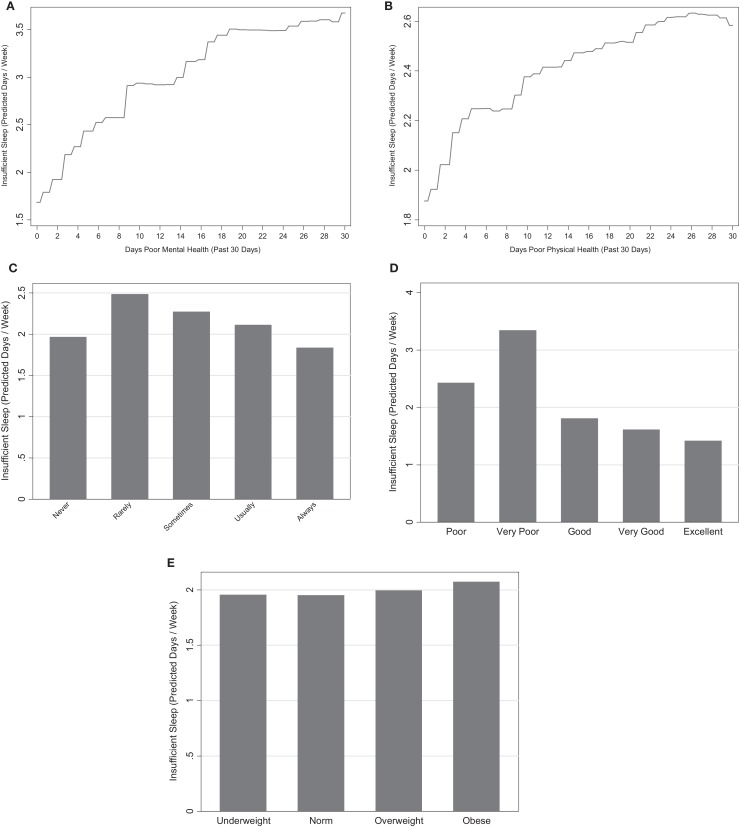
Insufficient sleep is associated with cardiometabolic disease and poor health. However, few studies have assessed its determinants in a nationally representative sample. Data from the 2009 behavioral risk factor surveillance system were used (N = 323,047 adults). Insufficient sleep was assessed as insufficient rest/sleep over 30 days. This was evaluated relative to sociodemographics (age, sex, race/ethnicity, marital status, region), socioeconomics (education, income, employment, insurance), health behaviors (diet, exercise, smoking, alcohol), and health/functioning (emotional support, BMI, mental/physical health). Overall, insufficient sleep was associated with being female, White or Black/African-American, unemployed, without health insurance, and not married; decreased age, income, education, physical activity; worse diet and overall health; and increased household size, alcohol, and smoking. These factors should be considered as risk factors for insufficient sleep.
Overview
The claims and statistics of this paper haven’t been checked yet.
Run the check — free, no account needed. It reads the open-access text and checks the sources it cites.
Integrity signals
Registry
Cites
Statistics
Figures
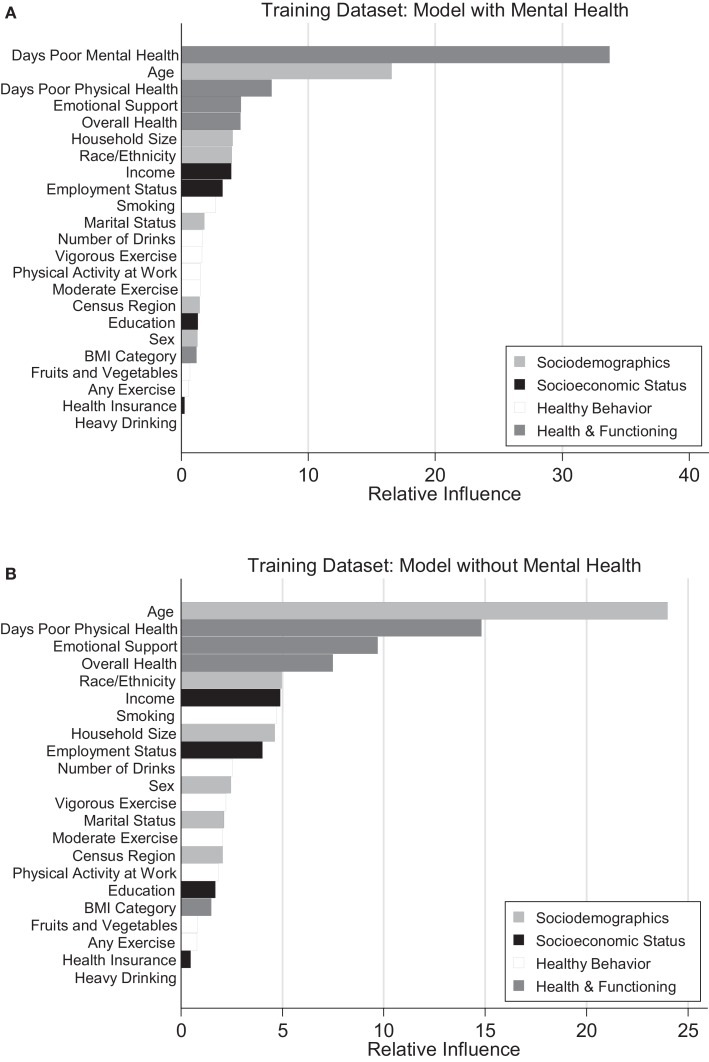
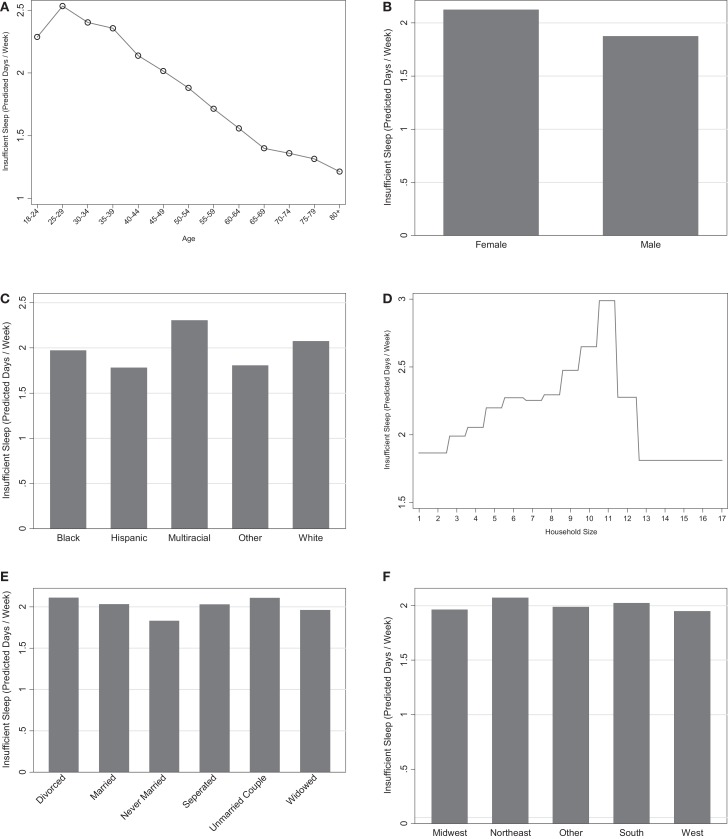
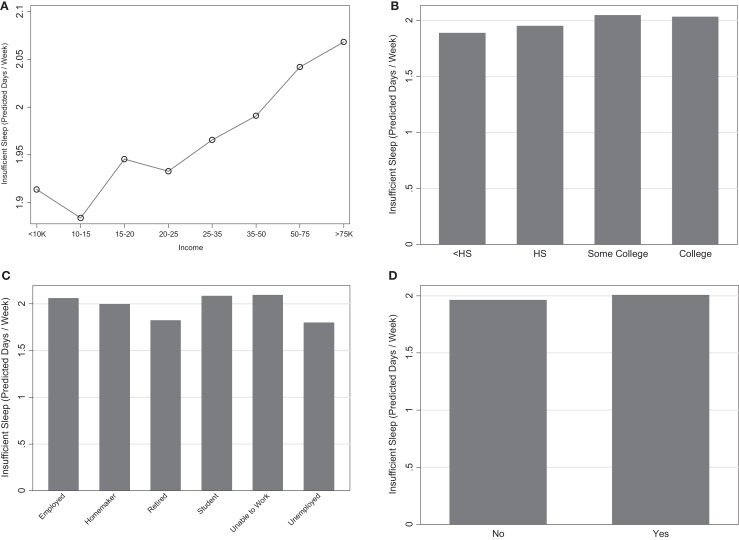
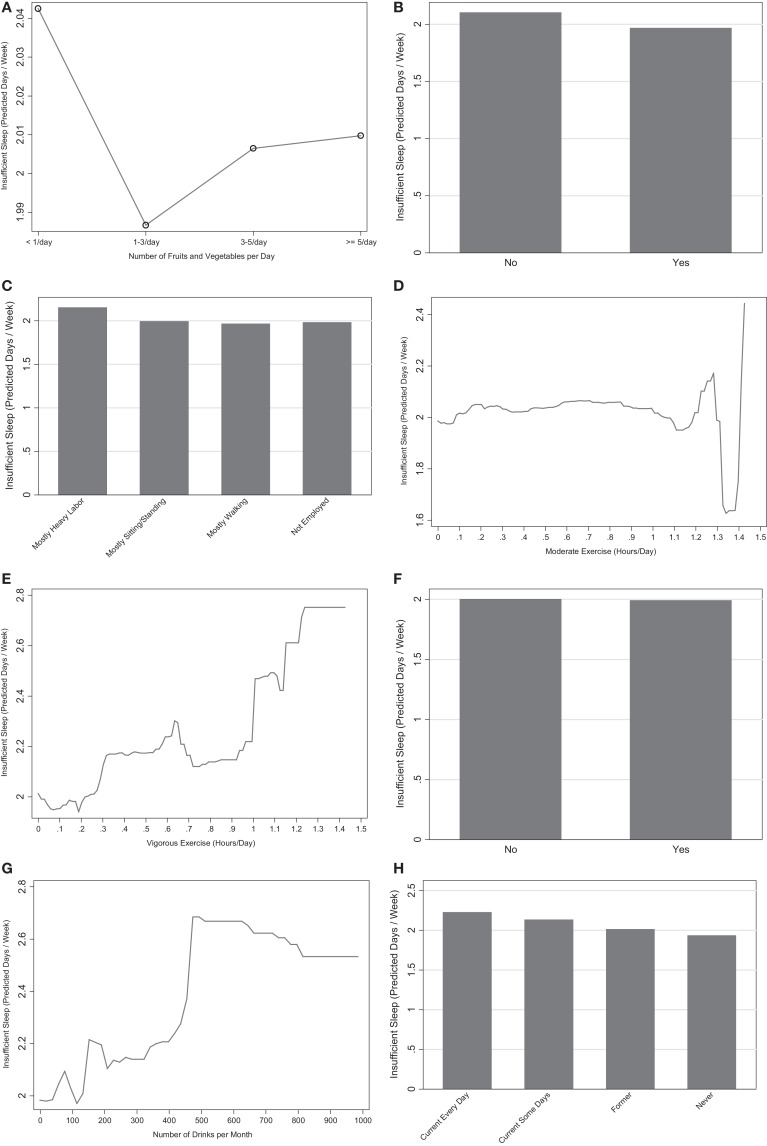
Verification
Claims the paper makes
The claims and statistics of this paper haven’t been checked yet.
Run the check — free, no account needed. It reads the open-access text and checks the sources it cites.
Claims other papers make about this one
Each is checked against this paper’s own text: does it say what the citing paper says it does?
The source backs part of the claim, not all of it — or backs it for a different population, condition or comparison.
In the citing paper
“For example, in an analysis of data from greater than 350,000 US adults, insufficient sleep was associated with poverty before adjusting for covariates, but after adjustment, the opposite relationship was seen.30”
From Sleep, Health, and Society (2017) · cites this paper as [30]
Experimental — accuracy not yet measuredThe cited source says what the claim attributes to it.
In the citing paper
“Chronic sleep insufficiency has played a role in motor vehicle accidents, industrial disasters, medical and other occupational errors, for instance(41, 42, 47-51).”
From Sleep: important considerations for the prevention of cardiovascular disease (2016) · cites this paper as [41]
In the citing paper
“In the general population, overall mental health has been identified as the leading predictor of self-reported insufficient sleep.30”
From Sleep, Health, and Society (2017) · cites this paper as [30]
In the citing paper
“Unemployment, on the other hand, is associated with more sleep problems.28,30”
From Sleep, Health, and Society (2017) · cites this paper as [30]
In the citing paper
“However, once the benefits of income are accounted for (by statistically covarying education, access to health care, and so forth), associations with income are often nonexistent and may go in the opposite direction.”
From Sleep, Health, and Society (2017) · cites this paper as [30]
In the citing paper
“Several studies have shown that poverty is associated with both shorter sleep duration and worse sleep quality.30”
From Sleep, Health, and Society (2017) · cites this paper as [30]
In the citing paper
“For example, household size is negatively associated with sleep, such that more crowded homes are more likely to foster insufficient sleep.30”
From Sleep, Health, and Society (2017) · cites this paper as [30]
In the citing paper
“A positive relationship between income and insufficient sleep after adjusting for covariates suggests that money may not buy sleep, but many of the benefits of income may contribute to healthy sleep.”
From Sleep, Health, and Society (2017) · cites this paper as [30]
In the citing paper
“For example, in an analysis of data from greater than 350,000 US adults, insufficient sleep was associated with poverty before adjusting for covariates, but after adjustment, the opposite relationship was seen.30”
From Sleep, Health, and Society (2017) · cites this paper as [30]
Self-check
Percentages, sums and reported differences re-computed from the paper’s own numbers.
The self-check needs the paper’s full text.
Citations
Cites
Health Effects of Fine Particulate Air Pollution: Lines that Connect
Pope, C. A., & Dockery, D. W. (2006) · Journal of the Air & Waste Management Association · doi:10.1080/10473289.2006.10464485 · Cited by 6,900
(2005) · doi:10.1093/acprof:oso/9780198565895.001.0001 · Cited by 2,155
Short Sleep Duration and Weight Gain: A Systematic Review
Patel, S. R., & Hu, F. B. (2008) · Obesity · doi:10.1038/oby.2007.118 · Cited by 1,505
Sleep Disorders and Sleep Deprivation: An Unmet Public Health Problem
(2006) · PsycEXTRA Dataset · doi:10.1037/e719732007-001 · Cited by 1,333
Buxton, O. M., & Marcelli, E. (2010) · Social Science & Medicine · doi:10.1016/j.socscimed.2010.05.041 · Cited by 818
Associations between Sleep Loss and Increased Risk of Obesity and Diabetes
Knutson, K. L., & Van Cauter, E. (2008) · Annals of the New York Academy of Sciences · doi:10.1196/annals.1417.033 · Cited by 810
Is Sleep Duration Associated With Childhood Obesity? A Systematic Review and Meta‐analysis
Chen, X., Beydoun, M. A., & Wang, Y. (2008) · Obesity · doi:10.1038/oby.2007.63 · Cited by 796
Sleep Duration in the United States: A Cross-sectional Population-based Study
Krueger, P. M., & Friedman, E. M. (2009) · American Journal of Epidemiology · doi:10.1093/aje/kwp023 · Cited by 791
Objectively Measured Sleep Characteristics among Early-Middle-Aged Adults
Lauderdale, D. S., Knutson, K. L., Yan, L. L., Rathouz, P. J., Hulley, S. B., Sidney, S., & Liu, K. (2006) · American Journal of Epidemiology · doi:10.1093/aje/kwj199 · Cited by 581
Who gets the best sleep? Ethnic and socioeconomic factors related to sleep complaints
Grandner, M. A., Patel, N. P., Gehrman, P. R., Xie, D., Sha, D., Weaver, T., & Gooneratne, N. (2010) · Sleep Medicine · doi:10.1016/j.sleep.2009.10.006 · Cited by 562
Self-citation
Research works printed but not linked: 5
- Colten, 2006, Institute of Medicine Committee on Sleep Medicine and Research
- Ulmer, 2009, Institute of Medicine Committee on Optimizing Graduate Medical Trainee (Resident) Hours and Work Schedules to Improve Patient Safety
- Centers for Disease Control, 2009, Overview: BRFSS 2009
- Centers for Disease Control, 2009, BRFSS 2009 Data Quality Report Handbook
- Nordin, 2006, Low Social Support and Disturbed Sleep: Epidemiological and Psychological Perspectives [PhD Dissertation]
Cited by
Sorted by citations
Items 201–202 of 202
de Passos, T. O. M., Mesas, A. E., Beneit, N., Goñi, V. D., Peral-Martinez, F., Cekrezi, S., Recio-Rodriguez, J. I., Martínez‐Vizcaíno, V., Bizzozero‐Peroni, B., & Jiménez‐López, E. (2026) · Scientific Reports · doi:10.1038/s41598-026-63193-9
Rae, Tubbs, A. S., Perlis, M. L., Fernandez, F., & Grandner, M. A. (2026) · PLOS Digital Health · doi:10.1371/journal.pdig.0001754
Self-citation
Metadata
- Authors
- Grandner, M. A., Jackson, N. J., Izci-Balserak, B., Gallagher, R. A., Murray-Bachmann, R., Williams, N. J., Patel, N. P., & Jean-Louis, G.
- Affiliations
- University of Pennsylvania (US)
- University of Southern California (US)
- SUNY Downstate Health Sciences University (US)
- NYU Langone Health (US)
- Reading Hospital (US)
- Corresponding author
- Grandner, Michael A.
- Venue
- Frontiers in Neurology
- Publisher
- Frontiers Media SA
- Published
- 2015-06-05
- Volume
- 6
- Pages
- 112-112
- ISSN
- 1664-2295 (ISSN-L)
- PMC
- PMC4456880
- OpenAlex
- W1865895031
- Cited by
- 202
- References
- 77
- Citations by year
- 2026: 11 · 2025: 24 · 2024: 18 · 2023: 22 · 2022: 29 · 2021: 20 · 2020: 17 · 2019: 22 · 2018: 20 · 2017: 10 · 2016: 9
- FWCI
- 19.64
- Type
- journal article
- Language
- en
- Open access
- gold
- doi.org
- Licence
- cc-by
- Locations
- Frontiers in Neurology (publishedVersion, cc-by)
- Europe PMC (PubMed Central) (publishedVersion, cc-by)
- PubMed Central (publishedVersion, cc-by)
- PubMed (publishedVersion)
- DOAJ (DOAJ: Directory of Open Access Journals) (submittedVersion, cc-by-sa)
- Funders
- American Heart Association
- University of Pennsylvania
- Georgia Clinical and Translational Science Alliance
- National Heart, Lung, and Blood Institute (K23HL110216)
- National Institute of Nursing Research (K99NR013187)
- National Institute of Environmental Health Sciences (R21ES022931)
- National Center for Research Resources (UL1RR024134)
- Topics
- Social Sciences › Psychology › Experimental and Cognitive Psychology › Sleep and related disorders
- Social Sciences › Psychology › Experimental and Cognitive Psychology › Sleep and Work-Related Fatigue
- Social Sciences › Health › Health disparities and outcomes
- Keywords
- insufficient sleep, sleep duration, social determinants of health, behavioral risk factors, sociodemographic factors, socioeconomic status, health behavior, diet, physical activity, smoking, alcohol consumption, health insurance, marital status, race and ethnicity, cardiometabolic risk
About these checks
Registry, retraction, Cites and statistics results are computed, not judged, with one exception: a printed reference that no index lists is read once by a model before it counts as a citation error. Claims are extracted by a model and kept only when their quote appears verbatim in the text; each cited source is then checked, with a model’s help, for whether it says what the claim relies on. Those verdicts can be wrong — read the claim’s quote and the cited source before relying on one.
Statistics and arithmetic are recomputed, not judged.
Confidence bands are shown only for fields calibrated on our annotated test set. None is calibrated yet, so no band is shown.
What counts as a claim ›How we measure confidence ›How we check this ›
Are you an author, or do you see a problem with this page? Request a review
