

The DOI matches its Crossref record; 50 of the 51 references it cites were found in a registry or an index.
Atypical Flexibility in Dynamic Functional Connectivity Quantifies the Severity in Autism Spectrum Disorder
Open accessPublished version of a preprint
Abstract
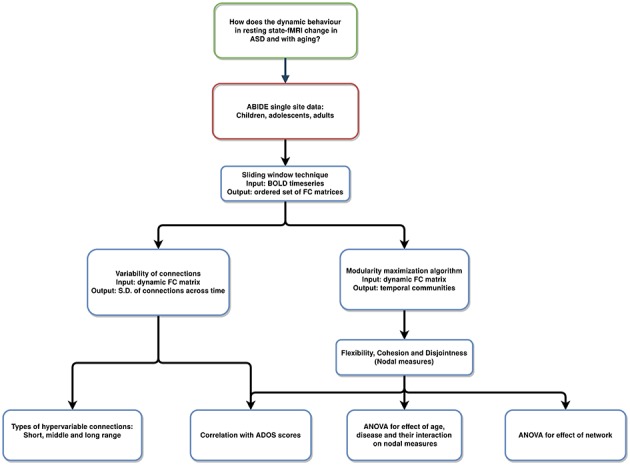
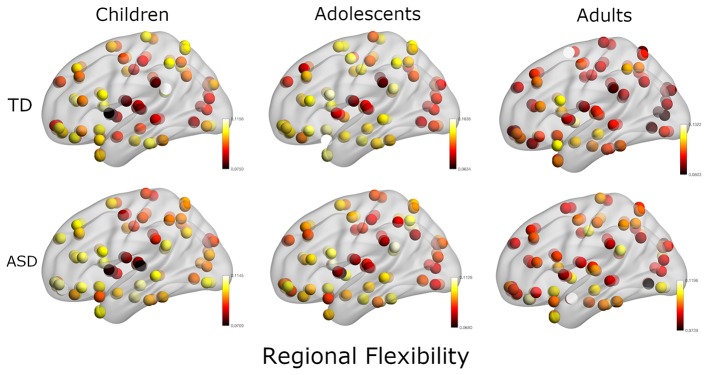
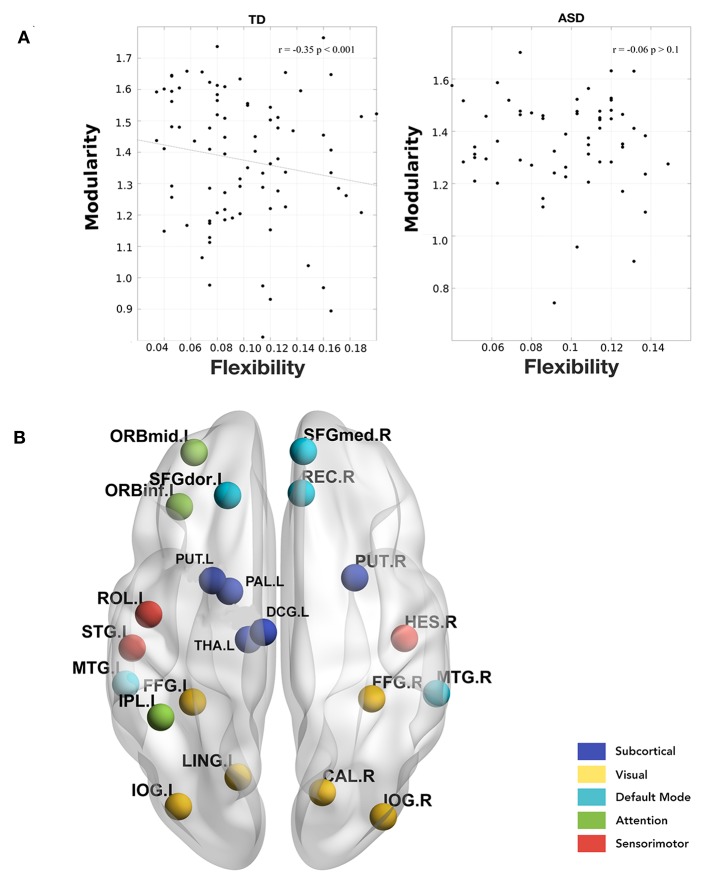
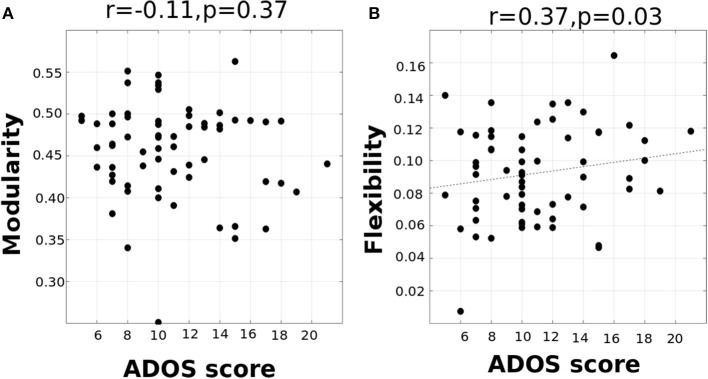
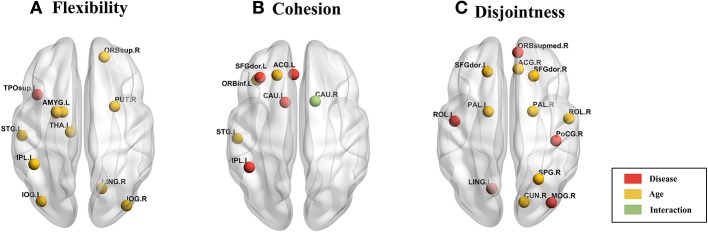
Resting-state functional connectivity (FC) analyses have shown atypical connectivity in autism spectrum disorder (ASD) as compared to typically developing (TD). However, this view emerges from investigating static FC overlooking the whole brain transient connectivity patterns. In our study, we investigated how age and disease influence the dynamic changes in functional connectivity of TD and ASD. We used resting-state functional magnetic resonance imaging (rs-fMRI) data stratified into three cohorts: children (7-11 years), adolescents (12-17 years), and adults (18+ years) for the analysis. The dynamic variability in the connection strength and the modular organization in terms of measures such as flexiblity, cohesion strength, and disjointness were explored for each subject to characterize the differences between ASD and TD. In ASD, we observed significantly higher inter-subject dynamic variability in connection strength as compared to TD. This hyper-variability relates to the symptom severity in ASD. We also found that whole-brain flexibility correlates with static modularity only in TD. Further, we observed a core-periphery organization in the resting-state, with Sensorimotor and Visual regions in the rigid core; and DMN and attention areas in the flexible periphery. TD also develops a more cohesive organization of sensorimotor areas. However, in ASD we found a strong positive correlation of symptom severity with flexibility of rigid areas and with disjointness of sensorimotor areas. The regions of the brain showing high predictive power of symptom severity were distributed across the cortex, with stronger bearings in the frontal, motor, and occipital cortices. Our study demonstrates that the dynamic framework best characterizes the variability in ASD.
Overview
The claims and statistics of this paper haven’t been checked yet.
Run the check — free, no account needed. It reads the open-access text and checks the sources it cites.
Integrity signals
Registry
Cites
Statistics
Figures
Verification
Claims the paper makes
The claims and statistics of this paper haven’t been checked yet.
Run the check — free, no account needed. It reads the open-access text and checks the sources it cites.
Claims other papers make about this one
Each is checked against this paper’s own text: does it say what the citing paper says it does?
In the citing paper
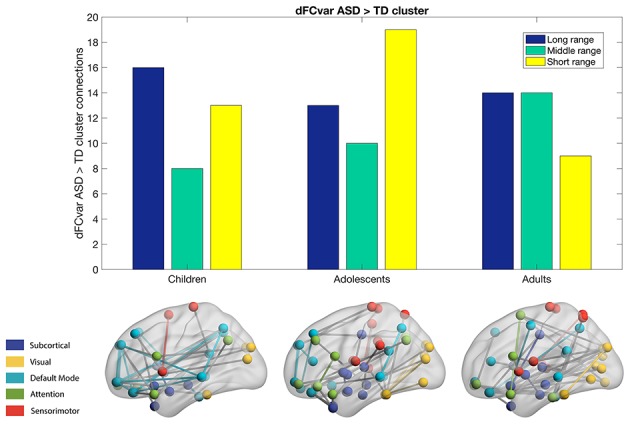
“The only study to stratify participants into child, adolescent, and adult groups found evidence for greater hyper-variability of short-range functional connections that distinguished adolescents with ASD (121).”
From Brain Mechanisms Supporting Flexible Cognition and Behavior in Adolescents With Autism Spectrum Disorder (2021) · cites this paper as [121]
Self-check
Percentages, sums and reported differences re-computed from the paper’s own numbers.
The self-check needs the paper’s full text.
Citations
Cites
Fast unfolding of communities in large networks
Blondel, V. D., Guillaume, J.-L., Lambiotte, R., & Lefebvre, E. (2008) · Journal of Statistical Mechanics: Theory and Experiment · doi:10.1088/1742-5468/2008/10/p10008 · Cited by 21,424
DPARSF: a MATLAB toolbox for “pipeline” data analysis of resting-state fMRI
Yan (2010) · Frontiers in System Neuroscience · doi:10.3389/fnsys.2010.00013 · Cited by 3,475
Exploring the brain network: A review on resting-state fMRI functional connectivity
van den Heuvel, M. P., & Hulshoff Pol, H. E. (2010) · European Neuropsychopharmacology · doi:10.1016/j.euroneuro.2010.03.008 · Cited by 3,326
Tracking whole-brain connectivity dynamics in the resting state
Allen, E. A., Damaraju, E., Plis, S. M., Erhardt, E. B., Eichele, T., & Calhoun, V. D. (2014) · Cerebral Cortex · doi:10.1093/cercor/bhs352 · Cited by 2,992
Network-based statistic: identifying differences in brain networks
Zalesky, A., Fornito, A., & Bullmore, E. T. (2010) · NeuroImage · doi:10.1016/j.neuroimage.2010.06.041 · Cited by 2,750
Murphy, K., Birn, R. M., Handwerker, D. A., Jones, T. B., & Bandettini, P. A. (2009) · NeuroImage · doi:10.1016/j.neuroimage.2008.09.036 · Cited by 2,387
Time–frequency dynamics of resting-state brain connectivity measured with fMRI
Chang, C., & Glover, G. H. (2010) · NeuroImage · doi:10.1016/j.neuroimage.2009.12.011 · Cited by 1,808
Dynamic reconfiguration of human brain networks during learning
Bassett, D. S., Wymbs, N. F., Porter, M. A., Mucha, P. J., Carlson, J. M., & Grafton, S. T. (2011) · Proceedings of the National Academy of Sciences · doi:10.1073/pnas.1018985108 · Cited by 1,705
Multi-task connectivity reveals flexible hubs for adaptive task control
Cole, M. W., Reynolds, J. R., Power, J. D., Repovs, G., Anticevic, A., & Braver, T. S. (2013) · Nature Neuroscience · doi:10.1038/nn.3470 · Cited by 1,704
The dynamic functional connectome: State-of-the-art and perspectives
Preti, M. G., Bolton, T. A. W., & Ville, D. V. D. (2016) · NeuroImage · doi:10.1016/j.neuroimage.2016.12.061 · Cited by 1,454
Research works printed but not linked: 1
- Harlalka, Atypical flexibility in dynamic functional connectivity quantifies the severity in autism spectrum disorder, bioXriv, 10.1101/387886 · DOI
Cited by
Sorted by citations
Tools of the trade: estimating time-varying connectivity patterns from fMRI data
Iraji, A., Faghiri, A., Lewis, N., Fu, Z., Rachakonda, S., & Calhoun, V. D. (2020) · Social Cognitive and Affective Neuroscience · doi:10.1093/scan/nsaa114 · Cited by 155
Uddin, L. Q. (2021) · Biological Psychiatry · doi:10.1016/j.biopsych.2020.05.010 · Cited by 116
Li, Y., Zhu, Y., Nguchu, B. A., Wang, Y., Wang, H., Qiu, B., & Wang, X. (2020) · Autism Research · doi:10.1002/aur.2212 · Cited by 95
Low-Dimensional Spatiotemporal Dynamics Underlie Cortex-wide Neural Activity
MacDowell, C. J., & Buschman, T. J. (2020) · Current Biology · doi:10.1016/j.cub.2020.04.090 · Cited by 94
Tapping into Multi-Faceted Human Behavior and Psychopathology Using fMRI Brain Dynamics
Bolton, T. A. W., Morgenroth, E., Preti, M. G., & Ville, D. V. D. (2020) · Trends in Neurosciences · doi:10.1016/j.tins.2020.06.005 · Cited by 94
Metadata
- Authors
- Harlalka, V., Bapi, R. S., Vinod, P. K., & Roy, D.
- Affiliations
- International Institute of Information Technology, Hyderabad (IN)
- University of Hyderabad (IN)
- National Brain Research Centre (IN)
- Corresponding author
- Vinod, P. K.
- Roy, Dipanjan
- Venue
- Frontiers in Human Neuroscience
- Publisher
- Frontiers Media SA
- Published
- 2019-02-01
- Volume
- 13
- Pages
- 6-6
- ISSN
- 1662-5161 (ISSN-L)
- PMC
- PMC6367662
- OpenAlex
- W2952965410
- Cited by
- 110
- References
- 51
- Citations by year
- 2026: 7 · 2025: 18 · 2024: 18 · 2023: 14 · 2022: 13 · 2021: 20 · 2020: 14 · 2019: 5
- FWCI
- 7.56
- Type
- journal article
- Language
- en
- Open access
- gold
- doi.org
- Licence
- Locations
- Frontiers in Human Neuroscience (publishedVersion, cc-by)
- bioRxiv (Cold Spring Harbor Laboratory) (acceptedVersion)
- Europe PMC (PubMed Central) (publishedVersion, cc-by)
- PubMed Central (publishedVersion, cc-by)
- PubMed (publishedVersion)
- DOAJ (DOAJ: Directory of Open Access Journals) (submittedVersion, cc-by-sa)
- Funders
- Department of Science and Technology, Ministry of Science and Technology, India (SR/CSRI/21/2016)
- Science and Engineering Research Board (ECR/2016/000488)
- Topics
- Life Sciences › Neuroscience › Cognitive Neuroscience › Functional Brain Connectivity Studies
- Life Sciences › Neuroscience › Cognitive Neuroscience › Autism Spectrum Disorder Research
- Life Sciences › Biochemistry, Genetics and Molecular Biology › Genetics › Genetics and Neurodevelopmental Disorders
- Keywords
- autism spectrum disorder, dynamic functional connectivity, network flexibility, symptom severity, brain modularity, dynamic variability, resting-state functional connectivity, sensorimotor regions, default mode network, age differences
About these checks
Registry, retraction, Cites and statistics results are computed, not judged, with one exception: a printed reference that no index lists is read once by a model before it counts as a citation error. Claims are extracted by a model and kept only when their quote appears verbatim in the text; each cited source is then checked, with a model’s help, for whether it says what the claim relies on. Those verdicts can be wrong — read the claim’s quote and the cited source before relying on one.
Statistics and arithmetic are recomputed, not judged.
Confidence bands are shown only for fields calibrated on our annotated test set. None is calibrated yet, so no band is shown.
What counts as a claim ›How we measure confidence ›How we check this ›
Are you an author, or do you see a problem with this page? Request a review
