

Listening Effort During Sentence Processing Is Increased for Non-native Listeners: A Pupillometry Study
Open accessThe DOI matches its Crossref record; 38 of the 38 references it cites were found in a registry or an index; none of the 46 sources its claims cite is checked for support yet.
Abstract
Current evidence demonstrates that even though some non-native listeners can achieve native-like performance for speech perception tasks in quiet, the presence of a background noise is much more detrimental to speech intelligibility for non-native compared to native listeners. Even when performance is equated across groups, it is likely that greater listening effort is required for non-native listeners. Importantly, the added listening effort might result in increased fatigue and a reduced ability to successfully perform multiple tasks simultaneously. Task-evoked pupil responses have been demonstrated to be a reliable measure of cognitive effort and can be useful in clarifying those aspects. In this study we compared the pupil response for 23 native English speakers and 27 Italian speakers of English as a second language. Speech intelligibility was tested for sentences presented in quiet and in background noise at two performance levels that were matched across groups. Signal-to-noise levels corresponding to these sentence intelligibility levels were pre-determined using an adaptive intelligibility task. Pupil response was significantly greater in non-native compared to native participants across both intelligibility levels. Therefore, for a given intelligibility level, a greater listening effort is required when listening in a second language in order to understand speech in noise. Results also confirmed that pupil response is sensitive to speech intelligibility during language comprehension, in line with previous research. However, contrary to our predictions, pupil response was not differentially modulated by intelligibility levels for native and non-native listeners. The present study corroborates that pupillometry can be deemed as a valid measure to be used in speech perception investigation, because it is sensitive to differences both across participants, such as listener type, and across conditions, such as variations in the level of speech intelligibility. Importantly, pupillometry offers us the possibility to uncover differences in listening effort even when those do not emerge in the performance level of individuals.
Overview
CoChat Summary
TL;DR
In a pupillometry study with 23 native English and 27 Italian speakers of English as a second language, non-native listeners showed greater pupil dilation than native listeners during sentence processing in quiet and in noise when intelligibility was matched in noise, indicating greater listening effort. Pupil response also increased for low versus high intelligibility, but this effect did not differ between listener groups.
Key findings
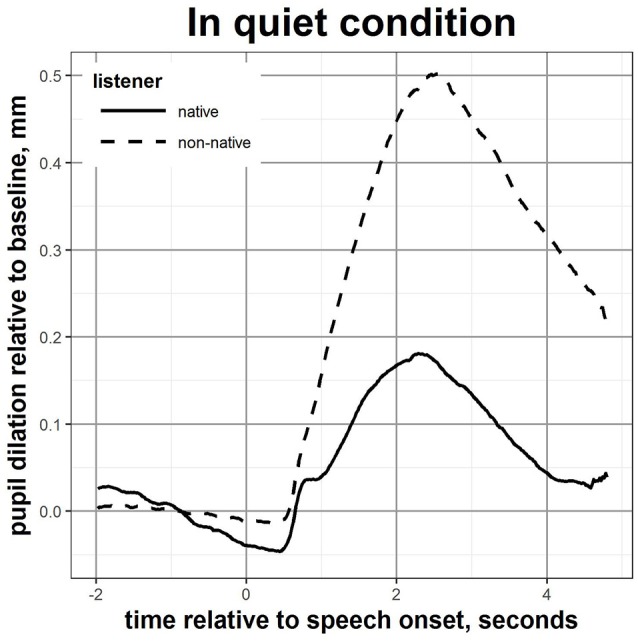
- Non-native listeners had significantly greater mean and peak pupil dilation than native listeners in quiet: mean dilation 0.30 vs. 0.08 mm, peak dilation 0.52 vs. 0.22 mm; t(48) = 5.52, p < 0.001 and t(48) = 4.93, p < 0.001, respectively.
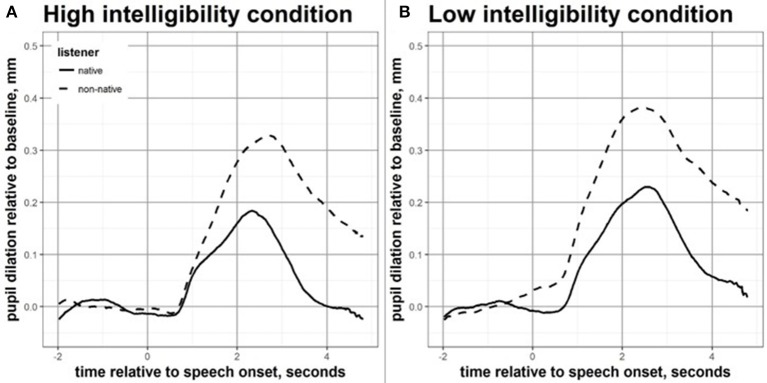
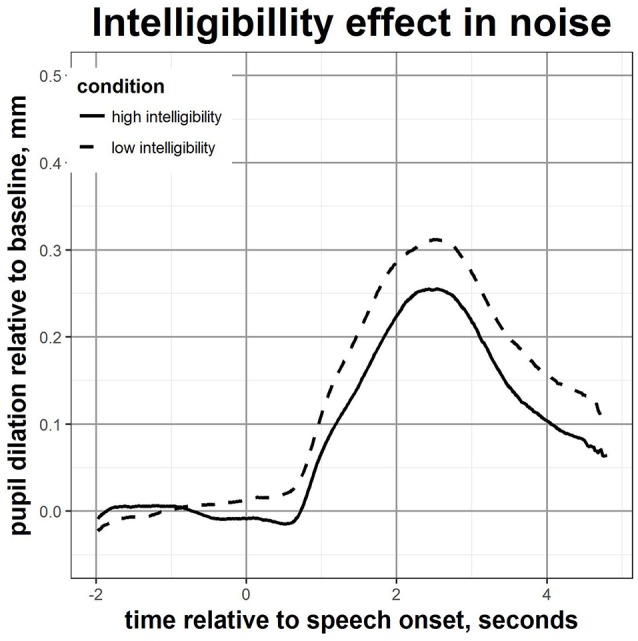
- In noise, mean pupil dilation differed significantly by language group [F(1, 48) = 7.60, p = 0.008] and by intelligibility level [F(1, 48) = 10.87, p = 0.002], with greater dilation for non-native listeners and for the low intelligibility condition. Peak dilation showed the same pattern: language group [F(1, 48) = 5.18, p = 0.027] and intelligibility [F(1, 48) = 9.45, p = 0.003].
- The interaction between language group and intelligibility was not significant, so pupil response was not differentially modulated by intelligibility level for native and non-native listeners.
- Behavioral performance in noise was matched across groups: high intelligibility averaged 71.3% correct (native 72.5%, non-native 70.3%) and low intelligibility averaged 43.8% (native 45.7%, non-native 42.1%), with no significant main effect of language group or interaction. Native listeners required lower SNRs than non-native listeners: −7.6 vs. −1.9 dB for high intelligibility and −11.4 vs. −6.6 dB for low intelligibility, both t(48) ≈ 5.95–5.97, p < 0.001.
Methods
- Fifty adults participated: 23 native British English listeners (15 women, 8 men; age 18–32, M = 23.3) and 27 Italian L1 / English L2 listeners (18 women, 9 men; age 20–35, M = 28.4), all living in the UK for at least 10 months.
- Speech intelligibility was tested with Basic English Lexicon sentences in quiet and in 8-talker babble noise. An adaptive procedure estimated SNRs for 40% (“low”) and 80% (“high”) intelligibility targets, followed by fixed-SNR blocks; pupil size was recorded from the left eye with an EyeLink 1000 at 500 Hz.
- Analyses included t-tests, mixed-design ANOVAs, and stepwise regressions; additional mixed-effects models were reported in supplementary material.
Limitations
- Stated: non-native participants were recruited with broad English proficiency criteria, no objective English proficiency measure was available, and participants could not be divided into balanced proficiency or length-of-stay groups; the working memory measure was not sensitive enough to capture individual variability; accent rating was based on a single sentence; individual-difference regressions explained low variance, were inconsistent across measures, and were not confirmed by multilevel modelling.
- Stated: although 80% intelligibility was targeted for the high condition, average keyword intelligibility was closer to 70%, likely because the adaptive procedure included relatively few trials.
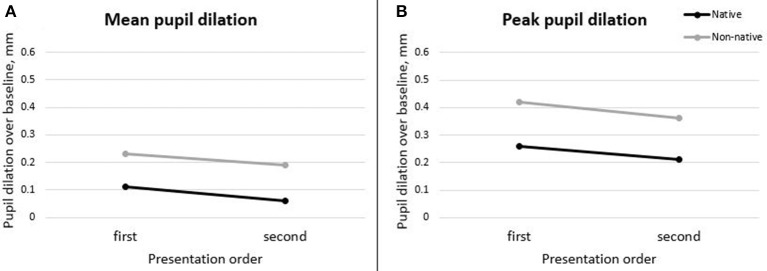
- Evident: the quiet condition was always presented first, had unmatched performance across groups, and used a silent baseline, so it was analyzed separately and excluded from the main noise analyses; noise conditions showed order effects; no intermediate intelligibility level (e.g., 50–60%) was tested.
Model-written summary. Check it against the paper before relying on it.
Integrity signals
Registry
Cites
Statistics
Figures
Verification
Claims the paper makes
0 Valid · 2 Not valid · 37 Not checked · 82 Own results and interpretations
A result the paper reports from its own data — it cites no other source for it, so there is none to check. The quote shows it is in the paper.
In the paper
“Results also confirmed that pupil response is sensitive to speech intelligibility during language comprehension, in line with previous research.”
§ Listening Effort During Sentence Processing Is Increased for Non-native Listeners: A Pupillometry Study > Abstract
boostedstates an association- Asserted: passes — The authors put it forward as true.
- Checkable: passes — It can be checked against evidence.
- Load-bearing: passes — The paper’s conclusions depend on it.
- Based: passes — The paper gives a reason why it holds.
A result the paper reports from its own data — it cites no other source for it, so there is none to check. The quote shows it is in the paper.
In the paper
“There was a significant difference in the percentage of correctly reported words in the speech in quiet task between native and non-native participants, t(48) = −4.80, p < 0.001.”
§ Listening Effort During Sentence Processing Is Increased for Non-native Listeners: A Pupillometry Study > Results > Behavioural results
plain- Asserted: passes — The authors put it forward as true.
- Checkable: passes — It can be checked against evidence.
- Load-bearing: unclear — It is unclear whether the paper’s conclusions depend on it.
- Based: passes — The paper gives a reason why it holds.
A result the paper reports from its own data — it cites no other source for it, so there is none to check. The quote shows it is in the paper.
In the paper
“none of the predictors considered explained a high percentage of the variance observed in speech perception performance and pupil response.”
§ Listening Effort During Sentence Processing Is Increased for Non-native Listeners: A Pupillometry Study > Results > Pupil data
plain- Asserted: passes — The authors put it forward as true.
- Checkable: passes — It can be checked against evidence.
- Load-bearing: unclear — It is unclear whether the paper’s conclusions depend on it.
- Based: passes — The paper gives a reason why it holds.
A result the paper reports from its own data — it cites no other source for it, so there is none to check. The quote shows it is in the paper.
In the paper
“As expected, for each intelligibility level, the SNR levels for native listeners were significantly lower than those required by non-native listeners: t(48) = 5.95, p < 0.001 for the high intelligibility condition, t(48) = 5.97, p < 0.001 for the low intelligibility condition.”
§ Listening Effort During Sentence Processing Is Increased for Non-native Listeners: A Pupillometry Study > Results > Behavioural results
plainstates an association- Asserted: passes — The authors put it forward as true.
- Checkable: passes — It can be checked against evidence.
- Load-bearing: passes — The paper’s conclusions depend on it.
- Based: passes — The paper gives a reason why it holds.
A result the paper reports from its own data — it cites no other source for it, so there is none to check. The quote shows it is in the paper.
In the paper
“Importantly however, as reported above, performance levels did not vary significantly across language groups for both intelligibility conditions.”
§ Listening Effort During Sentence Processing Is Increased for Non-native Listeners: A Pupillometry Study > Results > Behavioural results
plain- Asserted: passes — The authors put it forward as true.
- Checkable: passes — It can be checked against evidence.
- Load-bearing: passes — The paper’s conclusions depend on it.
- Based: passes — The paper gives a reason why it holds.
46 more claims
Create a free account to see all 121 claims and to verify the 37 references still open.
- It may state two separate claims as one. 37
- Probably not a substantial claim. 53
Claims other papers make about this one
Each is checked against this paper’s own text: does it say what the citing paper says it does?
The cited source says what the claim attributes to it.
In the citing paper
“and confirmed previous findings (Borghini and Hazan, 2018) that a greater listening effort is required when trying to understand a second compared to a native language in noise even when overall intelligibility is matched.”
From Effects of acoustic and semantic cues on listening effort during native and non-native speech perception (2020) · cites this paper as Borghini and Hazan, 2018
The cited source says what the claim attributes to it.
In the citing paper
“Generally speaking, listening effort increases with the magnitude of the obstacle such that more background noise (Van Engen & McLaughlin, 2018;Zekveld, Koelewijn, & Kramer, 2018) or poorer knowledge of the target language (Borghini & Hazan, 2018;Schmidtke et al., 2014) leads to greater listening effort”
From Listening effort and fatigue in native and non-native primary school children (2021) · cites this paper as Borghini & Hazan, 2018
The cited source says what the claim attributes to it.
In the citing paper
“Further, individual differences in exerted effort can sometimes be observed even when perceptual performance (intelligibility) is comparable or not affected (e.g., Borghini & Hazan, 2018, 2020; Desjardins & Doherty, 2014; Houben et al., 2013; Mackersie & Cones, 2011; Ohlenforst et al., 2018; Sarampalis et al., 2009; Strand et al., 2020; Wendt et al., 2017; Winn et al., 2015; Winn & Teece, 2021).”
From The Involvement of Listening Effort in Explaining Bilingual Listening Under Adverse Listening Conditions (2023) · cites this paper as Borghini & Hazan, 2018
The cited source says what the claim attributes to it.
In the citing paper
“Likewise, even in healthy populations, those who must exert additional effort when processing speech, like non-native speakers and second-language learners, may also suffer from increased listening-related fatigue (Borghini & Hazan, 2018; Kellerman, 1992).”
From Development and validation of the Vanderbilt Fatigue Scale for Adults (VFS-A). (2021) · cites this paper as Borghini & Hazan, 2018
In the citing paper
“as found in Borghini and Hazan (2018).”
From Effects of acoustic and semantic cues on listening effort during native and non-native speech perception (2020) · cites this paper as Borghini and Hazan (2018)
10 more claims about this paper
Create a free account to see every claim other papers make about this one.
Statistics recomputed
Every reported test result, recomputed from its test statistic and degrees of freedom. A result shows as not adding up only once an independent check has confirmed it.
- Consistentt(41.2) = -3.47reported p = .003 · recomputed p = .001
“t(41.2) = −3.47, p = .003”
The paper states a correction for multiple tests
- Consistentt(39.7) = -2.43reported p = .06 · recomputed p = .020
“t(39.7) = −2.43, p = .06”
The paper states a correction for multiple tests
- Consistentt(48) = -2.55reported p = .04 · recomputed p = .014
“t(48) = −2.55, p = .04”
The paper states a correction for multiple tests
- Consistentt(48) = -4.8reported p < .001 · recomputed p < .001
“t(48) = −4.80, p < .001”
- ConsistentF(1, 48) = 76.45reported p < .001 · recomputed p < .001
“F(1, 48) = 76.45, p < .001”
11 more recomputed tests
Create a free account to see every test the Stats check recomputed.
Self-check
Percentages, sums and reported differences re-computed from the paper’s own numbers.
Each contradiction between two passages listed here was confirmed by an independent check.
Rated major: it would touch a result — a value a result rests on, reported and recomputed p-values on opposite sides of the significance level, two passages that conflict with no sign which is right, or a cited work retracted before this paper was published.
In the paper
§ Listening Effort During Sentence Processing Is Increased for Non-native Listeners: A Pupillometry Study > Results > Behavioural results
“However, the effect size for this analysis (d = 0.14) was found not to reach Cohen's convention for a small effect (Cohen, 1988).”
§ Listening Effort During Sentence Processing Is Increased for Non-native Listeners: A Pupillometry Study > Results > Behavioural results
“| Performance (% correct) | 94.7 | 8.5 | 90.2 | 9.6 | 99.9 | 0.3 |”
Rated minor: it would not touch a result — a value no result rests on, a p-value that stays on the same side of the significance level, or a conflict that is clerical, resolved elsewhere in the paper, or outside its own findings.
In the paper
§ Listening Effort During Sentence Processing Is Increased for Non-native Listeners: A Pupillometry Study > Introduction
“According to the ELU model, explicit and implicit processes run in parallel, the former being rapid and automatic, the latter being slower and more demanding in terms of cognitive resources”
§ Listening Effort During Sentence Processing Is Increased for Non-native Listeners: A Pupillometry Study > Introduction
“However, when communication happens in sub-optimal listening conditions (i.e., due to signal distortion, background noise, non-native listener/speaker), an explicit contribution of working memory is necessary to support listening and to resolve the mismatch occurred, leading to an increased cognitive effort.”
Rated minor: it would not touch a result — a value no result rests on, a p-value that stays on the same side of the significance level, or a conflict that is clerical, resolved elsewhere in the paper, or outside its own findings.
In the paper
§ Listening Effort During Sentence Processing Is Increased for Non-native Listeners: A Pupillometry Study > Results > Pupil data
“with R2 = 0.138 and R2 = 0.81 respectively.”
§ Listening Effort During Sentence Processing Is Increased for Non-native Listeners: A Pupillometry Study > Results > Pupil data
“| Peak pupil low int. all listeners | Forward digit span | 0.081 | −0.057 | 0.028 | −0.285 | 4.250 | −2.062 | 0.045 |”
Rated minor: it would not touch a result — a value no result rests on, a p-value that stays on the same side of the significance level, or a conflict that is clerical, resolved elsewhere in the paper, or outside its own findings.
In the paper
§ Listening Effort During Sentence Processing Is Increased for Non-native Listeners: A Pupillometry Study > Materials and methods > Stimuli and tests
“During the three conditions, the speech level was constant at ~67–69 dB, as measured by a sound level meter.”
§ Listening Effort During Sentence Processing Is Increased for Non-native Listeners: A Pupillometry Study > Materials and methods > Stimuli and tests
“During the adaptive block, the SNR was manipulated by adapting both the speech and the masker levels so that the overall intensity level of the compound signal was fixed at 67–69 dB.”
Citations
Cites
Fitting Linear Mixed-Effects Models Using lme4
Bates, D., Mächler, M., Bolker, B., & Walker, S. (2015) · Journal of Statistical Software · doi:10.18637/jss.v067.i01 · Cited by 86,835
Transformed Up-Down Methods in Psychoacoustics
Levitt, H. (1971) · The Journal of the Acoustical Society of America · doi:10.1121/1.1912375 · Cited by 5,477
Marian, V., Blumenfeld, H. K., & Kaushanskaya, M. (2007) · Journal of Speech, Language, and Hearing Research · doi:10.1044/1092-4388(2007/067 · Cited by 1,991
Age constraints on second-language acquisition
Flege, J. E., Yeni-Komshian, G. H., & Liu, S. (1999) · Journal of Memory and Language · doi:10.1006/jmla.1999.2638 · Cited by 989 · cited 1×
“The aim of these tests was to obtain a cognitive profile for each participant including measures which previous research suggested to be related with the ability to perform a speech perception task in noise (Flege et al., 1999; Besser et al., 2013).”
MethodThe Ease of Language Understanding (ELU) model: theoretical, empirical, and clinical advances
Rönnberg, J., Lunner, T., Zekveld, A., Sörqvist, P., Danielsson, H., Lyxell, B., Dahlström, Ö., Signoret, C., Stenfelt, S., Pichora-Fuller, M. K., et al. (2013) · Frontiers in Systems Neuroscience · doi:10.3389/fnsys.2013.00031 · Cited by 989
The children's test of nonword repetition: A test of phonological working memory
Gathercole, S. E., Willis, C. S., Baddeley, A. D., & Emslie, H. (1994) · Memory · doi:10.1080/09658219408258940 · Cited by 897
Akeroyd, M. A. (2008) · International Journal of Audiology · doi:10.1080/14992020802301142 · Cited by 688
A perceptual interference account of acquisition difficulties for non-native phonemes
Iverson, P., Kuhl, P. K., Akahane-Yamada, R., Diesch, E., Tohkura, Y., Kettermann, A., & Siebert, C. (2003) · Cognition · doi:10.1016/s0010-0277(02)00198-1 · Cited by 647
McGarrigle, R., Munro, K. J., Dawes, P., Stewart, A. J., Moore, D. R., Barry, J. G., & Amitay, S. (2014) · International Journal of Audiology · doi:10.3109/14992027.2014.890296 · Cited by 532 · cited 1×
“As documented for individuals suffering from hearing loss (McGarrigle et al., 2014), it is reasonable to speculate that a prolonged increase in the listening effort needed to attend speech will result in a greater mental fatigue also for all non-native listeners.”
BackgroundCross Talk Between Native and Second Languages: Partial Activation of an Irrelevant Lexicon
Spivey, M. J., & Marian, V. (1999) · Psychological Science · doi:10.1111/1467-9280.00151 · Cited by 521
Research works printed but not linked: 2
- Cohen J. (1988). Statistical Power Analysis for the Behavior Science. Lawrance Eribaum Association.
- Wechsler D. Coalson D. L. Raiford S. E. (2008). WAIS-IV: Wechsler Adult Intelligence Scale. San Antonio, TX: Pearson.
Cited by
Listening effort: Are we measuring cognition or affect, or both
Francis, A. L., & Love, J. (2020) · WIREs Cognitive Science · doi:10.1002/wcs.1514 · Cited by 113
Publication guidelines and recommendations for pupillary measurement in psychophysiological studies
Steinhauer, S. R., Bradley, M. M., Siegle, G. J., Roecklein, K. A., & Dix, A. (2022) · Psychophysiology · doi:10.1111/psyp.14035 · Cited by 137
Cortical modulation of pupillary function: systematic review
Peinkhofer, C., Knudsen, G. M., Moretti, R., & Kondziella, D. (2019) · PeerJ · doi:10.7717/peerj.6882 · Cited by 97
Rapid adaptation to fully intelligible nonnative-accented speech reduces listening effort
Brown, V. A., McLaughlin, D. J., Strand, J. F., & Van Engen, K. J. (2020) · Quarterly Journal of Experimental Psychology · doi:10.1177/1747021820916726 · Cited by 55
Scharenborg, O., & van Os, M. (2019) · Speech Communication · doi:10.1016/j.specom.2019.03.001 · Cited by 78
Pupil Dilation Is Sensitive to Semantic Ambiguity and Acoustic Degradation
Kadem, M., Herrmann, B., Rodd, J. M., & Johnsrude, I. S. (2020) · Trends in Hearing · doi:10.1177/2331216520964068 · Cited by 77
Cognitive effort and active inference
Parr, T., Holmes, E., Friston, K. J., & Pezzulo, G. (2023) · Neuropsychologia · doi:10.1016/j.neuropsychologia.2023.108562 · Cited by 45
Individual Variations in Effort: Assessing Pupillometry for the Hearing Impaired
Wagner, A. E., Nagels, L., Toffanin, P., Opie, J. M., & Başkent, D. (2019) · Trends in Hearing · doi:10.1177/2331216519845596 · Cited by 63
Development and validation of the Vanderbilt Fatigue Scale for Adults (VFS-A).
Hornsby, B. W. Y., Camarata, S., Cho, S.-J., Davis, H., McGarrigle, R., & Bess, F. H. (2021) · Psychological Assessment · doi:10.1037/pas0001021 · Cited by 62
Nieder, J., Schwerdtle, P. N., Sauerborn, R., & Barteit, S. (2022) · Frontiers in Public Health · doi:10.3389/fpubh.2022.891987 · Cited by 58
Borghini, G., & Hazan, V. (2020) · The Journal of the Acoustical Society of America · doi:10.1121/10.0001126 · Cited by 44
Self-citationOn the interpretation of scalar implicatures in first and second language
Mazzaggio, G., Panizza, D., & Surian, L. (2020) · Journal of Pragmatics · doi:10.1016/j.pragma.2020.10.005 · Cited by 44
McGarrigle, R., Rakusen, L., & Mattys, S. (2021) · Psychophysiology · doi:10.1111/psyp.13703 · Cited by 43
Grenzebach, J., & Romanus, E. (2022) · Noise and Health · doi:10.4103/nah.nah_34_22 · Cited by 43
Listening effort and fatigue in native and non-native primary school children
Brännström, K. J., Rudner, M., Carlie, J., Sahlén, B., Gulz, A., Andersson, K., & Johansson, R. (2021) · Journal of Experimental Child Psychology · doi:10.1016/j.jecp.2021.105203 · Cited by 39
Older adults show a more sustained pattern of effortful listening than young adults.
McGarrigle, R., Knight, S., Rakusen, L. L., Geller, J., & Mattys, S. L. (2021) · Psychology and Aging · doi:10.1037/pag0000587 · Cited by 36
Smiljanić, R. (2021) · Wiley eBooks · doi:10.1002/9781119184096.ch7 · Cited by 33
Beatty‐Martínez, A. L., Tamargo, R. E. G., & Dussias, P. E. (2021) · Scientific Reports · doi:10.1038/s41598-021-03008-1 · Cited by 32
Highly proficient L2 speakers still need to attend to a talker’s mouth when processing L2 speech
Birulés, J., Bosch, L., Pons, F., & Lewkowicz, D. J. (2020) · Language Cognition and Neuroscience · doi:10.1080/23273798.2020.1762905 · Cited by 32
Visentin, C., Prodi, N., Cappelletti, F., Torresin, S., & Gasparella, A. (2019) · Building Acoustics · doi:10.1177/1351010x19882314 · Cited by 25
Vujović, M., Ramscar, M., & Wonnacott, E. (2021) · Journal of Memory and Language · doi:10.1016/j.jml.2021.104231 · Cited by 32
Using pupillometry to investigate predictive processes in infancy
Zhang, F., & Emberson, L. L. (2020) · Infancy · doi:10.1111/infa.12358 · Cited by 31
Chen, S. (2020) · The Journal of Specialised Translation · doi:10.26034/cm.jostrans.2020.139 · Cited by 30
Bsharat-Maalouf, D., Degani, T., & Karawani, H. (2023) · Trends in Hearing · doi:10.1177/23312165231205107 · Cited by 27
Bilinguals’ speech perception in noise: Perceptual and neural associations
Bsharat-Maalouf, D., & Karawani, H. (2022) · PLoS ONE · doi:10.1371/journal.pone.0264282 · Cited by 22
Seropian, L., Ferschneider, M., Cholvy, F., Micheyl, C., Bidet‐Caulet, A., & Moulin, A. M. (2022) · Heliyon · doi:10.1016/j.heliyon.2022.e09631 · Cited by 21
de Miguel, Á. R., González, J. C. F., & Macías, Á. R. (2021) · Journal of Clinical Medicine · doi:10.3390/jcm10173962 · Cited by 20
Kawata, M., Tsuruta-Hamamura, M., & Hasegawa, H. (2022) · Applied Acoustics · doi:10.1016/j.apacoust.2022.109093 · Cited by 20
Incorporating Symbolic Sequential Modeling for Speech Enhancement
Liao, C.-F., Tsao, Y., Lu, X., & Kawai, H. (2019) · Interspeech (USB) · doi:10.21437/interspeech.2019-1777 · Cited by 18
Reconceptualizing cognitive listening
Mattys, S. L., O’Leary, R. M., McGarrigle, R., & Wingfield, A. (2025) · Trends in Cognitive Sciences · doi:10.1016/j.tics.2025.09.014 · Cited by 17
Pupillometry as a measure for listening effort in children: a review
Gómez-Merino, N., Gheller, F., Spicciarelli, G., & Trevisi, P. (2020) · Hearing Balance and Communication · doi:10.1080/21695717.2020.1807256 · Cited by 13
The Neurophysiological Costs of Learning in a Noisy Classroom: An Ecological Virtual Reality Study
Levy, O., Korisky, A., Zvilichovsky, Y., & Golumbic, E. Z. (2025) · Journal of Cognitive Neuroscience · doi:10.1162/jocn_a_02249 · Cited by 16
Coulter, K., Gilbert, A. C., Kousaie, S., Baum, S. R., Gracco, V. L., Klein, D., Titone, D. A., & Phillips, N. A. (2020) · Bilingualism Language and Cognition · doi:10.1017/s1366728920000516 · Cited by 16
Oosthuizen, I., Picou, E. M., Pottas, L., Myburgh, H. C., & Swanepoel, D. W. (2020) · Journal of Speech, Language, and Hearing Research · doi:10.1044/2020_jslhr-19-00330 · Cited by 15
Gao, E., Guo, J., Pang, X., Bo, D., & Chen, Z. (2024) · Humanities and Social Sciences Communications · doi:10.1057/s41599-024-04025-x · Cited by 15
Age Impacts Speech-in-Noise Recognition Differently for Nonnative and Native Listeners
Phillips, I., Bieber, R. E., Dirks, C. E., Grant, K. W., & Brungart, D. S. (2024) · Journal of Speech Language and Hearing Research · doi:10.1044/2024_jslhr-23-00470 · Cited by 13
Spoorthi, G. N., Uppunda, A. K., Kalaiah, M. K., & Shastri, U. (2025) · European Archives of Oto-Rhino-Laryngology · doi:10.1007/s00405-025-09232-z · Cited by 11
Schmidtke, J., Bsharat-Maalouf, D., Degani, T., & Karawani, H. (2024) · Language Cognition and Neuroscience · doi:10.1080/23273798.2024.2427832 · Cited by 10
Drozdova, P., van Hout, R. W. N. M., & Scharenborg, O. (2019) · Attention Perception & Psychophysics · doi:10.3758/s13414-018-01657-5 · Cited by 10
Assessing the effects of “native speaker” status on classic findings in speech research.
Strand, J. F., Brown, V. A., Sewell, K., Lin, Y., Lefkowitz, E., & Saksena, C. G. (2024) · Journal of Experimental Psychology General · doi:10.1037/xge0001640 · Cited by 9
Through the Pupils’ Lens: Multilingual Effort in First and Second Language Listening
Bsharat-Maalouf, D., Schmidtke, J., Degani, T., & Karawani, H. (2024) · Ear and Hearing · doi:10.1097/aud.0000000000001602 · Cited by 9
The time-course of linguistic interference during native and non-native speech-in-speech listening
Mepham, A., Bi, Y., & Mattys, S. L. (2022) · The Journal of the Acoustical Society of America · doi:10.1121/10.0013417 · Cited by 8
Wisniewski, M. G., & Zakrzewski, A. C. (2020) · The Journal of the Acoustical Society of America · doi:10.1121/10.0001742 · Cited by 8
Eye movements of younger and older adults decrease during story listening in background noise
Herrmann, B., Scharf, F., & Widmann, A. (2025) · Hearing Research · doi:10.1016/j.heares.2025.109447 · Cited by 7
Communication Under Sharply Degraded Auditory Input and the “2-Sentence” Problem
Svirsky, M. A., Neukam, J. D., Capach, N. H., Amichetti, N. M., Lavender, A., & Wingfield, A. (2024) · Ear and Hearing · doi:10.1097/aud.0000000000001500 · Cited by 7
Pupil Dilation as a Dependent Variable in Language Research
Schmidtke, J., & Tobin, S. J. (2024) · Springer eBooks · doi:10.1007/978-3-031-54896-3_7 · Cited by 7
Carlie, J., Sahlén, B. S., Nirme, J., Andersson, K., Rudner, M., Johansson, R., Gulz, A., & Brännström, K. J. (2021) · Journal of Speech Language and Hearing Research · doi:10.1044/2021_jslhr-20-00611 · Cited by 7
Intelligibility and Listening Effort of Spanish Oesophageal Speech
Raman, S., Serrano, L., Winneke, A. H., Navas, E., & Hernáez, I. (2019) · Applied Sciences · doi:10.3390/app9163233 · Cited by 7
Pupillometry Studies of Listening Effort: Implications for Clinical Audiology
Kuchinsky, S. E., & Milvae, K. D. (2024) · Springer eBooks · doi:10.1007/978-3-031-54896-3_8 · Cited by 6
Ahad, M. T., Ahsan, M. M., Jahan, I., Nazim, R., Yazdan, M. M. S., Huebner, P., & Siddique, Z. (2021) · Technologies · doi:10.3390/technologies9030051 · Cited by 6
Dialogue Enhancement and Listening Effort in Broadcast Audio: A Multimodal Evaluation
Torcoli, M., Robotham, T., & Habets, E. A. P. (2022) · International Conference on Quality of Multimedia Experience (QoMEX) · doi:10.1109/qomex55416.2022.9900884 · Cited by 6
Jafari, Z., Ryait, H. S., Habibnezhad, M., Niehaus, C., Cantwell, E., Dudley, J., Kolb, B. E., & Mohajerani, M. H. (2025) · Journal of Speech Language and Hearing Research · doi:10.1044/2025_jslhr-24-00580 · Cited by 5
Vicente, T., González-Toledo, D., Cuevas-Rodríguez, M., Molina-Tanco, L., Reyes‐Lecuona, A., & Picinali, L. (2025) · Hearing Research · doi:10.1016/j.heares.2025.109490 · Cited by 5
How variability in language experience modulates multilingual listening effort
Bsharat-Maalouf, D., Degani, T., & Karawani, H. (2025) · Bilingualism Language and Cognition · doi:10.1017/s1366728925100254 · Cited by 5
Harel-Arbeli, T., Shaposhnik, H., Palgi, Y., & Ben‐David, B. M. (2024) · Ear and Hearing · doi:10.1097/aud.0000000000001582 · Cited by 5
Yüksel, M., Taşdemir, İ., & Çiprut, A. A. (2022) · Otology & Neurotology · doi:10.1097/mao.0000000000003690 · Cited by 5
De-centering the Monolingual: A Psychophysiological Study of Heritage Speaker Language Processing
Madsen, C. N. (2018) · CUNY Academic Works (City University of New York) · Cited by 7
Anticipatory processing of cataphora is constrained by binding principles in L2 English
Lyu, J., Fuchs, Z., & Kaiser, E. M. (2024) · Bilingualism Language and Cognition · doi:10.1017/s1366728924000208 · Cited by 4
Fleming, J. T., & Winn, M. B. (2025) · Ear and Hearing · doi:10.1097/aud.0000000000001683 · Cited by 4
Listening effort, fatigue, and streamed voice quality during online university courses
Mutlu, A. İ., & Yüksel, M. (2024) · Logopedics Phoniatrics Vocology · doi:10.1080/14015439.2024.2317789 · Cited by 4
Singh, A., Achuth Rao, M. V., Vaideeswaran, R., Yarra, C., & Ghosh, P. (2021) · International Conference on Speech Database and Assessments · doi:10.1109/o-cocosda202152914.2021.9660500 · Cited by 4
Assessing cognitive load using oculometrics to identify deceit during interviews
Mitre-Hernández, H. A., Sanchez‐Rodriguez, J., Cabada, R. Z., & Estrada, M. L. B. (2018) · Applied Cognitive Psychology · doi:10.1002/acp.3497 · Cited by 4
Voice Familiarization Training Improves Speech Intelligibility and Reduces Listening Effort
Baxter, F., Smith, H. J., & Holmes, E. (2025) · Trends in Hearing · doi:10.1177/23312165251401318 · Cited by 3
Prosodic Focus Interpretation in Spectrotemporally Degraded Speech by Non-Native Listeners
Everhardt, M. K., Sarampalis, A., Coler, M., Başkent, D., & Lowie, W. M. (2023) · Journal of Speech Language and Hearing Research · doi:10.1044/2023_jslhr-22-00568 · Cited by 3
Lam, B. P. W., & Marquardt, T. P. (2022) · Journal of Speech Language and Hearing Research · doi:10.1044/2022_jslhr-21-00563 · Cited by 3
Spanish versions of the Vanderbilt Fatigue Scale for Adults: translation and cultural adaptation
Benítez-Barrera, C. R., Jones, A., Hornsby, B. W. Y., & de Diego-Lázaro, B. (2024) · International Journal of Audiology · doi:10.1080/14992027.2024.2371886 · Cited by 3
Mepham, A., Knight, S., McGarrigle, R., Rakusen, L. L., & Mattys, S. L. (2025) · Journal of Speech Language and Hearing Research · doi:10.1044/2025_jslhr-24-00658 · Cited by 3
Bao, W., Alain, C., Thaut, M. H., & Molnar, M. T. (2025) · Bilingualism Language and Cognition · doi:10.1017/s1366728925100795 · Cited by 3
Sub-micron pupillometry for optical EEG measurements
Rohweder, N.-O., Gertheiss, J., & Rembe, C. (2021) · tm - Technisches Messen · doi:10.1515/teme-2021-0030 · Cited by 3
The role of exemplars in speech comprehension
Nijveld, A. (2019) · MPG.PuRe (Max Planck Society) · Cited by 3
Impaired Performance in Noise: Disentangling Listening Effort From the Irrelevant Speech Effect
Wennberg, J. W., Dillman-Hasso, N. H., Brown, V. A., & Strand, J. F. (2025) · Collabra Psychology · doi:10.1525/collabra.147319 · Cited by 2
Listening Effort Across Non-Native and Regional Accents: A Pupillometry Study
Barnard, M., Kunkel, S., Lamarque, R., & Chong, A. J. (2025) · Language and Speech · doi:10.1177/00238309251389573 · Cited by 2
Vanbuckhave, C., Eikner, J. S., Laeng, B., Onnis, L., & Mathôt, S. (2026) · Psychophysiology · doi:10.1111/psyp.70298 · Cited by 2
Bieber, R. E., Makashay, M. J., Sheffield, B. M., & Brungart, D. S. (2024) · Journal of Speech Language and Hearing Research · doi:10.1044/2024_jslhr-23-00312 · Cited by 2
Bilingual Speech Intelligibility
Bradlow, A. R. (2024) · Cambridge University Press eBooks · doi:10.1017/9781009105767.034 · Cited by 2
Speech and Non-Speech Auditory Task Performance by Non-Native English Speakers
McNamara, B., Brungart, D. S., Bieber, R. E., Phillips, I., Davidson, A. J., & Gordon-Salant, S. M. (2025) · Ear and Hearing · doi:10.1097/aud.0000000000001648 · Cited by 2
Pupillometry in children: a good method for assessing listening effort
Gheller, F., Spicciarelli, G., Gómez‐Merino, N., & Trevisi, P. (2020) · Padua Research Archive (University of Padova) · doi:10.14658/pupj-ijap-2020-1-4 · Cited by 2
Impact of language familiarity on abstract pattern recognition in 9- to 12-month-old infants
Fratacci, A., Clerc, O., Fort, M., & Pascalis, O. (2024) · International Journal of Behavioral Development · doi:10.1177/01650254241230643 · Cited by 2
Professionalism in the context of providing elective services: reflecting on bias
Nagle, K. F., & Pilkington, B. (2024) · Journal of Communications In Healthcare · doi:10.1080/17538068.2024.2323852 · Cited by 1
Buss, E., Hall, S. C. F., Garcia, S., Capretta, G. S., & Calandruccio, L. (2025) · The Journal of the Acoustical Society of America · doi:10.1121/10.0038978 · Cited by 1
Quan, L. D. A., Trang, L. T., Choi, I., & Woo, J. (2025) · Frontiers in Human Neuroscience · doi:10.3389/fnhum.2025.1661010 · Cited by 1
Zekveld, A. A., Visser, V. W., Kramer, S. E., Sangers, J., & Smits, C. (2026) · Journal of Speech Language and Hearing Research · doi:10.1044/2026_jslhr-25-00164 · Cited by 1
Reverse Hierarchical Processing of Speech in Talker Identification
Choi, J. Y., Xiong, S., McHaney, J. R., & Chandrasekaran, B. (2026) · European Journal of Neuroscience · doi:10.1111/ejn.70520 · Cited by 1
Zhang, S., Ferry, A. L., Brandt, S., Warren, E., & Theakston, A. (2026) · Applied Psycholinguistics · doi:10.1017/s014271642610085x · Cited by 1
Lum, J. A. G., Barham, M. P., & Hill, A. T. (2024) · Cortex · doi:10.1016/j.cortex.2024.02.019 · Cited by 1
Historical migration patterns and the evolution of culture
Niedenthal, P. M., & Wohltjen, S. (2025) · Current Research in Ecological and Social Psychology · doi:10.1016/j.cresp.2025.100243 · Cited by 1
Pupillometry and Psycholinguistics
Järvikivi, J. (2025) · Oxford University Press eBooks · doi:10.1093/acrefore/9780199384655.013.1121 · Cited by 1
Linguistically diverse children's speech processing in noise
Carlie, J. (2024) · Lund University Publications (Lund University) · Cited by 1
Motivation and fatigue effects in pupillometric measures of listening effort
Alfandari Menase, D. (2022) · Nottingham ePrints (University of Nottingham) · Cited by 1
Hennequin, A. (2019) · theses.fr (ABES) · doi:10.70675/672e065bzdac7z412cz8a60z7219f1ae3ff9
Talker Intelligibility and Listening Effort with Temporally Modified Speech
Paulus, M., Hazan, V. L., & Adank, P. (2019) · Interspeech (USB) · doi:10.21437/interspeech.2019-1402
Self-citationLanguage Factors Modulate Audiovisual Speech Perception. A Developmental Perspective
Birulés, J. (2020) · Dipòsit Digital de la Universitat de Barcelona (Universitat de Barcelona)
Furlani, A. L., Costa, M. H., & Tavares, M. C. R. (2022) · World Congress on Medical Physics and Biomedical Engineering, September 7 - 12, 2009, Munich, Germany · doi:10.1007/978-3-030-70601-2_225
Vujović, M., Ramscar, M., & Wonnacott, E. (2019) · OSF Preprints (OSF Preprints) · doi:10.31219/osf.io/f2n9d
Peer Review #2 of "Cortical modulation of pupillary function: systematic review (v0.1)"
Peinkhofer, C., Knudsen, G., Moretti, R., Kondziella, D., Equal, C., Laeng, B., Sirois, S., Gredebck, G., Granholm, E., Steinhauer, S., et al. (2019) · PeerJ · doi:10.7287/peerj.6882v0.1/reviews/2
Bossi, F., Gruttola, F. D., D’Arcangelo, S., Daneluzzi, G., Iannucci, R., & Ricciardi, E. (2024) · SSRN Electronic Journal · doi:10.2139/ssrn.4782343
Listening difficulty: From hearing to language
Kuchinsky, S. E., Phillips, I., & Bieber, R. E. (2024) · The Psychology of learning and motivation/The psychology of learning and motivation · doi:10.1016/bs.plm.2024.07.001
Gooskens, C. (2024) · De Gruyter eBooks · doi:10.1515/9783111134697-011
Metadata
- Authors
- Borghini, G., & Hazan, V.
- Affiliations
- University College London (GB)
- Corresponding author
- Borghini, Giulia
- Venue
- Frontiers in Neuroscience
- Publisher
- Frontiers Media SA
- Published
- 2018-03-13
- Volume
- 12
- Pages
- 152-152
- ISSN
- 1662-453X (ISSN-L)
- PMC
- PMC5859302
- OpenAlex
- W2787908389
- Cited by
- 127
- References
- 38
- Citations by year
- 2026: 15 · 2025: 26 · 2024: 23 · 2023: 6 · 2022: 14 · 2021: 12 · 2020: 14 · 2019: 15 · 2018: 2
- FWCI
- 9.16
- Type
- journal article
- Language
- en
- Open access
- gold
- doi.org
- Locations
- Frontiers in Neuroscience (publishedVersion, cc-by)
- Europe PMC (PubMed Central) (publishedVersion, cc-by)
- PubMed (publishedVersion)
- PubMed Central (publishedVersion, cc-by)
- DOAJ (DOAJ: Directory of Open Access Journals) (submittedVersion, cc-by-sa)
- UCL Discovery (University College London) (submittedVersion)
- Funders
- Economic and Social Research Council (ES/J500185/1)
- Topics
- Social Sciences › Psychology › Experimental and Cognitive Psychology › Phonetics and Phonology Research
- Life Sciences › Neuroscience › Cognitive Neuroscience › Neurobiology of Language and Bilingualism
- Social Sciences › Arts and Humanities › Language and Linguistics › EFL/ESL Teaching and Learning
- Keywords
- listening effort, pupillometry, speech perception in noise, non-native listeners, second language speech perception, sentence intelligibility, cognitive effort, signal-to-noise ratio, language comprehension
About these checks
Registry, retraction, Cites and statistics results are computed, not judged, with one exception: a printed reference that no index lists is read once by a model before it counts as a citation error. Claims are extracted by a model and kept only when their quote appears verbatim in the text; each cited source is then checked, with a model’s help, for whether it says what the claim relies on. Those verdicts can be wrong — read the claim’s quote and the cited source before relying on one.
A language model drew the claims from the paper on 2026-11-19, under version 3 of the claim definition (model deepseek-v4.1-flash, prompt extract-v3).
A second model labelled each claim on 2026-11-19 (model jev-1.13-20260917, definition revision gold-guideline-v0.2).
Statistics and arithmetic are recomputed, not judged.
Confidence bands are shown only for fields calibrated on our annotated test set. None is calibrated yet, so no band is shown.
What counts as a claim ›How we measure confidence ›How we check this ›
Are you an author, or do you see a problem with this page? Request a review
Data sources
Bibliographic data: Semantic Scholar, OpenAlex, Crossref.
Contains information from the Semantic Scholar Academic Graph Datasets, made available under the ODC Attribution License (ODC-BY 1.0).
Semantic Scholar’s data is described in: Kinney, R., et al. (2023). The Semantic Scholar Open Data Platform. arXiv:2301.10140.
