

The DOI matches its Crossref record; 159 of the 159 references it cites were found in a registry or an index.
The Temperature Dependence of Sleep
Open accessAbstract
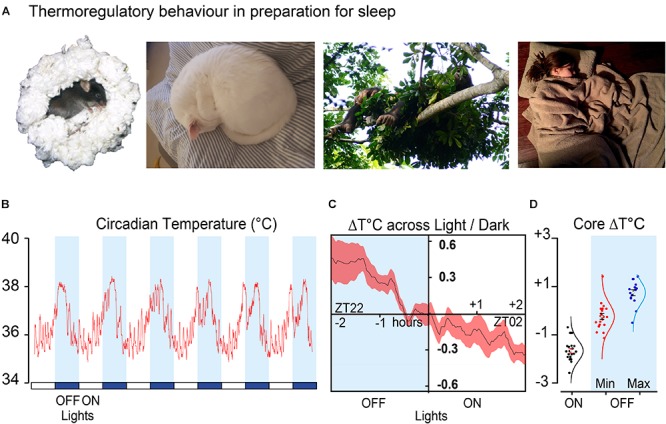
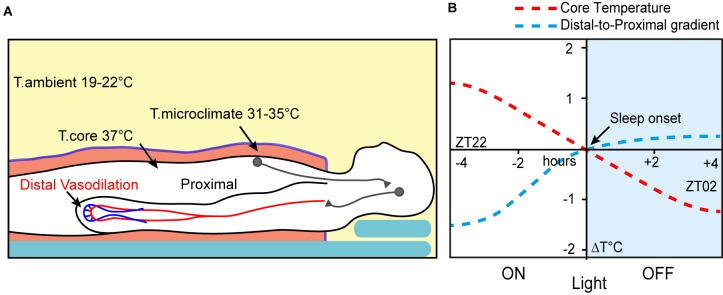
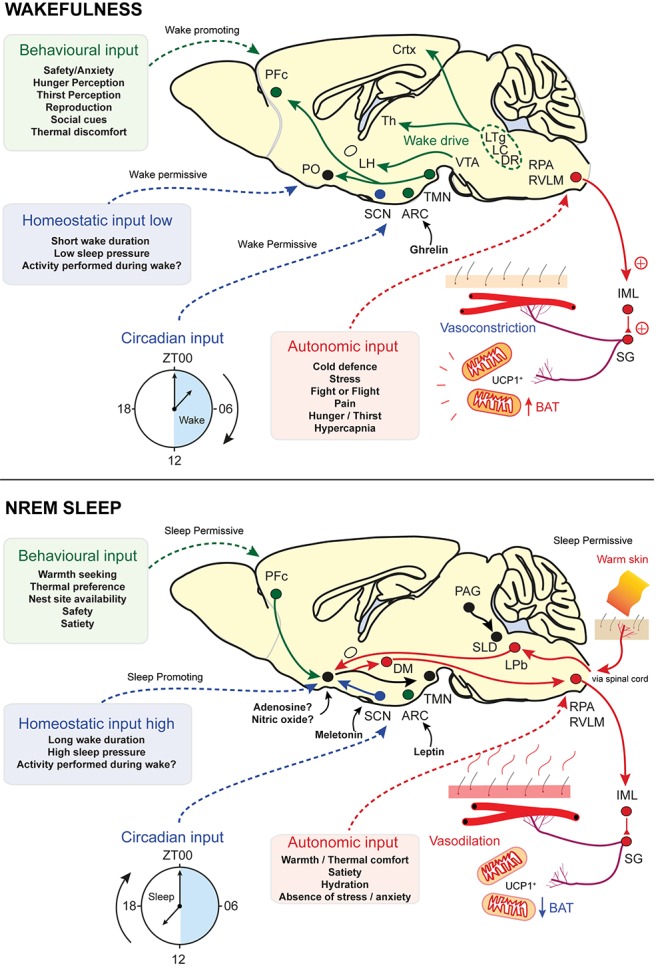
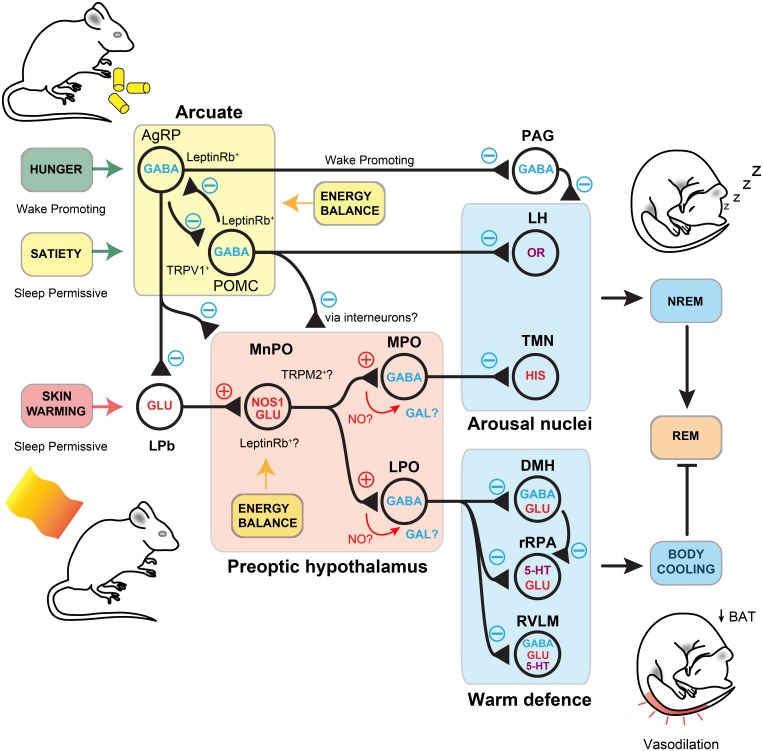
Mammals have evolved a range of behavioural and neurological mechanisms that coordinate cycles of thermoregulation and sleep. Whether diurnal or nocturnal, sleep onset and a reduction in core temperature occur together. Non-rapid eye movement (NREM) sleep episodes are also accompanied by core and brain cooling. Thermoregulatory behaviours, like nest building and curling up, accompany this circadian temperature decline in preparation for sleeping. This could be a matter of simply comfort as animals seek warmth to compensate for lower temperatures. However, in both humans and other mammals, direct skin warming can shorten sleep-latency and promote NREM sleep. We discuss the evidence that body cooling and sleep are more fundamentally connected and that thermoregulatory behaviours, prior to sleep, form warm microclimates that accelerate NREM directly through neuronal circuits. Paradoxically, this warmth might also induce vasodilation and body cooling. In this way, warmth seeking and nesting behaviour might enhance the circadian cycle by activating specific circuits that link NREM initiation to body cooling. We suggest that these circuits explain why NREM onset is most likely when core temperature is at its steepest rate of decline and why transitions to NREM are accompanied by a decrease in brain temperature. This connection may have implications for energy homeostasis and the function of sleep.
Overview
The claims and statistics of this paper haven’t been checked yet.
Run the check — free, no account needed. It reads the open-access text and checks the sources it cites.
Integrity signals
Registry
Cites
Statistics
Figures
Verification
Claims the paper makes
The claims and statistics of this paper haven’t been checked yet.
Run the check — free, no account needed. It reads the open-access text and checks the sources it cites.
Claims other papers make about this one
Each is checked against this paper’s own text: does it say what the citing paper says it does?
The check wasn’t confident either way, so it gives no verdict — never disputed.
In the citing paper
“Similarly, features of sleep-wake time series can directly capture insomnia-like patterns in sleep related to DM6,34,43,44.”
From Sleep and temperature data from wearable devices support noninvasive detection of diabetes mellitus in a large-scale, retrospective analysis (2026) · cites this paper as [34]
Experimental — accuracy not yet measuredThe check wasn’t confident either way, so it gives no verdict — never disputed.
In the citing paper
“Within a night, the complexity of the distal body temperature time series has been related to the autonomic nervous system’s (ANS) health during sleep6,34.”
From Sleep and temperature data from wearable devices support noninvasive detection of diabetes mellitus in a large-scale, retrospective analysis (2026) · cites this paper as [34]
Experimental — accuracy not yet measuredThe check wasn’t confident either way, so it gives no verdict — never disputed.
In the citing paper
“Studies suggest associations between DMN connectivity and subsequent sleep quality as measured by polysomnography, with greater DMNcortical connectivity associated with be er sleep efficiency and total sleep time [37].”
From Pre-Sleep Anxiety: Mechanisms and Therapeutic Approaches in Clinical Practice. (2026) · cites this paper as [37]
Experimental — accuracy not yet measuredIn the citing paper
“As a practical example, a hot bath (inducing vasodilation) prior to, but not immediately before the sleep period, is known to help with its initiation [9,52].”
From Human thermal perception and time of day: A review (2021) · cites this paper as [9]
Self-check
Percentages, sums and reported differences re-computed from the paper’s own numbers.
The self-check needs the paper’s full text.
Citations
Cites
Brown Adipose Tissue: Function and Physiological Significance
CANNON, B., & NEDERGAARD, J. (2004) · Physiological Reviews · doi:10.1152/physrev.00015.2003 · Cited by 6,433 · cited 1×
“It decouples the electron transport chain from the ATP-synthase, facilitating heat production through proton gradient dissipation, without ATP production, and compensatory metabolism (Cannon and Nedergaard, 2004).”
Two-Process Model of Sleep Regulation
Binder, M. D., Hirokawa, N., & Windhorst, U. (2008) · Springer eBooks · doi:10.1007/978-3-540-29678-2_6166 · Cited by 3,900 · cited 3×
“According to current thinking, these are known as Process C and Process S, the circadian and the homeostatic input, respectively, and are part of the two-process model (Borbély, 1982).”
BackgroundLeptin activates anorexigenic POMC neurons through a neural network in the arcuate nucleus
Cowley, M. A., Smart, J. L., Rubinstein, M., Cerdán, M. G., Diano, S., Horvath, T. L., Cone, R. D., & Low, M. J. (2001) · Nature · doi:10.1038/35078085 · Cited by 2,356 · cited 1×
“POMC oppose the action of AgRP neurons and are activated by leptin (Cowley et al., 2001).”
BackgroundThe two‐process model of sleep regulation: a reappraisal
Borbély, A. A., Daan, S., Wirz‐Justice, A., & Deboer, T. (2016) · Journal of Sleep Research · doi:10.1111/jsr.12371 · Cited by 1,577 · cited 1×
“However, as we have seen, sleep onset is also gated by other inputs: ambient temperature, as well as levels of satiety, mating opportunities and the need to escape predators all determine the appropriate moment for NREM onset (Borbély, 1982; Borbély et al., 2016; EbanRothschild et al., 2017; Logan and McClung, 2019).”
BackgroundMolecular, spatial, and functional single-cell profiling of the hypothalamic preoptic region
Moffitt, J. R., Bambah-Mukku, D., Eichhorn, S. W., Vaughn, E., Shekhar, K., Perez, J. D., Rubinstein, N. D., Hao, J., Regev, A., Dulac, C., et al. (2018) · Science · doi:10.1126/science.aau5324 · Cited by 1,365
Mammalian Hibernation: Cellular and Molecular Responses to Depressed Metabolism and Low Temperature
Carey, H. V., Andrews, M. T., & Martin, S. L. (2003) · Physiological Reviews · doi:10.1152/physrev.00008.2003 · Cited by 1,145 · cited 4×
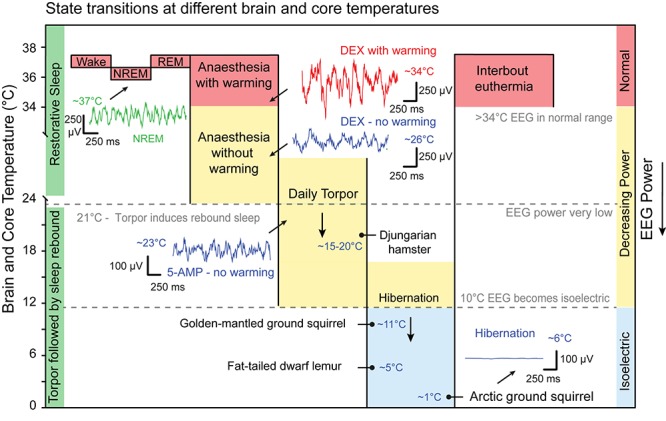
“These are periods of interbout euthermia (Boyer and Barnes, 1999; Carey et al., 2003).”
BackgroundInfluentialAssessing nest building in mice
Deacon, R. M. J. (2006) · Nature Protocols · doi:10.1038/nprot.2006.170 · Cited by 1,115 · cited 1×
“0 universal and the nesting mouse is adapted from Deacon (2006).”
BackgroundLeptin Differentially Regulates NPY and POMC Neurons Projecting to the Lateral Hypothalamic Area
Elias, C. F., Aschkenasi, C., Lee, C., Kelly, J., Ahima, R. S., Bjorbæk, C., Flier, J. S., Saper, C. B., & Elmquist, J. K. (1999) · Neuron · doi:10.1016/s0896-6273(01)80035-0 · Cited by 924 · cited 2×
“In rats, chronic total-sleep deprivation and selective REM deprivation, using the disk-overwater method for many days, leads to profound physiological effects and eventually death (Everson et al., 1989).”
BackgroundMethodDaily torpor and hibernation in birds and mammals
Ruf, T., & Geiser, F. (2014) · Biological reviews/Biological reviews of the Cambridge Philosophical Society · doi:10.1111/brv.12137 · Cited by 839 · cited 5×
“A range of mammals from ground squirrels to brown bears also use annual hibernation strategies for winter survival and reproduction (Carey et al., 2003; Ruf and Geiser, 2015).”
BackgroundInfluentialRegulation of Body Temperature by the Nervous System
Tan, C. L., & Knight, Z. A. (2018) · Neuron · doi:10.1016/j.neuron.2018.02.022 · Cited by 834 · cited 1×
“Neurons that receive afferent temperature information, but are not direct temperature ‘sensors’, have been distinguished by the term ‘warm-activated’ neurons (Tan and Knight, 2018).”
Background
Research works printed but not linked: 1
- Ma, 2019, Galanin neurons in the hypothalamus link sleep homeostasis, body temperature and actions of the alpha2 adrenergic agonist dexmedetomidine., bioRxiv, 10.1101/565747 · DOI
Cited by
Sorted by citations
Rising temperatures erode human sleep globally
Minor, K., Bjerre-Nielsen, A., Jonasdottir, S. S., Lehmann, S., & Obradovich, N. (2022) · One Earth · doi:10.1016/j.oneear.2022.04.008 · Cited by 261
Sleep Deprivation and Neurological Disorders
Bishir, M., Bhat, A., Essa, M. M., Ekpo, O. E., Ihunwo, A. O., Veeraraghavan, V. P., Surapaneni, K. M., Mahalakshmi, A. M., Ray, B., Tuladhar, S., et al. (2020) · BioMed Research International · doi:10.1155/2020/5764017 · Cited by 267
“NREM sleep is characterized by a low metabolic rate and an increase in brain temperature which helps to overcome the damages that are introduced during the wake cycle [7].”
The Promise of Sleep: A Multi-Sensor Approach for Accurate Sleep Stage Detection Using the Oura Ring
Altini, M., & Kinnunen, H. O. (2021) · Sensors · doi:10.3390/s21134302 · Cited by 208
“The reason is that core body temperature reductions are mechanistically accomplished through vasodilation of peripheral surface blood vessels of the skin in the extremities, particularly the hands and feet [48].”
BackgroundA systematic review of ambient heat and sleep in a warming climate
Chevance, G., Minor, K., Vielma, C., Campi, E., O’Callaghan-Gordo, C., Basagaña, X., Ballester, J., & Bernard, P. (2024) · Sleep Medicine Reviews · doi:10.1016/j.smrv.2024.101915 · Cited by 150
Galanin Neurons Unite Sleep Homeostasis and α2-Adrenergic Sedation
Ma, Y., Miracca, G., Yu, X., Harding, E. C., Miao, A., Yustos, R., Vyssotski, A. L., Franks, N. P., & Wisden, W. (2019) · Current Biology · doi:10.1016/j.cub.2019.07.087 · Cited by 130
“Given that sleep induction occurs when the rate of core body temperature decline is maximal [40, 41], this could explain why LPO-DGal mice are actually more awake compared with LPO-Gal-GFP mice at the start of lights on (Figure 1A).”
BackgroundSelf-citation
Metadata
- Authors
- Harding, E. C., Franks, N. P., & Wisden, W.
- Affiliations
- Imperial College London (GB)
- UK Dementia Research Institute (GB)
- Corresponding author
- Franks, Nicholas P.
- Wisden, William
- Venue
- Frontiers in Neuroscience
- Publisher
- Frontiers Media SA
- Published
- 2019-04-24
- Volume
- 13
- Pages
- 336-336
- ISSN
- 1662-453X (ISSN-L)
- PMC
- PMC6491889
- OpenAlex
- W2940903564
- Cited by
- 261
- References
- 159
- Citations by year
- 2026: 53 · 2025: 48 · 2024: 40 · 2023: 38 · 2022: 30 · 2021: 28 · 2020: 17 · 2019: 7
- FWCI
- 2.60
- Type
- journal article
- Language
- en
- Open access
- gold
- doi.org
- Licence
- Locations
- Frontiers in Neuroscience (publishedVersion, cc-by)
- Europe PMC (PubMed Central) (publishedVersion, cc-by)
- PubMed Central (publishedVersion, cc-by)
- PubMed (publishedVersion)
- DOAJ (DOAJ: Directory of Open Access Journals) (submittedVersion, cc-by-sa)
- Spiral (Imperial College London) (submittedVersion, other-oa)
- Funders
- Wellcome Trust
- Topics
- Life Sciences › Neuroscience › Cognitive Neuroscience › Sleep and Wakefulness Research
- Life Sciences › Neuroscience › Endocrine and Autonomic Systems › Circadian rhythm and melatonin
- Social Sciences › Psychology › Experimental and Cognitive Psychology › Sleep and related disorders
- Keywords
- sleep, thermoregulation, core body temperature, brain cooling, circadian rhythm, behavioral thermoregulation, nest building, skin warming, sleep latency, vasodilation, energy homeostasis, sleep function
About these checks
Registry, retraction, Cites and statistics results are computed, not judged, with one exception: a printed reference that no index lists is read once by a model before it counts as a citation error. Claims are extracted by a model and kept only when their quote appears verbatim in the text; each cited source is then checked, with a model’s help, for whether it says what the claim relies on. Those verdicts can be wrong — read the claim’s quote and the cited source before relying on one.
Statistics and arithmetic are recomputed, not judged.
Confidence bands are shown only for fields calibrated on our annotated test set. None is calibrated yet, so no band is shown.
What counts as a claim ›How we measure confidence ›How we check this ›
Are you an author, or do you see a problem with this page? Request a review
