

The DOI matches its Crossref record; 260 of the 261 references it cites were found in a registry or an index, and 1 are not checked yet.
Neurobiological and Hormonal Mechanisms Regulating Women’s Sleep
Open accessAbstract
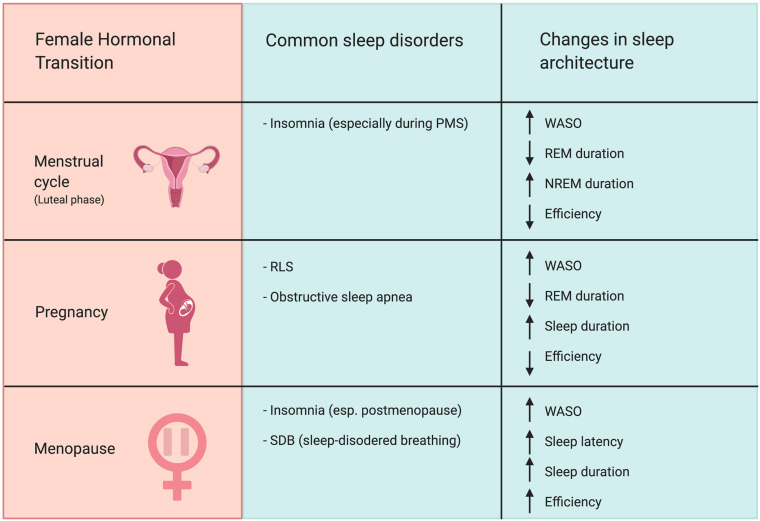
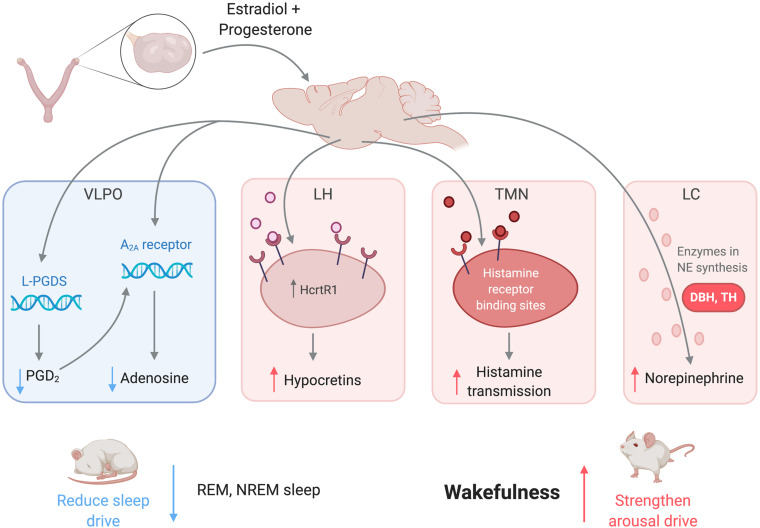
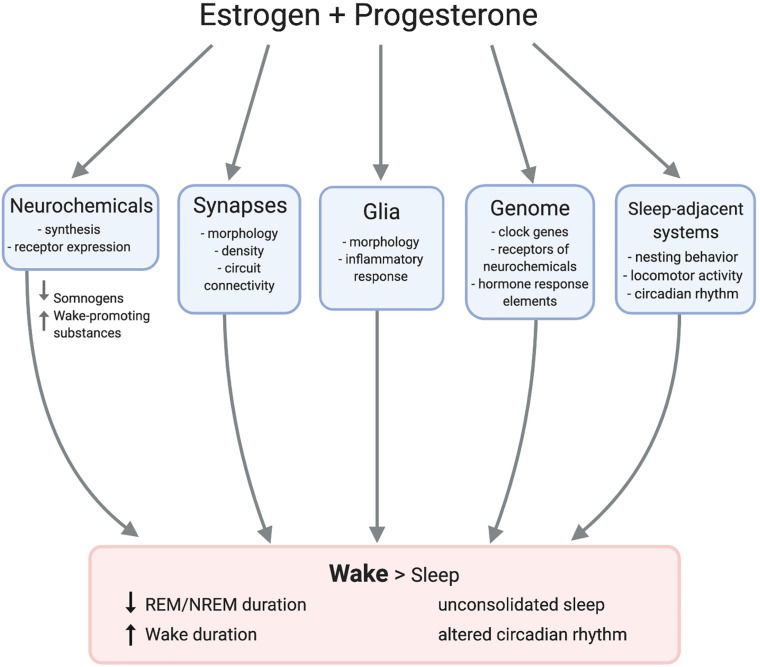
Sleep is crucial for optimal well-being, and sex differences in sleep quality have significant implications for women’s health. We review the current literature on sex differences in sleep, such as differences in objective and subjective sleep measures and their relationship with aging. We then discuss the convincing evidence for the role of ovarian hormones in regulating female sleep, and survey how these hormones act on a multitude of brain regions and neurochemicals to impact sleep. Lastly, we identify several important areas in need of future research to narrow the knowledge gap and improve the health of women and other understudied populations.
Overview
The claims and statistics of this paper haven’t been checked yet.
Run the check — free, no account needed. It reads the open-access text and checks the sources it cites.
Integrity signals
Registry
Cites
Statistics
Figures
Verification
Claims the paper makes
The claims and statistics of this paper haven’t been checked yet.
Run the check — free, no account needed. It reads the open-access text and checks the sources it cites.
Claims other papers make about this one
Each is checked against this paper’s own text: does it say what the citing paper says it does?
The source backs part of the claim, not all of it — or backs it for a different population, condition or comparison.
In the citing paper
“Interestingly, while women normally have longer and better sleep, they also report a higher incidence of sleep disorders.99–102”
From Effects of Traumatic Brain Injury on the Orexin/Hypocretin System (2025) · cites this paper as [100]
Experimental — accuracy not yet measured
Self-check
Percentages, sums and reported differences re-computed from the paper’s own numbers.
The self-check needs the paper’s full text.
Citations
Cites
Kessler, R. C., Berglund, P., Demler, O., Jin, R., Merikangas, K. R., & Walters, E. E. (2005) · Archives of General Psychiatry · doi:10.1001/archpsyc.62.6.593 · Cited by 20,391
Sakurai, T., Amemiya, A., Ishii, M., Matsuzaki, I., Chemelli, R. M., Tanaka, H., Williams, S. C., Richardson, J. A., Kozlowski, G. P., Wilson, S., et al. (1998) · Cell · doi:10.1016/s0092-8674(00)80949-6 · Cited by 5,501
Vale, W., Spiess, J., Rivier, C., & Rivier, J. (1981) · Science · doi:10.1126/science.6267699 · Cited by 3,965
Vale, W., Spiess, J., RIVIER, C. L., & Rivier, J. (1982) · Obstetrical & Gynecological Survey · doi:10.1097/00006254-198205000-00013 · Cited by 3,904
The hypocretins: hypothalamus-specific peptides with neuroexcitatory activity
de Lecea, L., Kilduff, T. S., Peyron, C., Gao, X.-B., Foye, P. E., Danielson, P. E., Fukuhara, C., Battenberg, E. L. F., Gautvik, V. T., Bartlett, F. S., et al. (1998) · Proceedings of the National Academy of Sciences · doi:10.1073/pnas.95.1.322 · Cited by 3,878
Neurons containing hypocretin (orexin) project to multiple neuronal systems
Peyron, C., Tighe, D. K., van den Pol, A. N., de Lecea, L., Heller, H. C., Sutcliffe, J. G., & Kilduff, T. S. (1998) · The Journal of Neuroscience · doi:10.1523/jneurosci.18-23-09996.1998 · Cited by 3,466
Dopamine, learning and motivation.
Wise, R. A. (2004) · Nature Reviews Neuroscience · doi:10.1038/nrn1406 · Cited by 3,379 · cited 1×
“Dopaminergic neurons in the ventral tegmental area (VTA) are well known for their role in motivation, learning, and reward (Wise, 2004; Bromberg-Martin et al., 2010).”
BackgroundNarcolepsy in orexin Knockout Mice
Chemelli, R. M., Willie, J. T., Sinton, C. M., Elmquist, J. K., Scammell, T., Lee, C., Richardson, J. A., Williams, S. C., Xiong, Y., Kisanuki, Y., et al. (1999) · Cell · doi:10.1016/s0092-8674(00)81973-x · Cited by 3,095
Lin, L., Faraco, J., Li, R., Kadotani, H., Rogers, W., Lin, X., Qiu, X., de Jong, P. J., Nishino, S., & Mignot, E. (1999) · Cell · doi:10.1016/s0092-8674(00)81965-0 · Cited by 2,613
Dopamine in motivational control: rewarding, aversive, and alerting
Bromberg-Martin, E. S., Matsumoto, M., & Hikosaka, O. (2010) · Neuron · doi:10.1016/j.neuron.2010.11.022 · Cited by 2,396
Research works printed but not linked: 1
- 2014, FDA approves new label changes and dosing for zolpidem products and a recommendation to avoid driving the day after using Ambien CR., Food Drug Adm. Drug Saf. Commun.
Cited by
Sorted by citations
Adolescent sleep and the foundations of prefrontal cortical development and dysfunction
Anastasiades, P. G., de Vivo, L., Bellesi, M., & Jones, M. W. (2022) · Progress in Neurobiology · doi:10.1016/j.pneurobio.2022.102338 · Cited by 89
Alshammari, B., Alkubati, S. A., Pasay-an, E. A., Alrasheeday, A., Alshammari, H. B., Asiri, S. M., Alshammari, S. B., Sayed, F., Madkhali, N. A. B., Laput, V., et al. (2023) · Healthcare · doi:10.3390/healthcare11182536 · Cited by 67
Sleep in women: a narrative review of hormonal influences, sex differences and health implications
Andersen, M. L., Hachul, H., Ishikura, I. A., & Tufik, S. (2023) · Frontiers in Sleep · doi:10.3389/frsle.2023.1271827 · Cited by 44
Coborn, J. E., de Wit, A. E., Crawford, S. L., Nathan, M., Rahman, S. A., Finkelstein, L. B., Wiley, A., & Joffe, H. (2022) · The Journal of Clinical Endocrinology & Metabolism · doi:10.1210/clinem/dgac447 · Cited by 33
Sleep Across the Lifespan: A Neurobehavioral Perspective
Simon, K. C. N. S., Cadle, C. E., Shuster, A. E., & Malerba, P. (2025) · Current Sleep Medicine Reports · doi:10.1007/s40675-025-00322-2 · Cited by 33
Metadata
- Authors
- Dorsey, A., de Lecea, L., & Jennings, K. J.
- Affiliations
- Stanford Medicine (US)
- Corresponding author
- Jennings, Kimberly J.
- Venue
- Frontiers in Neuroscience
- Publisher
- Frontiers Media SA
- Published
- 2021-01-14
- Volume
- 14
- Pages
- 625397-625397
- ISSN
- 1662-453X (ISSN-L)
- PMC
- PMC7840832
- OpenAlex
- W3120986069
- Cited by
- 100
- References
- 261
- Citations by year
- 2026: 19 · 2025: 33 · 2024: 21 · 2023: 14 · 2022: 8 · 2021: 5
- FWCI
- 1.76
- Type
- journal article
- Language
- en
- Open access
- gold
- doi.org
- Licence
- Locations
- Frontiers in Neuroscience (publishedVersion, cc-by)
- PubMed Central (publishedVersion, cc-by)
- PubMed (publishedVersion)
- DOAJ (DOAJ: Directory of Open Access Journals) (submittedVersion, cc-by-sa)
- Funders
- Stanford Bio-X
- National Institute of Mental Health
- Eunice Kennedy Shriver National Institute of Child Health and Human Development
- Rose Hills Foundation
- Topics
- Life Sciences › Neuroscience › Cognitive Neuroscience › Sleep and Wakefulness Research
- Social Sciences › Psychology › Experimental and Cognitive Psychology › Sleep and related disorders
- Life Sciences › Neuroscience › Endocrine and Autonomic Systems › Circadian rhythm and melatonin
- Keywords
- sex differences in sleep, women's sleep, ovarian hormones, sleep regulation, aging, sleep quality, neurochemicals, brain regions
About these checks
Registry, retraction, Cites and statistics results are computed, not judged, with one exception: a printed reference that no index lists is read once by a model before it counts as a citation error. Claims are extracted by a model and kept only when their quote appears verbatim in the text; each cited source is then checked, with a model’s help, for whether it says what the claim relies on. Those verdicts can be wrong — read the claim’s quote and the cited source before relying on one.
Statistics and arithmetic are recomputed, not judged.
Confidence bands are shown only for fields calibrated on our annotated test set. None is calibrated yet, so no band is shown.
What counts as a claim ›How we measure confidence ›How we check this ›
Are you an author, or do you see a problem with this page? Request a review
