

Learning New Vocabulary Implicitly During Sleep Transfers With Cross-Modal Generalization Into Wakefulness
Open accessThe DOI matches its Crossref record; 43 of the 43 references it cites were found in a registry or an index; 1 of the 20 sources its claims cite were checked for support.
Abstract
New information can be learned during sleep but the extent to which we can access this knowledge after awakening is far less understood. Using a novel Associative Transfer Learning paradigm, we show that, after hearing unknown Japanese words with sounds referring to their meaning during sleep, participants could identify the images depicting the meaning of newly acquired Japanese words after awakening (N = 22). Moreover, we demonstrate that this cross-modal generalization is implicit, meaning that participants remain unaware of this knowledge. Using electroencephalography, we further show that frontal slow-wave responses to auditory stimuli during sleep predicted memory performance after awakening. This neural signature of memory formation gradually emerged over the course of the sleep phase, highlighting the dynamics of associative learning during sleep. This study provides novel evidence that the formation of new associative memories can be traced back to the dynamics of slow-wave responses to stimuli during sleep and that their implicit transfer into wakefulness can be generalized across sensory modalities.
Overview
CoChat Summary
TL;DR
Using an Associative Transfer Learning paradigm, participants heard Japanese words paired with meaning-related sounds during sleep and later identified corresponding images above chance after awakening, with confidence ratings indicating implicit memory. Frontal slow-wave EEG responses during NREM sleep predicted later memory and shifted from early to late slow-wave activity over the sleep learning phase.
Key findings
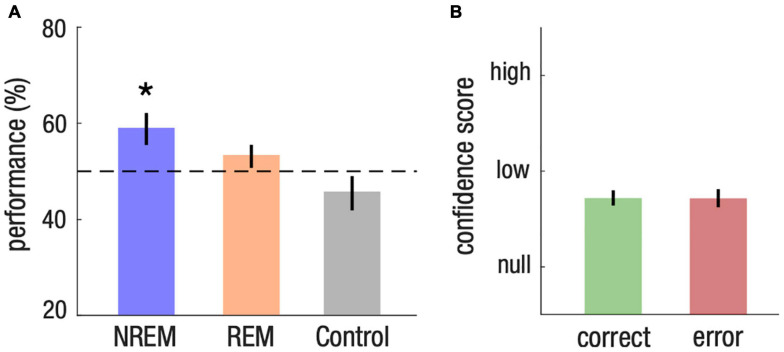
- Memory for NREM-presented words was above chance (59%, CI 52–66; d = 0.58; t(21) = 2.7, p = 0.013), whereas REM (53%, p = 0.201) and control (45%, p = 0.204) lists did not differ from chance; repeated-measures ANOVA showed an arousal-level effect [F(2,21) = 4.66, p = 0.021], with NREM vs. control p = 0.011.
- Learning was implicit: confidence scores did not differ between NREM and control lists (−0.03, CI −0.11–0.05, p = 0.444) or between correct and incorrect NREM items (0.00, CI −0.12–0.12, p = 0.959); in a wake control (n = 12), confidence was higher for learned vs. control and correct vs. incorrect items (Supplementary Figure 1).
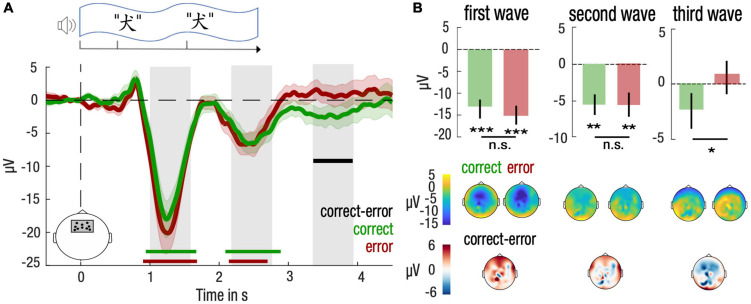
- EEG: correct vs. error trials differed after stimulation (3.36–3.93 s, d = −0.44, Pcluster = 0.029); for the 3rd slow wave, correct trials had lower amplitude than error trials (−3.22 μV, CI −6.3–−0.2, d = −0.46, t(21) = −2.2, p = 0.039).
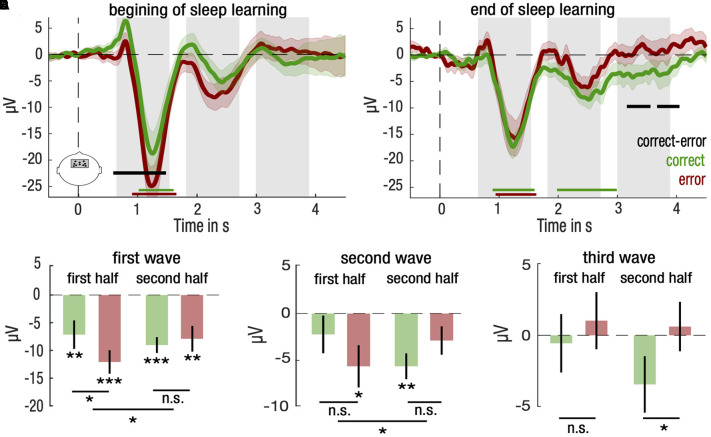
- Dynamics: in the first half, a correct-vs.-error cluster covered the 1st slow wave (0.59–1.48 s, Pcluster = 0.025); in the second half, late clusters emerged over the 3rd slow wave (3.16–3.56 s, Pcluster = 0.047; 3.67–4.05 s, Pcluster = 0.046), with interactions for the 1st SW [F(1,21) = 4.52, p = 0.046] and 2nd SW [F(1,21) = 4.45, p = 0.047].
Methods
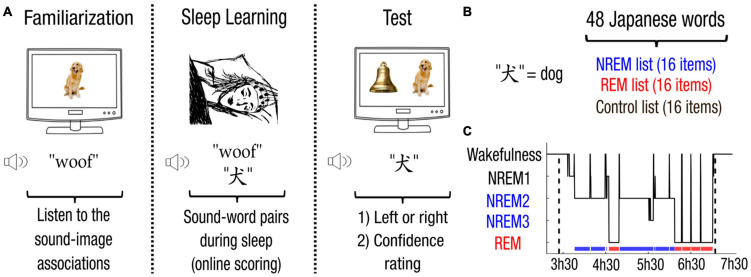
- ATL paradigm: 25 French-native speakers were recruited and 22 analyzed (age 23.7, range 20–29, 15 females); 48 Japanese words were assigned to NREM, REM, and control lists of 16. Awake familiarization used 48 sound-image pairs; during sleep, sounds alone were played when awake/NREM1 and Japanese translations were added during NREM/REM; after awakening, participants performed a 2AFC image-selection task plus confidence ratings (null/low/high). A separate wake control had n = 12.
- EEG: 64-channel EEG and chin EMG were recorded; sleep was scored online and offline; analysis focused on a frontal electrode cluster and slow-wave frequency at 0.85 Hz, using cluster-based permutation statistics (1,000 permutations), t-tests, ANOVA, and generalized linear mixed models.
Limitations
- Stated: REM vs. NREM comparison is limited because REM received about 3 times fewer presentations (13 vs. 40), preventing direct comparison of sleep learning across states; the study did not explain why some items or participants learned better, with individual preferences, language ability, memory capacity, and motivation suggested as possible factors.
- Stated: the origin of cross-modal generalization remains unclear—whether it reflects cross-modal retrieval at awakening or cross-modal encoding during sleep—and whether ATL extends to REM sleep requires further experiments.
- Evident: the analyzed sample is modest (22; wake control n = 12), and the paper notes explicit wake learning was much more efficient (4 vs. 40 repetitions; 88% vs. 59% accuracy), so the sleep-learning effect is small and implicit.
Model-written summary. Check it against the paper before relying on it.
Integrity signals
Registry
Cites
Statistics
Figures
Verification
Claims the paper makes
0 Valid · 1 Not valid · 12 Not checked · 39 Own results and interpretations
The cited sources that could be checked couldn’t confirm or dispute this claim.
In the paper
“Thus, the dynamics of neural signatures of learning cannot solely be explained by changes in the sleep structure.”
§ Learning New Vocabulary Implicitly During Sleep Transfers With Cross-Modal Generalization Into Wakefulness > Discussion
What the sources say
- Could not verifycites Nir et al., 2011 matched to “Regional Slow Waves and Spindles in Human Sleep” (2011) sourceExperimental — accuracy not yet measured
Our copy of Nir et al. (2011) contains no analysis of 'neural signatures of learning' or of whether their dynamics track changes in sleep structure; the paper's learning-related statements only credit other work (e.g. Discussion > Local Sleep Spindles cites Nishida and Walker, 2007 for spindle power correlating with motor learning; Discussion > Functional Significance cites slow-wave deprivation/enhancement studies Aeschbach 2008, Landsness 2009, Marshall 2006). The nearest structural analogue is in Results > Changes in Spatial Extent of Slow Waves and Spindles between Early and Late Sleep — 'local sleep spindles cannot be simply explained by an association with local slow waves' — which concerns spindle locality versus slow waves, not learning signatures versus sleep structure. Searched: sleep structure/architecture, sleep stages, learning, memory consolidation, 'cannot be simply explained'; none of these passages state the attributed claim, and none contradict it either. (LLM, conf=0.65)
plain- Asserted: passes — The authors put it forward as true.
- Checkable: passes — It can be checked against evidence.
- Load-bearing: passes — The paper’s conclusions depend on it.
- Based: passes — The paper gives a reason why it holds.
- Could not verify
In the paper
“We obtained remarkably similar effect sizes as a recent study showing the formation of new verbal associations during sleep (59% vs. 55%, Züst et al., 2019), replicating the finding that new vocabulary can be acquired during sleep.”
§ Learning New Vocabulary Implicitly During Sleep Transfers With Cross-Modal Generalization Into Wakefulness > Discussion
What the sources say
- Not matchedcites Züst et al., 2019
This doesn’t read as a citation we can look up.
plain- Asserted: passes — The authors put it forward as true.
- Checkable: passes — It can be checked against evidence.
- Load-bearing: unclear — It is unclear whether the paper’s conclusions depend on it.
- Based: passes — The paper gives a reason why it holds.
- Not matched
In the paper
“While Züst et al. (2019) obtained similar results during deep NREM sleep, we provide evidence that these results also hold true for light NREM sleep (Supplementary Figure 2 and Supplementary Table 3).”
§ Learning New Vocabulary Implicitly During Sleep Transfers With Cross-Modal Generalization Into Wakefulness > Discussion
What the sources say
- Not matchedcites Züst et al., 2019
This doesn’t read as a citation we can look up.
plain- Asserted: passes — The authors put it forward as true.
- Checkable: passes — It can be checked against evidence.
- Load-bearing: passes — The paper’s conclusions depend on it.
- Based: passes — The paper gives a reason why it holds.
- Not matched
A result the paper reports from its own data — it cites no other source for it, so there is none to check. The quote shows it is in the paper.
In the paper
“This effect came from a higher memory performance for words from the NREM list compared to words that were not presented during sleep, i.e., the control list (post hoc Tukey-test, NREM vs. control: p = 0.011; REM vs. control, p = 0.201; NREM vs. REM, p = 0.407).”
§ Learning New Vocabulary Implicitly During Sleep Transfers With Cross-Modal Generalization Into Wakefulness > Results > Learning During NREM Sleep
plainstates an association- Asserted: passes — The authors put it forward as true.
- Checkable: passes — It can be checked against evidence.
- Load-bearing: passes — The paper’s conclusions depend on it.
- Based: passes — The paper gives a reason why it holds.
A result the paper reports from its own data — it cites no other source for it, so there is none to check. The quote shows it is in the paper.
In the paper
“However, for the 3rd SW, post hoc comparisons confirmed a lower amplitude for correct trials compared to error trials [−3.22 μV, CI = (−6.3, −0.2), d = −0.46, t(21) = −2.2, p = 0.039, corrected for multiple comparison”
§ Learning New Vocabulary Implicitly During Sleep Transfers With Cross-Modal Generalization Into Wakefulness > Results > Neural Signatures of Sleep Learning
boostedstates an association- Asserted: passes — The authors put it forward as true.
- Checkable: passes — It can be checked against evidence.
- Load-bearing: unclear — It is unclear whether the paper’s conclusions depend on it.
- Based: passes — The paper gives a reason why it holds.
35 more claims
Create a free account to see all 52 claims and to verify the 13 references still open.
- It may state two separate claims as one. 8
- Probably not a substantial claim. 4
Statistics recomputed
Every reported test result, recomputed from its test statistic and degrees of freedom. A result shows as not adding up only once an independent check has confirmed it.
- ConsistentF(2, 21) = 4.66reported p = .021 · recomputed p = .021
“F(2,21) = 4.66, p = .021”
- Consistentt(21) = 2.7reported p = .013 · recomputed p = .013
“t(21) = 2.7, p = .013”
- Consistentt(21) = 1.32reported p = .201 · recomputed p = .201
“t(21) = 1.32, p = .201”
- Consistentt(21) = -1.31reported p = .204 · recomputed p = .204
“t(21) = −1.31, p = .204”
- ConsistentF(2, 1053) = 6.31reported p = .002 · recomputed p = .002
“F(2,1053) = 6.31, p = .002”
14 more recomputed tests
Create a free account to see every test the Stats check recomputed.
Self-check
Percentages, sums and reported differences re-computed from the paper’s own numbers.
Each contradiction between two passages listed here was confirmed by an independent check.
Rated minor: it would not touch a result — a value no result rests on, a p-value that stays on the same side of the significance level, or a conflict that is clerical, resolved elsewhere in the paper, or outside its own findings.
In the paper
§ Learning New Vocabulary Implicitly During Sleep Transfers With Cross-Modal Generalization Into Wakefulness > Results > Dynamics of Sleep Learning
“with brain potentials lower than baseline for error trials in the 1st half and for correct trials in the 2nd half”
§ Learning New Vocabulary Implicitly During Sleep Transfers With Cross-Modal Generalization Into Wakefulness > Results > Dynamics of Sleep Learning
“2nd half correct: 5.7 μV, CI = (−8.5, −2.8), d = −0.89, two-tailed Student’s t-test against baseline (0), t(21) = 4.19”
Rated minor: it would not touch a result — a value no result rests on, a p-value that stays on the same side of the significance level, or a conflict that is clerical, resolved elsewhere in the paper, or outside its own findings.
In the paper
§ Learning New Vocabulary Implicitly During Sleep Transfers With Cross-Modal Generalization Into Wakefulness > Results > Dynamics of Sleep Learning
“For the 1st half, we found a positive cluster covering the 1st SW [correct vs. error: (0.59, 1.48)s, d = −0.49, Σt(21) = 205.0, Pcluster = 0.025; Figure 4A].”
§ Learning New Vocabulary Implicitly During Sleep Transfers With Cross-Modal Generalization Into Wakefulness > Results > Dynamics of Sleep Learning
“For the 1st half, we found a positive cluster covering the 1st SW”
Citations
Cites
The control of the false discovery rate in multiple testing under dependency
Benjamini, Y., & Yekutieli, D. (2001) · The Annals of Statistics · doi:10.1214/aos/1013699998 · Cited by 10,490
(2007) · Cited by 6,530
Rasch, B., & Born, J. (2013) · Physiological Reviews · doi:10.1152/physrev.00032.2012 · Cited by 2,783
Building machines that learn and think like people
Lake, B. M., Ullman, T. D., Tenenbaum, J. B., & Gershman, S. J. (2017) · Behavioral and Brain Sciences · doi:10.1017/s0140525x16001837 · Cited by 2,550
Boosting slow oscillations during sleep potentiates memory
Marshall, L., Helgadóttir, H., Mölle, M., & Born, J. (2006) · Nature · doi:10.1038/nature05278 · Cited by 1,792
Torrey, L., & Shavlik, J. (2010) · Handbook of Research on Machine Learning Applications and Trends · doi:10.4018/978-1-60566-766-9.ch011 · Cited by 1,503
The sleep slow oscillation as a traveling wave
Massimini, M., Huber, R., Ferrarelli, F., Hill, S., & Tononi, G. (2004) · The Journal of Neuroscience · doi:10.1523/jneurosci.1318-04.2004 · Cited by 1,221
Odor cues during slow-wave sleep prompt declarative memory consolidation
Rasch, B., Büchel, C., Gais, S., & Born, J. (2007) · Science · doi:10.1126/science.1138581 · Cited by 1,181
Mechanisms of systems memory consolidation during sleep
Klinzing, J. G., Niethard, N., & Born, J. (2019) · Nature Neuroscience · doi:10.1038/s41593-019-0467-3 · Cited by 1,176
Dissociable stages of human memory consolidation and reconsolidation
Walker, M. P., Brakefield, T., Allan Hobson, J., & Stickgold, R. (2003) · Nature · doi:10.1038/nature01930 · Cited by 1,025
Regional Slow Waves and Spindles in Human Sleep
Nir, Y., Staba, R. J., Andrillon, T., Vyazovskiy, V. V., Cirelli, C., Fried, I., & Tononi, G. (2011) · Neuron · doi:10.1016/j.neuron.2011.02.043 · Cited by 924
Levels of processing during non-conscious perception: a critical review of visual masking
Kouider, S., & Dehaene, S. (2007) · Philosophical Transactions of the Royal Society B: Biological Sciences · doi:10.1098/rstb.2007.2093 · Cited by 835
Self-citationMetacognition in human decision-making: confidence and error monitoring
Yeung, N., & Summerfield, C. (2012) · Philosophical Transactions of the Royal Society B: Biological Sciences · doi:10.1098/rstb.2011.0416 · Cited by 667
Dreaming and the brain: from phenomenology to neurophysiology
Nir, Y., & Tononi, G. (2010) · Trends in Cognitive Sciences · doi:10.1016/j.tics.2009.12.001 · Cited by 595
Born, J., Rasch, B., & Gais, S. (2006) · The Neuroscientist · doi:10.1177/1073858406292647 · Cited by 557
Upgrading the sleeping brain with targeted memory reactivation
Oudiette, D., & Paller, K. A. (2013) · Trends in Cognitive Sciences · doi:10.1016/j.tics.2013.01.006 · Cited by 350
Sleeping brain, learning brain. The role of sleep for memory systems
Peigneux, P., Laureys, S., Delbeuck, X., & Maquet, P. (2001) · Neuroreport · doi:10.1097/00001756-200112210-00001 · Cited by 347
Implicit learning: Below the subjective threshold
Dienes, Z., & Berry, D. (1997) · Psychonomic Bulletin & Review · doi:10.3758/bf03210769 · Cited by 336
Disruption of hierarchical predictive coding during sleep
Strauss, M., Sitt, J. D., King, J.-R., Elbaz, M., Azizi, L., Buiatti, M., Naccache, L., van Wassenhove, V., & Dehaene, S. (2015) · Proceedings of the National Academy of Sciences · doi:10.1073/pnas.1501026112 · Cited by 244
Self-citationHumans can learn new information during sleep
Arzi, A., Shedlesky, L., Ben-Shaul, M., Nasser, K., Oksenberg, A., Hairston, I. S., & Sobel, N. (2012) · Nature Neuroscience · doi:10.1038/nn.3193 · Cited by 241
Interplay between spontaneous and induced brain activity during human non-rapid eye movement sleep
Dang-Vu, T. T., Bonjean, M., Schabus, M., Boly, M., Darsaud, A., Desseilles, M., Degueldre, C., Balteau, E., Phillips, C., Luxen, A., et al. (2011) · Proceedings of the National Academy of Sciences · doi:10.1073/pnas.1112503108 · Cited by 231
Neural Markers of Responsiveness to the Environment in Human Sleep
Andrillon, T., Poulsen, A. T., Hansen, L. K., Léger, D., & Kouider, S. (2016) · The Journal of Neuroscience · doi:10.1523/jneurosci.0902-16.2016 · Cited by 155
Self-citationThe vigilant sleeper: neural mechanisms of sensory (de)coupling during sleep
Andrillon, T., & Kouider, S. (2020) · Current Opinion in Physiology · doi:10.1016/j.cophys.2019.12.002 · Cited by 133
Self-citationThe K-complex as a special reactive sleep slow wave – A theoretical update
Halász, P. (2015) · Sleep Medicine Reviews · doi:10.1016/j.smrv.2015.09.004 · Cited by 130
Bastuji, H., García-Larrea, L., Franc, C., & Mauguière, F. (1995) · Journal of Clinical Neurophysiology · doi:10.1097/00004691-199503000-00006 · Cited by 119
The Evoked K-Complex: All-or-None Phenomenon?
Bastien, C., & Campbell, K. (1992) · Sleep · doi:10.1093/sleep/15.3.236 · Cited by 113
Implicit and Explicit Memory for Verbal Information Presented during Sleep
Wood, J. M., Bootzin, R. R., Kihlstrom, J. F., & Schacter, D. L. (1992) · Psychological Science · doi:10.1111/j.1467-9280.1992.tb00035.x · Cited by 104
Formation and suppression of acoustic memories during human sleep.
Andrillon, T., Pressnitzer, D., Léger, D., & Kouider, S. (2017) · Nature Communications · doi:10.1038/s41467-017-00071-z · Cited by 103
Self-citationInducing Task-Relevant Responses to Speech in the Sleeping Brain
Kouider, S., Andrillon, T., Barbosa, L. S., Goupil, L., & Bekinschtein, T. A. (2014) · Current Biology · doi:10.1016/j.cub.2014.08.016 · Cited by 102
Self-citationSlow oscillations during sleep coordinate interregional communication in cortical networks.
Cox, R., van Driel, J., de Boer, M., & Talamini, L. M. (2014) · The Journal of Neuroscience · doi:10.1523/jneurosci.1953-14.2014 · Cited by 100
Implicit Vocabulary Learning during Sleep Is Bound to Slow-Wave Peaks
Züst, M. A., Ruch, S., Wiest, R., & Henke, K. (2019) · Current Biology · doi:10.1016/j.cub.2018.12.038 · Cited by 98
Olfactory Aversive Conditioning during Sleep Reduces Cigarette-Smoking Behavior
Arzi, A., Holtzman, Y., Samnon, P., Eshel, N., Harel, E., & Sobel, N. (2014) · The Journal of Neuroscience · doi:10.1523/jneurosci.2291-14.2014 · Cited by 91
Preferential processing of emotionally and self-relevant stimuli persists in unconscious N2 sleep
Blume, C., del Giudice, R., Lechinger, J., Wislowska, M., Heib, D. P. J., Hoedlmoser, K., & Schabus, M. (2017) · Brain and Language · doi:10.1016/j.bandl.2016.02.004 · Cited by 60
Scott, R. B., Samaha, J., Chrisley, R., & Dienes, Z. (2018) · Cognition · doi:10.1016/j.cognition.2018.02.008 · Cited by 41
Implicit memory for words heard during sleep
Andrillon, T., & Kouider, S. (2016) · Neuroscience of Consciousness · doi:10.1093/nc/niw014 · Cited by 40
Self-citationRuch, S., Koenig, T. W., Mathis, J., Roth, C., & Henke, K. (2014) · Frontiers in Psychology · doi:10.3389/fpsyg.2014.01319 · Cited by 30
Transfer across form and modality in implicit and explicit memory.
Berry, D. C., Banbury, S., & Henry, L. (1997) · The Quarterly Journal of Experimental Psychology Section A · doi:10.1080/713755685 · Cited by 22
Transfer across modality in perceptual implicit memory.
Blum, D., & Yonelinas, A. P. (2001) · Psychonomic Bulletin & Review · doi:10.3758/bf03196151 · Cited by 22
Learning During Sleep: A Dream Comes True?
Ruch, S., & Henke, K. (2020) · Trends in Cognitive Sciences · doi:10.1016/j.tics.2019.12.007 · Cited by 21
Effect of Presenting Novel Verbal Material during Slow-wave Sleep
BRUCE, D. J., Evans, C. R., Fenwick, P. B. C., & SPENCER, V. (1970) · Nature · doi:10.1038/225873a0 · Cited by 19
Neural dynamics of associative learning during human sleep.
Canales-Johnson, A., Merlo, E., Bekinschtein, T. A., & Arzi, A. (2020) · Cerebral Cortex · doi:10.1093/cercor/bhz197 · Cited by 19
High quality time-scale modification of speech using a peak alignment overlap-add algorithm (PAOLA)
Dorran, D., Lawlor, R., & Coyle, E. (2003) · IEEE International Conference on Acoustics Speech and Signal Processing · doi:10.1109/icassp.2003.1198877 · Cited by 14
Studies of Learning during Sleep: Problems, Progress, and Perspectives
Puchkova, A. N. (2020) · Neuroscience and Behavioral Physiology · doi:10.1007/s11055-020-00895-1 · Cited by 5
Cited by
Türker, B., Musat, E. M., Chabani, E., Fonteix-Galet, A., Maranci, J.-B., Wattiez, N., Pouget, P., Sitt, J., Naccache, L., Arnulf, I., et al. (2023) · Nature Neuroscience · doi:10.1038/s41593-023-01449-7 · Cited by 57
“Recent studies suggest that word-association learning during sleep is possible 15,16 and could generalize into wakefulness in a cross-modal manner 17 .”
Updating memories of unwanted emotions during human sleep
Xia, T., Yao, Z., Guo, X., Liu, J., Chen, D., Liu, Q., Paller, K. A., & Hu, X. (2022) · Current Biology · doi:10.1016/j.cub.2022.12.004 · Cited by 52
Reciprocal relationships between sleep and smell
Gaeta, G., & Wilson, D. A. (2022) · Frontiers in Neural Circuits · doi:10.3389/fncir.2022.1076354 · Cited by 29
Episodic long-term memory formation during slow-wave sleep
Schmidig, F. J., Ruch, S., & Henke, K. (2024) · eLife · doi:10.7554/elife.89601 · Cited by 15
Learning during sleep in humans – A historical review
Ataei, S., Simo, E., Bergers, M., Schoch, S. F., Axmacher, N., & Dresler, M. (2023) · Sleep Medicine Reviews · doi:10.1016/j.smrv.2023.101852 · Cited by 12
Metadata
- Authors
- Koroma, M., Elbaz, M., Léger, D., & Kouider, S.
- Affiliations
- Centre National de la Recherche Scientifique (FR)
- Université Paris Cité (FR)
- Corresponding author
- Koroma, Matthieu
- Venue
- Frontiers in Neuroscience
- Publisher
- Frontiers Media SA
- Published
- 2022-03-09
- Volume
- 16
- Pages
- 801666-801666
- ISSN
- 1662-453X (ISSN-L)
- PMC
- PMC8959773
- OpenAlex
- W4220832644
- Cited by
- 24
- References
- 43
- Citations by year
- 2026: 4 · 2025: 4 · 2024: 3 · 2023: 9 · 2022: 4
- FWCI
- 2.05
- Type
- journal article
- Language
- en
- Open access
- gold
- doi.org
- Licence
- Locations
- Frontiers in Neuroscience (publishedVersion, cc-by)
- PubMed (publishedVersion)
- PubMed Central (publishedVersion, cc-by)
- HAL (submittedVersion, other-oa)
- ORBi (University of Liège) (submittedVersion, other-oa)
- DOAJ (DOAJ: Directory of Open Access Journals) (submittedVersion, cc-by-sa)
- Funders
- European Research Council
- Agence Nationale de la Recherche (ANR-10-LABX-0087)
- Direction Générale de l’Armement
- Canadian Institute for Advanced Research
- Topics
- Life Sciences › Neuroscience › Cognitive Neuroscience › Sleep and Wakefulness Research
- Life Sciences › Neuroscience › Cognitive Neuroscience › Memory and Neural Mechanisms
- Life Sciences › Neuroscience › Cognitive Neuroscience › Memory Processes and Influences
- Keywords
- sleep-dependent memory consolidation, implicit learning, cross-modal generalization, associative memory
About these checks
Registry, retraction, Cites and statistics results are computed, not judged, with one exception: a printed reference that no index lists is read once by a model before it counts as a citation error. Claims are extracted by a model and kept only when their quote appears verbatim in the text; each cited source is then checked, with a model’s help, for whether it says what the claim relies on. Those verdicts can be wrong — read the claim’s quote and the cited source before relying on one.
The claim verdicts this report counts are experimental: their accuracy is not yet measured.
A language model drew the claims from the paper on 2026-11-19, under version 3 of the claim definition (model deepseek-v4.1-flash, prompt extract-v3).
A second model labelled each claim on 2026-11-19 (model jev-1.13-20260917, definition revision gold-guideline-v0.2).
Cited sources are checked with a language model’s help (qwen3.8-omni-flash).
Statistics and arithmetic are recomputed, not judged.
Confidence bands are shown only for fields calibrated on our annotated test set. None is calibrated yet, so no band is shown.
What counts as a claim ›How we measure confidence ›How we check this ›
Are you an author, or do you see a problem with this page? Request a review
Data sources
Bibliographic data: Semantic Scholar, OpenAlex, Crossref.
Contains information from the Semantic Scholar Academic Graph Datasets, made available under the ODC Attribution License (ODC-BY 1.0).
Semantic Scholar’s data is described in: Kinney, R., et al. (2023). The Semantic Scholar Open Data Platform. arXiv:2301.10140.
