

Innovative wearable technology for continuous echocardiographic monitoring: first-in-neonate case report
Open accessThe DOI matches its Crossref record; 8 of the 8 references it cites were found in a registry or an index; 2 of the 16 sources its claims cite were checked for support.
Abstract
Neonates in the early stage are in the transition from fetal to adult circulation, accompanied by complex hemodynamic changes, which are prone to aggravate the condition of the circulatory system during the perioperative period. Here, we present a case of a 3-day-old neonate with upper gastrointestinal bleeding caused by multiple esophageal and gastric ulcers. To achieve accurate circulation management, we utilized a novel wearable ultrasound device for non—invasive, continuous echocardiographic monitoring throughout general anesthesia gastroscopy and postoperative NICU care. The case demonstrates the feasibility of continuous echocardiographic monitoring in neonates and offers new ideas for circulatory monitoring and management in critical neonates.
Overview
CoChat Summary
TL;DR
This case report describes the first use of a novel wearable ultrasound device to provide continuous, non-invasive echocardiographic monitoring in a 3-day-old neonate during general anesthesia for gastroscopy and subsequent NICU care. The authors conclude that continuous echocardiographic monitoring is feasible and practical for neonatal perioperative circulatory management.
Key findings
- A 3-day-old neonate (51 cm, 3.75 kg) with upper gastrointestinal bleeding from multiple esophageal and gastric ulcers underwent gastroscopy under general anesthesia with continuous wearable echocardiographic monitoring.
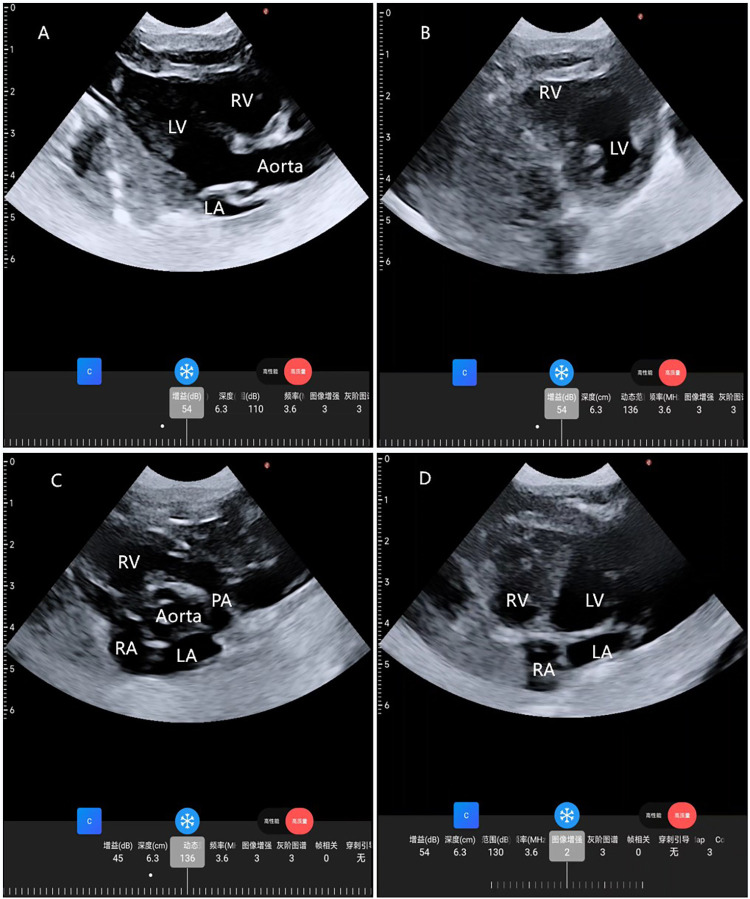
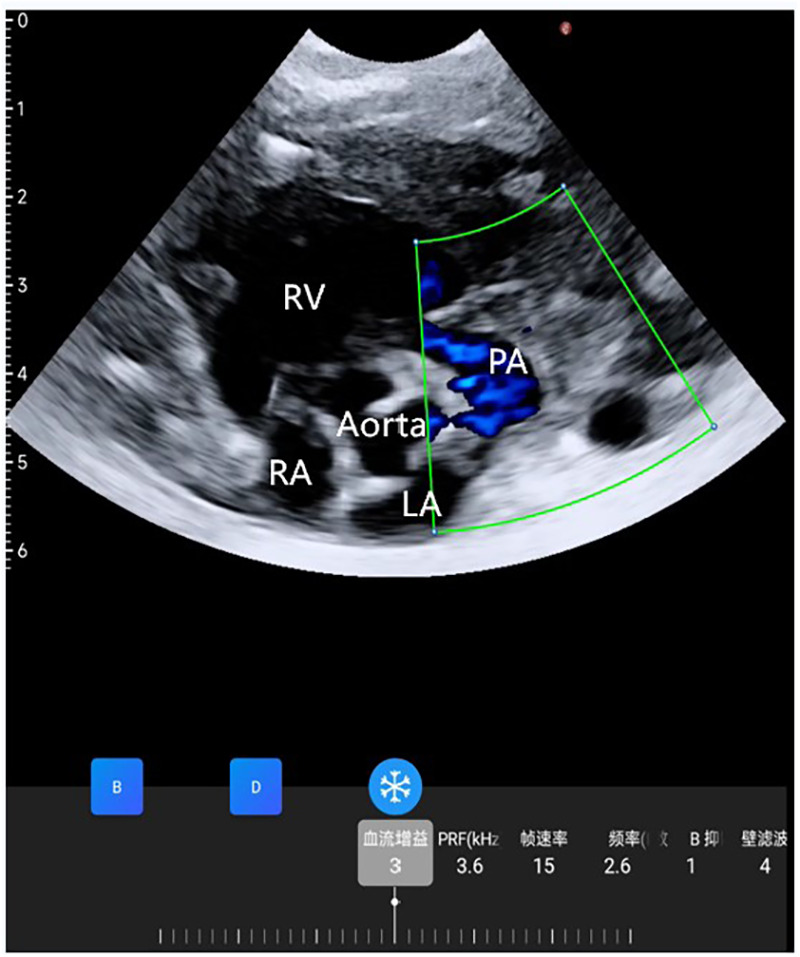
- Preoperative ultrasound showed a ~2.4 mm mid-atrial septal left-to-right shunt, a ~1.6 mm shunt between the descending aortic root and left pulmonary artery, and mild tricuspid regurgitation, suggesting PFO and PDA; no PDA shunt was detected during the wearable examination.
- After induction, vital signs were HR 130 beats/min, BP 58/40 mmHg, SPO2 92%, and monitoring showed slightly deficient left ventricular volume with normal contractility; based on this, 10 ml crystalloid was given and BP stabilized at 70/40 mmHg.
- Postoperatively in NICU, monitoring continued to guide fluid and circulation management; HR varied 130–150 beats/min with SPO2 above 94% (FiO2 40%), the endotracheal tube was removed on day 2, only mild tricuspid regurgitation remained on postoperative day 5, and the neonate was discharged on postoperative day 10.
Methods
- Design: single first-in-neonate case report.
- Case/data: one 3-day-old neonate admitted to NICU with hypoglycemia (blood glucose as low as 1.3 mmol/L) and gastrointestinal hemorrhage, treated with fasting, gastrointestinal decompression, intragastric hemostatic medication, and 40 ml cryoprecipitate transfusion before gastroscopy.
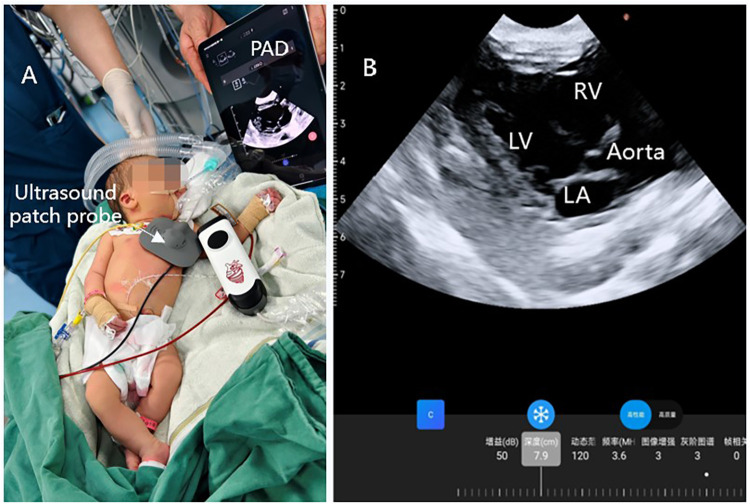
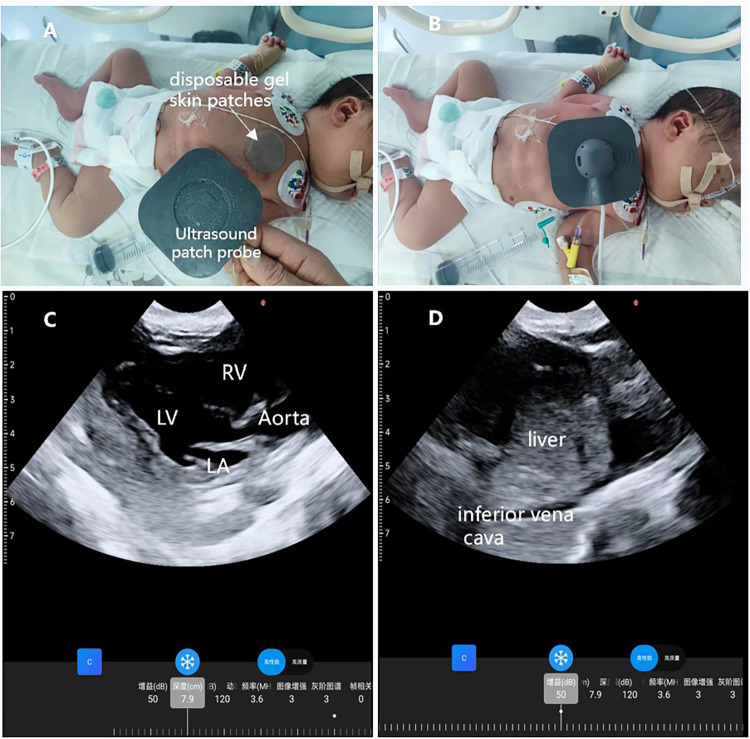
- Intervention/monitoring: a wearable ultrasound device (continuous phased array; model P2-5-64; 3.6-MHz center frequency, 64 array base, 0.32-mm array spacing) developed by Sichuan Wismed Medical Technology Co., Ltd., secured to the left anterior chest wall with disposable gel skin patches to obtain a parasternal long-axis view, with images wirelessly transmitted to terminal devices; anesthesia used 5 mg esketamine, 2 mg rocuronium bromide, and 3 mg propofol with endotracheal intubation.
Limitations
- The paper states no explicit limitations.
- Evident from the text: this is a single case (n=1) with no control or comparison group, so feasibility is demonstrated but efficacy, safety, and generalizability cannot be established.
- Evident from the text: the authors note the device was "not specifically designed for neonates," and the report relies on a single device model and operator-dependent image acquisition.
Model-written summary. Check it against the paper before relying on it.
Integrity signals
Registry
Cites
Statistics
Figures
Verification
Claims the paper makes
2 Valid · 0 Not valid · 11 Not checked · 18 Own results and interpretations
The cited sources support only part of this claim — read each source’s verdict below.
In the paper
“Echocardiography can easily and rapidly quantify ventricular function and size to guide circulation management (2)”
§ Innovative wearable technology for continuous echocardiographic monitoring: first-in-neonate case report > Introduction
What the sources say
- Partly supportedcites [2] Singh Y Tissot C Fraga MV Yousef N Cortes RG Lopez J International evidence-based guidelines on point of care ultrasound (POCUS) for critically ill neonates and children issued by the POCUS working group of the European society of paediatric and neonatal intensive care (ESPNIC). Crit Care. (2020) 24: 65. 10.1186/s13054-020-2787-9 32093763 PMC7041196 sourceExperimental — accuracy not yet measured
The Results section says cardiac POCUS can assess ventricular function semi-quantitatively in critically ill neonates and children and describes measures of ventricular dimensions. It does not establish that function and size can be easily and rapidly quantified; it specifies that detailed functional assessment requires advanced echocardiography training. Its discussion of filling and fluid responsiveness supports a role in circulation assessment, but is narrower than the claim. (LLM, conf=0.86)
plainstates a cause- Asserted: passes — The authors put it forward as true.
- Checkable: passes — It can be checked against evidence.
- Load-bearing: passes — The paper’s conclusions depend on it.
- Based: passes — The paper gives a reason why it holds.
- Partly supported
A result the paper reports from its own data — it cites no other source for it, so there is none to check. The quote shows it is in the paper.
In the paper
“No PDA shunt was detected during the examination (Figure 2).”
§ Innovative wearable technology for continuous echocardiographic monitoring: first-in-neonate case report > Case report
plainSingle case- Asserted: passes — The authors put it forward as true.
- Checkable: passes — It can be checked against evidence.
- Load-bearing: unclear — It is unclear whether the paper’s conclusions depend on it.
- Based: passes — The paper gives a reason why it holds.
A result the paper reports from its own data — it cites no other source for it, so there is none to check. The quote shows it is in the paper.
In the paper
“a shunt signal of approximately 1.6 mm in width between the descending aortic root and the left pulmonary artery”
§ Innovative wearable technology for continuous echocardiographic monitoring: first-in-neonate case report > Case report
plainSingle case- Asserted: passes — The authors put it forward as true.
- Checkable: passes — It can be checked against evidence.
- Load-bearing: unclear — It is unclear whether the paper’s conclusions depend on it.
- Based: passes — The paper gives a reason why it holds.
A result the paper reports from its own data — it cites no other source for it, so there is none to check. The quote shows it is in the paper.
In the paper
“a left-to-right shunt flow signal with a width of approximately 2.4 mm in the mid-portion of the atrial septum”
§ Innovative wearable technology for continuous echocardiographic monitoring: first-in-neonate case report > Case report
plainSingle case- Asserted: passes — The authors put it forward as true.
- Checkable: passes — It can be checked against evidence.
- Load-bearing: unclear — It is unclear whether the paper’s conclusions depend on it.
- Based: passes — The paper gives a reason why it holds.
In the paper
“Neonates and infants are the group of patients at highest risk for perioperative anesthetic complications”
§ Innovative wearable technology for continuous echocardiographic monitoring: first-in-neonate case report > Introduction
What the sources say
- Not checked — no full text of the sourcecites [1] Zielinska M Piotrowski A Vittinghoff M. Neonatal anaesthesia in Europe—is it time to create standards. Anaesth Crit Care Pain Med. (2022) 41: 101044. 10.1016/j.accpm.2022.101044 35192949 source
plain- Asserted: passes — The authors put it forward as true.
- Checkable: passes — It can be checked against evidence.
- Load-bearing: passes — The paper’s conclusions depend on it.
- Based: passes — The paper gives a reason why it holds.
6 more claims
Create a free account to see all 31 claims and every source verdict.
- Probably not a substantial claim. 13
- The quote only partly states this claim. 1
- It may state two separate claims as one. 7
Self-check
Percentages, sums and reported differences re-computed from the paper’s own numbers.
Each contradiction between two passages listed here was confirmed by an independent check.
Rated minor: it would not touch a result — a value no result rests on, a p-value that stays on the same side of the significance level, or a conflict that is clerical, resolved elsewhere in the paper, or outside its own findings.
In the paper
§ Innovative wearable technology for continuous echocardiographic monitoring: first-in-neonate case report > Discussion
“Xu et al. (8) reported a continuous, real-time wearable ultrasound patch for cardiac function assessment, which was validated in healthy volunteers.”
§ Innovative wearable technology for continuous echocardiographic monitoring: first-in-neonate case report > References
“8. Hu H Huang H Li M Gao X Yin L Qi R A wearable cardiac ultrasound imager.”
Citations
Cites
Singh, Y., Tissot, C., Fraga, M. V., Yousef, N., Cortes, R. G., Lopez, J., Sanchez-de-Toledo, J., Brierley, J., Colunga, J. M., Raffaj, D., et al. (2020) · Critical Care · doi:10.1186/s13054-020-2787-9 · Cited by 659
A wearable cardiac ultrasound imager
Hu, H., Huang, H., Li, M., Gao, X., Yin, L., Qi, R., Wu, R. S., Chen, X., Ma, Y., Shi, K., et al. (2023) · Nature · doi:10.1038/s41586-022-05498-z · Cited by 644 · cited 1×
“Xu et al. (8) reported a continuous, real-time wearable ultrasound patch for cardiac function assessment, which was validated in healthy volunteers.”
Anaesthetic considerations for surgery in newborns
Houck, C. S., & Vinson, A. E. (2017) · Archives of Disease in Childhood - Fetal and Neonatal Edition · doi:10.1136/archdischild-2016-311800 · Cited by 46
Hillier, S. C., Krishna, G., & Brasoveanu, E. (2004) · Seminars in Pediatric Surgery · doi:10.1053/j.sempedsurg.2004.04.002 · Cited by 32 · cited 1×
“…in the right-to-left shunt from the patent foramen ovale and the arterial ducts, which aggravates hypoxemia and hypotension and creates a vicious circle (4), or Wearable ultrasonic colour fl ow doppler examination between the aorta and pulmonary artery did not fi nd a PDA. even cardiac arrest.”
Anesthesia for major surgery in the neonate
Kuan, C. C., & Shaw, S. J. (2020) · Anesthesiology Clinics · doi:10.1016/j.anclin.2019.10.001 · Cited by 26
Preoperative cardiopulmonary evaluation in specific neonatal surgery
Petroze, R. T., & Puligandla, P. S. (2019) · Seminars in Pediatric Surgery · doi:10.1053/j.sempedsurg.2019.01.002 · Cited by 17
Bianzina, S., Singh, Y., Iacobelli, R., Amodeo, A., Guner, Y., & Di Nardo, M. (2024) · European Journal of Pediatrics · doi:10.1007/s00431-023-05386-2 · Cited by 8
Neonatal anaesthesia in Europe—is it time to create standards
Zielinska, M., Piotrowski, A., & Vittinghoff, M. (2022) · Anaesthesia Critical Care & Pain Medicine · doi:10.1016/j.accpm.2022.101044 · Cited by 4
Cited by
Zhao, J., Huang, Y., Zhang, Y., Xie, Y., Wei, G., Li, Y., & Wang, S. (2026) · Bioengineering · doi:10.3390/bioengineering13030345 · Cited by 7
“For example, Wang et al. [78] reported the first application of a wearable ultrasound device for continuous, non-invasive bedside cardiac monitoring in a neonate during perioperative management.”
Esketamine/propofol/rocuronium-bromide
(2025) · Reactions Weekly · doi:10.1007/s40278-025-83737-9
Wearable ultrasound monitoring in minimally invasive cardiac surgery: A case report
Zhang, P., Luo, X., Shao, Z., Liang, G., Fu, J., & Song, H. (2025) · JCA advances. · doi:10.1016/j.jcadva.2025.100168 · Cited by 1
Self-citationPeng, H., Ou, J., Huang, W. Y., Wen, J., Jiang, Y., Xianping, W., & Chen, M. (2026) · Frontiers in Medicine · doi:10.3389/fmed.2026.1895920
Li, J., & Wan, Q. (2026) · Information & Functional Materials · doi:10.1002/ifm2.70025
Metadata
- Authors
- Wang, Y., Wu, G., Song, J., Song, H., & Chu, Q.
- Affiliations
- Zhengzhou University (CN)
- West China Hospital of Sichuan University (CN)
- Corresponding author
- Chu, Qinjun
- Venue
- Frontiers in Pediatrics
- Publisher
- Frontiers Media SA
- Published
- 2025-04-15
- Volume
- 13
- Pages
- 1567386-1567386
- ISSN
- 2296-2360 (ISSN-L)
- PMC
- PMC12037362
- OpenAlex
- W4409469021
- Semantic Scholar
- ba0d3893707436207eee9daddf459fbf71ea848e
- Cited by
- 8
- References
- 8
- Citations by year
- 2026: 6 · 2025: 2
- FWCI
- 7.46
- Type
- journal article
- Language
- en
- Open access
- gold
- doi.org
- Licence
- Locations
- Frontiers in Pediatrics (publishedVersion, cc-by)
- PubMed Central (publishedVersion, cc-by)
- PubMed (publishedVersion)
- DOAJ (DOAJ: Directory of Open Access Journals) (submittedVersion, cc-by-sa)
- Topics
- Health Sciences › Medicine › Surgery › Hemodynamic Monitoring and Therapy
- Health Sciences › Medicine › Critical Care and Intensive Care Medicine › Ultrasound in Clinical Applications
- Health Sciences › Medicine › Cardiology and Cardiovascular Medicine › Congenital Heart Disease Studies
- Keywords
- wearable ultrasound device, neonates, upper gastrointestinal bleeding, esophageal ulcer, gastric ulcer, perioperative hemodynamic management, neonatal intensive care
About these checks
Registry, retraction, Cites and statistics results are computed, not judged, with one exception: a printed reference that no index lists is read once by a model before it counts as a citation error. Claims are extracted by a model and kept only when their quote appears verbatim in the text; each cited source is then checked, with a model’s help, for whether it says what the claim relies on. Those verdicts can be wrong — read the claim’s quote and the cited source before relying on one.
The claim verdicts this report counts are experimental: their accuracy is not yet measured.
A language model drew the claims from the paper on 2026-10-10, under version 3 of the claim definition (model deepseek-v4.1-flash, prompt extract-v3).
A second model labelled each claim on 2026-10-10 (model jev-1.13-20260917, definition revision gold-guideline-v0.2).
Cited sources are checked with a language model’s help (gpt-6-sol).
Statistics and arithmetic are recomputed, not judged.
Confidence bands are shown only for fields calibrated on our annotated test set. None is calibrated yet, so no band is shown.
What counts as a claim ›How we measure confidence ›How we check this ›
Are you an author, or do you see a problem with this page? Request a review
How to cite
Cite CoChat for the checks on this page, and the paper for its own findings.
- This page
- CoChat. (2026). Citation check: Innovative wearable technology for continuous echocardiographic monitoring: first-in-neonate case report. https://app.cochat.ai/papers/10.3389/fped.2025.1567386
- The paper
- Wang, Y., Wu, G., Song, J., Song, H., & Chu, Q. (2025). Innovative wearable technology for continuous echocardiographic monitoring: first-in-neonate case report. Frontiers in Pediatrics. https://doi.org/10.3389/fped.2025.1567386
Data sources
Bibliographic data: Semantic Scholar, OpenAlex, Crossref.
Contains information from the Semantic Scholar Academic Graph Datasets, made available under the ODC Attribution License (ODC-BY 1.0).
Semantic Scholar’s data is described in: Kinney, R., et al. (2023). The Semantic Scholar Open Data Platform. arXiv:2301.10140.
