

The DOI matches its Crossref record; 2 of the 2 references it cites were found in a registry or an index.
School climate's effect on hospitality department students' aesthetic experience, professional identity and innovative behavior
Open accessAbstract
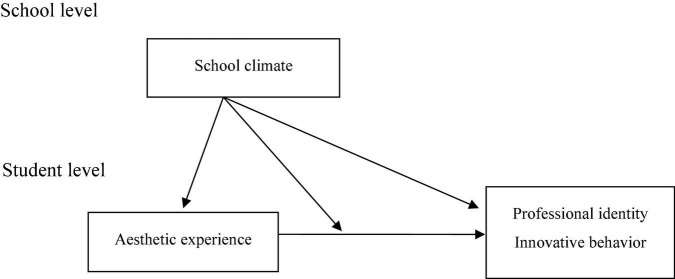
This study investigated the effects of school climate and students’ aesthetic experience on their professional identity and innovative behavior. A survey was conducted with 385 students from hospitality-related departments of colleges and universities in Hainan, China, and the data were analyzed using a hierarchical linear model (HLM). Using the criteria constituting the students’ aesthetic experience scale proposed by Chang, it was found that teacher support can improve students’ professional identity; school climate and students’ understanding of beauty and full experience contribute to the development of students’ innovative behavior; students’ understanding of beauty and full experience have mediating effects between teacher support and professional cognition; students’ understanding of beauty and full experience have mediating effects between student support and innovative behavior; student support positively moderates the relationships between full experience with professional cognition and students’ appraisal of the hospitality industry; and teacher support positively moderates the relationship between students’ full experience and professional emotion. Therefore, teacher support under school climate and students’ understanding of beauty and full experience under aesthetic experience were the most important factors in enhancing hospitality department students’ professional identity and innovative behavior.
Overview
The claims and statistics of this paper haven’t been checked yet.
Run the check — free, no account needed. It reads the open-access text and checks the sources it cites.
Integrity signals
Registry
Cites
Statistics
Figures
Verification
Claims the paper makes
The claims and statistics of this paper haven’t been checked yet.
Run the check — free, no account needed. It reads the open-access text and checks the sources it cites.
Claims other papers make about this one
Each is checked against this paper’s own text: does it say what the citing paper says it does?
The source backs part of the claim, not all of it — or backs it for a different population, condition or comparison.
In the citing paper
“Individuals with stronger PI tend to demonstrate greater role commitment and professional engagement, which increases their willingness to propose and implement new ideas in practice (Lin and Chang, 2022).”
From AI teaching innovation behavior among college teachers: a structural equation modeling analysis based on the AI-TPACK framework, teaching self-efficacy, professional identity, and AI literacy (2026) · cites this paper as Lin and Chang, 2022
Experimental — accuracy not yet measuredThe check wasn’t confident either way, so it gives no verdict — never disputed.
In the citing paper
“Although few studies have directly examined the link between PI and TIB among teachers, research in broader organizational contexts has consistently shown that PI relates to individual innovative behavior (Lin and Chang, 2022; Zhu et al., 2025).”
From AI teaching innovation behavior among college teachers: a structural equation modeling analysis based on the AI-TPACK framework, teaching self-efficacy, professional identity, and AI literacy (2026) · cites this paper as Lin and Chang, 2022
Experimental — accuracy not yet measuredThe check wasn’t confident either way, so it gives no verdict — never disputed.
In the citing paper
“When teachers possess strong integrative competence and internalize it as part of their professional self-concept—such as viewing themselves as educators capable of leading instructional change in the GenAI era—innovative behavior becomes more sustained (Lin and Chang, 2022).”
From AI teaching innovation behavior among college teachers: a structural equation modeling analysis based on the AI-TPACK framework, teaching self-efficacy, professional identity, and AI literacy (2026) · cites this paper as Lin and Chang, 2022
Experimental — accuracy not yet measured
Self-check
Percentages, sums and reported differences re-computed from the paper’s own numbers.
The self-check needs the paper’s full text.
Citations
Cites
Cruess, R. L., Cruess, S. R., Boudreau, J. D., Snell, L., & Steinert, Y. (2015) · Academic Medicine · doi:10.1097/acm.0000000000000700 · Cited by 1,038
Marković, S. (2012) · i-Perception · doi:10.1068/i0450aap · Cited by 346
Research works printed but not linked: 69
- Adams, 2006, Innovation management measurement: A review., Int. J. Manag. Rev., 8, 21, 10.1111/j.1468-2370.2006.00119.x · DOI
- 2021, State of the hotel industry 2021.
- Bammens, 2016, Employees’ innovative behavior in social context: A closer examination of the role of organizational care., J. Prod. Innov. Manag., 33, 244, 10.1111/jpim.12267 · DOI
- Bentler, 1995, EQS/Windows user’s guide.
- Bizumic, 2009, The role of the group in individual functioning: School identification and the psychological well-being of staff and students., Appl. Psychol., 58, 171, 10.1111/j.1464-0597.2008.00387.x · DOI
- Blue, 2011, Beginning the socialization to a new workforce model: Dental students’ preliminary knowledge of and attitudes about the role of the dental therapist., J. Dent. Educ., 75, 1465, 10.1002/j.0022-0337.2011.75.11.tb05204.x · DOI
- Brand, 2008, A large scale study of the assessment of the social environment of middle and secondary schools: The validity and utility of teachers’ ratings of school climate, cultural pluralism, and safety problems for understanding school effects and school improvement., J. Sch. Psychol., 46, 507, 10.1016/j.jsp.2007.12.001 · DOI
- Brand, 2003, Middle school improvement and reform: Development and validation of a school-level assessment of climate, cultural pluralism, and school safety., J. Educ. Psychol., 95, 570, 10.1037/0022-0663.95.3.570 · DOI
- Caiman, 2021, Aesthetic experience and imagination in early elementary school science – a growth of ‘Science–Art–Language–Game’., Int. J. Sci. Educ., 44, 833, 10.1080/09500693.2021.1976435 · DOI
- Chang, 2012, The effect of organization’s innovational climate on student’s creative self-efficacy and innovative behavior., Bus. Entrepr. J., 1, 75
- Chang, 2017, Construction on students’ aesthetics experience scale., Int. J. Organ. Innov., 10, 110
- Chang, 2018, Analyzing the moderating effect of knowledge innovation of tourism and hospitality department teachers on student creative self-efficacy and innovation behaviors by using hierarchical linear modeling., Cogent Educ., 5, 10.1080/2331186X.2018.1535755 · DOI
- Chang, 2021, Differences in the influence of aesthetic experience on the innovative behaviors of Thai students and Chinese international students., J. Appl. Res. High. Educ., 13, 900, 10.1108/JARHE-05-2020-0133 · DOI
- Colarossi, 2003, Differential effects of support providers on adolescents’ mental health., Soc. Work Res., 27, 19, 10.1093/swr/27.1.19 · DOI
- Craighead, 2011, Addressing common method variance: Guidelines for survey research on information technology, operations, and supply chain management., IEEE Trans. Eng. Manag., 58, 578, 10.1109/TEM.2011.2136437 · DOI
- Cropley, 1994, Creative intelligence: A concept of true giftedness., Eur. J. High Ability, 5, 6, 10.1080/0937445940050102 · DOI
- D’Olimpio, 2021, Defending aesthetic education., Br. J. Educ. Stud., 7, 263, 10.1080/00071005.2021.1960267 · DOI
- Dangmei, 2017, Organizational aesthetics and its implications for managing human resources at workplace., Asian J. Res. Bus. Econ. Manag., 7, 151, 10.5958/2249-7307.2017.00021.4 · DOI
- Davies, 2009, A companion to aesthetics., 10.1002/9781444310436 · DOI
- Dubar, 1991, La socialisation. construction des identités sociales et professionnelles.
- Dzhandzhugazova, 2016, Innovations in Hospitality Industry.”., Innov. Hosp. Ind., 11, 10387
- Eaton, 2001, Merit, aesthetic and ethical., 10.1093/oso/9780195140248.001.0001 · DOI
- Eco, 2007, On ugliness.
- Ferrucci, 2010, Beauty and the Soul: The Extraordinary power of everyday beauty to heal your life.
- Fingerhut, 2021, The aesthetic self. the importance of aesthetic taste in music and art for our perceived identity., Front. Psychol., 11, 10.3389/fpsyg.2020.577703 · DOI
- Fornell, 1981, Evaluating structural equation models with unobservable variables and measurement error., J. Mark. Res., 18, 39, 10.2307/3151312 · DOI · Paper page
- Garrison, 2001, Critical thinking, cognitive presence, and computer conferencing in distance education., Am. J. Distance Educ., 15, 7, 10.1080/08923640109527071 · DOI · Paper page
- Garrison, 1997, Dewey and Eros: Wisdom and desire in the art of teaching.
- Girod, 2002, An aesthetic (Deweyan) perspective on science learning: Case studies of three fourth graders., Element. Sch. J., 102, 199, 10.1086/499700 · DOI
- Gorshunova, 2014, The significance of high school teacher’s creativity for innovative pedagogical practice., J. Int. Sci. Public., 12, 607
- Gurnon, 2013, Integrating art and science in undergraduate education., PLoS Biol., 11, 10.1371/journal.pbio.1001491 · DOI
- Hair, 1998, Multivariate data analysi
- Hansen, 2007, Aesthetic leadership., Leadersh. Q., 18, 544, 10.1016/j.leaqua.2007.09.003 · DOI
- Haynes, 1997, School climate as a factor in student adjustment and achievement., J. Educ. Psychol. Consult., 8, 321, 10.1207/s1532768xjepc0803_4 · DOI
- Henkel, 2005, Academic identity and autonomy in a changing policy environment., High. Educ., 49, 155, 10.1007/1-4020-3504-7_10 · DOI
- Hunter, 2007, Climate for creativity: A quantitative review., Creat. Res. J., 19, 69, 10.1080/10400410709336883 · DOI
- James, 2015, Despite the terrors of typologies: The importance of understanding categories of difference and identity., Int. J. Postcolon. Stud, 17, 174, 10.1080/1369801X.2014.993332 · DOI
- Jia, 2009, The influence of student perceptions of school climate on socioemotional and academic adjustment: A comparison of Chinese and American adolescents., Child Dev., 80, 1514, 10.1111/j.1467-8624.2009.01348.x · DOI
- Joshi, 2021, Assessing the impact of the COVID-19 pandemic on hospitality and tourism education in India and preparing for the new normal., Worldwide Hosp. Tour. Themes, 13, 622, 10.1108/WHATT-05-2021-0068 · DOI
- Kark, 2003, The two faces of transformational leadership: Dependence and empowerment., J. Appl. Psychol., 88, 246, 10.1037/0021-9010.88.2.246 · DOI
- Kearney, 2009, When and how diversity benefits teams: The importance of team members’ need for cognition., Acad. Manag. J., 52, 581, 10.5465/amj.2009.41331431 · DOI · Paper page
- Kleebbua, 2021, Learning climate for enhancing innovative behavior in thai higher education., J. Behav. Sci., 16, 45
- Kleysen, 2001, Toward a multidimensional measure of individual innovative behavior., J. Intell. Cap., 2, 284, 10.1108/EUM0000000005660 · DOI · Paper page
- Leder, 2004, A model of aesthetic appreciation and aesthetic judgments., Br. J. Psychol., 95, 489, 10.1348/0007126042369811 · DOI · Paper page
- Loukas, 2007, What was school climate?, Leadersh. Compass, 5, 1
- Loukas, 2006, Examining school connectedness as a mediator of school climate effects., J. Res. Adolesc., 16, 491, 10.1111/j.1532-7795.2006.00504.x · DOI
- Lussier, 2010, Aesthetic literacy: The gold medal standard of learning excellence in dance., Phys. Health Educ. J., 76, 40
- Maitlis, 2013, Sensemaking and emotion in organizations., Organ. Psychol. Rev., 3, 222, 10.1177/2041386613489062 · DOI
- Maquet, 1986, The aesthetic experience: An anthropologist looks at the visual arts.
- Marhuenda, 2004, Conflicting vocational identities and careers in the sector of tourism., Career Dev. Int., 9, 222, 10.1108/13620430410535832 · DOI
- Maxwell, 2017, The impact of school climate and school identification on academic achievement: Multilevel modeling with student and teacher Data., Front. Psychol., 8, 10.3389/fpsyg.2017.02069 · DOI
- Petrie, 2014, The relationship between school climate and student bullying., TEACH J. Christ. Educ., 8, 26, 10.55254/1835-1492.1237 · DOI
- Raudenbush, 2002, Hierarchical linear models: Applications and data analysis methods
- Reynolds, 2017, How does school climate impact academic achievement? An examination of social identity processes., Sch. Psychol. Int., 38, 78, 10.1177/0143034316682295 · DOI
- Sabanciogullari, 2015, Relationship between job satisfaction, professional identity and intention to leave the profession among nurses in Turkey., J. Nurs. Manag., 23, 1076, 10.1111/jonm.12256 · DOI
- Saito, 2017, Aesthetics of the familiar: Everyday life and world-making.
- Schellekens, 2009, Taste and Objectivity: The emergence of the concept of the aesthetic., Philos. Compass, 4, 734, 10.1111/j.1747-9991.2009.00234.x · DOI
- Scott, 1994, Determinants of innovative behavior: A path model of individual innovation in the workplace., Acad. Manag. J., 37, 580, 10.2307/256701 · DOI · Paper page
- Shalley, 2004, The effects of personal and contextual characteristics on creativity: Where should we go from here?, J. Manag., 30, 933, 10.1016/j.jm.2004.06.007 · DOI · Paper page
- Steinart, 2007, Faculty Development as an Instrument of Change: A case study in teaching professionalism., Acad. Med., 82, 1057, 10.1097/01.ACM.0000285346.87708.67 · DOI
- Tajfel, 1971, Social comparison and social change: Studies in intergroup behavior.
- 2021, COVID-19 and tourism 2020: A year in review.
- Tierney, 2011, Creative self-efficacy development and creative performance over time., J. Appl. Psychol., 96, 277, 10.1037/a0020952 · DOI
- Webster, 2013, Incorporating the aesthetic dimension into pedagogy., Austr. J. Teach. Educ., 38, 21, 10.14221/ajte.2013v38n10.2 · DOI
- Wiles, 2013, Not easily put into a box: Constructing professional identity., Soc. Work Educ., 32, 854, 10.1080/02615479.2012.705273 · DOI
- Xenakis, 2014, Aesthetic perception and its minimal content: A naturalistic perspective., Front. Psychol., 5, 10.3389/fpsyg.2014.01038 · DOI
- Yu, 2018, Aesthetic experience anchors ego identity formation., Sustainability, 10, 10.3390/su10082596 · DOI
- Yu, 2021, Understanding the impacts of chinese undergraduate tourism students’. Professional identity on learning engagement., Sustainability, 13, 10.3390/su132313379 · DOI
- Zaitseva, 2013, Management in service industry: Tourism and hospitality.
Cited by
Sorted by citations
Bai, X., & Hsieh, T.-S. (2026) · Frontiers in Psychology · doi:10.3389/fpsyg.2026.1834827
“These results align with prior research (Huang et al., 2025; Lin and Chang, 2022; Wang et al., 2023).”
Influential
Metadata
- Authors
- Lin, W., & Chang, Y.-C.
- Affiliations
- Hainan Vocational University of Science and Technology (CN)
- Dhurakij Pundit University (TH)
- Corresponding author
- Chang, Yuan-Cheng
- ORCID
- Chang, Yuan-Cheng
- Venue
- Frontiers in Psychology
- Publisher
- Frontiers Media SA
- Published
- 2022-12-05
- Volume
- 13
- Pages
- 1059572-1059572
- ISSN
- 1664-1078 (ISSN-L)
- PMC
- PMC9760794
- OpenAlex
- W4311630007
- Cited by
- 8
- References
- 2
- Citations by year
- 2026: 3 · 2025: 2 · 2024: 2 · 2023: 1
- FWCI
- 2.05
- Type
- journal article
- Language
- en
- Open access
- gold
- doi.org
- Licence
- Locations
- Frontiers in Psychology (publishedVersion, cc-by)
- PubMed Central (publishedVersion, cc-by)
- PubMed (publishedVersion)
- DOAJ (DOAJ: Directory of Open Access Journals) (submittedVersion, cc-by-sa)
- Topics
- Social Sciences › Business, Management and Accounting › Tourism, Leisure and Hospitality Management › Hospitality and Tourism Education
- Social Sciences › Business, Management and Accounting › Organizational Behavior and Human Resource Management › Job Satisfaction and Organizational Behavior
- Social Sciences › Psychology › Applied Psychology › Career Development and Diversity
- Keywords
- school climate, aesthetic experience, professional identity, innovative behavior, hospitality students, teacher support, student support, professional cognition, professional emotions, mediating effect, moderating effect
About these checks
Registry, retraction, Cites and statistics results are computed, not judged, with one exception: a printed reference that no index lists is read once by a model before it counts as a citation error. Claims are extracted by a model and kept only when their quote appears verbatim in the text; each cited source is then checked, with a model’s help, for whether it says what the claim relies on. Those verdicts can be wrong — read the claim’s quote and the cited source before relying on one.
Statistics and arithmetic are recomputed, not judged.
Confidence bands are shown only for fields calibrated on our annotated test set. None is calibrated yet, so no band is shown.
What counts as a claim ›How we measure confidence ›How we check this ›
Are you an author, or do you see a problem with this page? Request a review
How to cite
Cite CoChat for the checks on this page, and the paper for its own findings.
- This page
- CoChat. (2026). Citation check: School climate's effect on hospitality department students' aesthetic experience, professional identity and innovative behavior. https://app.cochat.ai/papers/10.3389/fpsyg.2022.1059572
- The paper
- Lin, W., & Chang, Y.-C. (2022). School climate's effect on hospitality department students' aesthetic experience, professional identity and innovative behavior. Frontiers in Psychology. https://doi.org/10.3389/fpsyg.2022.1059572
