

Multimodal data integration for oncology in the era of deep neural networks: a review
Open accessThe DOI matches its Crossref record; 212 of the 212 references it cites were found in a registry or an index.
Abstract
Cancer research encompasses data across various scales, modalities, and resolutions, from screening and diagnostic imaging to digitized histopathology slides to various types of molecular data and clinical records. The integration of these diverse data types for personalized cancer care and predictive modeling holds the promise of enhancing the accuracy and reliability of cancer screening, diagnosis, and treatment. Traditional analytical methods, which often focus on isolated or unimodal information, fall short of capturing the complex and heterogeneous nature of cancer data. The advent of deep neural networks has spurred the development of sophisticated multimodal data fusion techniques capable of extracting and synthesizing information from disparate sources. Among these, Graph Neural Networks (GNNs) and Transformers have emerged as powerful tools for multimodal learning, demonstrating significant success. This review presents the foundational principles of multimodal learning including oncology data modalities, taxonomy of multimodal learning, and fusion strategies. We delve into the recent advancements in GNNs and Transformers for the fusion of multimodal data in oncology, spotlighting key studies and their pivotal findings. We discuss the unique challenges of multimodal learning, such as data heterogeneity and integration complexities, alongside the opportunities it presents for a more nuanced and comprehensive understanding of cancer. Finally, we present some of the latest comprehensive multimodal pan-cancer data sources. By surveying the landscape of multimodal data integration in oncology, our goal is to underline the transformative potential of multimodal GNNs and Transformers. Through technological advancements and the methodological innovations presented in this review, we aim to chart a course for future research in this promising field. This review may be the first that highlights the current state of multimodal modeling applications in cancer using GNNs and transformers, presents comprehensive multimodal oncology data sources, and sets the stage for multimodal evolution, encouraging further exploration and development in personalized cancer care.
Overview
The claims and statistics of this paper haven’t been checked yet.
Free: it reads the open-access text and checks the first 5 claims that cite a source we can check. Create a free account to check every claim.
Integrity signals
Registry
Cites
Statistics
Figures
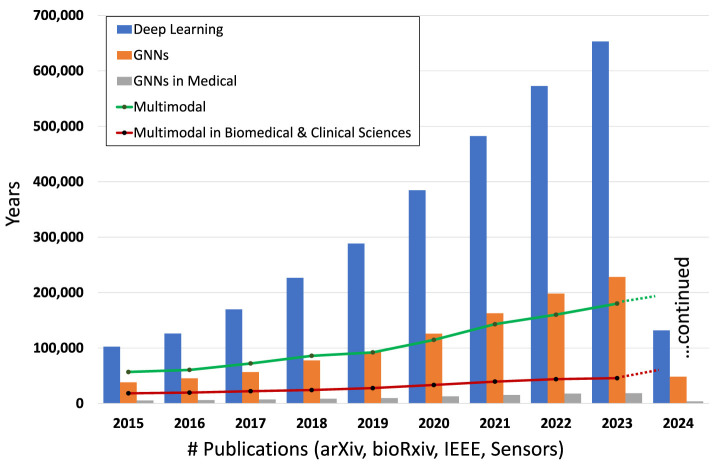
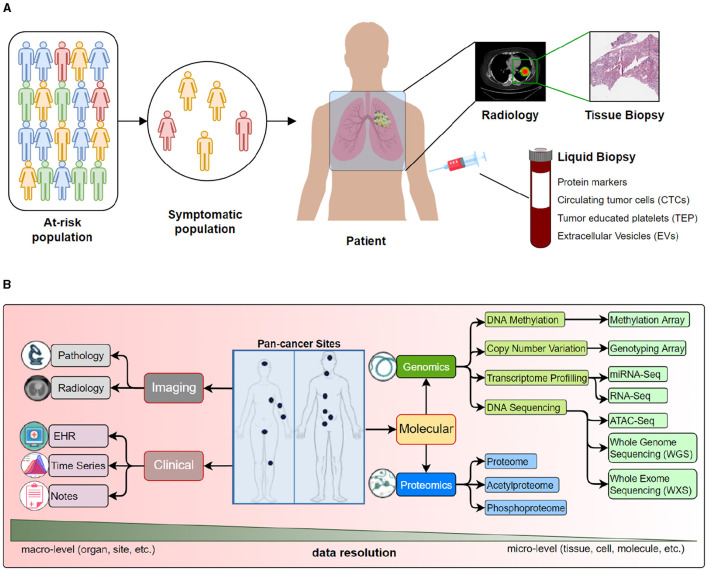
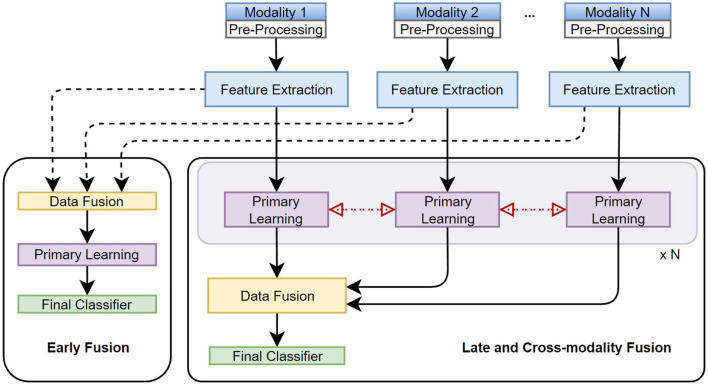
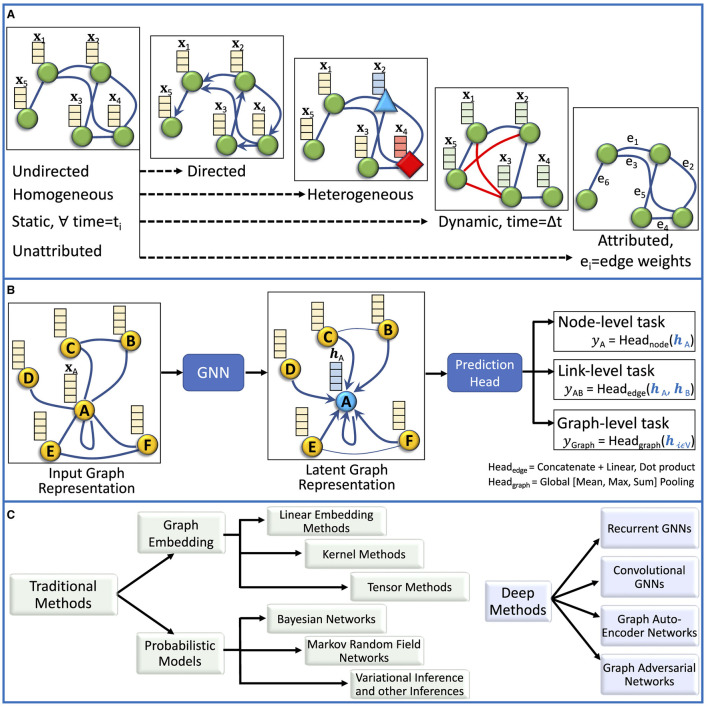
Verification
Claims the paper makes
The claims and statistics of this paper haven’t been checked yet.
Free: it reads the open-access text and checks the first 5 claims that cite a source we can check. Create a free account to check every claim.
Self-check
Percentages, sums and reported differences re-computed from the paper’s own numbers.
The self-check needs the paper’s full text.
Citations
Cites
Items 201–212 of 212
Graph Contrastive Learning for Multi-omics DataPreprint
Rajadhyaksha, N., & Chitkara, A. (2023) · arXiv (Cornell University) · doi:10.48550/arxiv.2301.02242 · Cited by 3 · cited 3×
“Learner(MOGCL) [157] uses graph structure and contrastive learning information to generate representations for improved downstream classification tasks on the breast cancer multi-omics dataset.”
BackgroundMethodInfluentialEditorial: AI applications for diagnosis of breast cancer
Muhammad, L. J., & Bria, A. (2023) · Frontiers in Artificial Intelligence · doi:10.3389/frai.2023.1247261 · Cited by 3
Tripathi, A. G., Waqas, A., Schabath, M. B., Yılmaz, Y., & Rasool, G. (2024) · arXiv (Cornell University) · doi:10.48550/arxiv.2405.07460 · Cited by 3
Self-citationDevelopment and Application of Matrix Variate Restricted Boltzmann Machine
Qi, G., Sun, Y., Li, M., & Hou, X. (2020) · IEEE Access · doi:10.1109/access.2020.3012603 · Cited by 2 · cited 3×
“Large amounts of high-quality data Thomee et al., 2016; Sun et al., 2017; Lipkova et al., 2022; Ektefaie et al., 2023 Data registration and alignment Liang P. P. et al., 2022; Zhao et al., 2023 Pan-cancer generalization and transference Wei et al., 2020; Liang P. P. et al., 2022 Missing data samples and modalities Mir…”
BackgroundMethodFracastoro, G., & Valsesia, D. (2021) · Wiley eBooks · doi:10.1002/9781119850830.ch3 · Cited by 2
Tripathi, A. G., Waqas, A., Yılmaz, Y., & Rasool, G. (2024) · Cancer Research · doi:10.1158/1538-7445.am2024-4905 · Cited by 2 · cited 1×
“Self-supervised learning methods, such as BERT (Bidirectional Encoder Representations from Transformers) and GPT (Generative Pre-trained Transformer), use the structure of training data itself for supervision, enabling tasks like predicting patient outcomes or understanding the progression of…”
MethodSelf-citationSelf-Normalizing Foundation Model for Enhanced Multi-Omics Data Analysis in OncologyPreprint
Waqas, A., Tripathi, A. G., Ahmed, S., et al. (2024) · arXiv (Cornell University) · doi:10.48550/arxiv.2405.08226 · Cited by 2 · cited 1×
“Efforts toward integrating molecular data resulted in the multi-omics research field (Waqas et al., 2024a).”
BackgroundSelf-citationGenomic Data Analysis with Variant of Secure Multi-Party Computation Technique
Yogi, M. K., & Mundru, Y. (2024) · Journal of Trends in Computer Science and Smart Technology · doi:10.36548/jtcsst.2023.4.006 · Cited by 1
Artificial neural network-assisted prediction of radiobiological indices in head and neck cancer
Ahmed, S. B. S., Naeem, S., Khan, A. M. H., Qureshi, B. M., Hussain, A., Aydogan, B., & Muhammad, W. (2024) · Frontiers in Artificial Intelligence · doi:10.3389/frai.2024.1329737 · Cited by 1
Chen, T., Wang, Z., Li, L., Li, D., Li, Z., Chang, X., Bian, P., Liang, G., Wang, Q., & Xie, T. (2025) · Schloss Dagstuhl – Leibniz-Zentrum für Informatik · doi:10.4230/lipics.ecoop.2025.6
OpenAI, Achiam, J., Adler, S., Agarwal, S., Ahmad, L., Akkaya, I., Aleman, F. L., Almeida, D., Altenschmidt, J., Altman, S., et al. (2023) · arXiv · doi:10.48550/arxiv.2303.08774 · cited 3×
“As the volume of oncology data continues to grow, DL stands at the forefront of this field, enhancing our understanding of cancer, improving diagnostic precision, predicting clinical outcomes, and paving the way for innovative treatments.”
BackgroundInfluentialBLOOM: A 176B-Parameter Open-Access Multilingual Language Model
Workshop, B., :, Scao, T. L., Fan, A., Akiki, C., Pavlick, E., Ilić, S., Hesslow, D., Castagné, R., Luccioni, A. S., et al. (2022) · arXiv · doi:10.48550/arxiv.2211.05100 · cited 2×
“Pre-training Transformers on large amounts of data, using unsupervised or self-supervised learning, and then fine-tuning for specific downstream tasks, has led to the development of foundation models (Boehm et al., 2021), such as BERT (Devlin et al., 2019), GPT (Radford et al., 2018), RoBERTa (Zhuang et al., 2021), CLIP…”
Method
Research works printed but not linked: 7
- Akter M. Moustafa N. Lynar T. (2022). “Edge intelligence-based privacy protection framework for iot-based smart healthcare systems,”? in IEEE INFOCOM 2022-IEEE Conference on Computer Communications Workshops (INFOCOM WKSHPS) (New York, NY: IEEE), 1– 8.
- Alayrac J.-B. Donahue J. Luc P. Miech A. Barr I. Hasson Y.. (2022). Flamingo: a visual language model for few-shot learning. Adv. Neural Inf. Process. Syst. 35, 23716– 23736. Available online at: https://proceedings.neurips.cc/paper_files/paper/2022/hash/960a172bc7fbf0177ccccbb411a7d800-Abstract-Conference.html
- Al-jabery K. K. Obafemi-Ajayi T. Olbricht G. R. Wunsch I. I. D. C. (2020). “Data preprocessing,”? in K. K. Al-jabery, T. Obafemi-Ajayi, G. R. Olbricht and D. C. Wunsch Computational Learning Approaches to Data Analytics in Biomedical Applications (Cambridge, MA: Academic Press), 7– 27.
- Defferrard M. Bresson X. Vandergheynst P. (2016). Convolutional neural networks on graphs with fast localized spectral filtering. Adv. Neural Inf. Process. Syst. 29, 3844– 3852. Available online at: https://proceedings.neurips.cc/paper_files/paper/2016/file/04df4d434d481c5bb723be1b6df1ee65-Paper.pdf
- Jaegle A. Borgeaud S. Alayrac J.-B. Doersch C. Ionescu C. Ding D.. (2021). Perceiver IO: A General Architecture for Structured Inputs &; Outputs (ICLR).
- Ma L. Yang Z. Miao Y. Xue J. Wu M. Zhou L.. (2019). “NeuGraph: parallel deep neural network computation on large graphs,” in USENIX Annual Technical Conference (USENIX), 443– 458.
- Remmer E. (2022). Explainability Methods for Transformer-based Artificial Neural Networks: a Comparative Analysis (PhD thesis).
Cited by
Transformers in Time-Series Analysis: A Tutorial
Ahmed, S., Nielsen, I. E., Tripathi, A., Siddiqui, S., Ramachandran, R. P., & Rasool, G. (2023) · Circuits, Systems, and Signal Processing · doi:10.1007/s00034-023-02454-8 · Cited by 305
“Apart from classical NLP tasks, examples from other areas include image classification [3], object detection and segmentation [4], image and language generation [5], sequential decision-making in reinforcement learning [6], multi-modal (text, speech, and image) data processing [7], and analysis of tabular and time-ser…”
BackgroundSelf-citationVision-language models for medical report generation and visual question answering: a review
Hartsock, I., & Rasool, G. (2024) · Frontiers in Artificial Intelligence · doi:10.3389/frai.2024.1430984 · Cited by 229
Self-citationDeep learning–driven multi-omics analysis: enhancing cancer diagnostics and therapeutics
Zhang, J., Che, Y., Liu, R., Wang, Z., & Liu, W. (2025) · Briefings in Bioinformatics · doi:10.1093/bib/bbaf440 · Cited by 112
“Data integration strategies can be categorized into early, mid, and late integration [23].”
Artificial Intelligence in Head and Neck Cancer: Innovations, Applications, and Future Directions
Pham, T. D., Teh, M., Chatzopoulou, D., Holmes, S., & Coulthard, P. (2024) · Current Oncology · doi:10.3390/curroncol31090389 · Cited by 89
“The integration of multimodal data is an emerging trend that leverages AI to combine various types of data for a comprehensive understanding of HNC [38,106,246].”
BackgroundA Comprehensive Review of Multimodal Deep Learning for Enhanced Medical Diagnostics
Al‐Zoghby, A. M., Ebada, A. I., Saleh, A. S., Abdelhay, M., & Awad, W. A. (2025) · Computers, materials & continua/Computers, materials & continua (Print) · doi:10.32604/cmc.2025.065571 · Cited by 90
Metadata
- Authors
- Waqas, A., Tripathi, A., Ramachandran, R. P., Stewart, P. A., & Rasool, G.
- Affiliations
- Moffitt Cancer Center (US)
- Rowan University (US)
- Corresponding author
- Waqas, Asim
- Venue
- Frontiers in Artificial Intelligence
- Publisher
- Frontiers Media SA
- Published
- 2024-07-25
- Volume
- 7
- Pages
- 1408843-1408843
- ISSN
- 2624-8212 (ISSN-L)
- PMC
- PMC11308435
- OpenAlex
- W4400981456
- Cited by
- 165
- References
- 206
- Citations by year
- 2026: 81 · 2025: 70 · 2024: 12
- FWCI
- 5.72
- Type
- journal article
- Language
- en
- Open access
- gold
- doi.org
- Licence
- Locations
- Frontiers in Artificial Intelligence (publishedVersion, cc-by)
- PubMed Central (publishedVersion, cc-by)
- PubMed (publishedVersion)
- arXiv (Cornell University) (submittedVersion, cc-by)
- Rowan Digitals Works (Rowan University) (submittedVersion, cc-by)
- DOAJ (DOAJ: Directory of Open Access Journals) (submittedVersion, cc-by-sa)
- arXiv (Cornell University) (cc-by)
- Funders
- National Science Foundation (1903466, 2008690, 2234468, 2234836)
- Moffitt Cancer Center (P30CA076292, CA076292)
- National Cancer Institute (CA076292, P30CA076292)
- Division of Electrical, Communications and Cyber Systems (ECCS-1903466)
- Topics
- Physical Sciences › Computer Science › Computer Vision and Pattern Recognition › Multimodal Machine Learning Applications
- Physical Sciences › Computer Science › Artificial Intelligence › AI in cancer detection
- Health Sciences › Medicine › Radiology, Nuclear Medicine and Imaging › Radiomics and Machine Learning in Medical Imaging
- Keywords
- multimodal data integration, oncology, graph neural networks, transformer models, multimodal fusion, precision oncology, cancer diagnosis, cancer screening, histopathology, molecular data, data heterogeneity
About these checks
Registry, retraction, Cites and statistics results are computed, not judged, with one exception: a printed reference that no index lists is read once by a model before it counts as a citation error. Claims are extracted by a model and kept only when their quote appears verbatim in the text; each cited source is then checked, with a model’s help, for whether it says what the claim relies on. Those verdicts can be wrong — read the claim’s quote and the cited source before relying on one.
Statistics and arithmetic are recomputed, not judged.
Confidence bands are shown only for fields calibrated on our annotated test set. None is calibrated yet, so no band is shown.
What counts as a claim ›How we measure confidence ›How we check this ›
Are you an author, or do you see a problem with this page? Request a review
Data sources
Bibliographic data: Semantic Scholar, OpenAlex, Crossref.
Contains information from the Semantic Scholar Academic Graph Datasets, made available under the ODC Attribution License (ODC-BY 1.0).
Semantic Scholar’s data is described in: Kinney, R., et al. (2023). The Semantic Scholar Open Data Platform. arXiv:2301.10140.
