

“Am I a priest in the armed forces, or a soldier who is a priest?” Identity work among military chaplains in the Swedish armed forces
Open accessThe DOI matches its Crossref record; 45 of the 45 references it cites were found in a registry or an index; none of the 120 sources its claims cite is checked for support yet.
Abstract
Military chaplains (MCs) in Sweden embody a hybrid professional identity at the intersection of ecclesiastical and military institutions. Ordained Lutheran priests serve within the Swedish Armed Forces, where they may carry arms for self-defense—challenging conventional boundaries between religious and military roles. This study investigates the identity work undertaken by Swedish MCs as they navigate this complex terrain. Based on qualitative data from a 2025 study involving 50 Swedish MCs, this article adopts a narrative approach to understanding identity work in hybrid professional roles. An anonymous qualitative questionnaire enabled participants to reflect openly on their experiences of negotiating the contrasting demands of military and clerical life. The findings reveal that Swedish MCs engage in continuous identity work to maintain clerical integrity while adapting to military culture. Entering the Armed Forces necessitates the deliberate acquisition and internalization of military culture, including its values, hierarchies, practices, and norms, while simultaneously preserving the integrity of the priestly identity, perspective, and commitment. Military culture, shaped by discipline, loyalty, and the potential use of lethal force, both challenges and transforms aspects of MCs’ identities. Carrying weapons intensifies underlying conflicts and constitutes a particularly charged locus of ethical and identity-related tension, which may also generate cognitive dissonance. Furthermore, MCs often inhabit a liminal position, fully belonging neither to the military community nor to the ecclesiastical sphere, which necessitates ongoing negotiation of professional boundaries and personal values. This study contributes to the sociology of hybrid professions and institutional complexity by illustrating how implicit work contracts and organizational cultures shape identity work in boundary-spanning roles. It highlights the need for structured support and reflective practice to sustain professional integrity in such demanding contexts. Future research should adopt longitudinal designs to explore how MCs’ identity work evolves over time, especially in light of shifting geopolitical contexts and increasing demands on their hybrid role.
Overview
CoChat Summary
TL;DR
Swedish military chaplains—ordained Lutheran priests who may carry arms for self-defense—engage in continuous identity work to preserve clerical integrity while internalizing military culture, and they occupy a liminal position belonging fully neither to the military nor to the Church. The study argues this hybridity is governed by an implicit work contract rather than formal regulation, generating tensions (especially around weapons) that call for structured support and reflective practice.
Key findings
- Participants engaged in ongoing identity work to acquire military culture (values, hierarchy, uniform, practices) while maintaining a priestly identity; the uniform functioned to "activate and deactivate" a military identity, and some described "two identities. One in clerical collar, one in uniform."
- Carrying weapons was the most charged locus of tension: e.g., "the pistol is a difficulty. What kind of priest am I if I shoot someone so that I can survive?"; one participant used the mantra "I am a non-combatant" as a deliberate identity-work strategy. Most arrived at a pragmatic framing (self-defense only) that reduced, but did not resolve, cognitive dissonance.
- Many described a liminal "island" position: "I will never, truly, be part of the group" (military side) and "In my parish work, I sometimes feel like an isolated island" (ecclesial side).
- Practical conflicts centered on working hours and dual employer arrangements (e.g., "The main conflict is about time"), plus cultural jargon ("meat in boots"), gender dynamics in a male-dominated culture, and reactions to military markers in parish settings.
Methods
- Qualitative questionnaire study conducted March 2025, commissioned by the Swedish Armed Forces' Chief of Chaplains; administered in paper format during training days on March 12–13, 2025, at Swedish Armed Forces Headquarters, Stockholm (electronic devices not permitted).
- 50 participants (32 men, 18 women; majority aged 35–55; 17 Regiments/Air Bases/Naval Stations/Garrisons MCs, 24 Home Guard Battalion MCs, 3 sensitive positions undisclosed, 6 did not disclose; 21 had held multiple MC roles; 11 had international deployments; length of service 0–30 years, average 8.75 years). Inclusion required serving as an MC at a Swedish military unit, presence at Headquarters during the training days, and voluntary consent.
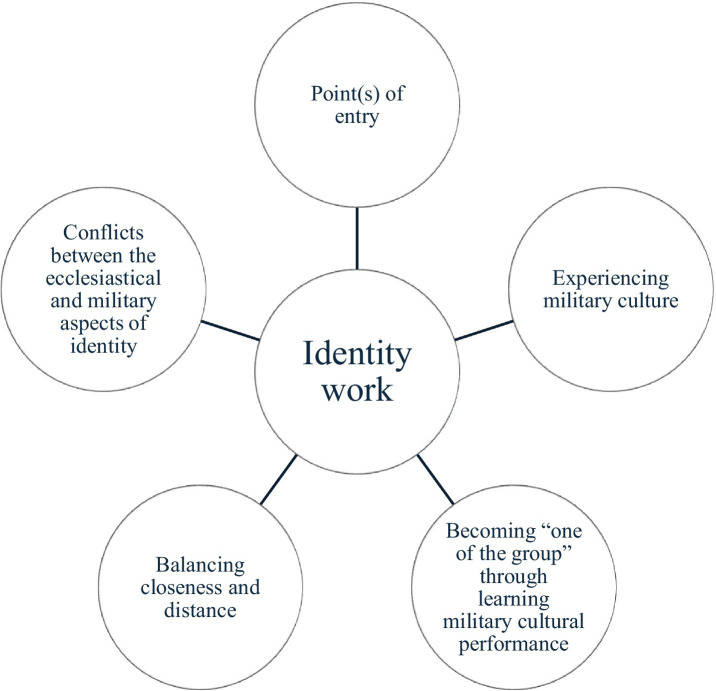
- Analysis drew on three open-ended questions in a "Military Culture and Identity" section (part of a 31-question, nine-page questionnaire yielding ~450 pages of responses), transcribed and coded in Atlas.ti using inductive thematic analysis; five code families organized the findings. Ethical approval: Swedish Ethical Review Authority, reference 2024–08417-01.
Limitations
- Stated: the qualitative method means findings cannot be generalized to the entire Swedish MC population; the questionnaire format precluded follow-up questions, so some responses were interpreted cautiously to avoid overinterpretation; the design did not allow systematic exploration of gender differences.
- Stated: applicability to Nordic/Scandinavian or other unarmed chaplaincy services remains an empirical question, though conflict and cognitive dissonance are likely lower without weapons.
- Evident from the text: participants were recruited at a single occasion and setting (the training days), and anonymity constraints meant gender, length of service, unit, and deployment details could not be reported alongside excerpts, limiting contextual interpretation of quotes.
Model-written summary. Check it against the paper before relying on it.
Integrity signals
Registry
Cites
Statistics
Figures
Verification
Claims the paper makes
0 Valid · 4 Not valid · 68 Not checked · 141 Own results and interpretations
A result the paper reports from its own data — it cites no other source for it, so there is none to check. The quote shows it is in the paper.
In the paper
“Military culture, shaped by discipline, loyalty, and the potential use of lethal force, both challenges and transforms aspects of MCs’ identities.”
§ “Am I a priest in the armed forces, or a soldier who is a priest?” Identity work among military chaplains in the Swedish armed forces > Abstract
plainstates a cause- Asserted: passes — The authors put it forward as true.
- Checkable: passes — It can be checked against evidence.
- Load-bearing: passes — The paper’s conclusions depend on it.
- Based: passes — The paper gives a reason why it holds.
A result the paper reports from its own data — it cites no other source for it, so there is none to check. The quote shows it is in the paper.
In the paper
“The findings reveal that Swedish MCs engage in continuous identity work to maintain clerical integrity while adapting to military culture.”
§ “Am I a priest in the armed forces, or a soldier who is a priest?” Identity work among military chaplains in the Swedish armed forces > Abstract
plain- Asserted: passes — The authors put it forward as true.
- Checkable: passes — It can be checked against evidence.
- Load-bearing: passes — The paper’s conclusions depend on it.
- Based: passes — The paper gives a reason why it holds.
A result the paper reports from its own data — it cites no other source for it, so there is none to check. The quote shows it is in the paper.
In the paper
“The integration process varied among participants, as they entered their assignments as military chaplains with diverse backgrounds.”
§ “Am I a priest in the armed forces, or a soldier who is a priest?” Identity work among military chaplains in the Swedish armed forces > Findings on identity work among participants > Entry points to experiencing military culture
plainstates a cause- Asserted: passes — The authors put it forward as true.
- Checkable: passes — It can be checked against evidence.
- Load-bearing: unclear — It is unclear whether the paper’s conclusions depend on it.
- Based: passes — The paper gives a reason why it holds.
A result the paper reports from its own data — it cites no other source for it, so there is none to check. The quote shows it is in the paper.
In the paper
“Tensions could also arise from comments or reactions from military personnel, especially when they lacked knowledge about the chaplains’ non-combatant status.”
§ “Am I a priest in the armed forces, or a soldier who is a priest?” Identity work among military chaplains in the Swedish armed forces > Findings on identity work among participants > Conflicts or tensions between the ecclesiastical and the military
hedgedstates a possible cause- Asserted: passes — The authors put it forward as true.
- Checkable: passes — It can be checked against evidence.
- Load-bearing: unclear — It is unclear whether the paper’s conclusions depend on it.
- Based: passes — The paper gives a reason why it holds.
- Rests on an assumption not shown here.
A result the paper reports from its own data — it cites no other source for it, so there is none to check. The quote shows it is in the paper.
In the paper
“Several participants also described experiences of a certain isolation in their role as MCs.”
§ “Am I a priest in the armed forces, or a soldier who is a priest?” Identity work among military chaplains in the Swedish armed forces > Findings on identity work among participants > Conflicts or tensions between the ecclesiastical and the military
plain- Asserted: passes — The authors put it forward as true.
- Checkable: passes — It can be checked against evidence.
- Load-bearing: passes — The paper’s conclusions depend on it.
- Based: passes — The paper gives a reason why it holds.
87 more claims
Create a free account to see all 213 claims and to verify the 67 references still open.
- Probably not a substantial claim. 85
- It may state two separate claims as one. 60
- The quote only partly states this claim. 1
Self-check
Percentages, sums and reported differences re-computed from the paper’s own numbers.
Each contradiction between two passages listed here was confirmed by an independent check.
Rated minor: it would not touch a result — a value no result rests on, a p-value that stays on the same side of the significance level, or a conflict that is clerical, resolved elsewhere in the paper, or outside its own findings.
In the paper
§ “Am I a priest in the armed forces, or a soldier who is a priest?” Identity work among military chaplains in the Swedish armed forces > Findings on identity work among participants > Conflicts or tensions between the ecclesiastical and the military
“Finally, it should be noted that priests of the Church of Sweden cannot be employed by another employer to perform priestly duties, as only the Church of Sweden holds the right to confer and oversee the exercise of the priesthood.”
§ “Am I a priest in the armed forces, or a soldier who is a priest?” Identity work among military chaplains in the Swedish armed forces > Method > Military chaplains in a Swedish context
“They therefore generally do not perform their duty days as part of their employment as parish priests in the Church of Sweden, but are instead employed by the Home Guard Battalion, i.e., the Swedish Armed Forces.”
Citations
Cites
A Theory of Cognitive Dissonance
Festinger, L. (1957) · doi:10.1515/9781503620766 · Cited by 24,241
The qualitative content analysis process
Elo, S., & Kyngäs, H. (2008) · Journal of Advanced Nursing · doi:10.1111/j.1365-2648.2007.04569.x · Cited by 22,617 · cited 1×
“A thematic analysis with an inductive approach (Elo and Kyngäs, 2008; Grimell, 2020, 2024b; Thomas, 2006) was conducted using the Atlas.ti software.”
A General Inductive Approach for Analyzing Qualitative Evaluation Data
Thomas, D. R. (2006) · American Journal of Evaluation · doi:10.1177/1098214005283748 · Cited by 10,858
Institutional Complexity and Organizational Responses
Greenwood, R., Raynard, M., Kodeih, F., Micelotta, E. R., & Lounsbury, M. (2011) · Academy of Management Annals · doi:10.5465/19416520.2011.590299 · Cited by 3,519
Identity Regulation as Organizational Control: Producing the Appropriate Individual
Alvesson, M., & Willmott, H. (2002) · Journal of Management Studies · doi:10.1111/1467-6486.00305 · Cited by 2,518
Managing Managerial Identities: Organizational Fragmentation, Discourse and Identity Struggle
Sveningsson, S., & Alvesson, M. (2003) · Human Relations · doi:10.1177/00187267035610001 · Cited by 1,685
The Dialogical Self: Toward a Theory of Personal and Cultural Positioning
Hermans, H. J. M. (2001) · Culture & Psychology · doi:10.1177/1354067x0173001 · Cited by 1,488 · cited 2×
“…two distinct identities or a hybrid MC identity, the identity work undertaken by MCs involves a continuous negotiation and dialogue (Grimell, 2024b; Hermans, 1996, 2001, 2002) between a salient priestly identity and a position within, or elements drawn from, a military culture—one that encompasses…”
Identity Matters: Reflections on the Construction of Identity Scholarship in Organization Studies
Alvesson, M., Lee Ashcraft, K., & Thomas, R. (2008) · Organization · doi:10.1177/1350508407084426 · Cited by 1,077
Identities and Identity Work in Organizations
Brown, A. D. (2015) · International Journal of Management Reviews · doi:10.1111/ijmr.12035 · Cited by 850
ROLE CONFLICT, AMBIGUITY, AND OVERLOAD: A 21-NATION STUDY.
PETERSON, M. F., SMITH, P. B., AKANDE, A., AYESTARAN, S., BOCHNER, S., CALLAN, V., JESUINO, J. C., D'AMORIM, M., FRANCOIS, P.-H., HOFMANN, K., et al. (1995) · Academy of Management Journal · doi:10.5465/256687 · Cited by 570
Research works printed but not linked: 12
- Flick U. (2018). An introduction to qualitative research. 6th Edn. London: SAGE Publications.
- French S. E. (2005). The code of the warrior: Exploring warrior values past and present. Maryland: Rowman & Littlefield Publishers.
- Grimell J. (2021b). Uniformer, identiteter och militära själavårdare: En intervjustudie om prästers erfarenheter av institutionssjälavård i Försvarsmakten. Skellefteå: Artos Academic.
- Hall L. K. (2012a). “ The importance of understanding military culture” in Advances in social work practice with the military. ed. Beder J. (New York: Routledge, Taylor & Francis Group), 3– 17.
- Hall L. K. (2012b). “ The military lifestyle and the relationship” in Handbook of counseling military couples. ed. Moore B. A. (New York: Routledge, Taylor and Francis Group), 137– 156.
- Hammar K. G. (1981). Prästidentitet och församlingssyn: Modeller för vägval. Arlöv: Skeab Förlag.
- Kahn R. L. Wolfe D. M. Quinn R. P. Snoek J. D. Rosenthal R. A. (1964). Organizational stress: Studies in role conflict and ambiguity. New York: Wiley.
- Kvale S. Brinkmann S. (2015). InterViews: Learning the craft of qualitative research interviewing. 3rd Edn. Thousand Oaks, CA: Sage Publications.
- Liuski T. Grimell J. (2022). The professional competence of the Finnish and Swedish military chaplains in divergent operational environments: an international comparison. Religion Worldviews Educ., 2, 74– 96. Available online at: https://journal.fi/ukk/article/view/115216
- Lunde N. T. (2009). “ Profesjonsetiske strategier: Nasjonal konsensus, liberal tilpasning og konservativ avskjerming [professional ethical strategies: national consensus, liberal adjustment and conservative shielding]” in Krigerkultur i en fredsnasjon [warrior culture in a peace nation]. eds. Edström E. Lunde N. T. Matlary J. H. (Oslo: Abstrakt Förlag), 156– 197.
- McAdams D. P. Josselson R. Lieblich A. (2002). Turns in the road: Narrative studies of lives in transition. Washington, DC: American Psychological Association.
- Verrips J. (2006). “ Dehumanization as a double-edged sword” in Grammars of identity/alterity: A structural approach. eds. Baumann G. Gingrich A. (New York: Berghahn Books), 142– 154.
Cited by
Still being checked.
Metadata
- Authors
- Grimell, J.
- Affiliations
- Umeå University (SE)
- Corresponding author
- Grimell, Jan
- ORCID
- Grimell, Jan
- Venue
- Frontiers in Sociology
- Publisher
- Frontiers Media SA
- Published
- 2025-10-22
- Volume
- 10
- Pages
- 1645776-1645776
- ISSN
- 2297-7775 (ISSN-L)
- PMC
- PMC12586133
- OpenAlex
- W4415418977
- Semantic Scholar
- d1d361381a4f3a1dfbc516a74ad74cfea6e411e8
- Cited by
- 3
- References
- 45
- Citations by year
- 2026: 3
- FWCI
- 1.63
- Type
- journal article
- Language
- en
- Open access
- gold
- doi.org
- Licence
- Locations
- Frontiers in Sociology (publishedVersion, cc-by)
- Europe PMC (PubMed Central) (publishedVersion, cc-by)
- PubMed Central (publishedVersion, cc-by)
- PubMed (publishedVersion)
- DiVA at Umeå University (Umeå University) (submittedVersion, other-oa)
- DOAJ (DOAJ: Directory of Open Access Journals) (submittedVersion)
- Funders
- Försvarsmakten
- Topics
- Social Sciences › Business, Management and Accounting › Organizational Behavior and Human Resource Management › Management and Organizational Studies
- Social Sciences › Arts and Humanities › Religious studies › Contemporary Christian Leadership and Education
- Social Sciences › Business, Management and Accounting › Organizational Behavior and Human Resource Management › Workplace Spirituality and Leadership
- Keywords
- military chaplains, identity work, military culture, Lutheran clergy, liminality, boundary-spanning roles, cognitive dissonance, professional boundaries, Swedish Armed Forces
About these checks
Registry, retraction, Cites and statistics results are computed, not judged, with one exception: a printed reference that no index lists is read once by a model before it counts as a citation error. Claims are extracted by a model and kept only when their quote appears verbatim in the text; each cited source is then checked, with a model’s help, for whether it says what the claim relies on. Those verdicts can be wrong — read the claim’s quote and the cited source before relying on one.
A language model drew the claims from the paper on 2026-11-26, under version 3 of the claim definition (model deepseek-v4.1-flash, prompt extract-v3).
A second model labelled each claim on 2026-11-26 (model jev-1.13-20260917, definition revision gold-guideline-v0.2).
Statistics and arithmetic are recomputed, not judged.
Confidence bands are shown only for fields calibrated on our annotated test set. None is calibrated yet, so no band is shown.
What counts as a claim ›How we measure confidence ›How we check this ›
Are you an author, or do you see a problem with this page? Request a review
How to cite
Cite CoChat for the checks on this page, and the paper for its own findings.
- This page
- CoChat. (2026). Citation check: “Am I a priest in the armed forces, or a soldier who is a priest?” Identity work among military chaplains in the Swedish armed forces. https://app.cochat.ai/papers/10.3389/fsoc.2025.1645776
- The paper
- Grimell, J. (2025). “Am I a priest in the armed forces, or a soldier who is a priest?” Identity work among military chaplains in the Swedish armed forces. Frontiers in Sociology. https://doi.org/10.3389/fsoc.2025.1645776
Data sources
Bibliographic data: Semantic Scholar, OpenAlex, Crossref.
Contains information from the Semantic Scholar Academic Graph Datasets, made available under the ODC Attribution License (ODC-BY 1.0).
Semantic Scholar’s data is described in: Kinney, R., et al. (2023). The Semantic Scholar Open Data Platform. arXiv:2301.10140.
