

Establishing the feasibility of exercise breaks during university lectures
Open accessThe DOI matches its Crossref record; 26 of the 26 references it cites were found in a registry or an index.
Abstract
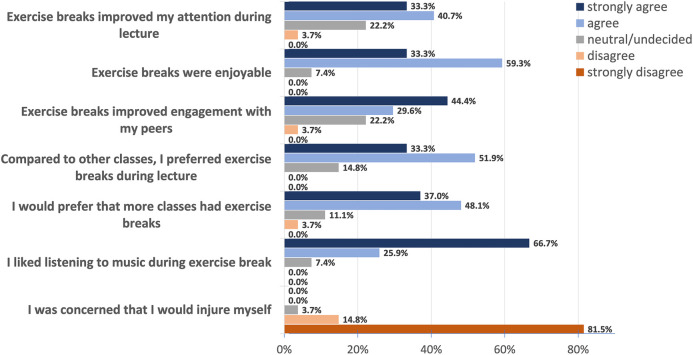
It is important that principles of laboratory-based studies with implications for academic performance be implemented in naturalistic learning environments to gauge their feasibility. Here, an adaptation of a laboratory-based study of exercise breaks during a single video lecture was implemented during large, in-person lectures at Ohio State University for the duration of a semester. The rationale for this approach was based on findings that research participants who took exercise breaks during a video lecture were more likely to be on task towards the end of the lecture and performed significantly better on a multiple choice exam. The current project had three goals: (1) Establish the feasibility of integrating student-led exercise breaks during in-person lectures in a large university setting (2) Provide practical guidelines for implementing exercise breaks during in-person lectures (3) Provide preliminary evidence of positive effects of exercise breaks in a higher-education setting. One to two student-led exercise breaks (5 min each) were implemented during each 80 min, in-person lecture for the duration of a semester in four upper level Psychology courses with student enrollment ranging from 20 to 93 students (total enrollment = 223 students). Students reported that the exercise breaks were a strength of the courses and a positive experience, including self-reported improvement in attention to lecture content. Self-reported quantitative data indicated that exercise breaks improved attention, increased course enjoyment, and enhanced peer engagement. Compared to other classes, the students preferred exercise breaks during lectures. The current approach establishes the feasibility of integrating exercise breaks in a large, in-person university lecture environment for the duration of a semester with preliminary data indicating a positive impact on attention, engagement, and enjoyment. Practical guidelines for implementing exercise breaks during in-person lectures are provided.
Overview
The claims and statistics of this paper haven’t been checked yet.
Free: it reads the open-access text and checks the first 5 claims that cite a source we can check. Create a free account to check every claim.
Integrity signals
Registry
Cites
Statistics
Figures
Verification
Claims the paper makes
The claims and statistics of this paper haven’t been checked yet.
Free: it reads the open-access text and checks the first 5 claims that cite a source we can check. Create a free account to check every claim.
Claims other papers make about this one
Each is checked against this paper’s own text: does it say what the citing paper says it does?
The cited source doesn’t support the claim as written.
In the citing paper
“Notably, seven studies investigated emotional engagement, six of which reported significant improvements [13, 17, 22, 25, 31, 34], whereas one reported no effect [38], resulting in relatively strong evidence strength (85.7%).”
From Effect of classroom physical activity breaks on learning behaviors and academic achievements in university students: a systematic review (2026) · cites this paper as [25]
Checked by a reasoning model — may be wrong.
Experimental — accuracy not yet measuredThe cited source doesn’t support the claim as written.
In the citing paper
“Three studies investigated behavioral engagement, with two showing improvements [25, 34] and one reporting no effect [33], yielding unclear evidence (66.7%) in this review.”
From Effect of classroom physical activity breaks on learning behaviors and academic achievements in university students: a systematic review (2026) · cites this paper as [25]
Checked by a reasoning model — may be wrong.
Experimental — accuracy not yet measuredThe source backs part of the claim, not all of it — or backs it for a different population, condition or comparison.
In the citing paper
“Regarding the impact of classroom physical activity breaks, seven studies explored positive emotions, with six reporting significant improvements [14, 22, 24–26, 36] and one showing no effect [38], resulting in relatively strong evidence strength (85.7%).”
From Effect of classroom physical activity breaks on learning behaviors and academic achievements in university students: a systematic review (2026) · cites this paper as [25]
Experimental — accuracy not yet measuredThe check wasn’t confident either way, so it gives no verdict — never disputed.
In the citing paper
“Cognitive and agentic engagement were each examined in fewer than three studies. Although the available findings suggested positive effects, the strength could not be determined [13, 25, 28].”
From Effect of classroom physical activity breaks on learning behaviors and academic achievements in university students: a systematic review (2026) · cites this paper as [25]
Experimental — accuracy not yet measuredThe check wasn’t confident either way, so it gives no verdict — never disputed.
In the citing paper
“Seven studies addressed sustained attention, five of which found significant improvements [22, 23, 25, 27, 34] and two reported no effect [29, 33], resulting in relatively strong evidence strength (71.4%).”
From Effect of classroom physical activity breaks on learning behaviors and academic achievements in university students: a systematic review (2026) · cites this paper as [25]
Experimental — accuracy not yet measured
Self-check
Percentages, sums and reported differences re-computed from the paper’s own numbers.
The self-check needs the paper’s full text.
Citations
Cites
Fitness Effects on the Cognitive Function of Older Adults: A Meta-Analytic Study
Colcombe, S., & Kramer, A. F. (2003) · Psychological Science · doi:10.1111/1467-9280.t01-1-01430 · Cited by 3,782
The effects of acute exercise on cognitive performance: a meta-analysis
Chang, Y. K., Labban, J. D., Gapin, J. I., & Etnier, J. L. (2012) · Brain Research · doi:10.1016/j.brainres.2012.02.068 · Cited by 1,930 · cited 2×
“A meta-analysis of predominately laboratory studies showed a small but positive effect of acute exercise on executive function (attention, planning, and inhibition (6) and a recent study indicated that a 10 min bout of exercise may enhance memory (7).”
BackgroundResultBasso, J. C., & Suzuki, W. A. (2016) · Brain Plasticity · doi:10.3233/bpl-160040 · Cited by 911 · cited 2×
“It was nice being able to get up instead of sitting for 80 min. endorphins, neurotransmitters, and neurotrophins, and alterations in neuronal fi ring and cerebral blood fl ow (for review, see (18).”
BackgroundResultEveryday Attention: Variation in Mind Wandering and Memory in a Lecture
Risko, E. F., Anderson, N., Sarwal, A., Engelhardt, M., & Kingstone, A. (2012) · Applied Cognitive Psychology · doi:10.1002/acp.1814 · Cited by 445
Physical Activity and Cognitive Vitality
Prakash, R. S., Voss, M. W., Erickson, K. I., & Kramer, A. F. (2015) · Annual Review of Psychology · doi:10.1146/annurev-psych-010814-015249 · Cited by 376 · cited 1×
“At a broader level, implementing exercise breaks during lectures provides an opportunity for instructors to model positive health behaviors, as multiple lab-based studies have reported positive associations between physical fi tness, physical activity, cognition, and the brain (5, 23, 24).”
BackgroundVaynman, S., & Gomez‐Pinilla, F. (2006) · Journal of Neuroscience Research · doi:10.1002/jnr.20979 · Cited by 299
Daly-Smith, A. J., Zwolinsky, S., McKenna, J., Tomporowski, P. D., Defeyter, M. A., & Manley, A. (2018) · BMJ Open Sport & Exercise Medicine · doi:10.1136/bmjsem-2018-000341 · Cited by 293
Fitness Effects on the Cognitive Function of Older Adults: A Meta-Analytic Study—Revisited
Kramer, A. F., & Colcombe, S. (2018) · Perspectives on Psychological Science · doi:10.1177/1745691617707316 · Cited by 285
Liao, Y., Shonkoff, E. T., & Dunton, G. F. (2015) · Frontiers in Psychology · doi:10.3389/fpsyg.2015.01975 · Cited by 280 · cited 1×
“For instance, acute bouts of exercise have a positive impact on depression and hostility (15), anxiety (16), and affect and energy (17).”
BackgroundEveryday attention and lecture retention: the effects of time, fidgeting, and mind wandering
Farley, J., Risko, E. F., & Kingstone, A. (2013) · Frontiers in Psychology · doi:10.3389/fpsyg.2013.00619 · Cited by 241
Research works printed but not linked: 1
- 14. American College of Sports Medicine. ACSM's Guidelines for Exercise Testing and Prescription. 11th Ed Philadelphia: Lippincott Williams & Wilkins (2021).
Cited by
Teuber, M., Leyhr, D., Moll, J., & Sudeck, G. (2022) · Frontiers in Sports and Active Living · doi:10.3389/fspor.2022.1024996 · Cited by 12
Bertón, J. N., Adelantado‐Renau, M., & Beltran‐Valls, M. R. (2025) · Critical Public Health · doi:10.1080/09581596.2025.2598710 · Cited by 5
“…not report significant changes (lubans et al., 2020). in terms of studies conducted at the university level, the chronic interventions which suggested significant changes lasted three, 14 and 26 weeks with a frequency of once or twice a week (hayes, 2024; lynch et al., 2022; Paulus et al., 2021).”
InfluentialProtocolo y estudio de viabilidad de un programa de descansos activos en el aula universitaria
Conti, J. V., García-Taibo, O., & Galmes-Panades, A. M. (2025) · Retos · doi:10.47197/retos.v66.111669 · Cited by 4
Utilization of Campus Recreation Programs Among University Students: A Systematic Review
Sim, J., Konnerth, A. N., Yun, S., & Kirk, T. N. (2026) · Recreational Sports Journal · doi:10.1177/15588661261424188 · Cited by 3
“For example, facilities might offer short high-intensity circuits, 10-minute stretching breaks between classes, or app-guided mini-workouts that fi t demanding academic schedules (Al-Nawaiseh et al., 2022; Hayes, 2024; Yin et al., 2025).”
Promoting well-being in schools: an evaluation of active breaks training for teachers
Russo, G., Senesi, G., Masini, A., Persiani, M., Montalti, M., Dallolio, L., & Ceciliani, A. (2025) · Preventing School Failure Alternative Education for Children and Youth · doi:10.1080/1045988x.2025.2596651 · Cited by 2
“Emerging research in higher education also highlights the feasibility and benefits of ABs for young adults, showing reductions in fatigue, improvements in concentration, and better affective states during lectures or study sessions (Hayes, 2024; Stockwell et al., 2021).”
Metadata
- Authors
- Hayes, S. M.
- Affiliations
- The Ohio State University (US)
- Corresponding author
- Hayes, Scott M.
- ORCID
- Hayes, Scott M.
- Venue
- Frontiers in Sports and Active Living
- Publisher
- Frontiers Media SA
- Published
- 2024-04-04
- Volume
- 6
- Pages
- 1358564-1358564
- ISSN
- 2624-9367 (ISSN-L)
- PMC
- PMC11027499
- OpenAlex
- W4393944533
- Semantic Scholar
- e07153e2aea1f2c6758fd21c36b48d8251106f5d
- Cited by
- 9
- References
- 25
- Citations by year
- 2026: 4 · 2025: 3
- FWCI
- 1.99
- Type
- journal article
- Language
- en
- Open access
- gold
- doi.org
- Licence
- Locations
- Frontiers in Sports and Active Living (publishedVersion, cc-by)
- PubMed Central (publishedVersion, cc-by)
- PubMed (publishedVersion)
- DOAJ (DOAJ: Directory of Open Access Journals) (submittedVersion, cc-by-sa)
- PsyArXiv (OSF Preprints) (submittedVersion)
- Funders
- Ohio State University
- National Institutes of Health
- National Institute on Aging (R21AG056921, R01AG068882)
- Topics
- Health Sciences › Medicine › Public Health, Environmental and Occupational Health › Physical Activity and Health
- Social Sciences › Education › Innovative Teaching Methods
- Social Sciences › Education › Innovations in Educational Methods
- Keywords
- exercise breaks, university lectures, student attention, student engagement, peer engagement, higher education, feasibility, implementation guidelines, physical activity in learning, psychology course
About these checks
Registry, retraction, Cites and statistics results are computed, not judged, with one exception: a printed reference that no index lists is read once by a model before it counts as a citation error. Claims are extracted by a model and kept only when their quote appears verbatim in the text; each cited source is then checked, with a model’s help, for whether it says what the claim relies on. Those verdicts can be wrong — read the claim’s quote and the cited source before relying on one.
Statistics and arithmetic are recomputed, not judged.
Confidence bands are shown only for fields calibrated on our annotated test set. None is calibrated yet, so no band is shown.
What counts as a claim ›How we measure confidence ›How we check this ›
Are you an author, or do you see a problem with this page? Request a review
Data sources
Bibliographic data: Semantic Scholar, OpenAlex, Crossref.
Contains information from the Semantic Scholar Academic Graph Datasets, made available under the ODC Attribution License (ODC-BY 1.0).
Semantic Scholar’s data is described in: Kinney, R., et al. (2023). The Semantic Scholar Open Data Platform. arXiv:2301.10140.
