

Organizational Change: Considering Truth and Buy-In
Open accessThe DOI matches its Crossref record; 29 of the 30 references it cites were found in a registry or an index; 4 of the 48 sources its claims cite were checked for support.
Abstract
Organizational change initiatives are often undertaken to update major business structural components or practices to meet the evolving needs of a changing industry.
Overview
CoChat Summary
TL;DR
This is a short conceptual article arguing that organizational change is much more likely to succeed when leaders communicate the “truth” about why change is needed and secure stakeholder buy-in early and continuously. The paper does not present original empirical data; it synthesizes prior work and gives practical implications for leadership and communication.
Key findings
- The author states that the absence of leadership-conveyed truth-telling and stakeholder truth acceptance “restrains the ability to grow, change, develop and evolve as an organization,” and that insufficient truth acceptance and buy-in leads to “deficient stakeholder engagement” and a “decreased likelihood” of success.
- The paper says “approximately 70% of organizational change efforts fail,” and identifies lack of stakeholder buy-in as a leading reason for failure.
- It argues that buy-in is an “honest, reciprocal agreement” involving trust, and that greater employee and stakeholder buy-in raises the likelihood of success.
- The paper claims truth and buy-in have benefits beyond change initiatives, positively influencing work performance, commitment, satisfaction, and turnover.
Methods
- Conceptual/communication article: the purpose is “to consider the general role(s) of truth and buy-in in the organizational change process” and to serve as a reminder of their importance.
- No primary dataset, sample, experiment, or case study is reported; the paper draws on prior literature and named change frameworks/models.
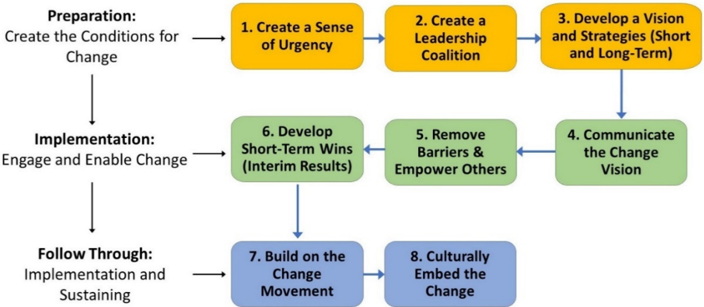
- The main analysis is a narrative synthesis/argument using examples from organizational change models (e.g., Kotter, Lewin, ADKAR, McKinsey 7-S) and prior studies on communication, trust, and buy-in.
Limitations
- The paper states it is “not” a thorough literature review and does not aim to consider all perspectives or reasons for discontinuities.
- It does not provide original empirical data; the text explicitly says “There are no data presented,” so its claims are not tested in this article. (Text-evident)
- The discussion is broad and generalized across organizations and industries, with no direct evaluation of a specific change intervention or outcome. (Text-evident)
Model-written summary. Check it against the paper before relying on it.
Integrity signals
Registry
Cites
Statistics
Figures

Verification
Claims the paper makes
2 Valid · 1 Not valid · 37 Not checked · 27 Own results and interpretations
Every source the paper cites for this claim was checked and supports it.
In the paper
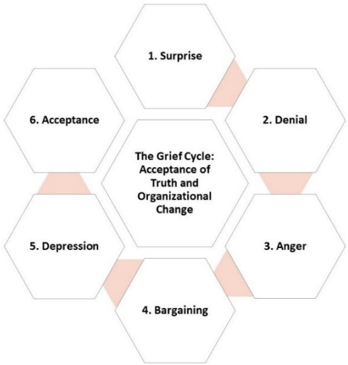
“accepting the truth(s) that lead to a successful organizational change initiative can be similar to the typical phases of grief.”
What the sources say
- Supportedcites McAlearney et al. 2015 matched to “The Journey through Grief: Insights from a Qualitative Study of Electronic Health Record Implementation” (2015) source
The 'Conceptualizing EHR Adoption as Personal Change Involving Loss' section states that framing the change process required to adopt an EHR 'in terms of loss and grief was surprisingly appropriate,' and that the five stages of Kübler-Ross's model (denial, anger, bargaining, depression, acceptance) 'can be articulated as required phases of personal change' for that initiative. The 'Empower others to act on the vision' section makes the same linkage explicit for acknowledging the reality/truth of the change (mapped to the denial stage and to Kotter's organizational change steps), and the 'Communicate the vision' section cites Henderson-Loney on the grief model as a guide to organizational change. The hedged phrasing of the claim ('can be similar to') matches the source's own hedging ('may indeed involve aspects of grief'). (LLM, conf=0.85)
- Supportedcites Romadona and Setiawan 2021 matched to “Researchers’ View on R&D Organizational Change Using the Grief Cycle” (2021) source
The Grief Cycle Theory section says that accepting the reality of change is a crucial phase in moving through the grief cycle and returning to productivity. The Results section likewise classifies experiences during organizational change as phases of that cycle. The claim describes a possible parallel, not a finding that the change studied was successful. (LLM, conf=0.88)
plainstates an association- Asserted: passes — The authors put it forward as true.
- Checkable: passes — It can be checked against evidence.
- Load-bearing: unclear — It is unclear whether the paper’s conclusions depend on it.
- Based: passes — The paper gives a reason why it holds.
- Supported
The cited sources support only part of this claim — read each source’s verdict below.
In the paper
“Those phases often include denial, anger, bargaining, depression, and finally acceptance (i.e., buy-in)”
What the sources say
- Supportedcites McAlearney et al. 2015 matched to “The Journey through Grief: Insights from a Qualitative Study of Electronic Health Record Implementation” (2015) source
The paper's 'Conceptualizing EHR Adoption as Personal Change Involving Loss' section (p. ~4) states outright that 'the five stages of Kübler-Ross's model—denial, anger, bargaining, depression, and acceptance—can be articulated as required phases of personal change,' matching the claim's list and order. Subsequent subsections describe each stage in turn (Denial/Anger p. ~4-5, Bargaining and Depression/Acceptance p. ~5-6), with acceptance framed as realistic acceptance of the changed reality and physicians taking 'ownership of this application' (p. ~6), which covers the claim's 'buy-in' gloss. (LLM, conf=0.92)
- Partly supportedcites Romadona and Setiawan 2021 matched to “Researchers’ View on R&D Organizational Change Using the Grief Cycle” (2021) sourceExperimental — accuracy not yet measured
Section II, “Grief Cycle Theory,” lists denial, anger, bargaining, depression, and acceptance in that order. But “B. Result” says acceptance can also mean indifference or giving up, so the parenthetical equation of acceptance with buy-in overstates the source. (LLM, conf=0.88)
plain- Asserted: passes — The authors put it forward as true.
- Checkable: passes — It can be checked against evidence.
- Load-bearing: passes — The paper’s conclusions depend on it.
- Based: passes — The paper gives a reason why it holds.
- Supported
In the paper
“If the vision and justification for organizational change are undercommunicated, the result is often a failed change initiative;”
What the sources say
- Not checked — no full text of the sourcecites Kotter 2012 matched to “Leading Change: Why Transformation Efforts Fail” (2012) source
plainstates a cause- Asserted: passes — The authors put it forward as true.
- Checkable: passes — It can be checked against evidence.
- Load-bearing: passes — The paper’s conclusions depend on it.
- Based: passes — The paper gives a reason why it holds.
A conclusion the paper draws from its own results — it cites no other source for it, so there is none to check. The quote shows it is in the paper.
In the paper
“It is only when that truth is accepted that change can occur because complacency is often no longer an issue with acceptance of the truth and commitment to change (buy-in).”
plainstates a cause- Asserted: passes — The authors put it forward as true.
- Checkable: passes — It can be checked against evidence.
- Load-bearing: passes — The paper’s conclusions depend on it.
- Based: passes — The paper gives a reason why it holds.
- Rests on an assumption not shown here.
In the paper
“Culture changing organizational change can take three-ten years (or more).”
What the sources say
- Not checked — no full text of the sourcecites Kotter 2012 matched to “Leading Change: Why Transformation Efforts Fail” (2012) source
plain- Asserted: passes — The authors put it forward as true.
- Checkable: passes — It can be checked against evidence.
- Load-bearing: unclear — It is unclear whether the paper’s conclusions depend on it.
- Based: unclear — It is unclear why the paper says it holds.
11 more claims
Create a free account to see all 67 claims and to verify the 1 reference still open.
- Probably not a substantial claim. 43
- It may state two separate claims as one. 16
Citations
Cites
Leading change: why transformation efforts fail
Kotter, J. P. (2009) · IEEE Engineering Management Review · doi:10.1109/emr.2009.5235501 · Cited by 3,566
Choosing Strategies for Change
Kotter, J. P., & Schlesinger, L. A. (1989) · Readings in Strategic Management · doi:10.1007/978-1-349-20317-8_21 · Cited by 1,386
Kotter, J. P. (2011) · doi:10.15358/9783800646159 · Cited by 522
Choosing Strategies for Change
Kotter, J. P., & Schlesinger, L. A. (2009) · The Principles and Practice of Change · doi:10.1007/978-1-137-16511-4_10 · Cited by 510
Kotcher, J. E., Myers, T. A., Vraga, E. K., Stenhouse, N., & Maibach, E. W. (2017) · Environmental Communication · doi:10.1080/17524032.2016.1275736 · Cited by 216 · cited 1×
“In all these cases and a myriad of others, there is a need to convey the truth and advance credibility through effectively communicating scientifically supported truths to obtain commitment (buy-in) to change (Allchin 2020; Kotcher et al. 2017; Yamamoto 2012).”
BackgroundInnovation Modification during Intraorganizational Adoption
Lewis, L. K., & Seibold, D. R. (1993) · The Academy of Management Review · doi:10.2307/258762 · Cited by 193
The role of the organizational champion in achieving health system change
Hendy, J., & Barlow, J. (2012) · Social Science & Medicine · doi:10.1016/j.socscimed.2011.02.009 · Cited by 189 · cited 1×
“This is particularly important during the first stages of a change initiative (Hendy and Barlow 2012) (Figure 1).”
BackgroundLewis, L. K., & Seibold, D. R. (1998) · Annals of the International Communication Association · doi:10.1080/23808985.1998.11678949 · Cited by 150 · cited 1×
“The final strategic point is important because studies have repeatedly shown that obtaining buy-in for change is most successful when a clear champion or change initiative leader is present (Lewis and Seibold 1998; Lewis 2007; Lewis and Seibold 1993).”
BackgroundAn Organizational Stakeholder Model of Change Implementation Communication
Lewis, L. K. (2007) · Communication Theory · doi:10.1111/j.1468-2885.2007.00291.x · Cited by 128 · cited 1×
“The final strategic point is important because studies have repeatedly shown that obtaining buy-in for change is most successful when a clear champion or change initiative leader is present (Lewis and Seibold 1998; Lewis 2007; Lewis and Seibold 1993).”
BackgroundInstitutionalized Resistance to Organizational Change: Denial, Inaction and Repression
Agócs, C. (1997) · Journal of Business Ethics · doi:10.1023/a:1017939404578 · Cited by 121
Research works printed but not linked: 6
- Hubbart, Jason A. 2022. The Coming Food Crisis: A Moment for Organizational Change at a Global Level. International Journal on Agriculture Research and Environmental Sciences 3: 3. [CrossRef]
- Jabri, Muayyad, and Estefan Jabri. 2022. Managing Organizational Change . Sydney: Bloomsbury Publishing.
- Kotter, John P., and Lorne A. Whitehead. 2010. Buy-In: Saving Your Good Idea from Getting Shot Down . Boston: Harvard Business Press.
- Peters, 2011, McKinsey 7-S model, Leadership Excellence, 28, 2011
- Sarayreh, Bashar Hussein, Hassan Khudair, and Eyad A. Barakat. 2013. Comparative study: The Kurt Lewin of change management. International Journal of Computer and Information Technology 2: 626-29.
- Tichy, Noel M. (1983). Managing Strategic Change: Technical, Political, and Cultural Dynamics, John Wiley & Sons.
Cited by
Organizational Change: The Challenge of Change Aversion
Hubbart, J. A. (2023) · Administrative Sciences · doi:10.3390/admsci13070162 · Cited by 154
“Whether organizational changes are due to industry adaptations, new regulations, or customer needs and preferences shifts, organizations must adjust their practices to remain competitive and relevant (Hubbart 2023; Kotter and Schlesinger 1979; Kotter 2012; Peus et al. 2009).”
Self-citationAsfahani, A. M. (2023) · Sustainability · doi:10.3390/su15107921 · Cited by 60
“In addition, ESSL may not be effectively integrated into the organization’s culture and values, leading to a lack of buy-in from employees [129] and difficulty in implementing GHRM practices effectively.”
BackgroundTime for Change: Designing Tailored Training Initiatives for Organizational Transformation
Viterouli, M., Belias, D., Koustelios, A. D., Tsigilis, N., & Papademetriou, C. (2024) · Advances in human resources management and organizational development book series · doi:10.4018/979-8-3693-3466-9.ch014 · Cited by 57
Lozano, J. P. R., Peñaflor-Guerra, R., & Fons, M. V. S. (2023) · Administrative Sciences · doi:10.3390/admsci13060137 · Cited by 93
“This also results in improvements in the customers or users’ responses, an increase in the quality and quantity of the organisational performance, and the influence of the response of the company on its stakeholders (Reio 2011; Hubbart 2022).”
BackgroundUnderstanding and Mitigating Leadership Fear-Based Behaviors on Employee and Organizational Success
Hubbart, J. A. (2024) · Administrative Sciences · doi:10.3390/admsci14090225 · Cited by 80
Self-citationAregbesola, A., Owolabi, S. E., & Adebisi, T. (2023) · Public Library Quarterly · doi:10.1080/01616846.2023.2253692 · Cited by 20
Translating the complexity of disaster resilience with local leaders
Wowk, K., Adams, M., & Martinez, E. M. (2023) · Frontiers in Communication · doi:10.3389/fcomm.2023.1100265 · Cited by 16
“Using consistent and trusted communications is key to enhancing understanding of and buy-in to emerging data, assessments and tools, which can then facilitate the application of science (Pielke et al., 2010; Villiers and Molinari, 2022; Hubbart, 2023).”
BackgroundHubbart, J. A. (2023) · Sustainability · doi:10.3390/su152115233 · Cited by 19
Self-citationBrzyskiewicz, S., McGarr, O., & Lenihan, R. (2025) · Irish Educational Studies · doi:10.1080/03323315.2025.2479439 · Cited by 12
Business Transformation in the Era of Digital Disruption: Potential Challenges and Disruptive Trends
Athreya, S., Ramya, G., & Azhar, M. (2024) · Advances in e-business research series · doi:10.4018/979-8-3693-7056-8.ch001 · Cited by 7
Considering Use-Inspired Design and Tangible Impacts in the Agricultural Sector
Hubbart, J. A. (2023) · Open Access Journal of Agricultural Research · doi:10.23880/oajar-16000323 · Cited by 4
Self-citationCreating Lasting Conditions for Meaningful Recess Reform: A 5‐School Exploration
London, R. A., Alvarez, G., Massey, W. V., Farello, A., & Santos, B. (2024) · Journal of School Health · doi:10.1111/josh.13511 · Cited by 3
The link between teacher buy‐in and intentions to continue working in their current school
Jerrim, J. (2024) · British Educational Research Journal · doi:10.1002/berj.3961 · Cited by 9
“There has only been limited previous research into the correlates of buy-in, with many of these conducted in other industries (e.g., French-Bravo & Crow, 2015; Hubbart, 2023).”
BackgroundResultHubbart, J. A., & Ghadimi, H. (2023) · Challenges · doi:10.3390/challe14040051 · Cited by 2
“As shown in Figure 5, the major components of each capital type and corresponding data items and sources are listed in a spatial metadata database.”
BackgroundSelf-citationSchuler, C., Ntow, G. E., Berner, R., Oo, S. T. N., & Pfister, R. E. (2025) · Global Health Action · doi:10.1080/16549716.2025.2567714 · Cited by 5
“This lack of buy-in may stem from limited acceptability or a poor fit between the innovation’s design and the participants’ needs, priorities, or contextual circum-stances [101].”
Li, T., You, J., & Lou, S. (2026) · Buildings · doi:10.3390/buildings16030647 · Cited by 3
Hubbart, J. A. (2024) · Journal of Humanities and Education Development · doi:10.22161/jhed.6.1.6 · Cited by 3
Self-citationThe Importance of Stakeholder Engagement Across Market Domains
Hubbart, J. A. (2024) · Journal of Global Entrepreneurial Management · doi:10.59462/jgem.2.1.106 · Cited by 2
“The outcomes of this engagement include greater trust, buy-in [1], and assurance that organizations are meeting the needs of society and the key stakeholders they serve [2].”
BackgroundSelf-citationIdentifying training needs of healthcare providers to implement caries risk assessment
Olatosi, O. O., Schroth, R. J., DeMaré, D., Manigque, M., Mittermuller, B.-A., Edwards, J., Yerex, K., Wong, P. D., Lavoie, J., Sanguins, J., et al. (2025) · Frontiers in Oral Health · doi:10.3389/froh.2025.1641307 · Cited by 1
“Leadership buy-in can support the necessary support, resources, authority and commitment to sustain change in practice (27).”
Kantola, J., & Kinnunen, J. (2024) · Journal of Organizational Change Management · doi:10.1108/jocm-05-2023-0188 · Cited by 8
Teoh, K., Lishman, E., Page, A., & Donnelly, O. (2025) · Journal of Work-Applied Management · doi:10.1108/jwam-01-2025-0014 · Cited by 1
Prevalence and reporting of sexual harassment and sexual assault at live music events in the USA
Price, A. E., & Driscoll, A. (2025) · Injury Prevention · doi:10.1136/ip-2025-045809 · Cited by 1
“36 It is also important to note that strategies suggested in this discussion section might look different in different areas of the world.”
De-mystifying the 'Cinderella' leadership model: Premia in the practice of curriculum leadership
Morrissey, B. (2025) · Educational Management Administration & Leadership · doi:10.1177/17411432251386325 · Cited by 3
Sungkawaningtyas, M., Susanto, E., Sumaryono, S., Wulandaru, D. R., & Rostiani, R. (2025) · International Journal of Organization Theory and Behavior · doi:10.1108/ijotb-03-2024-0056 · Cited by 4
Price, J. A. M., & Fernández‐Lahore, M. (2025) · Journal of Chemical Technology & Biotechnology · doi:10.1002/jctb.70089 · Cited by 2
MacDermid, J. C., Killip, S. C., Brazil, A., Lomotan, M., Fraser, S., Bryant, D., Cramm, H. A., & Carleton, R. N. (2025) · Comprehensive Psychiatry · doi:10.1016/j.comppsych.2025.152643 · Cited by 3
Kokorelias, K. M., Sheppard, C. L., Eaton, A. W., Wasilewski, M. B., Hitzig, S. L., Valentine, D., Earle, M., Navas, C., Gerstle, D. S., Harris, M. T., et al. (2026) · HIV Medicine · doi:10.1111/hiv.70194 · Cited by 3
AI adoption and organizational change: insights from international and local perspectives
Dumitrache, V.-G. (2025) · International Conference of Management and Industrial Engineering · doi:10.56177/12icmie2025.155 · Cited by 1
Shaya, M. F. S., & Ahmad, J. (2024) · Cogent Social Sciences · doi:10.1080/23311886.2024.2306753 · Cited by 1
“Specifically, organisational change is primarily contributed by the need to maintain organisational dynamics while simultaneously improving organisational success and personnel performance (Hubbart, 2022).”
Hewitt, A. J., Stafford, L. C., Alagöz, E., et al. (2024) · Diseases of the Colon & Rectum · doi:10.1097/dcr.0000000000003512 · Cited by 1
“20 In the case of anal cancer screening, the benefit of institutional buy-in is likely due, at least in part, to institutional resources being allocated toward securing the supplies, personnel, and training necessary to perform screening.”
Why We Must Argue: A Critique of the Essence, Purpose, and Craftsmanship of Argumentation
Hubbart, J. A. (2025) · Open Journal of Social Sciences · doi:10.4236/jss.2025.133016 · Cited by 3
Self-citationJarmatz, M., Thrane, S., & Zichella, G. (2024) · Journal of Management Accounting Research · doi:10.2308/jmar-2023-063
Anderson, A., Severt, J. B., Bleiberg, M. A., Bailey, E., & Calderón, R. (2025) · Oxford University Press eBooks · doi:10.1093/9780197692288.003.0016
Nordhall, O., Hörvallius, J., Nedelius, M., & Knez, I. (2025) · Frontiers in Organizational Psychology · doi:10.3389/forgp.2025.1637554 · Cited by 1
“In the present study, the current organizational change is in the preparation phase, meaning that a leadership vision has been worked out and communicated to the employees (see Hubbart, 2023).”
Designing Community Responsibility Decision Points into Engaged, Participatory Work
Durá, L., Paudel, S., Khatiwada, R., et al. (2025) · ACM International Conference on Design of Communication (SIGDOC) · doi:10.1145/3711670.3764624
Diversity Climate: Factors for Successful Implementation
Woong, J. E. K., & David, E. (2025) · Singapore Labour Journal · doi:10.1142/s2811031525000105
Decolonising Higher Education Institutions: Start at the Top
Shafi, A. A. (2025) · Emerald Group Publishing Limited eBooks · doi:10.1108/978-1-83608-912-420251014 · Cited by 1
An investigation into how coworking spaces can be developed to support end user buy-in
McTaggart, V., Gorman, G., & Quinn, E. (2026) · Community Work & Family · doi:10.1080/13668803.2026.2619054
Programmatic, Policy, and Communication Challenges in Developing CS Teacher Preparation Pathways
Anderson, E. N., Liao, Y., Mbaezue, I., et al. (2026) · ACM Technical Symposium on Computer Science Education (SIGCSE) · doi:10.1145/3770762.3772629
King, T. S., O’Brien, T., McCulloch, K. L., et al. (2026) · The Journal of Continuing Education in Nursing · doi:10.3928/00220124-20251211-01
Innovation´s Change Management Challenges
Gomes, A. M. D. S., & Pinto, J. Â. (2026) · Procedia Computer Science · doi:10.1016/j.procs.2026.03.144 · Cited by 1
Collaborative Practice in Community Settings in Western Pacific Region
Makino, T., & Melendres, J. C. N. (2026) · Springer eBooks · doi:10.1007/978-981-95-6953-3_13
Kamboj, N., Bailey, K., Raja, M., Gajjar, N., Vickery, J., Campbell, W., Fung, C., Ginzburg, A., Gitau, K., & Sharfuddin, N. (2026) · Canadian Journal of General Internal Medicine · doi:10.3138/cjgim.2025.0039
Winning Ways HR Leaders Reduce Employee Turnover and Employee Replacement Costs
McClinton, K., & Critchlow, K. A. (2026) · Open Journal of Business and Management · doi:10.4236/ojbm.2026.144100
Climate change impacts on US livestock production: a data-driven assessment
Jeroldin, F., Iyer, L., Santhosh, S., et al. (2026) · Parikalpana KIIT Journal of Management · doi:10.1108/pjsbsi-10-2025-0023
ไมยะปัน, ท., ประสิทธิ์, น., นิลเนตร, ณ., et al. (2026) · วารสารวิจัยและพัฒนาระบบสุขภาพ · doi:10.64962/rdhsj.v19i2.2026.278890
Cohn, B., Wiercioch, A. G., & Viglione, J. (2026) · Probation Journal · doi:10.1177/02645505261487112
Metadata
- Authors
- Hubbart, J. A.
- Affiliations
- West Virginia University (US)
- Corresponding author
- Hubbart, Jason A.
- ORCID
- Hubbart, Jason A.
- Venue
- Administrative Sciences
- Publisher
- MDPI AG
- Published
- 2022-12-22
- Volume
- 13
- Issue
- 1
- Pages
- 3
- ISSN
- 2076-3387 (ISSN-L)
- OpenAlex
- W4312187610
- Cited by
- 69
- References
- 24
- Citations by year
- 2026: 22 · 2025: 21 · 2024: 16 · 2023: 10
- FWCI
- 9.87
- Type
- journal article
- Language
- en
- Open access
- gold
- doi.org
- Licence
- Locations
- Administrative Sciences (publishedVersion, cc-by)
- Econstor (Econstor) (submittedVersion, cc-by)
- RePEc: Research Papers in Economics (submittedVersion)
- DOAJ (DOAJ: Directory of Open Access Journals) (submittedVersion)
- Funders
- USDA National Institute of Food and Agriculture (1011536, 2020-68012-31881, 7003934, 68-3D47-18-005)
- McIntire Stennis (1011536, 2020-68012-31881, 7003934, 68-3D47-18-005)
- West Virginia Agricultural and Forestry Experiment Station (1011536, 2020-68012-31881, 7003934, 68-3D47-18-005)
- USDA Natural Resources Conservation Service, Soil and Water Conservation, Environmental Quality Incentives Program (1011536, 2020-68012-31881, 7003934, 68-3D47-18-005)
- Topics
- Social Sciences › Business, Management and Accounting › Organizational Behavior and Human Resource Management › Organizational Change and Leadership
- Social Sciences › Business, Management and Accounting › Organizational Behavior and Human Resource Management › Organizational Management and Change
- Social Sciences › Business, Management and Accounting › Organizational Behavior and Human Resource Management › Appreciative Inquiry and Organizational Change
- Keywords
- organizational change, truth-telling, stakeholder buy-in, stakeholder engagement, leadership communication, employee commitment, employee turnover, employee performance, job satisfaction
About these checks
Registry, retraction, Cites and statistics results are computed, not judged, with one exception: a printed reference that no index lists is read once by a model before it counts as a citation error. Claims are extracted by a model and kept only when their quote appears verbatim in the text; each cited source is then checked, with a model’s help, for whether it says what the claim relies on. Those verdicts can be wrong — read the claim’s quote and the cited source before relying on one.
The claim verdicts this report counts are experimental: their accuracy is not yet measured.
A language model drew the claims from the paper on 2026-10-10, under version 3 of the claim definition (model deepseek-v4.1-flash, prompt extract-v3).
A second model labelled each claim on 2026-10-10 (model jev-1.13-20260917, definition revision gold-guideline-v0.2).
Cited sources are checked with a language model’s help (qwen3.8-omni-flash and gpt-6-sol).
Statistics and arithmetic are recomputed, not judged.
Confidence bands are shown only for fields calibrated on our annotated test set. None is calibrated yet, so no band is shown.
What counts as a claim ›How we measure confidence ›How we check this ›
Are you an author, or do you see a problem with this page? Request a review
Data sources
Bibliographic data: Semantic Scholar, OpenAlex, Crossref.
Contains information from the Semantic Scholar Academic Graph Datasets, made available under the ODC Attribution License (ODC-BY 1.0).
Semantic Scholar’s data is described in: Kinney, R., et al. (2023). The Semantic Scholar Open Data Platform. arXiv:2301.10140.
