

The DOI matches its Crossref record; 42 of the 42 references it cites were found in a registry or an index.
A Meta-analysis Describing the Effects of the Essential oils Blend Agolin Ruminant on Performance, Rumen Fermentation and Methane Emissions in Dairy Cows
Open accessAbstract
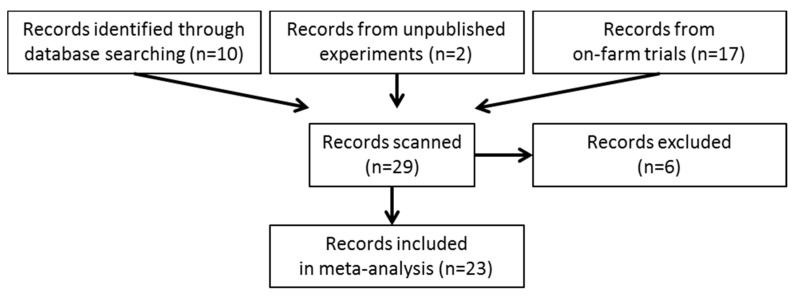
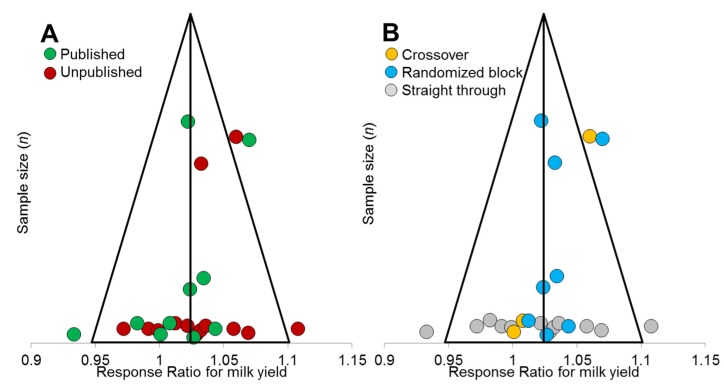
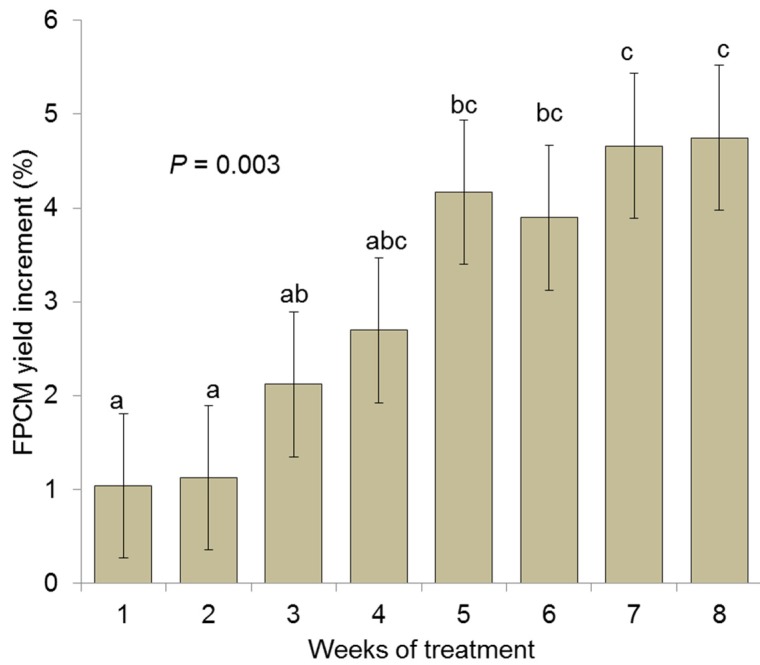
Ruminant on the productivity of dairy cows in comparison to non-treated animals. A total of 23 in vivo studies were identified in which Agolin was supplemented at 1 g/d per cow; then a meta-analysis was performed to determine the response ratio on milk yield, rumen fermentation, methane emissions and health. Results indicated that an adaptation period of at least 4 weeks of treatment is required. Whereas short-term studies showed minor and inconsistent effects of Agolin, long-term studies (>4 weeks of treatment) revealed that Agolin supplementation increases milk yield (+3.6%), fat and protein corrected milk (+4.1%) and feed efficiency (+4.4%) without further changes in milk composition and feed intake. Long-term treatment also decreased methane production per day (-8.8%), per dry matter intake (-12.9%) and per fat and protein corrected milk yield (-9.9%) without changes in rumen fermentation pattern. In conclusion, despite the mode of action is still unclear and the small number of studies considered, these findings show that Agolin represents an encouraging alternative to improve productivity in dairy cows.
Overview
The claims and statistics of this paper haven’t been checked yet.
Run the check — free, no account needed. It reads the open-access text and checks the sources it cites.
Integrity signals
Registry
Cites
Statistics
Figures
Verification
Claims the paper makes
The claims and statistics of this paper haven’t been checked yet.
Run the check — free, no account needed. It reads the open-access text and checks the sources it cites.
Claims other papers make about this one
Each is checked against this paper’s own text: does it say what the citing paper says it does?
The source backs part of the claim, not all of it — or backs it for a different population, condition or comparison.
In the citing paper
“Recently, a meta-analysis showed that dietary supplementation of a blend of EO (coriander, eugenol, and geraniol) increased the milk yield (3.6%), milk fat and protein (4.1%), and feed efficiency (4.4%), while decreasing DM intake (12.9%) and CH4 production (8.8%) during long term trial in dairy cattle (258).”
From Phytogenic Additives Can Modulate Rumen Microbiome to Mediate Fermentation Kinetics and Methanogenesis Through Exploiting Diet–Microbe Interaction (2020) · cites this paper as [258]
Experimental — accuracy not yet measured
Self-check
Percentages, sums and reported differences re-computed from the paper’s own numbers.
The self-check needs the paper’s full text.
Citations
Cites
Preferred Reporting Items for Systematic Reviews and Meta-Analyses: the PRISMA statement
Moher, D., Liberati, A., Tetzlaff, J., Altman, D. G., & for the PRISMA Group (2009) · BMJ · doi:10.1136/bmj.b2535 · Cited by 83,823
Measuring inconsistency in meta-analyses
Higgins, J. P. T., Thompson, S. G., Deeks, J. J., & Altman, D. G. (2003) · BMJ · doi:10.1136/bmj.327.7414.557 · Cited by 63,139
Preferred reporting items for systematic reviews and meta-analyses: the PRISMA Statement.
(2009) · PubMed Central · Cited by 44,859
Meta-analysis in clinical trials
DerSimonian, R., & Laird, N. (1986) · Controlled Clinical Trials · doi:10.1016/0197-2456(86)90046-2 · Cited by 39,552
Preferred reporting items for systematic reviews and meta-analyses: The PRISMA statement
Moher, D., Liberati, A., Tetzlaff, J., Altman, D. G., & the PRISMA Group* (2009) · Annals of Internal Medicine · doi:10.7326/0003-4819-151-4-200908180-00135 · Cited by 37,554
Conducting Meta-Analyses in R with the metafor Package
Viechtbauer, W. (2010) · Journal of Statistical Software · doi:10.18637/jss.v036.i03 · Cited by 20,464
Imputing missing standard deviations in meta-analyses can provide accurate results
Furukawa, T. A., Barbui, C., Cipriani, A., Brambilla, P., & Watanabe, N. (2006) · Journal of Clinical Epidemiology · doi:10.1016/j.jclinepi.2005.06.006 · Cited by 1,568
Invited review: essential oils as modifiers of rumen microbial fermentation
Calsamiglia, S., Busquet, M., Cardozo, P. W., Castillejos, L., & Ferret, A. (2007) · Journal of Dairy Science · doi:10.3168/jds.2006-644 · Cited by 1,014
St-Pierre, N. R. (2001) · Journal of Dairy Science · doi:10.3168/jds.s0022-0302(01)74530-4 · Cited by 846 · cited 1×
“This approach implied the existence of between-studies variance based on the assumption that studies included in the analysis correspond to a random sample of all possible studies [24].”
BackgroundA review of plant-derived essential oils in ruminant nutrition and production
Benchaar, C., Calsamiglia, S., Chaves, A. V., Fraser, G. R., Colombatto, D., McAllister, T. A., & Beauchemin, K. A. (2007) · Animal Feed Science and Technology · doi:10.1016/j.anifeedsci.2007.04.014 · Cited by 664
Research works printed but not linked: 3
- Dunkel, 2016, Die Wirkung der Zulage einer Mischung aus ätherischen Ölen auf die Leistung von Milchkühen. VDLUFA-Schriftenreihe, Tierische Produktion, 69, 592
- Jones, H., Newbold, C.J., and Zweifel, B. (2017, January 26–27). The effect of essential oils on rumen bacteria and protozoa in dairy cattle. Proceedings of the British Society of Animal Science, Chester, UK.
- Borenstein, M., Hedges, L.V., Higgins, J.P., and Rothstein, H.R. (2011). Introduction to meta-analysis, John Wiley & Sons.
Cited by
Sorted by citations
The rumen microbiome: balancing food security and environmental impacts
Mizrahi, I., Wallace, R. J., & Moraïs, S. (2021) · Nature Reviews Microbiology · doi:10.1038/s41579-021-00543-6 · Cited by 490
Invited review: current enteric methane mitigation options
Beauchemin, K. A., Ungerfeld, E. M., Abdalla, A. L., Alvarez, C., Arndt, C., Becquet, P., Benchaar, C., Berndt, A., Mauricio, R. M., McAllister, T. A., et al. (2022) · Journal of Dairy Science · doi:10.3168/jds.2022-22091 · Cited by 324
Role of Secondary Plant Metabolites on Enteric Methane Mitigation in Ruminants
Kú-Vera, J. C., Jiménez‐Ocampo, R., Valencia-Salazar, S. S., Montoya-Flores, M. D., Molina-Botero, I. C., Arango, J., Gómez, C., Aguilar-Pérez, C. F., & Solorio‐Sánchez, F. J. (2020) · Frontiers in Veterinary Science · doi:10.3389/fvets.2020.00584 · Cited by 300
Hassan, F.-U., Arshad, M. A., Ebeid, H. M., Rehman, M. S.-U., Khan, M. S., Shahid, S., & Yang, C. (2020) · Frontiers in Veterinary Science · doi:10.3389/fvets.2020.575801 · Cited by 186
Symposium review: Effective nutritional strategies to mitigate enteric methane in dairy cattle
Hristov, A. N., Audino Melgar, M., Wasson, D. E., & Arndt, C. (2022) · Journal of Dairy Science · doi:10.3168/jds.2021-21398 · Cited by 159
Metadata
- Authors
- Belanche, A., Newbold, C., Morgavi, D., Bach, A., Zweifel, B., & Yáñez-Ruiz, D.
- Affiliations
- Consejo Superior de Investigaciones Científicas (ES)
- Scotland's Rural College (GB)
- Université Clermont Auvergne (FR)
- Institució Catalana de Recerca i Estudis Avançats (ICREA), 08005 Barcelona, Spain
- Agolin SA, 1145 Bière, Switzerland
- Estación Experimental del Zaidín, Consejo Superior de Investigaciones Científicas (CSIC), Profesor Albareda 1, 18008 Granada, Spain
- Corresponding author
- Belanche, Alejandro
- Venue
- Animals
- Publisher
- MDPI AG
- Published
- 2020-04-03
- Volume
- 10
- Issue
- 4
- Pages
- 620
- ISSN
- 2076-2615 (ISSN-L)
- PMC
- PMC7222807
- OpenAlex
- W3014733351
- Cited by
- 143
- References
- 42
- Citations by year
- 2026: 19 · 2025: 23 · 2024: 32 · 2023: 27 · 2022: 20 · 2021: 19 · 2020: 3
- FWCI
- 2.33
- Type
- journal article
- Language
- en
- Open access
- gold
- dx.doi.org
- Licence
- Locations
- Animals (publishedVersion, cc-by)
- PubMed Central (publishedVersion, cc-by)
- PubMed (publishedVersion)
- LA Referencia (Red Federada de Repositorios Institucionales de Publicaciones Científicas) (publishedVersion, cc-by)
- HAL (submittedVersion, cc-by)
- DIGITAL.CSIC (Spanish National Research Council (CSIC)) (submittedVersion, cc-by)
- DOAJ (DOAJ: Directory of Open Access Journals) (submittedVersion, cc-by-sa)
- IRTA (Institut de Recerca i Tecnologia Agroalimentaries) (submittedVersion, cc-by)
- Topics
- Life Sciences › Agricultural and Biological Sciences › Animal Science and Zoology › Ruminant Nutrition and Digestive Physiology
- Life Sciences › Agricultural and Biological Sciences › Animal Science and Zoology › Animal Nutrition and Physiology
- Life Sciences › Agricultural and Biological Sciences › Animal Science and Zoology › Milk Quality and Mastitis in Dairy Cows
- Keywords
- essential oil blends, dairy cattle, milk yield, rumen fermentation, methane emissions, feed efficiency, feed additives, adaptation period, ruminant nutrition
About these checks
Registry, retraction, Cites and statistics results are computed, not judged, with one exception: a printed reference that no index lists is read once by a model before it counts as a citation error. Claims are extracted by a model and kept only when their quote appears verbatim in the text; each cited source is then checked, with a model’s help, for whether it says what the claim relies on. Those verdicts can be wrong — read the claim’s quote and the cited source before relying on one.
Statistics and arithmetic are recomputed, not judged.
Confidence bands are shown only for fields calibrated on our annotated test set. None is calibrated yet, so no band is shown.
What counts as a claim ›How we measure confidence ›How we check this ›
Are you an author, or do you see a problem with this page? Request a review
