

Probiotics for the Primary and Secondary Prevention of C. difficile Infections: A Meta-analysis and Systematic Review
Open accessThe DOI matches its Crossref record; 59 of the 60 references it cites were found in a registry or an index.
Abstract
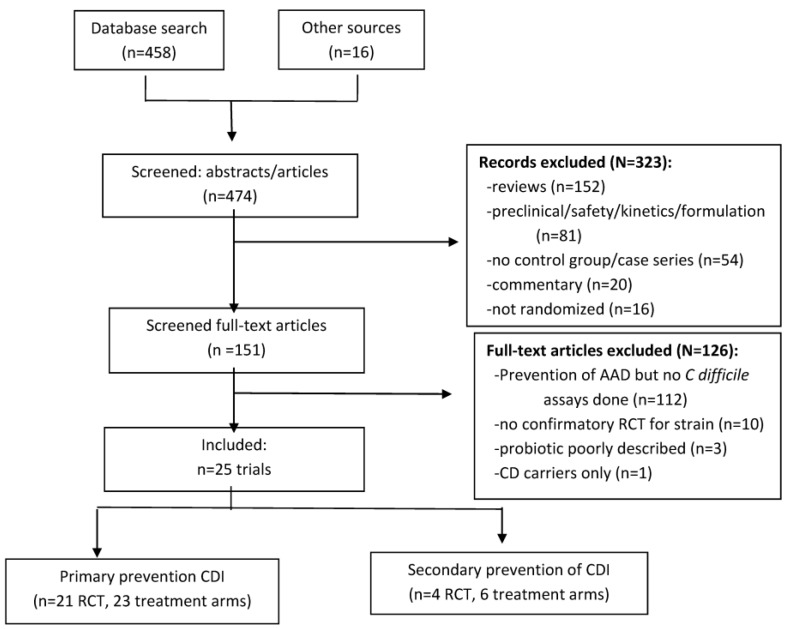
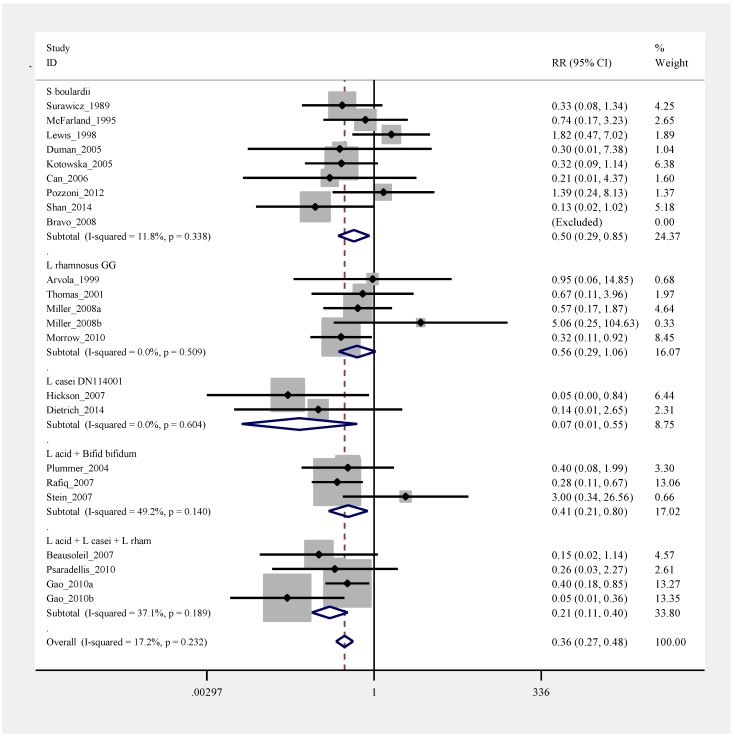
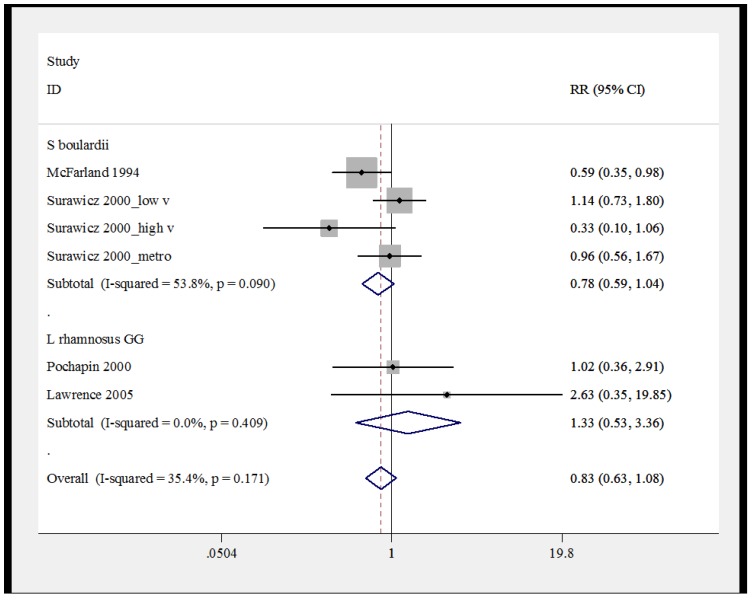
Clostridium difficile infections are a global clinical concern and are one of the leading causes of nosocomial outbreaks. Preventing these infections has benefited from multidisciplinary infection control strategies and new antibiotics, but the problem persists. Probiotics are effective in preventing antibiotic-associated diarrhea and may also be a beneficial strategy for C. difficile infections, but randomized controlled trials are scarce. This meta-analysis pools 21 randomized, controlled trials for primary prevention of C. difficile infections (CDI) and four trials for secondary prevention of C. difficile recurrences and assesses the efficacy of specific probiotic strains. Four probiotics significantly improved primary CDI prevention: (Saccharomyces boulardii, Lactobacillus casei DN114001, a mixture of L. acidophilus and Bifidobacterium bifidum, and a mixture of L. acidophilus, L. casei and L. rhamnosus). None of the tested probiotics significantly improved secondary prevention of CDI. More confirmatory randomized trials are needed to establish if probiotics are useful for preventing C. difficile infections. v
Overview
The claims and statistics of this paper haven’t been checked yet.
Free: it reads the open-access text and checks the first 5 claims that cite a source we can check. Create a free account to check every claim.
Integrity signals
Registry
Cites
Statistics
Figures
Verification
Claims the paper makes
The claims and statistics of this paper haven’t been checked yet.
Free: it reads the open-access text and checks the first 5 claims that cite a source we can check. Create a free account to check every claim.
Self-check
Percentages, sums and reported differences re-computed from the paper’s own numbers.
The self-check needs the paper’s full text.
Citations
Cites
Measuring inconsistency in meta-analyses
Higgins, J. P. T., Thompson, S. G., Deeks, J. J., & Altman, D. G. (2003) · BMJ · doi:10.1136/bmj.327.7414.557 · Cited by 63,139 · cited 1×
“Heterogeneity across trials was evaluated using Cochran Q test based on pooled relative risks by the Mantel-Haenazel method [54].”
MethodBias in meta-analysis detected by a simple, graphical test
Egger, M., Smith, G. D., Schneider, M., & Minder, C. (1997) · BMJ · doi:10.1136/bmj.315.7109.629 · Cited by 56,722 · cited 2×
“This meta-analysis followed PRISMA (Preferred Reporting Items for Systematic reviews and Meta-Analysis) statement guidelines [51] and guidelines using clearly delineated parameters, a priori inclusion and exclusion criteria and standardized data extraction tools [52,53] Systematic searches of PubMed (1960–2015), EMBAS…”
MethodLiberati, A., Altman, D. G., Tetzlaff, J., Mulrow, C., Gøtzsche, P. C., Ioannidis, J. P. A., Clarke, M., Devereaux, P. J., Kleijnen, J., & Moher, D. (2009) · PLoS Medicine · doi:10.1371/journal.pmed.1000100 · Cited by 28,164
Liberati, A., Altman, D. G., Tetzlaff, J., Mulrow, C., Gotzsche, P. C., Ioannidis, J. P. A., Clarke, M., Devereaux, P. J., Kleijnen, J., & Moher, D. (2009) · BMJ · doi:10.1136/bmj.b2700 · Cited by 17,648
Operating characteristics of a rank correlation test for publication bias
Begg, C. B., & Mazumdar, M. (1994) · Biometrics · doi:10.2307/2533446 · Cited by 16,955 · cited 1×
“To assess for publication bias, a funnel plot, as well as a weighted regression (Egger’s test) and a rank correlation test (Begg’s test for small study effects) were conducted [52,55].”
MethodMoher, D., Hopewell, S., Schulz, K. F., Montori, V., Gotzsche, P. C., Devereaux, P. J., Elbourne, D., Egger, M., & Altman, D. G. (2010) · BMJ · doi:10.1136/bmj.c869 · Cited by 8,883
Burden of Clostridium difficile Infection in the United States
Lessa, F. C., Mu, Y., Bamberg, W. M., Beldavs, Z. G., Dumyati, G. K., Dunn, J. R., Farley, M. M., Holzbauer, S. M., Meek, J. I., Phipps, E. C., et al. (2015) · New England Journal of Medicine · doi:10.1056/nejmoa1408913 · Cited by 2,641 · cited 1×
“[1].”
Comparison of two methods to detect publication bias in meta-analysis.
Peters, J. L. (2006) · JAMA · doi:10.1001/jama.295.6.676 · Cited by 2,278 · cited 1×
“Reporting bias (smaller studies showing no protective effect) often are not published, and are indicated by an asymmetrical appearance with a gap in the bottom left of a funnel plot [56].”
BackgroundMoher, D., Hopewell, S., Schulz, K. F., Montori, V., Gøtzsche, P. C., Devereaux, P. J., Elbourne, D., Egger, M., & Altman, D. G. (2010) · Journal of Clinical Epidemiology · doi:10.1016/j.jclinepi.2010.03.004 · Cited by 1,858
Guidelines for diagnosis, treatment, and prevention of Clostridium difficile infections
Surawicz, C. M., Brandt, L. J., Binion, D. G., Ananthakrishnan, A. N., Curry, S. R., Gilligan, P. H., McFarland, L. V., Mellow, M., & Zuckerbraun, B. S. (2013) · American Journal of Gastroenterology · doi:10.1038/ajg.2013.4 · Cited by 1,645
Self-citation
Research works printed but not linked: 1
- Rafiq R. Prevention of Clostridium difficile (C. difficile) diarrhea with probiotic in hospitalized patients treated with antibiotics Gastroenterology 2007 132 A187
Cited by
Items 101–114 of 114
Hiroshima University Affiliated Hospital Probiotics Usage Guidelines
Hiyama, T., Kunihiro, M., Asayama, N., Urabe, Y., Okanobu, H., Onogawa, S., Kunihiro, K., Kuwai, T., Kodama, M., Sanomura, Y., et al. (2023) · Nihon Daicho Komonbyo Gakkai Zasshi · doi:10.3862/jcoloproctology.76.467
SidharthMidha, Shukla, S., DivyanshuDhamija, Bello, A. O., Khan, A., DheerajGutlapalli, S., MehvishSohail, Patel, P., & Mohammed, L. (2023) · Journal For International Medical Graduates · doi:10.56570/jimgs.v2i2.107
“[9], Lactobacillus caseiShirota was found to produce an antimicrobial substance that inhibited the growth of C.”
BackgroundEditorial: Prerequisites for a Successful Probiotic Therapy in Dysbiosis
Dolai, S., & Borody, T. J. (2022) · JOURNAL OF GASTROINTESTINAL INFECTIONS · doi:10.1055/s-0042-1759787
Abinash, R., Karthick, A., & Jegan, G. (2023) · Biosciences Biotechnology Research Asia · doi:10.13005/bbra/3190
Probiotics as Curators of a Healthy Gut Microbiota
Mills, S., Murphy, A., Dinan, T. G., Cryan, J. F., Stanton, C., & Ross, R. P. (2024) · Elsevier eBooks · doi:10.1016/b978-0-323-99971-7.00006-0
Isolation and Characterization of Probiotic Lactic Acid Bacteria from Human Saliva
Kumaresan, V., & Punamalai, G. (2024) · International Journal of Biosciences (IJB) · doi:10.12692/ijb/25.1.13-22
Uso de probióticos en patología gastrointestinal desde atención primaria
Pérez, A. R. (2025) · TITULA
Caractérisation du biofilm de Clostridium difficile : du support inerte à la colonisation digestive
Soavelomandroso, A. P. (2017) · theses.fr (ABES) · doi:10.70675/623af393zbbf6z4acez85cdzb7359299582a
Caractérisation du microbiote intestinal des enfants atteints de la malnutrition aigüe sévère
Pham, T. P. T. (2019) · theses.fr (ABES) · doi:10.70675/003bce66z53a3z4bf4zb0dez43e6bb672e0f
Ataei-Alamdari, S., Alimardani, F., Afkhami, H., Kashfi, M., & Yousefi, M. H. (2026) · New Microbes and New Infections · doi:10.1016/j.nmni.2026.101804
“The probiotic could help restore gut microbiota diversity by promoting beneficial microbial populations [62,63], while the phage cocktail would directly target and lyse C. difficile cells, reducing bacterial proliferation and toxin-mediated damage [64,65].”
Probiotics unveiled: bridging general health benefits to the era of precision medicine
Ullah, M., Rizwan, M., Waheed, M. I., Alam, M. S., Jan, S. U., Raza, A., Shahid, M. F., Andoh, V., & Chen, Y. (2026) · World Journal of Microbiology and Biotechnology · doi:10.1007/s11274-026-05143-1
Kovačević, P., Mrdja, V., Kovačević, T., Mrdja, J., Soldatović, I., & Rajkovača, Z. (2026) · Antibiotics · doi:10.3390/antibiotics15090868
“Other systematic reviews have likewise found insufficient or inconsistent evidence for the use of S. boulardii in primary CDI prevention, while suggesting that selected probiotic regimens may have a role in reducing recurrence in particular patient populations [18,19].”
Diego, L. D. (n.d.) · UnissResearch (Università degli Studi di Sassari)
Metadata
- Authors
- McFarland, L.
- Affiliations
- University of Washington (US)
- Corresponding author
- McFarland, Lynne
- ORCID
- McFarland, Lynne
- Venue
- Antibiotics
- Publisher
- MDPI AG
- Published
- 2015-04-13
- Volume
- 4
- Issue
- 2
- Pages
- 160-178
- ISSN
- 2079-6382 (ISSN-L)
- PMC
- PMC4790329
- OpenAlex
- W2036627873
- Cited by
- 109
- References
- 60
- Citations by year
- 2026: 7 · 2025: 3 · 2024: 9 · 2023: 9 · 2022: 12 · 2021: 6 · 2020: 13 · 2019: 13 · 2018: 9 · 2017: 11 · 2016: 15 · 2015: 2
- FWCI
- 1.87
- Type
- journal article
- Language
- en
- Open access
- gold
- dx.doi.org
- Licence
- Locations
- Antibiotics (publishedVersion, cc-by)
- PubMed Central (publishedVersion, cc-by)
- PubMed (publishedVersion)
- DOAJ (DOAJ: Directory of Open Access Journals) (submittedVersion)
- Topics
- Health Sciences › Medicine › Infectious Diseases › Clostridium difficile and Clostridium perfringens research
- Life Sciences › Agricultural and Biological Sciences › Food Science › Probiotics and Fermented Foods
- Life Sciences › Biochemistry, Genetics and Molecular Biology › Molecular Biology › Gut microbiota and health
- Keywords
- probiotics, Clostridium difficile infection, primary prevention, secondary prevention, recurrence prevention, Saccharomyces boulardii, Lactobacillus casei, Lactobacillus acidophilus, Bifidobacterium bifidum, Lactobacillus rhamnosus, nosocomial infections, antibiotic-associated diarrhea
About these checks
Registry, retraction, Cites and statistics results are computed, not judged, with one exception: a printed reference that no index lists is read once by a model before it counts as a citation error. Claims are extracted by a model and kept only when their quote appears verbatim in the text; each cited source is then checked, with a model’s help, for whether it says what the claim relies on. Those verdicts can be wrong — read the claim’s quote and the cited source before relying on one.
Statistics and arithmetic are recomputed, not judged.
Confidence bands are shown only for fields calibrated on our annotated test set. None is calibrated yet, so no band is shown.
What counts as a claim ›How we measure confidence ›How we check this ›
Are you an author, or do you see a problem with this page? Request a review
Data sources
Bibliographic data: Semantic Scholar, OpenAlex, Crossref.
Contains information from the Semantic Scholar Academic Graph Datasets, made available under the ODC Attribution License (ODC-BY 1.0).
Semantic Scholar’s data is described in: Kinney, R., et al. (2023). The Semantic Scholar Open Data Platform. arXiv:2301.10140.
