

The DOI matches its Crossref record; 215 of the 215 references it cites were found in a registry or an index.
Microalgae Produce Antioxidant Molecules with Potential Preventive Effects on Mitochondrial Functions and Skeletal Muscular Oxidative Stress
Open accessAbstract
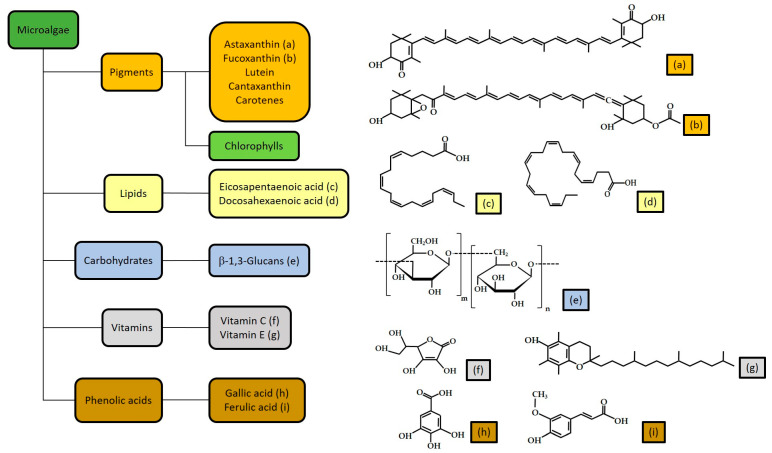
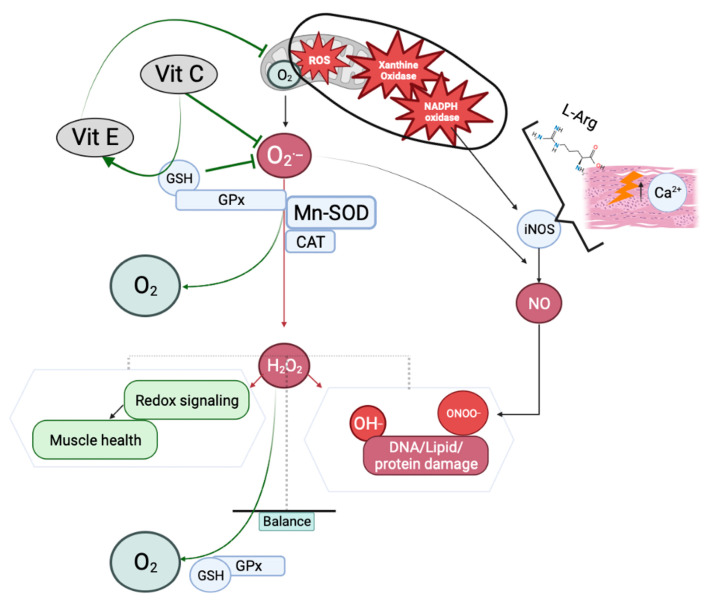
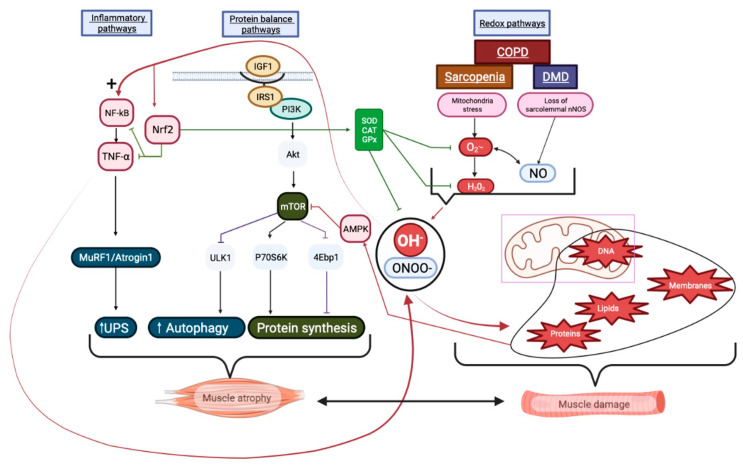
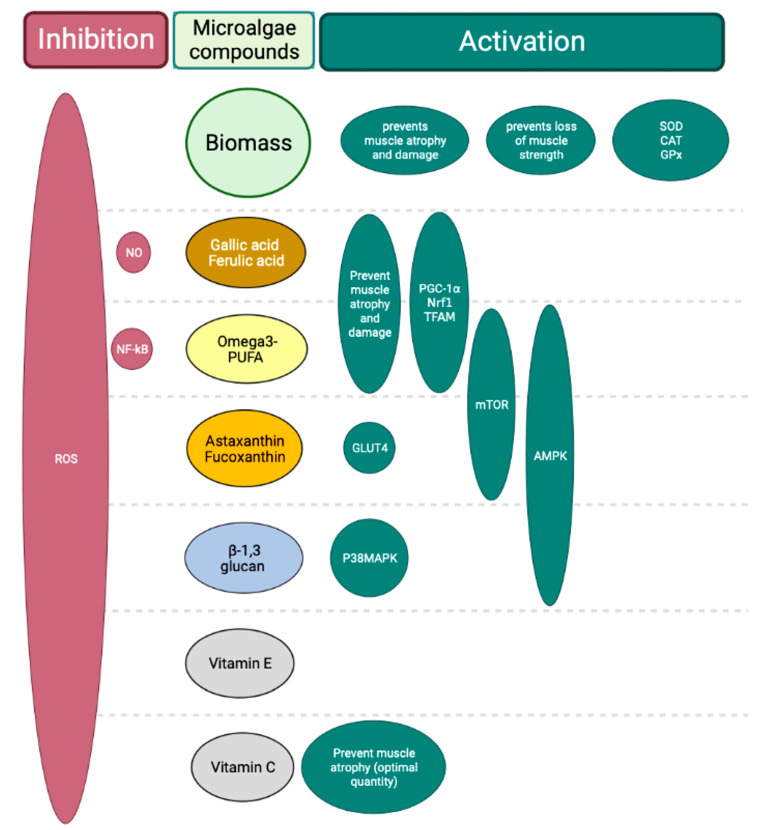
In recent years, microalgae have become a source of molecules for a healthy life. Their composition of carbohydrates, peptides, lipids, vitamins and carotenoids makes them a promising new source of antioxidant molecules. Skeletal muscle is a tissue that requires constant remodeling via protein turnover, and its regular functioning consumes energy in the form of adenosine triphosphate (ATP), which is produced by mitochondria. Under conditions of traumatic exercise or muscular diseases, a high production of reactive oxygen species (ROS) at the origin of oxidative stress (OS) will lead to inflammation and muscle atrophy, with life-long consequences. In this review, we describe the potential antioxidant effects of microalgae and their biomolecules on mitochondrial functions and skeletal muscular oxidative stress during exercises or in musculoskeletal diseases, as in sarcopenia, chronic obstructive pulmonary disease (COPD) and Duchenne muscular dystrophy (DMD), through the increase in and regulation of antioxidant pathways and protein synthesis.
Overview
The claims and statistics of this paper haven’t been checked yet.
Run the check — free, no account needed. It reads the open-access text and checks the sources it cites.
Integrity signals
Registry
Cites
Statistics
Figures
Verification
Claims the paper makes
The claims and statistics of this paper haven’t been checked yet.
Run the check — free, no account needed. It reads the open-access text and checks the sources it cites.
Claims other papers make about this one
Each is checked against this paper’s own text: does it say what the citing paper says it does?
The cited source says what the claim attributes to it.
In the citing paper
“Finally, novel evidence suggests that microalgae may protect mitochondrial function and muscle tissue from oxidative damage, offering benefits for ageing populations and individuals with metabolic or muscular disorders [47].”
From Microalgae Bioactives for Functional Food Innovation and Health Promotion (2025) · cites this paper as [47]
Self-check
Percentages, sums and reported differences re-computed from the paper’s own numbers.
The self-check needs the paper’s full text.
Citations
Cites
Sarcopenia: revised European consensus on definition and diagnosis
Cruz-Jentoft, A. J., Bahat, G., Bauer, J., Boirie, Y., Bruyère, O., Cederholm, T., Cooper, C., Landi, F., Rolland, Y., Sayer, A. A., et al. (2019) · Age and Ageing · doi:10.1093/ageing/afy169 · Cited by 13,818
Sarcopenia: European consensus on definition and diagnosis
Cruz-Jentoft, A. J., Baeyens, J. P., Bauer, J. M., Boirie, Y., Cederholm, T., Landi, F., Martin, F. C., Michel, J.-P., Rolland, Y., Schneider, S. M., et al. (2010) · Age and Ageing · doi:10.1093/ageing/afq034 · Cited by 11,601
NF-κB signaling in inflammation
Liu, T., Zhang, L., Joo, D., & Sun, S.-C. (2017) · Signal Transduction and Targeted Therapy · doi:10.1038/sigtrans.2017.23 · Cited by 8,791
Levine, B., & Klionsky, D. J. (2004) · Developmental Cell · doi:10.1016/s1534-5807(04)00099-1 · Cited by 3,728
Juan, C. A., Pérez de la Lastra, J. M., Plou, F. J., & Pérez-Lebeña, E. (2021) · International Journal of Molecular Sciences · doi:10.3390/ijms22094642 · Cited by 2,810
Bodine, S. C., Stitt, T. N., Gonzalez, M., Kline, W. O., Stover, G. L., Bauerlein, R., Zlotchenko, E., Scrimgeour, A., Lawrence, J. C., Glass, D. J., et al. (2001) · Nature Cell Biology · doi:10.1038/ncb1101-1014 · Cited by 2,752
Mitochondria as multifaceted regulators of cell death
Bock, F. J., & Tait, S. W. G. (2019) · Nature Reviews Molecular Cell Biology · doi:10.1038/s41580-019-0173-8 · Cited by 2,531
Gleeson, M., Bishop, N. C., Stensel, D. J., Lindley, M. R., Mastana, S. S., & Nimmo, M. A. (2011) · Nature Reviews Immunology · doi:10.1038/nri3041 · Cited by 2,470
Exercise-Induced Oxidative Stress: Cellular Mechanisms and Impact on Muscle Force Production
Powers, S. K., & Jackson, M. J. (2008) · Physiological Reviews · doi:10.1152/physrev.00031.2007 · Cited by 2,459
Nutrient-dependent mTORC1 Association with the ULK1–Atg13–FIP200 Complex Required for Autophagy
Hosokawa, N., Hara, T., Kaizuka, T., Kishi, C., Takamura, A., Miura, Y., Iemura, S.-I., Natsume, T., Takehana, K., Yamada, N., et al. (2009) · Molecular Biology of the Cell · doi:10.1091/mbc.e08-12-1248 · Cited by 2,076
Cited by
Sorted by citations
Pereira, L., & Valado, A. (2023) · Life · doi:10.3390/life13091831 · Cited by 59
Mavrommatis, A., Tsiplakou, E., Zerva, A., Pantiora, P. D., Georgakis, N., Tsintzou, G. P., Madesis, P. B., & Labrou, N. E. (2023) · Antioxidants · doi:10.3390/antiox12101882 · Cited by 59
Microalgae Bioactives for Functional Food Innovation and Health Promotion
Guil-Guerrero, J. L., & Prates, J. A. M. (2025) · Foods · doi:10.3390/foods14122122 · Cited by 47
“Finally, novel evidence suggests that microalgae may protect mitochondrial function and muscle tissue from oxidative damage, offering benefits for ageing populations and individuals with metabolic or muscular disorders [47].”
Antioxidants from microalgae and their potential impact on human well-being
Pereira, L., Cotas, J., & Valado, A. (2024) · Exploration of Drug Science · doi:10.37349/eds.2024.00048 · Cited by 48
Dhanker, R., Khatana, K., Verma, K., Singh, A., Heena, Kumar, R., & Mohamed, H. I. (2023) · Biocatalysis and Agricultural Biotechnology · doi:10.1016/j.bcab.2023.102936 · Cited by 48
Metadata
- Authors
- Vignaud, J., Loiseau, C., Hérault, J., Mayer, C., Côme, M., Martin, I., & Ulmann, L.
- Affiliations
- Le Mans Université (FR)
- BiOSSE (Biology of Organisms, Stress, Health, Environment), Institut Universitaire de Technologie, Département Génie Biologique, Le Mans Université, F-53020 Laval, France
- Corresponding author
- Ulmann, Lionel
- Venue
- Antioxidants
- Publisher
- MDPI AG
- Published
- 2023-05-05
- Volume
- 12
- Issue
- 5
- Pages
- 1050
- ISSN
- 2076-3921 (ISSN-L)
- PMC
- PMC10215861
- OpenAlex
- W4372347288
- Cited by
- 72
- References
- 213
- Citations by year
- 2026: 19 · 2025: 31 · 2024: 16 · 2023: 6
- FWCI
- 2.44
- Type
- journal article
- Language
- en
- Open access
- gold
- doi.org
- Licence
- Locations
- Antioxidants (publishedVersion, cc-by)
- PubMed Central (publishedVersion, cc-by)
- PubMed (publishedVersion)
- HAL (submittedVersion, other-oa)
- DOAJ (DOAJ: Directory of Open Access Journals) (submittedVersion, cc-by-sa)
- Funders
- Collectivités Locales Mayennaises
- Topics
- Health Sciences › Medicine › Physiology (medical) › Exercise and Physiological Responses
- Life Sciences › Biochemistry, Genetics and Molecular Biology › Molecular Biology › Muscle Physiology and Disorders
- Life Sciences › Agricultural and Biological Sciences › Aquatic Science › Seaweed-derived Bioactive Compounds
- Keywords
- microalgae, antioxidants, mitochondrial function, reactive oxygen species, sarcopenia, chronic obstructive pulmonary disease, Duchenne muscular dystrophy, exercise-induced muscle damage, muscle atrophy, antioxidant pathways, protein synthesis, carotenoids
About these checks
Registry, retraction, Cites and statistics results are computed, not judged, with one exception: a printed reference that no index lists is read once by a model before it counts as a citation error. Claims are extracted by a model and kept only when their quote appears verbatim in the text; each cited source is then checked, with a model’s help, for whether it says what the claim relies on. Those verdicts can be wrong — read the claim’s quote and the cited source before relying on one.
Statistics and arithmetic are recomputed, not judged.
Confidence bands are shown only for fields calibrated on our annotated test set. None is calibrated yet, so no band is shown.
What counts as a claim ›How we measure confidence ›How we check this ›
Are you an author, or do you see a problem with this page? Request a review
