

Research Progress in Calcitonin Gene-Related Peptide and Bone Repair
Open accessThe DOI matches its Crossref record; 135 of the 135 references it cites were found in a registry or an index.
Abstract
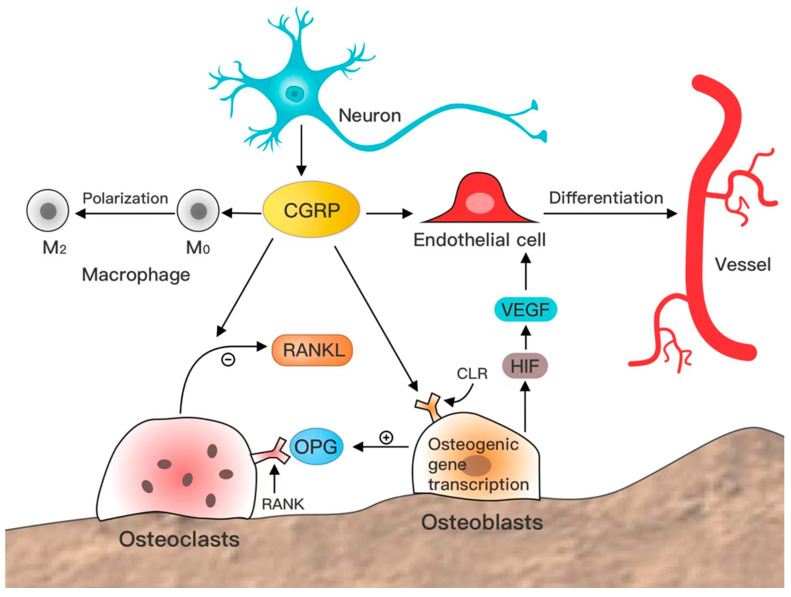
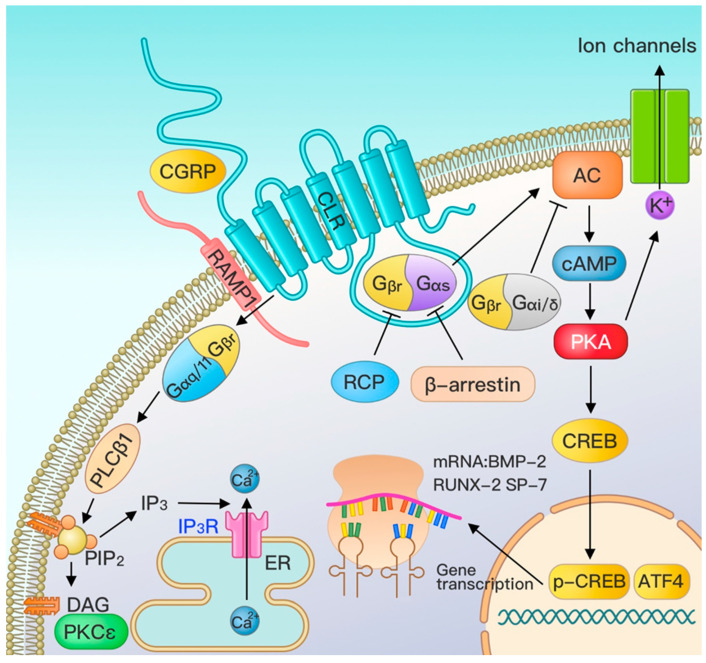
Calcitonin gene-related peptide (CGRP) has 37 amino acids. Initially, CGRP had vasodilatory and nociceptive effects. As research progressed, evidence revealed that the peripheral nervous system is closely associated with bone metabolism, osteogenesis, and bone remodeling. Thus, CGRP is the bridge between the nervous system and the skeletal muscle system. CGRP can promote osteogenesis, inhibit bone resorption, promote vascular growth, and regulate the immune microenvironment. The G protein-coupled pathway is vital for its effects, while MAPK, Hippo, NF-κB, and other pathways have signal crosstalk, affecting cell proliferation and differentiation. The current review provides a detailed description of the bone repair effects of CGRP, subjected to several therapeutic studies, such as drug injection, gene editing, and novel bone repair materials.
Overview
The claims and statistics of this paper haven’t been checked yet.
Free: it reads the open-access text and checks the first 5 claims that cite a source we can check. Create a free account to check every claim.
Integrity signals
Registry
Cites
Statistics
Figures
Verification
Claims the paper makes
The claims and statistics of this paper haven’t been checked yet.
Free: it reads the open-access text and checks the first 5 claims that cite a source we can check. Create a free account to check every claim.
Claims other papers make about this one
Each is checked against this paper’s own text: does it say what the citing paper says it does?
The source backs part of the claim, not all of it — or backs it for a different population, condition or comparison.
In the citing paper
“Sensory nerves (Aδ and C fibers) release neuropeptides like substance P (SP) and calcitonin gene-related peptide (CGRP), which shape bone remodeling, stimulate osteoblast differentiation, and are vital for fracture healing [32]”
From Interorgan Communications in Skeletal Pathophysiology: From Molecular Pathways to Multidisciplinary Therapies (2026) · cites this paper as [32]
Experimental — accuracy not yet measured
Self-check
Percentages, sums and reported differences re-computed from the paper’s own numbers.
The self-check needs the paper’s full text.
Citations
Cites
Peptide therapeutics: current status and future directions
Fosgerau, K., & Hoffmann, T. (2015) · Drug Discovery Today · doi:10.1016/j.drudis.2014.10.003 · Cited by 3,030 · cited 1×
“Overcoming the shortcomings of natural peptides through reasonable design is the future direction of peptide therapy [135].”
BackgroundRAMPs regulate the transport and ligand specificity of the calcitonin-receptor-like receptor
McLatchie, L. M., Fraser, N. J., Main, M. J., Wise, A., Brown, J., Thompson, N., Solari, R., Lee, M. G., & Foord, S. M. (1998) · Nature · doi:10.1038/30666 · Cited by 2,134 · cited 1×
“This creates a CLR-RAMP1 dimer for CGRP to bind and function with CLR; thus, RAMP1 is essential for CLR function [9].”
Leptin regulation of bone resorption by the sympathetic nervous system and CART
Elefteriou, F., Ahn, J. D., Takeda, S., Starbuck, M., Yang, X., Liu, X., Kondo, H., Richards, W. G., Bannon, T. W., Noda, M., et al. (2005) · Nature · doi:10.1038/nature03398 · Cited by 1,311 · cited 1×
“ATF4 is an ATF/CREB family member, a cell-specific CREB-related transcriptional essential for osteoblast differentiation and function factor [65].”
BackgroundCalcitonin Gene-Related Peptide: Physiology and Pathophysiology
Russell, F. A., King, R., Smillie, S.-J., Kodji, X., & Brain, S. D. (2014) · Physiological Reviews · doi:10.1152/physrev.00034.2013 · Cited by 1,258 · cited 5×
“Calcitonin gene-related peptide (CGRP) is a polypeptide with 37 amino acids [1].”
BackgroundInfluentialZhang, Y., Xu, J., Ruan, Y. C., Yu, M. K., O'Laughlin, M., Wise, H., Chen, D., Tian, L., Shi, D., Wang, J., et al. (2016) · Nature Medicine · doi:10.1038/nm.4162 · Cited by 1,051 · cited 6×
“Thus, local bone defect repairing was induced by releasing CGRP from nerve endings within the periosteum [75].”
BackgroundInfluentialMesenchymal stem cell-macrophage crosstalk and bone healing
Pajarinen, J., Lin, T., Gibon, E., Kohno, Y., Maruyama, M., Nathan, K., Lu, L., Yao, Z., & Goodman, S. B. (2019) · Biomaterials · doi:10.1016/j.biomaterials.2017.12.025 · Cited by 999 · cited 2×
“In contrast, M2 macrophages later affect bone matrix mineralization [55], which aligns with the prevailing view of immune regulation of bone repair.”
BackgroundCGRP as the target of new migraine therapies — successful translation from bench to clinic
Edvinsson, L., Haanes, K. A., Warfvinge, K., & Krause, D. N. (2018) · Nature Reviews Neurology · doi:10.1038/s41582-018-0003-1 · Cited by 999 · cited 1×
“CGRP receptor antagonists and monoclonal antibodies effectively relieve migraine [33].”
BackgroundZhao, D., Witte, F., Lu, F., Wang, J., Li, J., & Qin, L. (2017) · Biomaterials · doi:10.1016/j.biomaterials.2016.10.017 · Cited by 945 · cited 1×
“Mg and its alloys have good biodegradability and biocompatibility and can become bone-replacement materials [129].”
BackgroundTsuji, K., Bandyopadhyay, A., Harfe, B. D., Cox, K., Kakar, S., Gerstenfeld, L., Einhorn, T., Tabin, C. J., & Rosen, V. (2006) · Nature Genetics · doi:10.1038/ng1916 · Cited by 822
Regulation of Langerhans cell function by nerves containing calcitonin gene-related peptide
Hosoi, J., Murphy, G. F., Egan, C. L., Lerner, E. A., Grabbe, S., Asahina, A., & Granstein, R. D. (1993) · Nature · doi:10.1038/363159a0 · Cited by 631
Cited by
Singh, J., Hashmi, A. W., Ahmad, S., & Tian, Y. (2024) · Inorganic Chemistry Communications · doi:10.1016/j.inoche.2024.113111 · Cited by 80
Entangled cellular and molecular relationships at the sensory neuron-cancer interface
Sur, D., Zeng, Y., Kobayashi, H. H., Zhi, X., Goetz, M. R., Müller, C., Zavitsanou, A., Picoli, C. C., Matos, A. A. M., Pareja, J. R., et al. (2025) · Neuron · doi:10.1016/j.neuron.2025.07.017 · Cited by 34
Jiang, Q., Zhou, L., Yang, Y., Long, H., Ge, L., Li, D., Mu, C., Lai, W., Xu, Z., & Wang, Y. (2024) · Chemical Engineering Journal · doi:10.1016/j.cej.2024.154627 · Cited by 30
Zhan, C., Dai, Q., Ren, J., Jin, L., Wang, W., Ye, Z., Tsoi, J. K. H., & Lin, Y. (2025) · Advanced Science · doi:10.1002/advs.202506438 · Cited by 34
Shu, Y., Tan, Z., Pan, Z., Chen, Y., Wang, J., He, J., Wang, J., & Wang, Y. (2024) · Cell Death and Differentiation · doi:10.1038/s41418-024-01368-5 · Cited by 29
“Blunt dissection was used to expose the femur from the intermuscular space fully.”
Metadata
- Authors
- Wang, Q., Qin, H., Deng, J., Xu, H., Liu, S., Weng, J., & Zeng, H.
- Affiliations
- Shenzhen University (CN)
- Peking University Shenzhen Hospital (CN)
- Corresponding author
- Weng, Jian
- Zeng, Hui
- Venue
- Biomolecules
- Publisher
- MDPI AG
- Published
- 2023-05-15
- Volume
- 13
- Issue
- 5
- Pages
- 838
- ISSN
- 2218-273X (ISSN-L)
- PMC
- PMC10216440
- OpenAlex
- W4376614395
- Cited by
- 58
- References
- 135
- Citations by year
- 2026: 21 · 2025: 19 · 2024: 16 · 2023: 2
- FWCI
- 1.53
- Type
- journal article
- Language
- en
- Open access
- gold
- doi.org
- Licence
- Locations
- Biomolecules (publishedVersion, cc-by)
- PubMed Central (publishedVersion, cc-by)
- PubMed (publishedVersion)
- DOAJ (DOAJ: Directory of Open Access Journals) (submittedVersion, cc-by-sa)
- Funders
- National Natural Science Foundation of China (82172432, 82001319, 82102568, XMHT20190204007, ZDSYS20220606100602005, SZXK023, SZSM201612092, Z2021N054, JCYJ20210324110214040, JCYJ20190809152409606)
- National & Local Joint Engineering Research Center of Orthopaedic Biomaterials (82172432, 82001319, 82102568, XMHT20190204007, ZDSYS20220606100602005, SZXK023, SZSM201612092, Z2021N054, JCYJ20210324110214040, JCYJ20190809152409606)
- Shenzhen Key Laboratory of Orthopedic Diseases and Biomaterials Research (82172432, 82001319, 82102568, XMHT20190204007, ZDSYS20220606100602005, SZXK023, SZSM201612092, Z2021N054, JCYJ20210324110214040, JCYJ20190809152409606)
- Shenzhen Key Medical Discipline Construction Fund (82172432, 82001319, 82102568, XMHT20190204007, ZDSYS20220606100602005, SZXK023, SZSM201612092, Z2021N054, JCYJ20210324110214040, JCYJ20190809152409606)
- Shenzhen “San-Ming” Project of Medicine (82172432, 82001319, 82102568, XMHT20190204007, ZDSYS20220606100602005, SZXK023, SZSM201612092, Z2021N054, JCYJ20210324110214040, JCYJ20190809152409606)
- Research and Development Projects of Shenzhen (82172432, 82001319, 82102568, XMHT20190204007, ZDSYS20220606100602005, SZXK023, SZSM201612092, Z2021N054, JCYJ20210324110214040, JCYJ20190809152409606)
- Shenzhen Science and Technology Program (82172432, 82001319, 82102568, XMHT20190204007, ZDSYS20220606100602005, SZXK023, SZSM201612092, Z2021N054, JCYJ20210324110214040, JCYJ20190809152409606)
- Topics
- Life Sciences › Biochemistry, Genetics and Molecular Biology › Molecular Biology › Bone Metabolism and Diseases
- Life Sciences › Neuroscience › Cellular and Molecular Neuroscience › Neuropeptides and Animal Physiology
- Physical Sciences › Engineering › Biomedical Engineering › Bone Tissue Engineering Materials
- Keywords
- calcitonin gene-related peptide, bone regeneration, bone remodeling, bone formation, bone resorption, peripheral nervous system, G protein-coupled receptor signaling, MAPK signaling, Hippo signaling pathway, NF-κB signaling, signaling crosstalk, bone vascularization, immune microenvironment, genome editing, bone repair materials
- MeSH terms
- Bone Resorption, Humans, Osteogenesis, Calcitonin Gene-Related Peptide, NF-kappa B, Bone Remodeling
About these checks
Registry, retraction, Cites and statistics results are computed, not judged, with one exception: a printed reference that no index lists is read once by a model before it counts as a citation error. Claims are extracted by a model and kept only when their quote appears verbatim in the text; each cited source is then checked, with a model’s help, for whether it says what the claim relies on. Those verdicts can be wrong — read the claim’s quote and the cited source before relying on one.
Statistics and arithmetic are recomputed, not judged.
Confidence bands are shown only for fields calibrated on our annotated test set. None is calibrated yet, so no band is shown.
What counts as a claim ›How we measure confidence ›How we check this ›
Are you an author, or do you see a problem with this page? Request a review
How to cite
Cite CoChat for the checks on this page, and the paper for its own findings.
- This page
- CoChat. (2026). Citation check: Research Progress in Calcitonin Gene-Related Peptide and Bone Repair. https://app.cochat.ai/papers/10.3390/biom13050838
- The paper
- Wang, Q., Qin, H., Deng, J., Xu, H., Liu, S., Weng, J., & Zeng, H. (2023). Research Progress in Calcitonin Gene-Related Peptide and Bone Repair. Biomolecules. https://doi.org/10.3390/biom13050838
Data sources
Bibliographic data: Semantic Scholar, OpenAlex, Crossref.
Contains information from the Semantic Scholar Academic Graph Datasets, made available under the ODC Attribution License (ODC-BY 1.0).
Semantic Scholar’s data is described in: Kinney, R., et al. (2023). The Semantic Scholar Open Data Platform. arXiv:2301.10140.
