

The DOI matches its Crossref record; 287 of the 296 references it cites were found in a registry or an index.
MicroRNAs as Critical Biomarkers of Major Depressive Disorder: A Comprehensive Perspective
Open accessAbstract
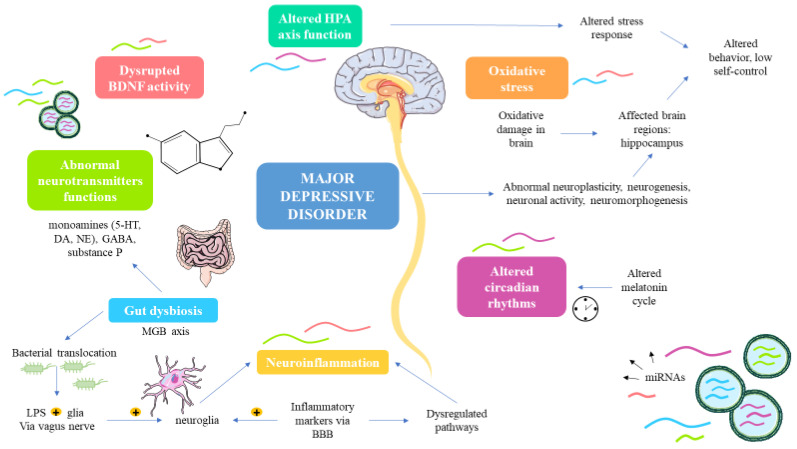
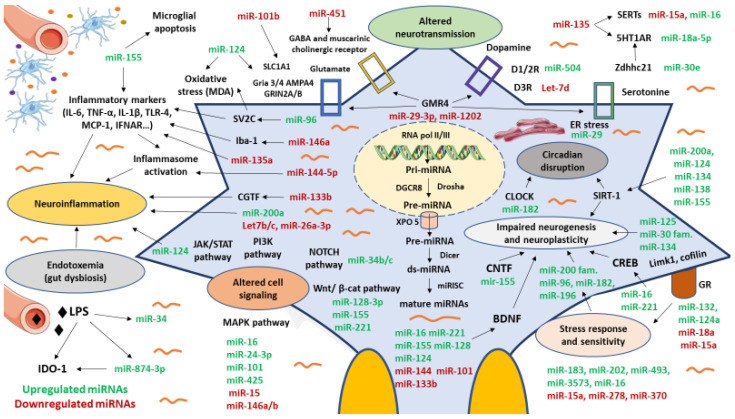
Major Depressive Disorder (MDD) represents a major global health concern, a body-mind malady of rising prevalence worldwide nowadays. The complex network of mechanisms involved in MDD pathophysiology is subjected to epigenetic changes modulated by microRNAs (miRNAs). Serum free or vesicles loaded miRNAs have starred numerous publications, denoting a key role in cell-cell communication, systematically and in brain structure and neuronal morphogenesis, activity and plasticity. Upregulated or downregulated expression of these signaling molecules may imply the impairment of genes implicated in pathways of MDD etiopathogenesis (neuroinflammation, brain-derived neurotrophic factor (BDNF), neurotransmitters, hypothalamic-pituitary-adrenal (HPA) axis, oxidative stress, circadian rhythms...). In addition, these miRNAs could serve as potential biomarkers with diagnostic, prognostic and predictive value, allowing to classify severity of the disease or to make decisions in clinical management. They have been considered as promising therapy targets as well and may interfere with available antidepressant treatments. As epigenetic malleable regulators, we also conclude emphasizing lifestyle interventions with physical activity, mindfulness and diet, opening the door to new clinical management considerations.
Overview
The claims and statistics of this paper haven’t been checked yet.
Run the check — free, no account needed. It reads the open-access text and checks the sources it cites.
Integrity signals
Registry
Cites
Statistics
Figures
Verification
Claims the paper makes
The claims and statistics of this paper haven’t been checked yet.
Run the check — free, no account needed. It reads the open-access text and checks the sources it cites.
Claims other papers make about this one
Each is checked against this paper’s own text: does it say what the citing paper says it does?
The cited source says what the claim attributes to it.
In the citing paper
“Dysregulated microRNA expression is also linked to synaptic plasticity, neuroinflammation, and stress response (Ortega et al., 2021; Elhag and Al Khodor, 2023).”
From Histone modifications and depression: epigenetic mechanisms, therapeutic targets, and translational outlook (2026) · cites this paper as Ortega et al., 2021
Self-check
Percentages, sums and reported differences re-computed from the paper’s own numbers.
The self-check needs the paper’s full text.
Citations
Cites
3 retracted
Yang, Y., Hu, Z., Du, X., Davies, H., Huo, X., & Fang, M. (2017) · Frontiers in Neuroscience · doi:10.3389/fnins.2017.00428 · Cited by 90
RetractedRETRACTED: Individual Differences in Response to Antidepressants
Maslej, M. M., Furukawa, T. A., Cipriani, A., Andrews, P. W., & Mulsant, B. H. (2020) · JAMA Psychiatry · doi:10.1001/jamapsychiatry.2019.4815 · Cited by 65
RetractedPei, G., Xu, L., Huang, W., & Yin, J. (2020) · International Immunopharmacology · doi:10.1016/j.intimp.2019.106076 · Cited by 26
RetractedDiagnostic and Statistical Manual of Mental Disorders
American Psychiatric Association (2013) · doi:10.1176/appi.books.9780890425596 · Cited by 116,369
Hamilton, M. (1960) · Journal of Neurology, Neurosurgery & Psychiatry · doi:10.1136/jnnp.23.1.56 · Cited by 32,817 · cited 8×
“Predictive: Paroxetine may lead to decreased serum levels of miR-221-3p, which is related to decreased HAM-D score Therapy: ERK pathway regulates miR-221 expression [124,187,194,195,246,277] Biomedicines 2021, 9, 1659 25 of 38 Table 1.”
BackgroundInfluentialExtracellular vesicles: Exosomes, microvesicles, and friends
Raposo, G., & Stoorvogel, W. (2013) · Journal of Cell Biology · doi:10.1083/jcb.201211138 · Cited by 8,099
Selective Cortical Undercutting As a Means of Modifying and Studying Frontal Lobe Function in Man
Scoville, W. B. (1949) · Journal of neurosurgery · doi:10.3171/jns.1949.6.1.0065 · Cited by 7,374
Regulation of microRNA biogenesis
Ha, M., & Kim, V. N. (2014) · Nature Reviews Molecular Cell Biology · doi:10.1038/nrm3838 · Cited by 5,462
Overview of MicroRNA Biogenesis, Mechanisms of Actions, and Circulation
O'Brien, J., Hayder, H., Zayed, Y., & Peng, C. (2018) · Frontiers in Endocrinology · doi:10.3389/fendo.2018.00402 · Cited by 5,287
MicroRNA genes are transcribed by RNA polymerase II
Lee, Y., Kim, M., Han, J., Yeom, K.-H., Lee, S., Baek, S. H., & Kim, V. N. (2004) · The EMBO Journal · doi:10.1038/sj.emboj.7600385 · Cited by 4,556
Cited by
Sorted by citations
Ortega, M. A., Álvarez-Mon, M. Á., Montero, C. G., Fraile‐Μartinez, O., Guijarro, L. G., Lahera, G., Monserrat, J., Valls, P., Mora, F., Rodríguez–Jiménez, R., et al. (2022) · Metabolites · doi:10.3390/metabo12010050 · Cited by 131
Self-citationDissecting early life stress-induced adolescent depression through epigenomic approach
Ochi, S., & Dwivedi, Y. (2022) · Molecular Psychiatry · doi:10.1038/s41380-022-01907-x · Cited by 94
Pekarek, L., Torres‐Carranza, D., Fraile‐Μartinez, O., Montero, C. G., Pekarek, T., Sáez, M. A., Rueda-Correa, F., Pimentel-Martinez, C., Guijarro, L. G., Dı́az, R., et al. (2023) · International Journal of Molecular Sciences · doi:10.3390/ijms24087268 · Cited by 80
Self-citationOrtega, M. A., Fraile‐Μartinez, O., Montero, C. G., Álvarez-Mon, M. Á., Lahera, G., Monserrat, J., Llavero-Valero, M., Gutiérrez-Rojas, L., Molina, R., Rodríguez–Jiménez, R., et al. (2022) · Nutrients · doi:10.3390/nu14153099 · Cited by 77
Self-citationNutrition, Epigenetics, and Major Depressive Disorder: Understanding the Connection
Ortega, M. A., Fraile‐Μartinez, O., Montero, C. G., Álvarez-Mon, M. Á., Lahera, G., Monserrat, J., Llavero-Valero, M., Mora, F., Rodríguez–Jiménez, R., Fernández-Rojo, S., et al. (2022) · Frontiers in Nutrition · doi:10.3389/fnut.2022.867150 · Cited by 59
Self-citation
Metadata
- Authors
- Ortega, M. A., Alvarez-Mon, M. A., García-Montero, C., Fraile-Martinez, O., Lahera, G., Monserrat, J., Muñoz-Merida, L., Mora, F., Rodríguez-Jiménez, R., Fernandez-Rojo, S., Quintero, J., & Álvarez-Mon, M.
- Affiliations
- Universidad de Alcalá (ES)
- Department of Medicine and Medical Specialities, University of Alcala, 28801 Alcalá de Henares, Spain
- Universidad Complutense de Madrid (ES)
- Department of Legal Medicine and Psychiatry, Complutense University, 28040 Madrid, Spain
- Cancer Registry and Pathology Department, Hospital Universitario Principe de Asturias, 28806 Alcalá de Henares, Spain
- ORCID
- Venue
- Biomedicines
- Publisher
- MDPI AG
- Published
- 2021-11-10
- Volume
- 9
- Issue
- 11
- Pages
- 1659
- ISSN
- 2227-9059 (ISSN-L)
- PMC
- PMC8615526
- OpenAlex
- W3211397738
- Cited by
- 57
- References
- 296
- Citations by year
- 2026: 13 · 2025: 14 · 2024: 11 · 2023: 10 · 2022: 9
- FWCI
- 0.90
- Type
- journal article
- Language
- en
- Open access
- gold
- doi.org
- Licence
- Locations
- Biomedicines (publishedVersion, cc-by)
- PubMed Central (publishedVersion, cc-by)
- PubMed (publishedVersion)
- DOAJ (DOAJ: Directory of Open Access Journals) (submittedVersion, cc-by-sa)
- Funders
- Instituto de Salud Carlos III (PI18/01726)
- Comunidad de Madrid (B2017/BMD3804)
- Topics
- Life Sciences › Biochemistry, Genetics and Molecular Biology › Cancer Research › MicroRNA in disease regulation
- Health Sciences › Medicine › Pharmacology (medical) › Treatment of Major Depression
- Life Sciences › Neuroscience › Biological Psychiatry › Tryptophan and brain disorders
- Keywords
- major depressive disorder, microRNA, biomarkers, epigenetics, serum microRNA, extracellular vesicles, neuroinflammation, brain-derived neurotrophic factor, hypothalamic-pituitary-adrenal axis, oxidative stress, circadian rhythm, antidepressant targets, lifestyle intervention, physical activity, mindfulness, diet
About these checks
Registry, retraction, Cites and statistics results are computed, not judged, with one exception: a printed reference that no index lists is read once by a model before it counts as a citation error. Claims are extracted by a model and kept only when their quote appears verbatim in the text; each cited source is then checked, with a model’s help, for whether it says what the claim relies on. Those verdicts can be wrong — read the claim’s quote and the cited source before relying on one.
Statistics and arithmetic are recomputed, not judged.
Confidence bands are shown only for fields calibrated on our annotated test set. None is calibrated yet, so no band is shown.
What counts as a claim ›How we measure confidence ›How we check this ›
Are you an author, or do you see a problem with this page? Request a review
