

Neutrophil-to-Lymphocyte, Platelet-to-Lymphocyte and Monocyte-to-Lymphocyte Ratio in Bipolar Disorder
Open accessThe DOI matches its Crossref record; 52 of the 54 references it cites were found in a registry or an index; 1 of the 8 sources its claims cite were checked for support.
Abstract
Background: Several inflammatory hypotheses have been suggested to explain the etiopathogenesis of bipolar disorder (BD) and its different phases. Neutrophil-to-lymphocyte (NLR), platelet-to-lymphocyte (PLR), and monocyte-to-lymphocyte (MLR) ratios have been proposed as potential peripheral biomarkers of mood episodes. Methods: We recruited 294 patients affected by BD, of which 143 were experiencing a (hypo)manic episode and 151 were in a depressive phase. A blood sample was drawn to perform a complete blood count. NLR, PLR, and MLR were subsequently calculated. A t-test was performed to evaluate differences in blood cell counts between depressed and (hypo)manic patients and a regression model was then computed. Results: Mean values of neutrophils, platelets, mean platelet volume, NLR, PLR, and MLR were significantly higher in (hypo)manic than depressed individuals. Logistic regression showed that PLR may represent an independent predictor of (hypo)mania. Conclusions: Altered inflammatory indexes, particularly PLR, may explain the onset and recurrence of (hypo)manic episodes in patients with BD. As inflammatory ratios represent economical and accessible markers of inflammation, further studies should be implemented to better elucidate their role as peripheral biomarkers of BD mood episodes.
Overview
CoChat Summary
TL;DR
In 294 bipolar inpatients, neutrophil, platelet, NLR, PLR, and MLR values were significantly higher during (hypo)manic than depressive episodes. After adjustment for age and sex, PLR was the only independent predictor of (hypo)mania.
Key findings
- (Hypo)manic patients had higher neutrophils (4.87 ± 1.89 vs. 4.37 ± 1.56, p = 0.014) and platelets (261.25 ± 68.80 vs. 234.73 ± 58.97, p < 0.001) than depressed patients.
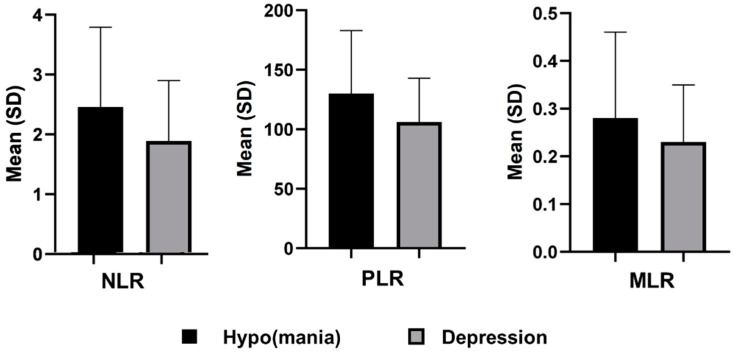
- NLR (2.46 ± 1.33 vs. 1.89 ± 1.01, p < 0.001), PLR (130.13 ± 52.84 vs. 106.05 ± 36.79, p < 0.001), and MLR (0.28 ± 0.18 vs. 0.23 ± 0.12, p = 0.008) were significantly higher in the (hypo)manic group; effect sizes were medium for NLR and PLR (Cohen’s d = 0.41 and 0.48) and small-to-medium for MLR (d = 0.33).
- In binary logistic regression, only PLR was significantly associated with (hypo)manic illness phase after correcting for age and sex (OR = 1.12, p = 0.03); the model was marginally significant (R² Nagelkerke = 0.32, p = 0.05).
Methods
- Cross-sectional study of 294 inpatients with a primary diagnosis of bipolar disorder consecutively referred to two Italian university hospitals (Genoa and Catania) from January 2017 to December 2019; 143 were experiencing a (hypo)manic episode and 151 a major depressive episode.
- Inclusion criteria were current (hypo)manic or major depressive episode, age ≥18 years, and written informed consent; exclusions included pregnancy/recent childbirth, severe/acute medical comorbidities, clozapine within six months, current substance use disorder, acute neurological injury, and inability/refusal to consent.
- Blood samples were drawn in the morning of the first hospitalization day after 12 h fasting, processed within 30 min by flow cytometry; analyses used Student’s t-test, Cohen’s d, and binary logistic regression correcting for age and gender, with p < 0.05.
Limitations
- The paper states it did not analyze symptom severity, included only inpatients, did not measure cytokines or CRP, did not consider physiological or pathological conditions potentially affecting inflammatory status as covariates, and did not include euthymic BD patients or healthy controls.
- Evident from the text: the cross-sectional design cannot establish temporal or causal relationships between inflammatory ratios and mood episodes.
- Evident from the text: the regression model corrected only for age and sex, despite most patients taking multiple medications (mean 3.81 ± 1.22 medications; 85.6% on antipsychotics), so medication effects were not adjusted for.
Model-written summary. Check it against the paper before relying on it.
Integrity signals
Registry
Cites
Statistics
Figures
Verification
Claims the paper makes
0 Valid · 1 Not valid · 5 Not checked · 16 Own results and interpretations
A result the paper reports from its own data — it cites no other source for it, so there is none to check. The quote shows it is in the paper.
In the paper
“bipolar patients experiencing a current (hypo)manic episode had a higher number of neutrophils (4.87 ± 1.89 vs. 4.37 ± 1.56, p = 0.014)”
§ Neutrophil-to-Lymphocyte, Platelet-to-Lymphocyte and Monocyte-to-Lymphocyte Ratio in Bipolar Disorder > 3. Results > 3.2. Complete Blood Count and Inflammatory Ratios: Differences between Major Depressive and (Hypo)manic Episode
plainstates an association- Asserted: passes — The authors put it forward as true.
- Checkable: passes — It can be checked against evidence.
- Load-bearing: passes — The paper’s conclusions depend on it.
- Based: passes — The paper gives a reason why it holds.
A result the paper reports from its own data — it cites no other source for it, so there is none to check. The quote shows it is in the paper.
In the paper
“NLR (2.46 ± 1.33 vs. 1.89 ± 1.01, p < 0.001), PLR (130.13 ± 52.84 vs. 106.05 ± 36.79, p < 0.001), and MLR (0.28 ± 0.18 vs. 0.23 ± 0.12, p = 0.008) were significantly higher in the (hypo)manic than depressed group.”
§ Neutrophil-to-Lymphocyte, Platelet-to-Lymphocyte and Monocyte-to-Lymphocyte Ratio in Bipolar Disorder > 3. Results > 3.2. Complete Blood Count and Inflammatory Ratios: Differences between Major Depressive and (Hypo)manic Episode
plainstates an association- Asserted: passes — The authors put it forward as true.
- Checkable: passes — It can be checked against evidence.
- Load-bearing: passes — The paper’s conclusions depend on it.
- Based: passes — The paper gives a reason why it holds.
A result the paper reports from its own data — it cites no other source for it, so there is none to check. The quote shows it is in the paper.
In the paper
“Specifically, effect size was medium for NLR and PLR (Cohen’s d = 0.41 and 0.48, respectively), and small-to-medium for MLR (d = 0.33).”
§ Neutrophil-to-Lymphocyte, Platelet-to-Lymphocyte and Monocyte-to-Lymphocyte Ratio in Bipolar Disorder > 3. Results > 3.2. Complete Blood Count and Inflammatory Ratios: Differences between Major Depressive and (Hypo)manic Episode
plain- Asserted: passes — The authors put it forward as true.
- Checkable: passes — It can be checked against evidence.
- Load-bearing: unclear — It is unclear whether the paper’s conclusions depend on it.
- Based: passes — The paper gives a reason why it holds.
A result the paper reports from its own data — it cites no other source for it, so there is none to check. The quote shows it is in the paper.
In the paper
“and platelets (261.25 ± 68.80 vs. 234.73 ± 58.97, p < 0.001) compared to bipolar patients with a current major depressive episode.”
§ Neutrophil-to-Lymphocyte, Platelet-to-Lymphocyte and Monocyte-to-Lymphocyte Ratio in Bipolar Disorder > 3. Results > 3.2. Complete Blood Count and Inflammatory Ratios: Differences between Major Depressive and (Hypo)manic Episode
plainstates an association- Asserted: passes — The authors put it forward as true.
- Checkable: passes — It can be checked against evidence.
- Load-bearing: passes — The paper’s conclusions depend on it.
- Based: passes — The paper gives a reason why it holds.
8 more claims
Create a free account to see all 22 claims and every source verdict.
- Probably not a substantial claim. 6
- It may state two separate claims as one. 6
Claims other papers make about this one
Each is checked against this paper’s own text: does it say what the citing paper says it does?
The cited source says what the claim attributes to it.
In the citing paper
“some studies also pointed out differences in these markers according to the specific affective disorder (i.e., BD vs. MDD) [50] and/or mood episode (manic vs. depressive) [51,52,53,54]”
From Immune Cell Ratios Are Higher in Bipolar Affective than Unipolar Depressive Disorder and Modulated by Mood Episode: A Retrospective, Cross-Sectional Study (2023) · cites this paper as [52]
In the citing paper
“Partially in line with previous reports (56) that N/L ratio is higher in BDM than in BDD or MDD”
From Are serum levels of inflammatory markers associated with the severity of symptoms of bipolar disorder? (2023) · cites this paper as [56]
In the citing paper
“These biomarkers appear to be associated with mood disorders, supporting the inflammatory hypothesis underlying the etiopathogenesis of these conditions40,42.”
From Optimizing multi-domain hematologic biomarkers and clinical features for the differential diagnosis of unipolar depression and bipolar depression (2023) · doi:10.1038/s44184-023-00024-z · cites this paper as [42]
Self-check
Percentages, sums and reported differences re-computed from the paper’s own numbers.
Rated minor: it would not touch a result — a value no result rests on, a p-value that stays on the same side of the significance level, or a conflict that is clerical, resolved elsewhere in the paper, or outside its own findings.
In the paper
“One-hundred fifty-one (53.4%) were females”
§ Neutrophil-to-Lymphocyte, Platelet-to-Lymphocyte and Monocyte-to-Lymphocyte Ratio in Bipolar Disorder > 3. Results > 3.1. General Characteristics of the Sample
Reported 53.4 · recomputed 51.360544
Citations
Cites
Diagnostic and Statistical Manual of Mental Disorders
American Psychiatric Association (2013) · doi:10.1176/appi.books.9780890425596 · Cited by 116,369
From inflammation to sickness and depression: when the immune system subjugates the brain
Dantzer, R., O'Connor, J. C., Freund, G. G., Johnson, R. W., & Kelley, K. W. (2008) · Nature Reviews Neuroscience · doi:10.1038/nrn2297 · Cited by 7,395
Zahorec, R. (2001) · Bratislava Medical Journal · doi:10.1007/bf03656390 · Cited by 1,601 · cited 1×
“Of note, NLR was originally developed by intensivists to provide a suitable parameter that could reflect the intensity of stress and/or systemic inflammation in critically ill patients [41], and the cytokine cascade following systemic inflammation appears notably associated with mood disorders [42,43].”
BackgroundNeuroinflammation and psychiatric illness
Najjar, S., Pearlman, D. M., Alper, K., Najjar, A., & Devinsky, O. (2013) · Journal of Neuroinflammation · doi:10.1186/1742-2094-10-43 · Cited by 733
Depression and sickness behavior are Janus-faced responses to shared inflammatory pathways
Maes, M., Berk, M., Goehler, L., Song, C., Anderson, G., Gałecki, P., & Leonard, B. (2012) · BMC Medicine · doi:10.1186/1741-7015-10-66 · Cited by 629 · cited 1×
“Indeed, immunity and inflammatory imbalance may affect mental functioning from the earliest stages of neural development [5,6].”
BackgroundKim, Y.-K., Na, K.-S., Myint, A.-M., & Leonard, B. E. (2016) · Progress in Neuro-Psychopharmacology and Biological Psychiatry · doi:10.1016/j.pnpbp.2015.06.008 · Cited by 620 · cited 1×
“Of note, NLR was originally developed by intensivists to provide a suitable parameter that could reflect the intensity of stress and/or systemic inflammation in critically ill patients [41], and the cytokine cascade following systemic inflammation appears notably associated with mood disorders [42,43].”
BackgroundThe effects of serotonin in immune cells
Herr, N., Bode, C., & Duerschmied, D. (2017) · Frontiers in Cardiovascular Medicine · doi:10.3389/fcvm.2017.00048 · Cited by 497
Rao, J. S., Harry, G. J., Rapoport, S. I., & Kim, H. W. (2010) · Molecular Psychiatry · doi:10.1038/mp.2009.47 · Cited by 432 · cited 1×
“Of note, alterations in the inflammatory pathways are not limited to peripheral markers, as the presence of brain excitotoxicity and inflammation in patients with BD has been detected both in vivo [14] and post mortem [15].”
BackgroundComparison of cytokine levels in depressed, manic and euthymic patients with bipolar disorder
Brietzke, E., Stertz, L., Fernandes, B. S., Kauer-Sant’Anna, M., Mascarenhas, M., Escosteguy Vargas, A., Chies, J. A., & Kapczinski, F. (2009) · Journal of Affective Disorders · doi:10.1016/j.jad.2008.12.001 · Cited by 423
Preoperative neutrophil-lymphocyte ratio and outcome from coronary artery bypass grafting
Gibson, P. H., Croal, B. L., Cuthbertson, B. H., Small, G. R., Ifezulike, A. I., Gibson, G., Jeffrey, R. R., Buchan, K. G., El-Shafei, H., & Hillis, G. S. (2007) · American Heart Journal · doi:10.1016/j.ahj.2007.06.043 · Cited by 382 · cited 1×
“Importantly, these parameters seem less affected by exercise, catecholamine release, and other confounding conditions than single leukocyte parameters or other commonly used markers of inflammation [52].”
BackgroundImbalance between pro-inflammatory and anti-inflammatory cytokines in bipolar disorder
Kim, Y.-K., Jung, H.-G., Myint, A.-M., Kim, H., & Park, S.-H. (2007) · Journal of Affective Disorders · doi:10.1016/j.jad.2007.02.018 · Cited by 375
Beumer, W., Gibney, S. M., Drexhage, R. C., Pont-Lezica, L., Doorduin, J., Klein, H. C., Steiner, J., Connor, T. J., Harkin, A., Versnel, M. A., et al. (2012) · Journal of Leukocyte Biology · doi:10.1189/jlb.0212100 · Cited by 347 · cited 2×
“As per the MLR, it has been demonstrated that levels of circulating monocytes are elevated in patients with psychiatric disorders such as BD, major depressive disorder (MDD), and schizophrenia, due to enhanced expression of immune genes and the overproduction of monocytes/macrophage-related cytokines [47].”
BackgroundNeutrophil/lymphocyte ratio and platelet/lymphocyte ratio in mood disorders: A meta-analysis
Mazza, M. G., Lucchi, S., Tringali, A. G. M., Rossetti, A., Botti, E. R., & Clerici, M. (2018) · Progress in Neuro-Psychopharmacology and Biological Psychiatry · doi:10.1016/j.pnpbp.2018.03.012 · Cited by 326 · cited 1×
“[25] summarized the literature on the topic, reporting that subjects with BD had higher NLR and PLR compared to healthy controls.”
BackgroundNeutrophil-Derived Cytokines: Potential Therapeutic Targets in Inflammation
Kasama, T., Miwa, Y., Isozaki, T., Odai, T., Adachi, M., & Kunkel, S. (2005) · Current Drug Target -Inflammation & Allergy · doi:10.2174/1568010054022114 · Cited by 286
Neuroinflammation in Bipolar Depression
Benedetti, F., Aggio, V., Pratesi, M. L., Greco, G., & Furlan, R. (2020) · Frontiers in Psychiatry · doi:10.3389/fpsyt.2020.00071 · Cited by 274
Biological hypotheses and biomarkers of bipolar disorder
Sigitova, E., Fišar, Z., Hroudová, J., Cikánková, T., & Raboch, J. (2017) · Psychiatry and Clinical Neurosciences · doi:10.1111/pcn.12476 · Cited by 235
Neuroinflammation in bipolar disorder – A [11C]-(R)-PK11195 positron emission tomography study
Haarman, B. C. M. (., Riemersma-Van der Lek, R. F., de Groot, J. C., Ruhé, H. G. (., Klein, H. C., Zandstra, T. E., Burger, H., Schoevers, R. A., de Vries, E. F. J., Drexhage, H. A., et al. (2014) · Brain, Behavior, and Immunity · doi:10.1016/j.bbi.2014.03.016 · Cited by 211
Rowland, T., Perry, B. I., Upthegrove, R., Barnes, N., Chatterjee, J., Gallacher, D., & Marwaha, S. (2018) · The British Journal of Psychiatry · doi:10.1192/bjp.2018.144 · Cited by 196
A systematic review of evidence for the role of inflammatory biomarkers in bipolar patients
Sayana, P., Colpo, G. D., Simões, L. R., Giridharan, V. V., Teixeira, A. L., Quevedo, J., & Barichello, T. (2017) · Journal of Psychiatric Research · doi:10.1016/j.jpsychires.2017.03.018 · Cited by 187
Serafini, G., Parisi, V. M., Aguglia, A., Amerio, A., Sampogna, G., Fiorillo, A., Pompili, M., & Amore, M. (2020) · International Journal of Environmental Research and Public Health · doi:10.3390/ijerph17072393 · Cited by 172
Self-citationAnderson, G., & Maes, M. H. J. (2015) · Current Psychiatry Reports · doi:10.1007/s11920-014-0541-1 · Cited by 160
Özdin, S., Sarisoy, G., & Böke, Ö. (2017) · Nordic Journal of Psychiatry · doi:10.1080/08039488.2017.1340517 · Cited by 148
Cytokines in Bipolar Disorder: Paving the Way for Neuroprogression
Barbosa, I. G., Bauer, M. E., Machado-Vieira, R., & Teixeira, A. L. (2014) · Neural Plasticity · doi:10.1155/2014/360481 · Cited by 147
Abnormalities in serum chemokine levels in euthymic patients with Bipolar Disorder
Brietzke, E. M., Kauer‐Sant’Anna, M., Teixeira, A. L., & Kapczinski, F. P. (2009) · Brain Behavior and Immunity · doi:10.1016/j.bbi.2009.04.008 · Cited by 144
Cytokine production in bipolar affective disorder patients under lithium treatment
Boufidou, F., Nikolaou, C., Alevizos, B., Liappas, I. A., & Christodoulou, G. N. (2004) · Journal of Affective Disorders · doi:10.1016/j.jad.2004.01.007 · Cited by 130 · cited 1×
“Moreover, their levels seem to be responsive to lithium therapy [32,33].”
BackgroundEkinci, O., & Ekinci, A. (2017) · Nordic Journal of Psychiatry · doi:10.1080/08039488.2017.1363285 · Cited by 122 · cited 1×
“estimated the blood cell inflammatory ratios in depressed patients with and without suicide attempts, suggesting that NLR may be a trait marker for suicidal vulnerability in patients diagnosed with depression [23].”
BackgroundSpreux‐Varoquaux, O., Alvarez, J., Berlin, I., Batista, G., Despierre, P.-G., Gilton, A., & Cremniter, D. (2001) · Life Sciences · doi:10.1016/s0024-3205(01)01158-4 · Cited by 122
Jacomb, I., Stanton, C., Vasudevan, R., Powell, H., O'Donnell, M., Lenroot, R., Bruggemann, J., Balzan, R., Galletly, C., Liu, D., et al. (2018) · Frontiers in Immunology · doi:10.3389/fimmu.2018.02230 · Cited by 110
Neutrophil-lymphocyte and platelet-lymphocyte ratios as inflammation markers for bipolar disorder
Kalelioglu, T., Akkus, M., Karamustafalioglu, N., Genc, A., Genc, E. S., Cansiz, A., & Emul, M. (2015) · Psychiatry Research · doi:10.1016/j.psychres.2015.05.110 · Cited by 105 · cited 1×
“instead showed increased NLR and PLR levels in BD patients than controls, but no differences between euthymic and manic phases [20].”
BackgroundCytokine levels in euthymic bipolar patients
Guloksuz, S., Aktas Cetin, E., Cetin, T., Deniz, G., Oral, E. T., & Nutt, D. J. (2010) · Journal of Affective Disorders · doi:10.1016/j.jad.2010.04.027 · Cited by 102
Chemokine alterations in bipolar disorder: A systematic review and meta-analysis
Misiak, B., Bartoli, F., Carrà, G., Małecka, M., Samochowiec, J., Jarosz, K., Banik, A., & Stańczykiewicz, B. (2020) · Brain, Behavior, and Immunity · doi:10.1016/j.bbi.2020.04.013 · Cited by 102
Serotonin and Suicidal Behaviora
MANN, J. J., ARANGO, V., & UNDERWOOD, M. D. (1990) · Annals of the New York Academy of Sciences · doi:10.1111/j.1749-6632.1990.tb16903.x · Cited by 90
Mazza, M. G., Tringali, A. G. M., Rossetti, A., Botti, R. E., & Clerici, M. (2019) · General Hospital Psychiatry · doi:10.1016/j.genhosppsych.2019.02.003 · Cited by 89 · cited 5×
“[27] who first attempted to evaluate complete blood count as a potential biomarkers of different mood episodes of BD.”
BackgroundResultInfluentialTargeting the immune system in the treatment of bipolar disorder
Rosenblat, J. D. (2019) · Psychopharmacology · doi:10.1007/s00213-019-5175-x · Cited by 83
Dietrich-Muszalska, A., & Wachowicz, B. (2017) · The World Journal of Biological Psychiatry · doi:10.3109/15622975.2016.1155748 · Cited by 78 · cited 1×
“This finding is important, as the activation of platelets, mediated by various inflammatory factors, seems to play an important role in the etiology of psychiatric disorders [37].”
BackgroundThe effect of mood-stabilizing drugs on cytokine levels in bipolar disorder: A systematic review
van den Ameele, S., van Diermen, L., Staels, W., Coppens, V., Dumont, G. J. H., Sabbe, B., & Morrens, M. (2016) · Journal of Affective Disorders · doi:10.1016/j.jad.2016.06.016 · Cited by 74
Increased neutrophil/lymphoctye ratio in patients with bipolar disorder: a preliminary study.
Çakır, U., Tuman, T. C., & Yıldırım, O. (2015) · PubMed · Cited by 69
Neurotrophins, inflammation and oxidative stress as illness activity biomarkers in bipolar disorder
Pfaffenseller, B., Fries, G. R., Wollenhaupt-Aguiar, B., Colpo, G. D., Stertz, L., Panizzutti, B., Magalhães, P. V., & Kapczinski, F. (2013) · Expert Review of Neurotherapeutics · doi:10.1586/14737175.2013.811981 · Cited by 68
Mean platelet volume in bipolar disorder:The search for an ideal biomarker
Mert, D. G., & Terzi, H. (2016) · Neuropsychiatric Disease and Treatment · doi:10.2147/ndt.s112374 · Cited by 67 · cited 1×
“Other studies were specifically focused on specific mood episodes, showing increased NLR and PLR values [18], as well as decreased MLR values [19] in manic patients than healthy subjects.”
BackgroundNeutrophil-lymphocyte ratio: a controversial marker in predicting Crohn's disease severity.
Gao, S., Huang, L., Dai, R.-J., Chen, D., Hu, W., & Shan, Y. (2015) · PubMed · Cited by 66
Brietzke, E. M., Mansur, R. B., Soczynska, J. K., Powell, A. M., & McIntyre, R. S. (2012) · Progress in Neuro-Psychopharmacology and Biological Psychiatry · doi:10.1016/j.pnpbp.2012.05.004 · Cited by 62
Zulfic, Z., Weickert, C. S., Weickert, T. W., Liu, D., Myles, N., & Galletly, C. (2020) · Australasian Psychiatry · doi:10.1177/1039856220908172 · Cited by 54 · cited 1×
“These parameters appear associated with mood disorders, supporting the inflammatory hypothesis underlying the etiopathogenesis of these conditions [16].”
BackgroundBustan, Y., Drapisz, A., Ben Dor, D. H., Avrahami, M., Schwartz-Lifshitz, M., Weizman, A., & Barzilay, R. (2018) · Psychiatry Research · doi:10.1016/j.psychres.2018.02.002 · Cited by 53
Aguglia, A., Amerio, A., Asaro, P., Caprino, M., Conigliaro, C., Giacomini, G., Parisi, V. M., Trabucco, A., Amore, M., & Serafini, G. (2021) · The World Journal of Biological Psychiatry · doi:10.1080/15622975.2020.1761033 · Cited by 43 · cited 2×
“Of note, PLR has been recently proposed as a biomarker of high-lethality suicide attempts too [22].”
BackgroundSelf-citationSağlam Aykut, D., Civil Arslan, F., Özkorumak Karagüzel, E., Aral, G., & Karakullukçu, S. (2018) · Nordic Journal of Psychiatry · doi:10.1080/08039488.2017.1397192 · Cited by 40
Kowalczyk, M., Szemraj, J., Bliźniewska, K., Maes, M., Berk, M., Su, K.-P., & Gałecki, P. (2019) · Pharmacological Reports · doi:10.1016/j.pharep.2019.05.022 · Cited by 38 · cited 1×
“Indeed, immunity and inflammatory imbalance may affect mental functioning from the earliest stages of neural development [5,6].”
BackgroundMayda, H., Ahsen, A., Bagcioglu, E., Ozturk, A., Bahceci, B., Soyucok, E., Baspinar, E., & Ulu, M. S. (2016) · Noro Psikiyatri Arsivi · doi:10.5152/npa.2016.10272 · Cited by 33
A Systematic Review of Nutraceuticals for the Treatment of Bipolar Disorder
Ashton, M. M., Kavanagh, B. E., Marx, W., Berk, M., Sarris, J. J., Ng, C. H., Hopwood, M., Williams, L. J., & Dean, O. M. (2020) · The Canadian Journal of Psychiatry · doi:10.1177/0706743720961734 · Cited by 29
Risk Calculators in Bipolar Disorder: A Systematic Review
Silva Ribeiro, J., Pereira, D., Salagre, E., Coroa, M., Santos Oliveira, P., Santos, V., Madeira, N., Grande, I., & Vieta, E. (2020) · Brain Sciences · doi:10.3390/brainsci10080525 · Cited by 26 · cited 1×
“BD affects 2–3% of the general population worldwide and its onset typically occurs during adolescence or early adulthood [1].”
BackgroundFusar-Poli, L., Surace, T., Vanella, A., Meo, V., Patania, F., Furnari, R., Signorelli, M. S., & Aguglia, E. (2019) · Journal of Affective Disorders · doi:10.1016/j.jad.2019.04.039 · Cited by 24
Self-citationChou, Y.-H., Hsieh, W.-C., Chen, L.-C., Lirng, J.-F., & Wang, S.-J. (2016) · Journal of Affective Disorders · doi:10.1016/j.jad.2015.10.056 · Cited by 23
Platelet Serotonin as Biomarker for Assessing Suicidal Behaviour in Patients with Bipolar I Disorder
Giurgiuca, A., Schipor, S., Caragheorgheopol, A., Crasan, A., Postolache, E., Tudose, C., Prelipceanu, D., & Cozman, D. (2016) · Acta Endocrinologica (Bucharest) · doi:10.4183/aeb.2016.275 · Cited by 13
Cited by
Neutrophil-lymphocyte ratios as inflammatory biomarkers in psychiatric patients
Bhikram, T., & Sandor, P. (2022) · Brain, Behavior, and Immunity · doi:10.1016/j.bbi.2022.07.006 · Cited by 103
Dionisie, V., Filip, G. A., Manea, M. C., Movileanu, R. C., Moisa, E., Manea, M., Riga, S., & Ciobanu, A. M. (2021) · Journal of Clinical Medicine · doi:10.3390/jcm10091924 · Cited by 82
Catatonia: demographic, clinical and laboratory associations
Rogers, J. P., Pollak, T. A., Begum, N., Griffin, A., Carter, B., Pritchard, M., Broadbent, M., Kolliakou, A., Ke, J., Stewart, R. J., et al. (2021) · Psychological Medicine · doi:10.1017/s0033291721004402 · Cited by 76
Puangsri, P., & Ninla-aesong, P. (2021) · Psychiatry Research · doi:10.1016/j.psychres.2021.114216 · Cited by 62
Wei, Y., Feng, J., Ma, J., Chen, D., & Chen, J. (2022) · Journal of Affective Disorders · doi:10.1016/j.jad.2022.04.092 · Cited by 56
Metadata
- Authors
- Fusar-Poli, L., Natale, A., Amerio, A., Cimpoesu, P., Grimaldi Filioli, P., Aguglia, E., Amore, M., Serafini, G., & Aguglia, A.
- Affiliations
- Psychiatry Unit, Department of Clinical and Experimental Medicine, University of Catania, 95124 Catania, Italy
- University of Catania (IT)
- Tufts University (US)
- Ospedale Policlinico San Martino (IT)
- Department of Neuroscience, Rehabilitation, Ophthalmology, Genetics, Maternal and Child Health, Section of Psychiatry, University of Genoa, 16126 Genoa, Italy
- Corresponding author
- Aguglia, Andrea
- ORCID
- Venue
- Brain Sciences
- Publisher
- MDPI AG
- Published
- 2021-01-06
- Volume
- 11
- Issue
- 1
- Pages
- 58
- ISSN
- 2076-3425 (ISSN-L)
- PMC
- PMC7825034
- OpenAlex
- W3119807283
- Cited by
- 93
- References
- 54
- Citations by year
- 2026: 7 · 2025: 25 · 2024: 15 · 2023: 18 · 2022: 21 · 2021: 7
- FWCI
- 10.94
- Type
- journal article
- Language
- en
- Open access
- gold
- doi.org
- Licence
- Locations
- Brain Sciences (publishedVersion, cc-by)
- Europe PMC (PubMed Central) (publishedVersion, other-oa)
- PubMed Central (publishedVersion, cc-by)
- PubMed (publishedVersion)
- DOAJ (DOAJ: Directory of Open Access Journals) (submittedVersion, cc-by-sa)
- CINECA IRIS Institutial Research Information System (University of Genoa) (submittedVersion)
- CINECA IRIS Institutial Research Information System (University of Genoa) (submittedVersion, other-oa)
- Funders
- Ministero dell’Istruzione, dell’Università e della Ricerca (LAW 232/2016, 20182022, MIUR 2018-2022, 232/2016)
- Topics
- Health Sciences › Medicine › Psychiatry and Mental health › Bipolar Disorder and Treatment
- Health Sciences › Medicine › Oncology › Inflammatory Biomarkers in Disease Prognosis
- Life Sciences › Neuroscience › Biological Psychiatry › Tryptophan and brain disorders
- Keywords
- bipolar disorder, neutrophil-to-lymphocyte ratio, platelet-to-lymphocyte ratio, monocyte-to-lymphocyte ratio, inflammatory markers, hypomania, depression, mood episodes, peripheral biomarkers, inflammation, mean platelet volume
About these checks
Registry, retraction, Cites and statistics results are computed, not judged, with one exception: a printed reference that no index lists is read once by a model before it counts as a citation error. Claims are extracted by a model and kept only when their quote appears verbatim in the text; each cited source is then checked, with a model’s help, for whether it says what the claim relies on. Those verdicts can be wrong — read the claim’s quote and the cited source before relying on one.
The claim verdicts this report counts are experimental: their accuracy is not yet measured.
A language model drew the claims from the paper on 2026-10-10, under version 3 of the claim definition (model deepseek-v4.1-flash, prompt extract-v3).
A second model labelled each claim on 2026-10-10 (model jev-1.13-20260917, definition revision gold-guideline-v0.2).
Statistics and arithmetic are recomputed, not judged.
Confidence bands are shown only for fields calibrated on our annotated test set. None is calibrated yet, so no band is shown.
What counts as a claim ›How we measure confidence ›How we check this ›
Are you an author, or do you see a problem with this page? Request a review
Data sources
Bibliographic data: Semantic Scholar, OpenAlex, Crossref.
Contains information from the Semantic Scholar Academic Graph Datasets, made available under the ODC Attribution License (ODC-BY 1.0).
Semantic Scholar’s data is described in: Kinney, R., et al. (2023). The Semantic Scholar Open Data Platform. arXiv:2301.10140.
