

Executive Functioning and Clinical Variables in Patients with Obsessive-Compulsive Disorder
Open accessThe DOI matches its Crossref record; 49 of the 50 references it cites were found in a registry or an index.
Abstract
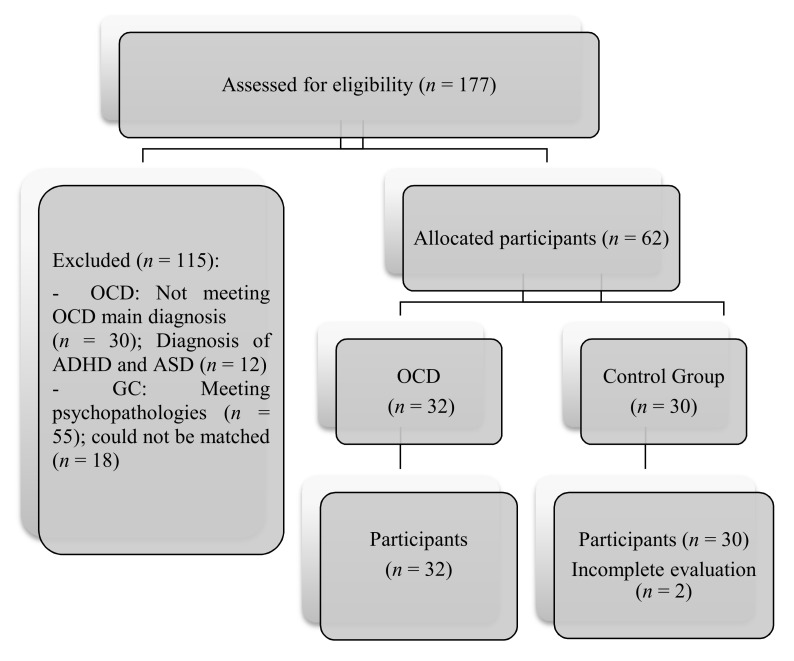
Background: Cognitive flexibility, response inhibition, and working memory are considered the main mechanisms responsible for executive control. This study examined differences in cognitive flexibility, inhibition, and working memory in patients with obsessive–compulsive disorder (OCD) relative to a control group. Method: A total of 62 obsessive-compulsive participants (OCD = 32; healthy control = 32) aged between 17 and 56 years old (M = 33.16, SD = 9.23) were administered the computerized Wisconsin Card Sorting Test, Stroop Color–Word Test, Go/No-Go Task, Digit Test, and Corsi Block Test. Clinician-rated and self-reported obsessive–compulsive symptom severity, and anxiety, depression, and obsessive beliefs were evaluated. Results: The control group performed better than the OCD group in tasks involving cognitive flexibility, inhibition, and visuospatial working memory. Anxiety and obsessive beliefs influenced the participants’ performance on inhibition and working memory tasks. Similarly, comorbidity also influenced inhibition and working memory. In addition, the use of pharmacotherapy and the degree of OCD symptom severity influenced verbal working memory. Conclusions: Cognitive flexibility, inhibition, and visuospatial working memory deficits may be endophenotypes of OCD but require further examination for specificity. OCD severity, comorbidity patterns, anxiety, and obsessive beliefs may influence performance.
Overview
The claims and statistics of this paper haven’t been checked yet.
Free: it reads the open-access text and checks the first 5 claims that cite a source we can check. Create a free account to check every claim.
Integrity signals
Registry
Cites
Statistics
Figures
Verification
Claims the paper makes
The claims and statistics of this paper haven’t been checked yet.
Free: it reads the open-access text and checks the first 5 claims that cite a source we can check. Create a free account to check every claim.
Claims other papers make about this one
Each is checked against this paper’s own text: does it say what the citing paper says it does?
The source backs part of the claim, not all of it — or backs it for a different population, condition or comparison.
In the citing paper
“Various studies show reduced cognitive flexibility in OCD patients compared to control and generalized anxiety groups, regardless of medication use or comorbidity (120, 121).”
From Neural mechanisms underlying cognitive inflexibility in obsessive-compulsive disorder: a review (2026) · cites this paper as [121]
Experimental — accuracy not yet measuredThe cited source says what the claim attributes to it.
In the citing paper
“In the Go/No-Go task, individuals with OCD can show significant difficulties with response inhibition – with higher rates of both commission and omission errors compared to controls (121, 136, 137; but see 120 on omission errors).”
From Neural mechanisms underlying cognitive inflexibility in obsessive-compulsive disorder: a review (2026) · cites this paper as [121]
The cited source says what the claim attributes to it.
In the citing paper
“In the Go/No-Go task, individuals with OCD can show significant difficulties with response inhibition – with higher rates of both commission and omission errors compared to controls (121, 136, 137; but see 120 on omission errors).”
From Neural mechanisms underlying cognitive inflexibility in obsessive-compulsive disorder: a review (2026) · cites this paper as [121]
Self-check
Percentages, sums and reported differences re-computed from the paper’s own numbers.
The self-check needs the paper’s full text.
Citations
Cites
Diagnostic and Statistical Manual of Mental Disorders
American Psychiatric Association (2013) · doi:10.1176/appi.books.9780890425596 · Cited by 116,369
Miyake, A., Friedman, N. P., Emerson, M. J., Witzki, A. H., Howerter, A., & Wager, T. D. (2000) · Cognitive Psychology · doi:10.1006/cogp.1999.0734 · Cited by 15,798 · cited 1×
“Executive function (EF), and the relationship between its different subdomains as independent entities or as part of a whole [3], has been the subject of several studies in OCD.”
BackgroundDiamond, A. (2013) · Annual Review of Psychology · doi:10.1146/annurev-psych-113011-143750 · Cited by 13,268
The Yale-Brown Obsessive Compulsive Scale: I. Development, Use, and Reliability
Goodman, W. K. (1989) · Archives of General Psychiatry · doi:10.1001/archpsyc.1989.01810110048007 · Cited by 7,712 · cited 7×
“The Yale–Brown Obsessive Compulsive Scale (Y-BOCS) [32] is comprised of 10 items assessing the severity of OCD.”
BackgroundMethodInfluentialMiyake, A., & Friedman, N. P. (2012) · Current Directions in Psychological Science · doi:10.1177/0963721411429458 · Cited by 3,944 · cited 1×
“EF consists of regulatory mechanisms of cognition, behavior, and emotions that allow the achievement of individual goals and objectives [4].”
BackgroundThe multi-component model of working memory: Explorations in experimental cognitive psychology
RepovŠ, G., & Baddeley, A. (2006) · Neuroscience · doi:10.1016/j.neuroscience.2005.12.061 · Cited by 795 · cited 1×
“WM can also be divided into verbal and visuospatial components [10].”
BackgroundModels of response inhibition in the stop-signal and stop-change paradigms
Verbruggen, F., & Logan, G. D. (2009) · Neuroscience & Biobehavioral Reviews · doi:10.1016/j.neubiorev.2008.08.014 · Cited by 724 · cited 1×
“between RI and compulsions only, supporting the notion that compulsions could be a behavioral demonstration of underlying RI deficits [54].”
BackgroundInhibitory control and emotion regulation in preschool children
Carlson, S. M., & Wang, T. S. (2007) · Cognitive Development · doi:10.1016/j.cogdev.2007.08.002 · Cited by 701 · cited 1×
“RI refers to mental processes responsible for intentional and voluntary control, or the ability to prevent interference of non-pertinent information in the face of responses or patterns of responses underway, and to suppress previously relevant information which is not currently useful [8].”
BackgroundThe neuropsychology of adult obsessive–compulsive disorder: A meta-analysis
Abramovitch, A., Abramowitz, J. S., & Mittelman, A. (2013) · Clinical Psychology Review · doi:10.1016/j.cpr.2013.09.004 · Cited by 444 · cited 2×
“[31] reported that RI showed a lesser overall effect size than expected, perhaps due to the different sensitivity of tests used (Go/No-Go errors of commission and Stroop interference).”
BackgroundMethodExecutive functions and updating of the contents of working memory in unipolar depression
Harvey, P. O., Le Bastard, G., Pochon, J. B., Levy, R., Allilaire, J. F., Dubois, B., & Fossati, P. (2004) · Journal of Psychiatric Research · doi:10.1016/j.jpsychires.2004.03.003 · Cited by 359 · cited 1×
“WM is defined as maintaining or manipulating information across a short delay when that information is not available in the environment and involves both short-term storage of information and simultaneous manipulation of mental content [9].”
BackgroundCognitive functioning in obsessive-compulsive disorder: A meta-analysis
Shin, N. Y., Lee, T. Y., Kim, E., & Kwon, J. S. (2014) · Psychological Medicine · doi:10.1017/s0033291713001803 · Cited by 334 · cited 4×
“ES achieved in CF were high, while medium-low in visuospatial WM and low in cognitive RI [11,12,43].”
BackgroundInfluentialSnyder, H. R., Kaiser, R. H., Warren, S. L., & Heller, W. (2015) · Clinical Psychological Science · doi:10.1177/2167702614534210 · Cited by 325 · cited 5×
“Other meta-analyses and systematic reviews [11,12] suggest that effect sizes were medium in CF, medium and medium-low in RI, while low and medium in WM.”
InfluentialCognitive dysfunction in obsessive-compulsive disorder
Okasha, A., Rafaat, M., Mahallawy, N., Nahas, G. E., Dawla, A. S. E., Sayed, M., & Kholi, S. E. (2000) · Acta Psychiatrica Scandinavica · doi:10.1111/j.1600-0447.2000.tb10926.x · Cited by 170
The cognitive neuropsychology of obsessive-compulsive disorder: a critical review
Abramovitch, A., & Cooperman, A. (2015) · Journal of Obsessive-Compulsive and Related Disorders · doi:10.1016/j.jocrd.2015.01.002 · Cited by 126 · cited 1×
“Conversely, depression did not play a moderating role, which is consistent with Abramovitch and Cooperman [47].”
ResultAbramovitch, A., Dar, R., Hermesh, H., & Schweiger, A. (2012) · Journal of Neuropsychology · doi:10.1111/j.1748-6653.2011.02021.x · Cited by 126 · cited 2×
“Some studies report a worse performance for errors of commission in participants with OCD in a Go/No-Go Task (motor inhibition), with no differences in errors of omission and reaction time [15,16].”
BackgroundResultMataix-Cols, D., Alonso, P., Pifarré, J., Menchón, J. M., & Vallejo, J. (2002) · Psychiatry Research · doi:10.1016/s0165-1781(02)00024-0 · Cited by 116 · cited 1×
“However, medication intake did not influence CF and RI in the current study, which contradicts results of previous studies [12,50] and coincides with others [51].”
ResultCognitive flexibility in preschoolers: the role of representation activation and maintenance
Chevalier, N., & Blaye, A. (2008) · Developmental Science · doi:10.1111/j.1467-7687.2008.00679.x · Cited by 111 · cited 1×
“Correspondingly, CF is the ability that allows changing representation based on incoming information, and to keep representation intact when changes are irrelevant [6].”
BackgroundKashyap, H., Kumar, J. K., Kandavel, T., & Reddy, Y. C. J. (2013) · Comprehensive Psychiatry · doi:10.1016/j.comppsych.2012.12.003 · Cited by 104 · cited 1×
“Differences in WM remain significant even after the controlling effects of age, gender, and education [21], obtaining worse results in participants with the highest age at onset [22].”
ResultTo go or not to go: inhibitory control in ‘hard to manage’ children
Brophy, M., Taylor, E., & Hughes, C. (2002) · Infant and Child Development · doi:10.1002/icd.301 · Cited by 84
Abramovitch, A., McCormack, B., Brunner, D., Johnson, M., & Wofford, N. (2019) · Clinical Psychology Review · doi:10.1016/j.cpr.2018.09.003 · Cited by 83 · cited 4×
“[25], who found a small degree of negative association between visuospatial memory and symptomatic severity of OCD.”
BackgroundInfluentialAbramovitch, A., Dar, R., Schweiger, A., & Hermesh, H. (2011) · Archives of Clinical Neuropsychology · doi:10.1093/arclin/acr022 · Cited by 82 · cited 2×
“Some studies report a worse performance for errors of commission in participants with OCD in a Go/No-Go Task (motor inhibition), with no differences in errors of omission and reaction time [15,16].”
BackgroundCognitive deficits of executive functions and decision‐making in obsessive‐compulsive disorder
Dittrich, W. H., & Johansen, T. (2013) · Scandinavian Journal of Psychology · doi:10.1111/sjop.12066 · Cited by 79 · cited 1×
“The OCD group presented lower scores in CF, measured with the WCST and the Five Digit Test, coinciding with findings from previous studies [41,42].”
ResultNeuropsychological performance in OCD: A study in medication-naïve patients
Krishna, R., Udupa, S., George, C. M., Kumar, K. J., Viswanath, B., Kandavel, T., Venkatasubramanian, G., & Reddy, Y. C. J. (2011) · Progress in Neuro-Psychopharmacology and Biological Psychiatry · doi:10.1016/j.pnpbp.2011.09.009 · Cited by 69 · cited 1×
“In CF, there were no differences between OCD patients related to these variables, coinciding with previous studies [48].”
ResultEscitalopram in Obsessive-Compulsive Disorder:Response of Symptom Dimensions to Pharmacotherapy
Stein, D. J., Carey, P. D., Lochner, C., Seedat, S., Fineberg, N., & Andersen, E. W. (2008) · CNS Spectrums · doi:10.1017/s1092852900016722 · Cited by 68
Differences in Neuropsychological Performance Between Subtypes of Obsessive–Compulsive Disorder
Nedeljkovic, M., Kyrios, M., Moulding, R., Doron, G., Wainwright, K., Pantelis, C., Purcell, R., & Maruff, P. (2009) · Australian & New Zealand Journal of Psychiatry · doi:10.1080/00048670802653273 · Cited by 67 · cited 1×
“[45] found that OCD patients had a lower spatial storage capacity, which could contribute to mistrust in memory and a larger dependence on external validations [46].”
BackgroundBedard, M.-J., Joyal, C. C., Godbout, L., & Chantal, S. (2009) · Archives of Clinical Neuropsychology · doi:10.1093/arclin/acp052 · Cited by 62 · cited 1×
“However, other studies have reported the absence of a significant association between symptom severity and performance in neuropsychological testing [26].”
BackgroundBelloch, A., Morillo, C., Luciano, J. V., García-Soriano, G., Cabedo, E., & Carrió, C. (2010) · The Spanish journal of psychology · doi:10.1017/s1138741600003930 · Cited by 57 · cited 5×
“The Obsessive Beliefs Spanish Inventory-Revised (OBSI-R) [35] is a 50-item self-report questionnaire (from 1, strongly disagree, to 7, strongly agree) with eight scales: inflated responsibility, over-importance of thoughts, thought action fusion-likelihood, thought action fusion-moral, importance of controlling one’s…”
BackgroundInfluentialBragdon, L. B., Gibb, B. E., & Coles, M. E. (2018) · Depression and Anxiety · doi:10.1002/da.22785 · Cited by 57
Heinzel, S., Kaufmann, C., Grützmann, R., Hummel, R., Klawohn, J., Riesel, A., Bey, K., Lennertz, L., Wagner, M., & Kathmann, N. (2018) · NeuroImage: Clinical · doi:10.1016/j.nicl.2017.10.039 · Cited by 55 · cited 2×
“In addition, worse performance in WM tasks has been observed in OCD patients when compared to a control group [18].”
ResultMorein-Zamir, S., Craig, K. J., Ersche, K. D., Abbott, S., Muller, U., Fineberg, N. A., Bullmore, E. T., Sahakian, B. J., & Robbins, T. W. (2010) · Psychopharmacology · doi:10.1007/s00213-010-1963-z · Cited by 54 · cited 1×
“Other findings have yielded contradicting results indicating there were no differences between OCD and control groups [19,20].”
ResultRosa-Alcázar, Á., Olivares-Olivares, P. J., Martínez-Esparza, I. C., Parada-Navas, J. L., Rosa-Alcázar, A. I., & Olivares-Rodríguez, J. (2020) · International Journal of Clinical and Health Psychology · doi:10.1016/j.ijchp.2019.07.006 · Cited by 53 · cited 1×
“The inclusion of specific modules on flexibility could potentially enhance the effectiveness of exposure with response prevention, improving adherence to treatment, and preventing desertion [55].”
BackgroundSelf-citationObsessive beliefs and neurocognitive flexibility in obsessive–compulsive disorder
Bradbury, C. L., Cassin, S. E., & Rector, N. A. (2010) · Psychiatry Research · doi:10.1016/j.psychres.2010.11.008 · Cited by 47 · cited 1×
“[28] stated that the importance attached to obsessive beliefs in OCD could cause deficits in CF.”
BackgroundTeubner-Rhodes, S., Vaden, K. I., Dubno, J. R., & Eckert, M. A. (2017) · Neuropsychologia · doi:10.1016/j.neuropsychologia.2017.05.027 · Cited by 45 · cited 2×
“In the present study, OCD participants achieved a lower performance both in perseverative errors and number of categories, which are considered the main signs of frontal dysfunction [7].”
BackgroundKim, K. L., Christensen, R. E., Ruggieri, A., Schettini, E., Freeman, J. B., Garcia, A. M., Flessner, C., Stewart, E., Conelea, C., & Dickstein, D. P. (2019) · Depression and Anxiety · doi:10.1002/da.22848 · Cited by 42 · cited 1×
“CF has been lower in those with OCD when compared to healthy participants [14].”
ResultKalanthroff, E., Teichert, T., Wheaton, M. G., Kimeldorf, M. B., Linkovski, O., Ahmari, S. E., Fyer, A. J., Schneier, F. R., Anholt, G. E., & Simpson, H. B. (2017) · Depression and Anxiety · doi:10.1002/da.22492 · Cited by 41
Subirà, M., Cano, M., de Wit, S. J., Alonso, P., Cardoner, N., Hoexter, M. Q., Kwon, J. S., Nakamae, T., Löchner, C., Sato, J. R., et al. (2016) · Journal of Psychiatry and Neuroscience · doi:10.1503/jpn.150012 · Cited by 37 · cited 1×
“Given the heterogeneous nature of OCD and its multidetermined etiology, research in neuropsychology has attempted to ascertain the degree of correspondence between neuroimaging data and neuropsychological test results, with the purpose of identifying a clinical phenotype, and to predict and improve treatment outcomes…”
BackgroundThe cross-cultural and transdiagnostic nature of unwanted mental intrusions
Pascual-Vera, B., Akin, B., Belloch, A., Bottesi, G., Clark, D. A., Doron, G., Fernández-Alvarez, H., Ghisi, M., Gómez, B., Inozu, M., et al. (2019) · International Journal of Clinical and Health Psychology · doi:10.1016/j.ijchp.2019.02.005 · Cited by 36 · cited 1×
“However, cognitive models propose that dysfunctional beliefs and intrusive thoughts play a central role in maintaining mental disorders [27].”
BackgroundResponse inhibition and error-monitoring processes in individuals with obsessive-compulsive disorder
Berlin, G. S., & Lee, H.-J. (2018) · Journal of Obsessive-Compulsive and Related Disorders · doi:10.1016/j.jocrd.2017.11.001 · Cited by 32 · cited 2×
“This finding is consistent with Berlin and Lee [53], who observed a relationship”
ResultAltered spontaneous brain activity in obsessive-compulsive personality disorder
Lei, H., Huang, L., Li, J., Liu, W., Fan, J., Zhang, X., Xia, J., Zhao, K., Zhu, X., & Rao, H. (2019) · Comprehensive Psychiatry · doi:10.1016/j.comppsych.2019.152144 · Cited by 30 · cited 1×
“The OCD group presented lower scores in CF, measured with the WCST and the Five Digit Test, coinciding with findings from previous studies [41,42].”
ResultMartoni, R. M., Salgari, G., Galimberti, E., Cavallini, M. C., & O’Neill, J. (2015) · European Archives of Psychiatry and Clinical Neuroscience · doi:10.1007/s00406-015-0604-2 · Cited by 27 · cited 2×
“[44] concluded that deficits found in visuospatial WM in OCD appeared more severe as workload increased, and that they could be mediated by task strategy (executive dysfunction).”
BackgroundResultEmel, K. U. R. T., Yıldırım, E., & Topçuoğlu, V. (2017) · Nöro Psikiyatri Arşivi · doi:10.5152/npa.2016.14872 · Cited by 23
Saremi, A. A., Department of Cognitive Neuroscience, I. F. C. S. S. (., Shariat, S. V., Mental Health Research Center, T. I. O. P., Nazari, M. A., Department of Psychology, F. O. E. &. P., Dolatshahi, B., & Department of Psychology, U. O. S. W. A. R. S. (2017) · Basic and Clinical Neuroscience Journal · doi:10.18869/nirp.bcn.8.3.233 · Cited by 22 · cited 3×
“[13] concluded that these deficits have clinical significance in understanding incidence, maintenance, and severity of OCD symptoms.”
BackgroundResultAssessing neurocognitive function in psychiatric disorders: A roadmap for enhancing consensus
Ahmari, S. E., Eich, T., Cebenoyan, D., Smith, E. E., & Blair Simpson, H. (2014) · Neurobiology of Learning and Memory · doi:10.1016/j.nlm.2014.06.011 · Cited by 20 · cited 1×
“Other findings have yielded contradicting results indicating there were no differences between OCD and control groups [19,20].”
ResultYazdi-Ravandi, S., Shamsaei, F., Matinnia, N., Moghimbeigi, A., Shams, J., Ahmadpanah, M., & Ghaleiha, A. (2018) · Asian Journal of Psychiatry · doi:10.1016/j.ajp.2018.09.002 · Cited by 20 · cited 2×
“ES achieved in CF were high, while medium-low in visuospatial WM and low in cognitive RI [11,12,43].”
ResultGrisham, J. R., & Williams, A. D. (2013) · Journal of Behavior Therapy and Experimental Psychiatry · doi:10.1016/j.jbtep.2013.01.005 · Cited by 18 · cited 2×
“Likewise, findings from Grisham and Williams [30] indicated that participants in an OCD group displayed a greater need to control their thoughts when compared to social anxiety and healthy groups, which could be related to worse results obtained in WM and RI.”
BackgroundResultScrupulosity and contamination OCD are not associated with deficits in response inhibition
Rasmussen, J., Siev, J., Abramovitch, A., & Wilhelm, S. (2016) · Journal of Behavior Therapy and Experimental Psychiatry · doi:10.1016/j.jbtep.2015.06.004 · Cited by 16 · cited 1×
“[23] concluded that there were no deficits in RI in OCD scrupulousness and contamination groups compared to healthy controls.”
ResultMemory and Executive Functions in Patients with Obsessive-Compulsive Disorder
Vandborg, S. K., Hartmann, T. B., Bennedsen, B. E., Pedersen, A. D., & Thomsen, P. H. (2014) · Cognitive and Behavioral Neurology · doi:10.1097/wnn.0000000000000021 · Cited by 16 · cited 1×
“These results are in line with those suggested by other authors [49].”
ResultPerna, G., Cavedini, P., Riva, A., Chiaro, N. V. D., Bellotti, M., Diaferia, G., & Caldirola, D. (2018) · Cognitive Neuropsychiatry · doi:10.1080/13546805.2018.1544888 · Cited by 13 · cited 2×
“[45] found that OCD patients had a lower spatial storage capacity, which could contribute to mistrust in memory and a larger dependence on external validations [46].”
BackgroundResultŞahin, H., Köşger, F., Eşsizoğlu, A., & Aksaray, G. (2017) · Nöro Psikiyatri Arşivi · doi:10.5152/npa.2017.21648 · Cited by 12 · cited 2×
“[29] found greater cognitive inflexibility in OCD patients with higher obsessive beliefs.”
Background
Research works printed but not linked: 4
- Beck A.T. Steer R.A. Brown G.K. Sanz J. Valverde C.V. Inventario de Depresión de Beck (BDI-II) Pearson Madrid, Spain 2011
- Beck A.T. Steer R.A. Inventario de Ansiedad de Beck (BAI) Pearson Madrid, Spain 1996
- Wechsler D. WAIS-IV, Escala de Inteligencia de Wechsler para Adultos-IV Pearson Madrid, Spain 2012
- Wechsler D. WMS III, Escala de Memoria de Wechsler-III Pearson Madrid, Spain 1997
Cited by
Obsessive-compulsive disorder: Etiology, neuropathology, and cognitive dysfunction
Jalal, B., Chamberlain, S. R., & Sahakian, B. J. (2023) · Brain and Behavior · doi:10.1002/brb3.3000 · Cited by 111
“ory impairments compared to healthy controls (Shin et al., 2014; for other meta-analyses, see Abramovitch et al., 2013; Bora, 2020; see also, Katrin Kuelz et al., 2006;Martínez-Esparza et al., 2021; Vandborg et al., 2015).”
BackgroundClarke, A. T., Fineberg, N. A., Pellegrini, L., & Laws, K. R. (2024) · Comprehensive Psychiatry · doi:10.1016/j.comppsych.2024.152491 · Cited by 25
“15 studies used neuro-cognitive tasks to assess both phenotypes e.g. the IED and the CGT ([20,32,36,38,44,102,105,112,186,210,211]; Saremi et al., 20,017; [48,109,127,129]).”
MethodFornaro, S., & Vallesi, A. (2024) · Current Psychology · doi:10.1007/s12144-023-04312-x · Cited by 21
“Nonetheless, associations between executive impairments and specific clinical dimensions (Bragdon et al., 2018; Pedron et al., 2015) were reported, along with evidence that obsessional beliefs affect executive performance (Martínez-Esparza et al., 2021).”
Serweta-Pawlik, A., Lachowicz, M., Żurek, A., Rosen, B., & Żurek, G. (2023) · Cancers · doi:10.3390/cancers15061639 · Cited by 13
“Based on the study by Martinez-Esparza et al. (2021), which used the CORSI test in two forms, one may wonder whether the backward subtype of the test would be more sensitive to the possible changes in the working memory functioning of cancer patients [32].”
MethodCognitive Neural Mechanism of Backward Inhibition and Deinhibition: A Review
Chen, J., Wu, S., & Li, F. (2022) · Frontiers in Behavioral Neuroscience · doi:10.3389/fnbeh.2022.846369 · Cited by 11
“A major aspect of OCD involves cognitive inflexibility (Chamberlain et al., 2006; Rosa-Alcázar et al., 2020; Martínez-Esparza et al., 2021).”
Background
Metadata
- Authors
- Martínez-Esparza, I. C., Olivares-Olivares, P. J., Rosa-Alcázar, Á., Rosa-Alcázar, A. I., & Storch, E. A.
- Affiliations
- Universidad de Murcia (ES)
- Department of Psychology, Catholic University of Murcia, 30107 Murcia, Spain
- Department of Personality, Assessment & Psychological Treatment, University of Murcia, 30100 Murcia, Spain
- Baylor College of Medicine (US)
- ORCID
- Venue
- Brain Sciences
- Publisher
- MDPI AG
- Published
- 2021-02-20
- Volume
- 11
- Issue
- 2
- Pages
- 267
- ISSN
- 2076-3425 (ISSN-L)
- PMC
- PMC7924057
- OpenAlex
- W3133105105
- Cited by
- 21
- References
- 50
- Citations by year
- 2026: 3 · 2025: 4 · 2024: 4 · 2023: 7 · 2022: 2 · 2021: 1
- FWCI
- 2.39
- Type
- journal article
- Language
- en
- Open access
- gold
- doi.org
- Licence
- Locations
- Brain Sciences (publishedVersion, cc-by)
- PubMed Central (publishedVersion, cc-by)
- PubMed (publishedVersion)
- DOAJ (DOAJ: Directory of Open Access Journals) (submittedVersion, cc-by-sa)
- Funders
- Ministry of Economy and competitiveness of the Spanish Government (PSI2016-78185-P)
- Topics
- Social Sciences › Psychology › Clinical Psychology › Obsessive-Compulsive Spectrum Disorders
- Life Sciences › Neuroscience › Cognitive Neuroscience › Neural and Behavioral Psychology Studies
- Social Sciences › Psychology › Experimental and Cognitive Psychology › Anxiety, Depression, Psychometrics, Treatment, Cognitive Processes
- Keywords
- obsessive-compulsive disorder, executive function, cognitive flexibility, response inhibition, working memory, visuospatial working memory, endophenotypes, anxiety, obsessive beliefs, comorbidities, pharmacotherapy, symptom severity, Wisconsin Card Sorting Test, Stroop task, go/no-go task, Corsi block test
About these checks
Registry, retraction, Cites and statistics results are computed, not judged, with one exception: a printed reference that no index lists is read once by a model before it counts as a citation error. Claims are extracted by a model and kept only when their quote appears verbatim in the text; each cited source is then checked, with a model’s help, for whether it says what the claim relies on. Those verdicts can be wrong — read the claim’s quote and the cited source before relying on one.
Statistics and arithmetic are recomputed, not judged.
Confidence bands are shown only for fields calibrated on our annotated test set. None is calibrated yet, so no band is shown.
What counts as a claim ›How we measure confidence ›How we check this ›
Are you an author, or do you see a problem with this page? Request a review
Data sources
Bibliographic data: Semantic Scholar, OpenAlex, Crossref.
Contains information from the Semantic Scholar Academic Graph Datasets, made available under the ODC Attribution License (ODC-BY 1.0).
Semantic Scholar’s data is described in: Kinney, R., et al. (2023). The Semantic Scholar Open Data Platform. arXiv:2301.10140.
