

The DOI matches its Crossref record; 269 of the 269 references it cites were found in a registry or an index.
Role of Glial Cells in Neuronal Function, Mood Disorders, and Drug Addiction
Open accessPublished version of a preprint
Abstract
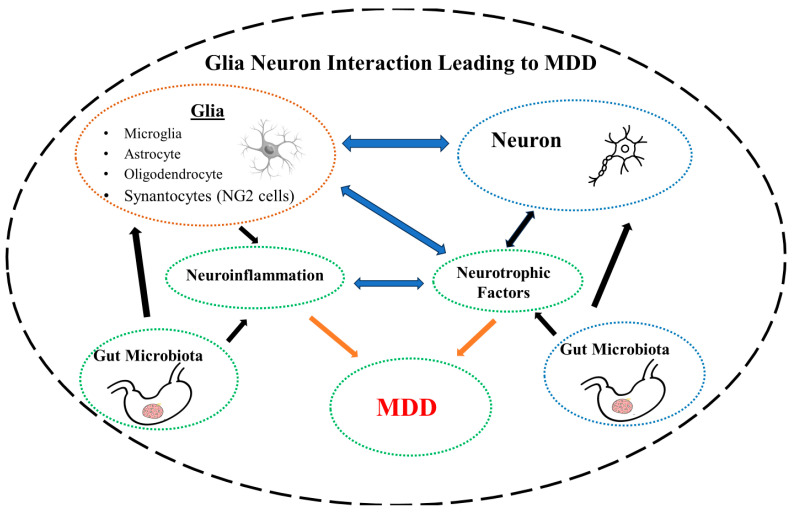
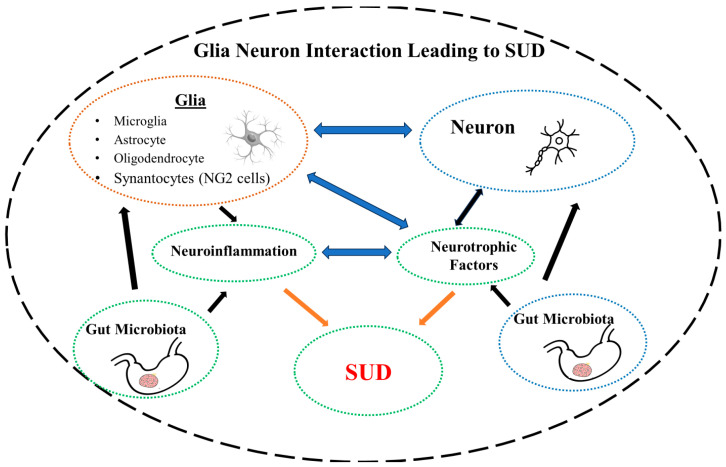
Mood disorders and substance use disorder (SUD) are of immense medical and social concern. Although significant progress on neuronal involvement in mood and reward circuitries has been achieved, it is only relatively recently that the role of glia in these disorders has attracted attention. Detailed understanding of the glial functions in these devastating diseases could offer novel interventions. Here, following a brief review of circuitries involved in mood regulation and reward perception, the specific contributions of neurotrophic factors, neuroinflammation, and gut microbiota to these diseases are highlighted. In this context, the role of specific glial cells (e.g., microglia, astroglia, oligodendrocytes, and synantocytes) on phenotypic manifestation of mood disorders or SUD are emphasized. In addition, use of this knowledge in the potential development of novel therapeutics is touched upon.
Overview
The claims and statistics of this paper haven’t been checked yet.
Run the check — free, no account needed. It reads the open-access text and checks the sources it cites.
Integrity signals
Registry
Cites
Statistics
Figures
Verification
Claims the paper makes
The claims and statistics of this paper haven’t been checked yet.
Run the check — free, no account needed. It reads the open-access text and checks the sources it cites.
Self-check
Percentages, sums and reported differences re-computed from the paper’s own numbers.
The self-check needs the paper’s full text.
Citations
Cites
The biology , function , and biomedical applications of exosomes
Kalluri, R., & LeBleu, V. S. (2020) · Science · doi:10.1126/science.aau6977 · Cited by 10,770
Gage, F. H. (2000) · Science · doi:10.1126/science.287.5457.1433 · Cited by 4,786
The role of inflammation in depression: from evolutionary imperative to modern treatment target
Miller, A. H., & Raison, C. L. (2016) · Nature Reviews Immunology · doi:10.1038/nri.2015.5 · Cited by 3,942 · cited 2×
“Thus, when neuroin-flammation ensues, it may further exacerbate SUD or induce MDD [4,98].”
BackgroundMechanisms underlying inflammation in neurodegeneration
Glass, C. K., Saijo, K., Winner, B., Marchetto, M. C., & Gage, F. H. (2010) · Cell · doi:10.1016/j.cell.2010.02.016 · Cited by 3,580
THE CATECHOLAMINE HYPOTHESIS OF AFFECTIVE DISORDERS: A REVIEW OF SUPPORTING EVIDENCE
Schildkraut, J. J. (1965) · American Journal of Psychiatry · doi:10.1176/ajp.122.5.509 · Cited by 3,568
Dysfunction of the prefrontal cortex in addiction: neuroimaging findings and clinical implications
Goldstein, R. Z., & Volkow, N. D. (2011) · Nature Reviews Neuroscience · doi:10.1038/nrn3119 · Cited by 2,749 · cited 1×
“Drug addiction involves functional changes to brain circuits controlling reward or pleasure and extends to pathways dealing with stress response and self-control [81].”
BackgroundSokoloff, P., Bruno Giros, A., Martres, M., Bouthenet, M.-L., & Schwartz, J. (1990) · Nature · doi:10.1038/347146a0 · Cited by 2,608
Tripartite synapses: glia, the unacknowledged partner
Araque, A., Parpura, V., Sanzgiri, R. P., & Haydon, P. G. (1999) · Trends in Neurosciences · doi:10.1016/s0166-2236(98)01349-6 · Cited by 2,529
The human hippocampus and spatial and episodic memory
Burgess, N., Maguire, E. A., & O'Keefe, J. (2002) · Neuron · doi:10.1016/s0896-6273(02)00830-9 · Cited by 2,401
Essential role of BDNF in the mesolimbic dopamine pathway in social defeat stress
Berton, O., McClung, C. A., DiLeone, R. J., Krishnan, V., Renthal, W., Russo, S. J., Graham, D., Tsankova, N. M., Bolanos, C. A., Rios, M., et al. (2006) · Science · doi:10.1126/science.1120972 · Cited by 2,129
Cited by
Sorted by citations
The Gut Microbiome-Neuroglia Axis: Implications for Brain Health, Inflammation, and Disease
Camberos-Barraza, J., Guadrón‐Llanos, A. M., & la Herrán-Arita, A. K. D. (2024) · Neuroglia · doi:10.3390/neuroglia5030018 · Cited by 34
Miller, M. R., Landis, H. E., Miller, R. E., & Tizabi, Y. (2024) · Cells · doi:10.3390/cells13181554 · Cited by 26
Self-citationHeavy Metal Interactions with Neuroglia and Gut Microbiota: Implications for Huntington’s Disease
Tizabi, Y., Bennani, S., Kouhen, N. E., Getachew, B., & Aschner, M. (2024) · Cells · doi:10.3390/cells13131144 · Cited by 17
Self-citationNanoparticles: a new frontier in neurodegenerative disease therapy
Kumar, V., Sharma, S., & Singh, A. K. (2025) · Frontiers in Medical Technology · doi:10.3389/fmedt.2025.1654003 · Cited by 22
Effects of focused ultrasound stimulation on various in vitro neurological cell models
Bano, I., Jeevanandam, J., & Tsenov, G. (2025) · Journal of Neuroscience Methods · doi:10.1016/j.jneumeth.2025.110544 · Cited by 7
Metadata
- Authors
- Tizabi, Y., Getachew, B., Hauser, S. R., Tsytsarev, V., Manhães, A. C., & da Silva, V. D. A.
- Affiliations
- Howard University (US)
- Indiana University School of Medicine (US)
- University of Maryland, Baltimore (US)
- Universidade do Estado do Rio de Janeiro (BR)
- Laboratory of Neurochemistry and Cell Biology, Department of Biochemistry and Biophysics, Institute of Health Sciences, Federal University of Bahia, Salvador 40110-100, BA, Brazil
- Corresponding author
- Tizabi, Yousef
- ORCID
- Venue
- Brain Sciences
- Publisher
- MDPI AG
- Published
- 2024-05-30
- Volume
- 14
- Issue
- 6
- Pages
- 558
- ISSN
- 2076-3425 (ISSN-L)
- PMC
- PMC11201416
- OpenAlex
- W4399175317
- Cited by
- 27
- References
- 269
- Citations by year
- 2026: 4 · 2025: 16 · 2024: 7
- FWCI
- 1.38
- Type
- journal article
- Language
- en
- Open access
- gold
- doi.org
- Licence
- Locations
- Brain Sciences (publishedVersion, cc-by)
- Preprints.org (acceptedVersion, cc-by)
- PubMed Central (publishedVersion, cc-by)
- PubMed (publishedVersion)
- IUScholarWorks (Indiana University) (submittedVersion, cc-by)
- DOAJ (DOAJ: Directory of Open Access Journals) (submittedVersion, cc-by-sa)
- Funders
- NIH/NIAAA (R03AA022479, 2 SO6 GM08016-39)
- NIH/NIGMS (R03AA022479, 2 SO6 GM08016-39)
- Topics
- Life Sciences › Neuroscience › Neurology › Neuroinflammation and Neurodegeneration Mechanisms
- Life Sciences › Neuroscience › Cellular and Molecular Neuroscience › Neuroscience and Neuropharmacology Research
- Life Sciences › Neuroscience › Biological Psychiatry › Tryptophan and brain disorders
- Keywords
- glial cells, mood disorders, substance use disorders, drug addiction, microglia, astrocytes, oligodendrocytes, neurotrophic factors, neuroinflammation, gut microbiota, reward systems, mood regulation, new drugs
About these checks
Registry, retraction, Cites and statistics results are computed, not judged, with one exception: a printed reference that no index lists is read once by a model before it counts as a citation error. Claims are extracted by a model and kept only when their quote appears verbatim in the text; each cited source is then checked, with a model’s help, for whether it says what the claim relies on. Those verdicts can be wrong — read the claim’s quote and the cited source before relying on one.
Statistics and arithmetic are recomputed, not judged.
Confidence bands are shown only for fields calibrated on our annotated test set. None is calibrated yet, so no band is shown.
What counts as a claim ›How we measure confidence ›How we check this ›
Are you an author, or do you see a problem with this page? Request a review
