

Bipolar Disorder and Immune Dysfunction: Epidemiological Findings, Proposed Pathophysiology and Clinical Implications
Open accessThe DOI matches its Crossref record; 143 of the 144 references it cites were found in a registry or an index.
Abstract
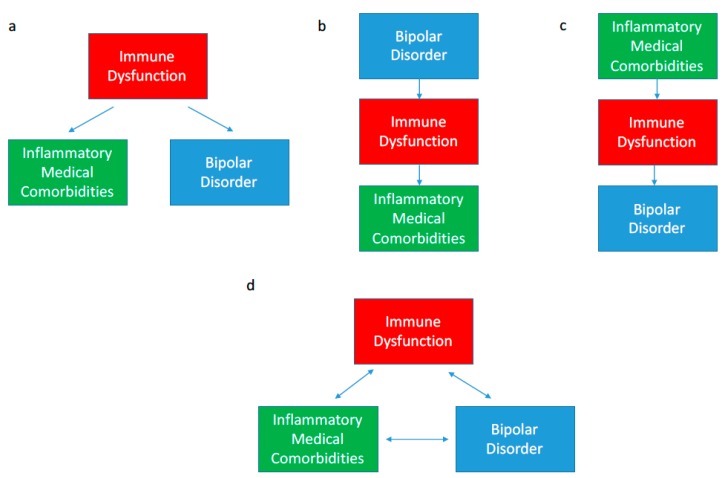
Bipolar disorder (BD) is strongly associated with immune dysfunction. Replicated epidemiological studies have demonstrated that BD has high rates of inflammatory medical comorbidities, including autoimmune disorders, chronic infections, cardiovascular disease and metabolic disorders. Cytokine studies have demonstrated that BD is associated with chronic low-grade inflammation with further increases in pro-inflammatory cytokine levels during mood episodes. Several mechanisms have been identified to explain the bidirectional relationship between BD and immune dysfunction. Key mechanisms include cytokine-induced monoamine changes, increased oxidative stress, pathological microglial over-activation, hypothalamic-pituitary-adrenal (HPA) axis over-activation, alterations of the microbiome-gut-brain axis and sleep-related immune changes. The inflammatory-mood pathway presents several potential novel targets in the treatment of BD. Several proof-of-concept clinical trials have shown a positive effect of anti-inflammatory agents in the treatment of BD; however, further research is needed to determine the clinical utility of these treatments. Immune dysfunction is likely to only play a role in a subset of BD patients and as such, future clinical trials should also strive to identify which specific group(s) of BD patients may benefit from anti-inflammatory treatments.
Overview
The claims and statistics of this paper haven’t been checked yet.
Free: it reads the open-access text and checks the first 5 claims that cite a source we can check. Create a free account to check every claim.
Integrity signals
Registry
Cites
Statistics
Figures
Verification
Claims the paper makes
The claims and statistics of this paper haven’t been checked yet.
Free: it reads the open-access text and checks the first 5 claims that cite a source we can check. Create a free account to check every claim.
Claims other papers make about this one
Each is checked against this paper’s own text: does it say what the citing paper says it does?
The source backs part of the claim, not all of it — or backs it for a different population, condition or comparison.
In the citing paper
“Evidence of altered inflammation-related markers across psychiatric conditions [6–8], along with reports of anti-inflammatory effects from psychotropic medications [9, 10] and the ameliorative impact of anti-inflammatory drugs on psychiatric symptoms [11–14], suggests a strong link between abnormal inflammatory responses and major psychiatric disorders.”
From Inflammatory ratios as predictors of length of hospitalization in psychiatric patients: A multicenter study (2025) · doi:10.1007/s00406-025-02033-9 · cites this paper as [14]
Experimental — accuracy not yet measuredThe cited source says what the claim attributes to it.
In the citing paper
“growing and converging evidence has demonstrated that immune dysfunction is involved in the pathophysiology of BD (1).”
From Are serum levels of inflammatory markers associated with the severity of symptoms of bipolar disorder? (2023) · cites this paper as [1]
The cited source says what the claim attributes to it.
In the citing paper
“On one hand, drugs that target IRFs have been proposed for treating psychiatric disorders, including major depression (MDD)10–12, schizophrenia (SCZ)13 and bipolar disorder (BD)14, particularly in a subset of patients with chronic inflammation10”
From Inflammation-related biomarkers in major psychiatric disorders: a cross-disorder assessment of reproducibility and specificity in 43 meta-analyses (2019) · cites this paper as [14]
Self-check
Percentages, sums and reported differences re-computed from the paper’s own numbers.
The self-check needs the paper’s full text.
Citations
Cites
Inflammation and Atherosclerosis
Libby, P., Ridker, P. M., & Maseri, A. (2002) · Circulation · doi:10.1161/hc0902.104353 · Cited by 7,724
From inflammation to sickness and depression: when the immune system subjugates the brain
Dantzer, R., O'Connor, J. C., Freund, G. G., Johnson, R. W., & Kelley, K. W. (2008) · Nature Reviews Neuroscience · doi:10.1038/nrn2297 · Cited by 7,395
Origin and physiological roles of inflammation
Medzhitov, R. (2008) · Nature · doi:10.1038/nature07201 · Cited by 6,618 · cited 1×
“The inflammatory response to infections is an essential physiological response that has been evolutionarily conserved amongst all mammal species [11]; however, in the case of chronic infections, the prolonged inflammatory response may also have deleterious effects, as the immune response is best suited for clearing an…”
BackgroundMind-altering microorganisms: the impact of the gut microbiota on brain and behaviour
Cryan, J. F., & Dinan, T. G. (2012) · Nature Reviews Neuroscience · doi:10.1038/nrn3346 · Cited by 4,572 · cited 1×
“The gut and brain may communicate in a bidirectional fashion through numerous pathways including via the parasympathetic nervous system (primarily the vagus nerve), the gut neuroendocrine system, the circulatory system (delivering neuroactive metabolites and neuro-transmitters directly produced in the gut), and most n…”
BackgroundStructural and functional features of central nervous system lymphatic vessels
Louveau, A., Smirnov, I., Keyes, T. J., Eccles, J. D., Rouhani, S. J., Peske, J. D., Derecki, N. C., Castle, D., Mandell, J. W., Lee, K. S., et al. (2015) · Nature · doi:10.1038/nature14432 · Cited by 4,413
Inflammation and Its Discontents: The Role of Cytokines in the Pathophysiology of Major Depression
Miller, A. H., Maletic, V., & Raison, C. L. (2009) · Biological Psychiatry · doi:10.1016/j.biopsych.2008.11.029 · Cited by 3,848 · cited 1×
“, the brain) has been increasingly recognized as important [8,9].”
BackgroundThe Neuroendocrinology of Stress: A Never Ending Story
Lightman, S. L. (2008) · Journal of Neuroendocrinology · doi:10.1111/j.1365-2826.2008.01711.x · Cited by 3,566
Dynamics of fat cell turnover in humans
Spalding, K. L., Arner, E., Westermark, P. O., Bernard, S., Buchholz, B. A., Bergmann, O., Blomqvist, L., Hoffstedt, J., Näslund, E., Britton, T., et al. (2008) · Nature · doi:10.1038/nature06902 · Cited by 2,357 · cited 1×
“The lypolytic rate is therefore increased leading to increased production of leptin (pro-inflammatory) and decreased production of adiponectin (anti-inflammatory), thereby signaling the release of pro-inflammatory cytokines [40].”
BackgroundIrwin, M. R., Olmstead, R., & Carroll, J. E. (2016) · Biological Psychiatry · doi:10.1016/j.biopsych.2015.05.014 · Cited by 2,085 · cited 1×
“Replicated evidence has demonstrated sleep dysfunction to be associated with increased levels of pro-inflammatory cytokines with a bidirectional causal association identified [106,107].”
BackgroundGoldsmith, D. R., Rapaport, M. H., & Miller, B. J. (2016) · Molecular Psychiatry · doi:10.1038/mp.2016.3 · Cited by 1,683 · cited 1×
“The most robust evidence exists for an association between pro-inflammatory cytokines and depressive episodes, in both bipolar and unipolar depression [50].”
Background
Research works printed but not linked: 2
- Abbas A.K. Lichtman A.H. Pillai S. Cellular and Molecular Immunology 7th ed. Elsevier Saunders Philadelphia, PA, USA 2012
- Boutzios G. Kaltsas G. Immune System Effects on the Endocrine System Available online: https://www.ncbi.nlm.nih.gov/books/NBK279139/ (accessed on 29 October 2017)
Cited by
Items 201–265 of 265
Causal role of immune cells in bipolar disorder: a Mendelian randomization study
Wang, M., Wang, S., Yuan, G., Gao, M., Zhao, X., Chu, Z., & Gao, D. (2024) · Frontiers in Psychiatry · doi:10.3389/fpsyt.2024.1411280 · Cited by 4
The Neuroimmune System in Psychiatric Disorders
Hassan, Y., ESTEVES, S. C., Leyrer‐Jackson, J. M., & Thomas, M. P. (2024) · Springer eBooks · doi:10.1007/978-3-031-68237-7_56 · Cited by 3
Tumor necrosis factor receptor 2: A potential target for antidepressant drug development
Seymour, N., Gibbons, A., & Dean, B. (2019) · Clinical and Experimental Neuroimmunology · doi:10.1111/cen3.12537 · Cited by 2
The hypothalamic-pituitary-adrenal axis in bipolar disorder
Trinetti, J., Sforzini, L., & Pariante, C. M. (2020) · Elsevier eBooks · doi:10.1016/b978-0-12-819182-8.00024-7 · Cited by 2
Neurobiological Markers for Predicting Treatment Response in Patients with Bipolar Disorder
Chen, Y.-L., Huang, T., Tu, P., Bai, Y., Su, T., Chen, M., Hong, J., & Wu, Y. (2022) · Biomedicines · doi:10.3390/biomedicines10123047 · Cited by 2
Biomarkers for Bipolar Disorder
O’Leary, E., Dodd, S., & Berk, M. (2023) · Springer eBooks · doi:10.1007/978-3-031-43356-6_14 · Cited by 3
(2025) · doi:10.1007/s00406-025-02033-9 · Cited by 1
Biomarkers of Neuroprogression
Tietbohl-Santos, B., McIntyre, A., & Wollenhaupt-Aguiar, B. (2025) · Springer eBooks · doi:10.1007/978-3-031-85519-1_19 · Cited by 1
Greenberg, R. (2025) · Frontiers in Child and Adolescent Psychiatry · doi:10.3389/frcha.2025.1685016 · Cited by 2
Marano, G., Bardi, F., Chiara, E. D., Lisci, F. M., Brisi, C., Caroppo, E., Sani, G., Gasbarrini, A., Pola, R., Gaetani, E., et al. (2025) · Actas Españolas de Psiquiatría · doi:10.62641/aep.v53i6.2001 · Cited by 1
“Although BD and IBD differ in primary organ involvement-the brain and the gut, respectively-both are marked by immune-inflammatory activation that contributes to the manifestation and severity of clinical symptoms [ 74,75].”
Ekici, F., Tekdemir, R., Bayırlı, Ö., Çınar, F., & Tezcan, M. E. (2026) · Frontiers in Psychiatry · doi:10.3389/fpsyt.2026.1780722 · Cited by 1
Peripheral complement C3 and C4 are associated with clinical features of schizophrenia
Szwajca, M., Śmierciak, N., Biesaga, B., Donicz, P., Szwajca, K., & Pilecki, M. W. (2026) · Frontiers in Psychiatry · doi:10.3389/fpsyt.2026.1767438 · Cited by 1
Pathak, B. D., Ercis, M., Solares‐Bravo, M., Ghafouri, N., Singh, B., Ozerdem, A., Park, J. M., Ceylan, D., Coombes, B. J., Romo‐Nava, F., et al. (2026) · International Journal of Bipolar Disorders · doi:10.1186/s40345-026-00419-9 · Cited by 1
“…found to be associated with immune-inflammatory changes, as evidenced by higher rates of chronic autoimmune and inflammatory comorbidities (Barbosa et al. 2014; Chen et al. 2021; Cremaschi et al. 2017; Frye 2011; Hsu et al. 2014; Joseph et al. 2021; Rosenblat and McIntyre 2017; Sidhom et al. 2012).”
Somatic morbidity in bipolar disorders
Lageborn, C. T., Savinen, S., Sjölander, A., Chang, Z., Brikell, I., Kuja‐Halkola, R., D'Onofrio, B. M., Guðbjörnsdóttir, S., Garcia‐Argibay, M., Larsson, H., et al. (2026) · International Journal of Bipolar Disorders · doi:10.1186/s40345-026-00427-9 · Cited by 1
“…concentrations of interleukin-6—a proinflammatory cytokine—have been observed during hypomanic and manic episodes (Munk-holm et al. 2015, Velazquez-Salinas et al. 2019), and are known to contribute to vascular dysfunction and atherosclerosis (Rosenblat and McIntyre 2017, Ramji and Davies 2015).”
Hou, L., Li, Y., Xiong, X., Tanigawa, Y., Park, Y., Lenz, S. W., Grayson, A., Lee, J., Ryu, E., Olson, J. E., et al. (2026) · Nature Communications · doi:10.1038/s41467-026-72543-0 · Cited by 1
Mason, B. L. (2020) · Psychiatric Annals · doi:10.3928/00485713-20200506-01 · Cited by 1
Allostatic load: Implications for the pathophysiology, evolution, and treatment of bipolar disorder
DuBow, A., Melun, J.-P., & Juster, R. (2020) · Elsevier eBooks · doi:10.1016/b978-0-12-819182-8.00021-1 · Cited by 1
Partonen, T., Karlsson, H., & Isometsä, E. T. (2021) · Neuroscience & Biobehavioral Reviews · doi:10.1016/j.neubiorev.2021.09.039 · Cited by 1
Bipolar Bozukluk ve Romatoid Artrit İlişkisi
MANDACI, M., Sarandöl, A., & Akkaya, C. (2022) · Psikiyatride Guncel Yaklasimlar - Current Approaches in Psychiatry · doi:10.18863/pgy.921569 · Cited by 1
IL-10 Dysregulation in Bipolar Disorder: Potential Mechanisms and Treatment Implications
Mopuru, R. (2023) · Indian Journal of Psychological Medicine · doi:10.1177/02537176231154270 · Cited by 1
Natural killer (NK) cells in bipolar disorders
Tamouza, R., Leboyer, M., & Vieillard, V. (2024) · Neuroscience Applied · doi:10.1016/j.nsa.2024.104066 · Cited by 1
“Increased levels of IL-2, IL-4 and IL-6 cytokines were reported during mania, while during depressive episodes, only IL-6 was found elevated (Brietzke et al., 2009; Rosenblat and McIntyre, 2017; Barbosa et al., 2012; Hope et al., 2015).”
Pan, Z. (2018) · TSpace (University of Toronto) · Cited by 1
On Neuroimmunology and Brain Function: Experimental and Clinical Studies
Strenn, N. (2019) · Gothenburg University Publications Electronic Archive (Gothenburg University)
Malatesta, E. M., & del Río, M. A. S. (2020) · Journal of Psoriasis and Psoriatic Arthritis · doi:10.1177/2475530320911637
“This may be caused by the bidirectional interaction of BD with an immune dysfunction.(9,10)”
BackgroundZhou, Y., Zhang, X., Ruhan, A., Chen, Y., & Sun, X. (2020) · Journal of Psychiatric Research · doi:10.1016/j.jpsychires.2020.09.017
Variations immunologiques après traitement d’un épisode maniaque
Halouani, N., Feki, R. C., Ellouze, S., Turki, M., Hachicha, H., Masmoudi, H., Aribi, L., & Aloulou, J. (2021) · L Encéphale · doi:10.1016/j.encep.2021.03.004
Koc, G. H., Özel, F., Okay, K., Koç, D., & de Jong, P. H. P. (2021) · SSRN Electronic Journal · doi:10.1101/2021.08.12.21261493
Severe Mood Disorders During Pregnancy and the Postpartum Period
Gilden, J. (2021) · EUR Research Repository (Erasmus University Rotterdam)
Immune Dysfunction and Bipolar Disorder
Singh, P., & Chaudhury, S. (2022) · Medical Journal of Dr D Y Patil Vidyapeeth · doi:10.4103/mjdrdypu.mjdrdypu_548_21
Sayde, G. E., Miletello, S., & McConville, J. B. (2022) · Psychiatry Research Case Reports · doi:10.1016/j.psycr.2022.100058
Master Regulator Candidates in Bipolar Disorder: An in silico Transcriptome Analysis in PsychiatryPreprint
Ziani, P. R., Bastiani, M. A. D., Scotton, E., Hizo, G. H., de Carvalho, Q., & Rosa, A. R. (2023) · Research Square · doi:10.21203/rs.3.rs-2500586/v1
Liu, Y.-F., Jia, H., Wu, M., Cao, D., Lv, G., Li, C., Zhang, R., & Chen, G. (2023) · Research Square · doi:10.21203/rs.3.rs-2884595/v1
Immune-mediated cognition impairment in multiple sclerosis
Kolahchi, Z., Saien, S., Khaboushan, A. S., Naghavi, E., Perry, G. L., & Rezaei, N. (2023) · Elsevier eBooks · doi:10.1016/b978-0-443-18578-6.00012-x
De novo mutations in bipolar disorder implicate neurodevelopment, immunity, and synaptic signalingPreprint
Shimada, T., Smith, R. L., Sung, H., Besancon, E., Lopez, F., Kassem, L., Akula, N., & McMahon, F. J. (2023) · Research Square · doi:10.21203/rs.3.rs-3381851/v1
Pehlıvan, S., Aytaç, H. M., Nursal, A. F., Tunçel, F. C., & Pehlıvan, M. (2023) · Nucleosides Nucleotides & Nucleic Acids · doi:10.1080/15257770.2023.2266820
“[36] In a rat study given intracerebroventricular ouabain, which causes mania-like behavior and depressive-like behavior, it was found that there was an increase in IL-1β, IL-6, IL-10, TNF-α, and cytokine-induced neutrophil chemoat-tractant 1 (CINC-1) in the frontal cortex and hippocampus.”
BackgroundQualification and predictors of the development of affective disorders in multiple sclerosi
Glushchenko, E. I., GUBSKAIA, K. V., Sinitsyna, L. V., & Malygin, Y. V. (2024) · Vestnik nevrologii psihiatrii i nejrohirurgii (Bulletin of Neurology Psychiatry and Neurosurgery) · doi:10.33920/med-01-2401-12
A Cross-Sectional Study of Peripheral Blood Inflammatory Ratios in Mood Disorder Patients
张, 延. (2024) · Advances in Clinical Medicine · doi:10.12677/acm.2024.143703
Mitochondria, Mood Lability, And Bone: MtSNPs’ Surprising Relationship To Mental Homeostasis
Mingo, E., & Stephens, C. E. (2024) · Advances In Clinical And Medical Research · doi:10.52793/acmr.2024.5(2)-s1
Research Progress of Bipolar Disorder
付, 佳. (2024) · Advances in Clinical Medicine · doi:10.12677/acm.2024.1472151
A Novel Statistical Method for Unmasking Sex‐Specific Genomics Signatures in Complex Traits
Mansouri, S., Rochette, M., Labonté, B., Zhang, Q., & Chen, T. (2025) · Genetic Epidemiology · doi:10.1002/gepi.22612
“Accumulating evidence has consistently affirmed the pivotal role of immune system dysfunctionality in the initiation and progression of bipolar disorder (Rosenblat and McIntyre 2017).”
Blood Biomarkers in Bipolar Disorder
Zhao, N. O., Chiang, S., Jha, R., & Fries, G. R. (2025) · Springer eBooks · doi:10.1007/978-3-031-85519-1_14
Le trouble bipolaire de type I
Romier, A., & Geoffroy, P. A. (2023) · Elsevier eBooks · doi:10.1016/b978-2-294-77180-4.00006-8
The Relationship between Thyroid Dysfunction and Bipolar Disorder
Skryabin, V. Y., Sokolova, S. I., & Petrovskiy, V. P. (2025) · Psikhiatriya · doi:10.30629/2618-6667-2025-23-3-97-110
Neuropsychiatric Disorders and Their Relations to Host Immunological PathwaysPreprint
Hu, W. (2025) · Preprints.org · doi:10.20944/preprints202509.2232.v1
Baykan, Ö., Akbas, F., Avcıkurt, A. S., & Baykan, H. (2025) · BMC Psychiatry · doi:10.1186/s12888-025-07548-y
“Despite their well-defined clinical features, the etiology and underlying mechanisms of BD and MDD remain incompletely understood [5, 6].”
Paolini, M., Raffaelli, L., Bettonagli, V., Lorenzi, C., Spadini, S., Bravi, B., Fortaner-Uyà, L., Gulino, G., Fabbri, C., Serretti, A., et al. (2025) · European Neuropsychopharmacology · doi:10.1016/j.euroneuro.2025.11.011 · Cited by 1
Mucci, F. (2023) · Use Siena air (University of Siena) · doi:10.25434/federico-mucci_phd2023
Clinical predictors of cognitive impairment in older age bipolar disorder
Beatino, M. F. (2025) · Electronic Theses and Dissertations Repository (University of Pisa)
The interplay between bipolar disorder and thyroid malfunctions: Review article
Hussein, M. S., Al Ghalbi, A. N., Alzahrani, A., Ghaneem, Z. A., Altuwaijri, A. M., Aljasser, W. K., Alotaibi, M. K., Kentab, A., Albaz, A. M. A., Alsahhaf, A. H., et al. (2024) · Dialnet (Universidad de la Rioja) · Cited by 1
Salagre Muñoz, E. (2021) · Dipòsit Digital de la Universitat de Barcelona (Universitat de Barcelona)
Hu, B., Zhou, Q., Wu, H., Yang, D., Xiong, C., & Zhang, X. (2026) · PLoS ONE · doi:10.1371/journal.pone.0337618
“These findings contribute to the growing body of literature that implicates immune dysregulation and inflammation in the pathophysiology of BPAD [15,16].”
Major Depression and Metabolic Syndrome
Marazziti, D., Cappellato, G., Chiarantini, I., Palermo, S., Arone, A., & Dell’Osso, L. (2026) · Springer eBooks · doi:10.1007/978-3-031-96019-2_3
Wu, H., Lan, Z., Zhang, T., Dai, W., Zhang, J., Chen, X., Li, S., Huang, M., Xue, S., & Liao, J. (2026) · Research Square · doi:10.21203/rs.3.rs-8917613/v1
Altérations de la connectivité corticale au cours de périodes critiques du développement
Druart, M. (2020) · theses.fr (ABES) · doi:10.70675/b4f48d73za850z42b2z8dadzfad47d4f0a69
Segerlin, S. V., Damgaard, V., Jespersen, A. E., Schandorff, J. M., Thommesen, K. K., Sankar, A., Fisher, P. M., Macoveanu, J., & Miskowiak, K. W. (2026) · Psychiatry Research Neuroimaging · doi:10.1016/j.pscychresns.2026.112221
Li, X., Shi, S., Gu, J., Chu, X., Dai, X., & Shi, X. (2026) · PeerJ · doi:10.7717/peerj.21131
“Accumulating evidence indicates that immune–inflammatory dysregulation contributes to the pathophysiology of mood disorders ( Dionisie et al., 2021 ; Rosenblat & McIntyre, 2017 ).”
Örüm, M. H., Yılmaz, S. A., & Öner, P. (2026) · The International Journal of Psychiatry in Medicine · doi:10.1177/00912174261449676
Yassa, R., Ibrahim, M., & El‐Mallakh, R. S. (2026) · Expert Opinion on Drug Discovery · doi:10.1080/17460441.2026.2671292
“These include increased oxidative stress [10,95]; neuroinflammation [96,97], apoptosis [98,99], and mitochondrial dysfunction [100].”
Özyurt, G., Tanıgör, E. K., Özyürek, S. E., Korkut, K. A., Öztürk, Y., Tufan, A. E., Baykara, B., & İnal, N. (2026) · Developmental Neurobiology · doi:10.1002/dneu.70050
“Recent research indicates that immune dysfunction plays a significant role in the pathophysiology of mood disorders (Rosenblat and McIntyre 2017 ).”
Sari, M., Sahab, A., Khairani, L., Ghiffari, A., & Tanzila, R. A. (2026) · Jurnal Ilmiah Kedokteran dan Kesehatan · doi:10.55606/klinik.v5i3.7057
“Secara biologis, disregulasi aksis hipotalamus-hipofisis-adrenal, aktivasi sistem imun, inflamasi kronis derajat rendah, resistensi insulin, dan sindrom metabolik berperan dalam gangguan regulasi mood dan metabolisme energi (Penninx & Lange, 2018; Rosenblat & McIntyre, 2017).”
Treatment of obesity with liraglutide in bipolar disorder: a case report
Cipolla, S., Vasca, G., Francesco, D. D., Lombardo, S., Femine, G. D., Volpicelli, A., Perris, F., Sampogna, G., & Luciano, M. (2026) · Frontiers in Psychiatry · doi:10.3389/fpsyt.2026.1855446
Lee, K. S., & Park, Y.-M. (2026) · Springer eBooks · doi:10.1007/978-981-92-1323-8_4
Shen, P., Xu, H., Zhou, Y., Sun, X., Cai, R., Jia, D., & Zhao, W. (2026) · European Archives of Psychiatry and Clinical Neuroscience · doi:10.1007/s00406-026-02350-7
Immunomodulatory effects of lithium treatment in bipolar disorder: A prospective cohort study
Ponzer, K., Bektash, B. Y., Lundberg, M., Wikström, F., Gran, C., Linderståhl, R. N. K., Palm, R. N. B., Nivins, S., Månsson, K. N. T., Martinsson, L., et al. (2026) · Progress in Neuro-Psychopharmacology and Biological Psychiatry · doi:10.1016/j.pnpbp.2026.111965
Chapter 2. Inflammation in the Brain and the Body
(2025) · American Psychiatric Association Publishing eBooks · doi:10.1176/appi.books.9798894550930.lg02
Metadata
- Authors
- Rosenblat, J., & McIntyre, R.
- Affiliations
- University Health Network (CA)
- Corresponding author
- Rosenblat, Joshua
- Venue
- Brain Sciences
- Publisher
- MDPI AG
- Published
- 2017-10-30
- Volume
- 7
- Issue
- 11
- Pages
- 144
- ISSN
- 2076-3425 (ISSN-L)
- PMC
- PMC5704151
- OpenAlex
- W2766540017
- Cited by
- 258
- References
- 144
- Citations by year
- 2026: 17 · 2025: 25 · 2024: 34 · 2023: 35 · 2022: 42 · 2021: 38 · 2020: 31 · 2019: 26 · 2018: 10
- FWCI
- 2.79
- Type
- journal article
- Language
- en
- Open access
- gold
- doi.org
- Licence
- Locations
- Brain Sciences (publishedVersion, cc-by)
- Europe PMC (PubMed Central) (publishedVersion, cc-by)
- PubMed Central (publishedVersion, cc-by)
- PubMed (publishedVersion)
- TSpace (University of Toronto) (submittedVersion, cc-by)
- DOAJ (DOAJ: Directory of Open Access Journals) (submittedVersion)
- Topics
- Health Sciences › Medicine › Psychiatry and Mental health › Bipolar Disorder and Treatment
- Life Sciences › Neuroscience › Biological Psychiatry › Tryptophan and brain disorders
- Health Sciences › Medicine › Pharmacology (medical) › Treatment of Major Depression
- Keywords
- bipolar disorder, immune dysfunction, inflammation, autoimmune disease comorbidity, low-grade inflammation, inflammatory cytokines, oxidative stress, microglial activation, hypothalamic-pituitary-adrenal axis, microbiome-gut-brain axis, sleep and immunity, anti-inflammatory therapy, mood episodes
About these checks
Registry, retraction, Cites and statistics results are computed, not judged, with one exception: a printed reference that no index lists is read once by a model before it counts as a citation error. Claims are extracted by a model and kept only when their quote appears verbatim in the text; each cited source is then checked, with a model’s help, for whether it says what the claim relies on. Those verdicts can be wrong — read the claim’s quote and the cited source before relying on one.
Statistics and arithmetic are recomputed, not judged.
Confidence bands are shown only for fields calibrated on our annotated test set. None is calibrated yet, so no band is shown.
What counts as a claim ›How we measure confidence ›How we check this ›
Are you an author, or do you see a problem with this page? Request a review
Data sources
Bibliographic data: Semantic Scholar, OpenAlex, Crossref.
Contains information from the Semantic Scholar Academic Graph Datasets, made available under the ODC Attribution License (ODC-BY 1.0).
Semantic Scholar’s data is described in: Kinney, R., et al. (2023). The Semantic Scholar Open Data Platform. arXiv:2301.10140.
