

Co-morbid insomnia and sleep apnea (COMISA): Prevalence, consequences, methodological considerations, and recent randomized controlled trials
Open accessThe DOI matches its Crossref record; 111 of the 120 references it cites were found in a registry or an index; 42 of the 153 sources its claims cite were checked for support.
Abstract
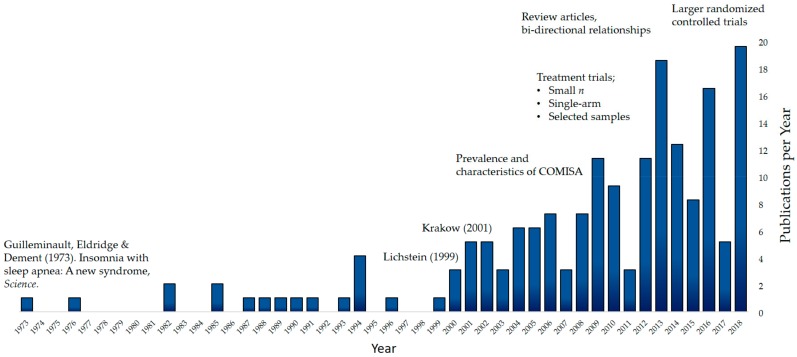
Co-morbid insomnia and sleep apnea (COMISA) is a highly prevalent and debilitating disorder, which results in additive impairments to patients’ sleep, daytime functioning, and quality of life, and complex diagnostic and treatment decisions for clinicians. Although the presence of COMISA was first recognized by Christian Guilleminault and colleagues in 1973, it received very little research attention for almost three decades, until the publication of two articles in 1999 and 2001 which collectively reported a 30%–50% co-morbid prevalence rate, and re-ignited research interest in the field. Since 1999, there has been an exponential increase in research documenting the high prevalence, common characteristics, treatment complexities, and bi-directional relationships of COMISA. Recent trials indicate that co-morbid insomnia symptoms may be treated with cognitive and behavioral therapy for insomnia, to increase acceptance and use of continuous positive airway pressure therapy. Hence, the treatment of COMISA appears to require nuanced diagnostic considerations, and multi-faceted treatment approaches provided by multi-disciplinary teams of psychologists and physicians. In this narrative review, we present a brief overview of the history of COMISA research, describe the importance of measuring and managing insomnia symptoms in the presence of sleep apnea, discuss important methodological and diagnostic considerations for COMISA, and review several recent randomized controlled trials investigating the combination of CBTi and CPAP therapy. We aim to provide clinicians with pragmatic suggestions and tools to identify, and manage this prevalent COMISA disorder in clinical settings, and discuss future avenues of research to progress the field. © 2019 by the authors. Licensee MDPI, Basel, Switzerland.
Overview
CoChat Summary
TL;DR
COMISA is a common co-morbidity of insomnia and obstructive sleep apnea, associated with worse sleep, daytime functioning, and quality of life than either disorder alone. This narrative review argues that COMISA should be actively screened for and treated with combined CBTi and CPAP, while noting that the best sequencing and measurement approaches still need refinement.
Key findings
- The paper states COMISA prevalence is commonly in the range of 30%–50%; earlier studies reported 43% of 80 insomnia patients had AHI ≥ 5 and 29% had AHI ≥ 15, while 50% of 231 OSA patients reported clinically significant insomnia symptoms.
- A 2010 review cited in the paper concluded 39%–58% of OSA patients report insomnia symptoms, and 29%–67% of insomnia patients meet minimal OSA criteria; a later meta-analysis of 37 studies reported 35% of insomnia patients had AHI ≥ 5, 29% had AHI ≥ 15, and 38% of OSA patients met insomnia criteria.
- The review says COMISA patients have greater impairment in sleep, daytime functioning, depressive/psychiatric symptoms, and quality of life than patients with insomnia or OSA alone, and are also more likely to have reduced CPAP acceptance and use.
- Recent randomized controlled trials reported that CBTi improved insomnia outcomes in COMISA and, in some studies, increased CPAP use by 78 min at 3 months and 48 min at 6 months, or by 61 min at 6 months; another study reported 57 min and 64 min greater CPAP use at 3 and 6 months, respectively.
Methods
- Narrative review of COMISA research, covering prevalence, consequences, measurement issues, treatment approaches, bidirectional mechanisms, and recent randomized controlled trials.
- Synthesizes prior studies and recent RCTs; the text specifically discusses studies of 56, 80, 231, 134, 121, 125, 145, and 630 participants, depending on the cited study.
- Main analytic approach is qualitative synthesis of published evidence rather than a new empirical analysis.
Limitations
- Stated in the paper: there has been a lack of research attention to COMISA for long periods, and there is still a need to validate and refine insomnia measures in the presence of OSA.
- Stated in the paper: the available RCTs give only tentative support for CBTi/CPAP sequencing, and the paper notes that more data are needed to confirm which treatment sequence is best.
- Evident from the text: this is a narrative review, so conclusions depend on heterogeneous prior studies with varying definitions of insomnia, OSA, populations, and outcomes; the paper itself notes that prevalence estimates vary considerably by criteria and sample.
Model-written summary. Check it against the paper before relying on it.
Integrity signals
Registry
Cites
Statistics
Figures
Verification
Claims the paper makes
31 Valid · 2 Not valid · 46 Not checked · 25 Own results and interpretations
Some cited sources support this claim and some don’t — read each source’s verdict below.
In the paper
“Since this time, a large number of case studies [69], pilot studies [70,71], chart-reviews [65,72], treatment trials [44,49,50], and cluster analyses [41,42] have examined the effect of co-morbid insomnia symptoms on reduced CPAP outcomes in OSA patients.”
§ Co-Morbid Insomnia and Sleep Apnea (COMISA): Prevalence, Consequences, Methodological Considerations, and Recent Randomized Controlled Trials > 2. Treatment of COMISA > 2.1. Traditional Treatment Approaches
What the sources say
- Partly supportedcites [69] An H. Chung S. A case of obstructive sleep apnea syndrome presenting as paradoxical insomnia Psychiatry Investig. 2010 7 75 78 10.4306/pi.2010.7.1.75 PMC2848777 20396438 sourceExperimental — accuracy not yet measured
The Abstract identifies this as a case report about insomnia symptoms in a patient with obstructive sleep apnea, supporting its citation as a case study. But the Case section says the patient refused CPAP, so the report does not examine whether insomnia reduced CPAP outcomes. (LLM, conf=0.88)
- Not matchedcites [70] Smith S.S. Dunn N. Douglas J. Jorgensen G. Sleep onset insomnia is associated with reduced adherence to CPAP therapy Sleep Biol. Rhythm. 2009 7 74
We searched by its title and found no matching paper.
- Not checked — no full text of the sourcecites [71] Suraiya S. Lavie P. Sleep onset insomnia in sleep apnea patients: Influence on acceptance of nCPAP treatment Sleep Med. 2006 7 S85 10.1016/j.sleep.2006.07.203 source
- Disputedcites [65] Philip P. Bioulac S. Altena E. Morin C.M. Ghorayeb I. Coste O. Monteyrol P.J. Micoulaud-Franchi JA. Specific insomnia symptoms and self-efficacy explain CPAP compliance in a sample of OSAS patients PLoS ONE 2018 13 e0195343 10.1371/journal.pone.0195343 29617414 PMC5884569 sourceExperimental — accuracy not yet measured
The citation identifies this paper as a treatment trial, but Methods and materials > Participants describes its design as retrospective and cross-sectional. The Discussion also says that no causal inference can be made. Although the paper examines insomnia symptoms and CPAP compliance, it is not a treatment trial. (LLM, conf=0.88)
Checked by a reasoning model — may be wrong.
- Not checked — no full text of the sourcecites [72] Wickwire E.M. Smith M.T. Birnbaum S. Collop N.A. Sleep maintenance insomnia complaints predict poor CPAP adherence: A clinical case series Sleep Med. 2010 11 772 776 10.1016/j.sleep.2010.03.012 20673741 source
plainstates a cause- Asserted: passes — The authors put it forward as true.
- Checkable: passes — It can be checked against evidence.
- Load-bearing: unclear — It is unclear whether the paper’s conclusions depend on it.
- Based: passes — The paper gives a reason why it holds.
- Partly supported
The cited sources support only part of this claim — read each source’s verdict below.
In the paper
“a lack of access to CBTi has resulted in the majority of insomnia sufferers receiving prescriptions for sedative-hypnotic medications as the initial and ongoing treatment [12,13].”
§ Co-Morbid Insomnia and Sleep Apnea (COMISA): Prevalence, Consequences, Methodological Considerations, and Recent Randomized Controlled Trials > 1. Introduction > 1.1. Insomnia and Obstructive Sleep Apnea
What the sources say
- Partly supportedcites [12] Miller C.B. Valenti L. Harrison C.M. Bartlett D.J. Glozier N. Cross N.E. Grunstein R.R. Britt H.C. Marshall N.S. Time trends in the family physician management of insomnia: The Australian experience (2000–2015) J. Clin. Sleep Med. 2017 13 785 790 10.5664/jcsm.6616 28454597 PMC5443739 sourceExperimental — accuracy not yet measured
The Results (Changes in Management Approaches; page unavailable) report medication use at approximately 90% of Australian family-physician insomnia management occasions. The Introduction describes limited CBT access, but the Discussion says only that unchanged management practices were possibly due to limited health-system capacity. The paper does not establish that lack of CBT access caused most insomnia sufferers to receive sedative-hypnotic prescriptions as both initial and ongoing treatment. (LLM, conf=0.87)
- Partly supportedcites [13] Kaufmann C.N. Spira A.P. Depp C.A. Mojtabai R. Long-term use of benzodiazepines and nonbenzodiazepine hypnotics, 1999–2014 Psychiatr. Serv. 2017 69 235 238 10.1176/appi.ps.201700095 29089011 PMC5794624 sourceExperimental — accuracy not yet measured
The Discussion (page not available) says behavioral treatments for insomnia are much less common than CBT for anxiety, while the Results report that most recorded hypnotic use for sleep problems was medium- or long-term. The paper does not establish that lack of CBT-I access caused prescribing, that most people with insomnia received these medications, or that they received them as initial treatment; it says the reasons for prescribing trends are unclear. (LLM, conf=0.88)
plainstates a cause- Asserted: passes — The authors put it forward as true.
- Checkable: passes — It can be checked against evidence.
- Load-bearing: unclear — It is unclear whether the paper’s conclusions depend on it.
- Based: passes — The paper gives a reason why it holds.
- Partly supported
Every source the paper cites for this claim was checked and supports it.
In the paper
“Although epidemiological studies provide statistical support for these ‘risk factors’ (e.g., OSA is associated with male gender, increased age, overweight and obesity, snoring, and daytime sleepiness [14])”
§ Co-Morbid Insomnia and Sleep Apnea (COMISA): Prevalence, Consequences, Methodological Considerations, and Recent Randomized Controlled Trials > 1. Introduction > 1.2. The Beginning of COMISA Research
What the sources say
- Supportedcites [14] Punjabi N.M. The epidemiology of adult obstructive sleep apnea Proc. Am. Thor. Soc. 2008 5 136 143 10.1513/pats.200709-155MG PMC2645248 18250205 source
The Abstract identifies age, male sex, and obesity as factors that increase vulnerability to OSA. It also identifies loud snoring and daytime sleepiness as signs or symptoms that help identify people needing evaluation, supporting the citing sentence’s stated associations. (LLM, conf=0.90)
plainstates an association- Asserted: passes — The authors put it forward as true.
- Checkable: passes — It can be checked against evidence.
- Load-bearing: unclear — It is unclear whether the paper’s conclusions depend on it.
- Based: passes — The paper gives a reason why it holds.
- Supported
The sources with a verdict support this claim; the rest weren’t checked yet, have no full text we could read, or their verdicts aren’t rated yet.
In the paper
“For example, questionnaire measures of insomnia commonly include both nocturnal and daytime symptoms [54,55,61].”
§ Co-Morbid Insomnia and Sleep Apnea (COMISA): Prevalence, Consequences, Methodological Considerations, and Recent Randomized Controlled Trials > 1. Introduction > 1.5. Refining the Measurement of COMISA
What the sources say
- Not checked — no full text of the sourcecites [54] Bastien C.H. Vallières A. Morin C.M. Validation of the insomnia severity index as an outcome measure for insomnia research Sleep Med. 2001 2 297 307 10.1016/S1389-9457(00)00065-4 11438246 source
- Not checked — no full text of the sourcecites [55] Soldatos C.R. Dikeos D.G. Paparrigopoulos T.J. Athens Insomnia Scale: Validation of an instrument based on ICD-10 criteria J. Psychosom. Res. 2000 48 555 560 10.1016/S0022-3999(00)00095-7 11033374 source
- Supportedcites [61] Espie C.A. Kyle S.D. Hames P. Gardani M. Fleming L. Cape J. The Sleep Condition Indicator: A clinical screening tool to evaluate insomnia disorder BMJ Open 2014 4 e004183 10.1136/bmjopen-2013-004183 PMC3964344 24643168 source
In Results > Development of the SCI (page not supplied), the paper describes an insomnia questionnaire with items on getting to and remaining asleep and items on daytime functioning and performance. The Discussion (page not supplied) likewise describes sleep pattern and the impact of poor sleep as two components of insomnia assessment. This supports the cited paper as an example of a questionnaire covering both. (LLM, conf=0.88)
plain- Asserted: passes — The authors put it forward as true.
- Checkable: passes — It can be checked against evidence.
- Load-bearing: passes — The paper’s conclusions depend on it.
- Based: passes — The paper gives a reason why it holds.
Every source the paper cites for this claim was checked and supports it.
In the paper
“However, there has previously been a lack of research attention directed toward the validity of existing insomnia measures in the presence of OSA [58].”
§ Co-Morbid Insomnia and Sleep Apnea (COMISA): Prevalence, Consequences, Methodological Considerations, and Recent Randomized Controlled Trials > 1. Introduction > 1.5. Refining the Measurement of COMISA
What the sources say
- Supportedcites [58] Sweetman A. Lack L.C. McEvoy D. Refining the Measurement of Insomnia in Patients with Obstructive Sleep Apnea: Commentary on Wallace and Wohlgemuth. Predictors of Insomnia Severity Index Profiles in US veterans with Obstructive Sleep Apnea J. Clin. Sleep Med. 2019 in press PMC7099194 31855156 source
In the commentary’s opening discussion, the authors explicitly describe a “surprising lack of research investigating the validity of current measures of insomnia” when OSA co-occurs. The following discussion also identifies a prior lack of validity data for the Insomnia Severity Index specifically. (LLM, conf=0.95)
plain- Asserted: passes — The authors put it forward as true.
- Checkable: passes — It can be checked against evidence.
- Load-bearing: passes — The paper’s conclusions depend on it.
- Based: passes — The paper gives a reason why it holds.
- Supported
51 more claims · 9 with their cited sources checked
Create a free account to see all 104 claims and to verify the 6 references still open.
- Probably not a substantial claim. 14
- It may state two separate claims as one. 41
- The quote only partly states this claim. 1
Claims other papers make about this one
Each is checked against this paper’s own text: does it say what the citing paper says it does?
The source backs part of the claim, not all of it — or backs it for a different population, condition or comparison.
In the citing paper
“The SR concluded that these trials demonstrate the beneficial effects of therapist-administered cognitive behavioral therapy for insomnia (CBTi) on improving insomnia symptoms and increasing CPAP therapy usage.1189”
From International Consensus Statement on Obstructive Sleep Apnea (2023) · cites this paper as [1189]
Experimental — accuracy not yet measured
Citations
Cites
Diagnostic and Statistical Manual of Mental Disorders
American Psychiatric Association (2013) · doi:10.1176/appi.books.9780890425596 · Cited by 116,369
Validation of the Insomnia Severity Index as an outcome measure for insomnia research
Bastien, C. (2001) · Sleep Medicine · doi:10.1016/s1389-9457(00)00065-4 · Cited by 8,067 · cited 3×
“For example, questionnaire measures of insomnia commonly include both nocturnal and daytime symptoms [54,55,61].”
BackgroundMethodSelf-citationIncreased Prevalence of Sleep-Disordered Breathing in Adults
Peppard, P. E., Young, T., Barnet, J. H., Palta, M., Hagen, E. W., & Hla, K. M. (2013) · American Journal of Epidemiology · doi:10.1093/aje/kws342 · Cited by 4,618 · cited 1×
“The prevalence of OSA varies by diagnostic criteria and the sample population, however it is estimated that approximately 10% of the general population fulfil diagnostic criteria for OSA [20].”
BackgroundEpidemiology of insomnia: what we know and what we still need to learn
Ohayon, M. M. (2002) · Sleep Medicine Reviews · doi:10.1053/smrv.2002.0186 · Cited by 3,743 · cited 2×
“The estimated prevalence of insomnia varies widely according to diagnostic criteria and specific populations of interest, however it is thought that 6%–10% of the general population suffer from chronic insomnia disorder, which includes clinically significant and frequent nocturnal sleep disturbances and impaired dayti…”
BackgroundResultAdult Obstructive Sleep Apnea Task Force of the American Academy of Sleep Medicine, Epstein, L. J., Kristo, D., Strollo, P. J., Friedman, N., Malhotra, A., Patil, S. P., Ramar, K., Rogers, R., Schwab, R. J., et al. (2009) · Journal of Clinical Sleep Medicine · doi:10.5664/jcsm.27497 · Cited by 3,360 · cited 5×
“Furthermore, as sleep clinics are encouraged to offer educational support for OSA patients commencing CPAP therapy [15], it may be possible to include CBTi interventions within these existing education platforms, to simultaneously target both insomnia symptoms and improved CPAP use [79].”
BackgroundInfluentialThe epidemiology of adult obstructive sleep apnea
Punjabi, N. M. (2008) · Proceedings of the American Thoracic Society · doi:10.1513/pats.200709-155mg · Cited by 2,361 · cited 2×
“, OSA is associated with male gender, increased age, overweight and obesity, snoring, and daytime sleepiness [14]), reliance on this single profile clearly does not represent all OSA sufferers [26–28].”
BackgroundCPAP for Prevention of Cardiovascular Events in Obstructive Sleep Apnea
McEvoy, R. D., Antic, N. A., Heeley, E., Luo, Y., Ou, Q., Zhang, X., Mediano, O., Chen, R., Drager, L. F., Liu, Z., et al. (2016) · New England Journal of Medicine · doi:10.1056/nejmoa1606599 · Cited by 2,101 · cited 1×
“The most effective treatment for moderate and severe OSA is continuous positive airway pressure (CPAP) therapy, which stabilizes breathing throughout the night, improves daytime sleepiness and quality of life, and reduces risk of motor-vehicle accidents [15,19,21,22].”
BackgroundQaseem, A., Kansagara, D., Forciea, M. A., Cooke, M., Denberg, T. D., & for the Clinical Guidelines Committee of the American College of Physicians* (2016) · Annals of Internal Medicine · doi:10.7326/m15-2175 · Cited by 1,965 · cited 1×
“CBTi is the recommended ‘first line’ treatment for insomnia, and appears to be effective in the presence of co-morbid OSA [8,9,52].”
BackgroundClinical Guideline for the Evaluation and Management of Chronic Insomnia in Adults
Schutte-Rodin, S., Broch, L., Buysse, D., Dorsey, C., & Sateia, M. (2008) · Journal of Clinical Sleep Medicine · doi:10.5664/jcsm.27286 · Cited by 1,943 · cited 1×
“CBTi is the recommended ‘first line’ treatment for insomnia, and appears to be effective in the presence of co-morbid OSA [8,9,52].”
BackgroundAthens Insomnia Scale: Validation of an instrument based on ICD-10 criteria
Soldatos, C. R., Dikeos, D. G., & Paparrigopoulos, T. J. (2000) · Journal of Psychosomatic Research · doi:10.1016/s0022-3999(00)00095-7 · Cited by 1,754 · cited 1×
“For example, questionnaire measures of insomnia commonly include both nocturnal and daytime symptoms [54,55,61].”
Background
Research works printed but not linked: 3
- Lichstein K. McCrae C. Wilson N. Secondary insomnia: Diagnostic issues, cognitive-behavioral treatment, and future directions. Treating Sleep Disorders: Principles and Practice of Behavioral Sleep Medicine Wiley Hoboken, NJ, USA 2003 286 304
- Smith S.S. Dunn N. Douglas J. Jorgensen G. Sleep onset insomnia is associated with reduced adherence to CPAP therapy Sleep Biol. Rhythm. 2009 7 74
- Parikh S. White D. Jordan A. Merchia P. Malhotra A. Eckert D. 36 Hours of Sleep Deprivation Reduces Genioglossus Muscle Activity during Hypercapnia and Inspiratory Resistive Loads during Wakefulness Sleep 2011 34 A153
Cited by
Items 201–251 of 251
The many faces of obstructive sleep apnea
Carter, G. L. (2023) · IntechOpen eBooks · doi:10.5772/intechopen.1003062
Ich finde keinen Schlaf, das kann doch keine Schlafapnoe sein – COMISA
Frohnhofen, H. (2023) · Springer eBooks · doi:10.1007/978-3-662-60290-4_20
A first look at childhood abuse in women with obstructive sleep apnea
Pal, A., Martínez, F., Wagman, J. A., Aysola, R., Shechter, A., Mysliwiec, V., Martin, J. L., & Macey, P. M. (2024) · Frontiers in Sleep · doi:10.3389/frsle.2023.1281425 · Cited by 1
Diagnosis and Management of OSA Comorbid with Insomnia (COMISA)
Gupta, R. M., & Saini, L. K. (2023) · Progress in Sleep Research · doi:10.1007/978-981-99-7901-1_8
Prediction of Sleep Disorder From Actigraphy Data Using Deep Learning
Kim, K., Park, J., Yook, S., Kim, H. S., & Joo, E. Y. (2024) · Journal of Sleep Medicine · doi:10.13078/jsm.230028
Opciones de tratamiento para la apnea obstructiva del sueño leve y moderada
Jorge Jorquera, A., Constanza Salas, C., Oyarzo, J. F., Pacheco, C., Favero, M. D., & Sánchez, M. (2024) · Revista Médica Clínica Las Condes · doi:10.1016/j.rmclc.2024.04.001 · Cited by 1
“Este grupo de pacientes se describe con el acrónimo COMISA que proviene del inglés “comorbid insomnia and sleep apnea” 31 .”
BackgroundLau, P. H., Marway, O. S., & Carney, C. E. (2025) · Cambridge University Press eBooks · doi:10.1017/9781009086264.011
Krakow, B. J., & Krakow, J. (2025) · Sleep Medicine · doi:10.1016/j.sleep.2025.03.014
Cognitive/Behavioral Approaches for Treating Sleep Disorders
Bastien, C., & Vallières, A. (2025) · doi:10.1093/med/9780197756782.003.0031
Self-citationIntegrating sleep and central adiposity in cardiovascular risk in older adults: next steps?
Pacheco, A. P. (2025) · European Journal of Cardiovascular Nursing · doi:10.1093/eurjcn/zvaf077
Pan, L., Hang, L., Li, H., Yi, Y., Li, L., Zhan, W., Li, Y., He, Q., Chen, H., Wu, Y., et al. (2025) · SSRN Electronic Journal · doi:10.2139/ssrn.5316625
Why Barnaby Joyce’s TV diagnosis of insomnia plus sleep apnoea is such a big deal
Sweetman, A. (2024) · The Conversation · doi:10.64628/aa.54ghqx7dx
Self-citationDefillo, A., Grassi, M., Daccò, S., Martin, J. L., Caldirola, D., & Perna, G. (2025) · Frontiers in Sleep · doi:10.3389/frsle.2025.1648256
Sleep apnea at the frontier— an integrated multidisciplinary functional framework
Beache, G. M., Hutchinson, B., Raman, B., Macey, P. M., Pham, N., Lozano, P. F. R., Redeker, N. S., & Somers, V. K. (2025) · Sleep Medicine Reviews · doi:10.1016/j.smrv.2025.102190 · Cited by 1
Zhang, C., Liu, Y., Guo, X., Shen, Y., & Ma, J. (2025) · Postgraduate Medical Journal · doi:10.1093/postmj/qgaf203 · Cited by 1
Role of Sleep Disturbances and Diabetes‐Related Distress on Glycemic Control: A Path Analysis
Jeon, B., Luyster, F. S., & Chasens, E. R. (2025) · Research in Nursing & Health · doi:10.1002/nur.70047
“In the context of OSA, although insomnia often coexists with OSA and increases the risk of cardiometabolic morbidity (Sweetman et al. 2019), few studies have specifically considered the impact of comorbid insomnia on glucose control in patients with T2D (Passali et al. 2025).”
Cavaco, M. J., Mateus, L., Silva, C., Pimentel, S., Alves, S. F., Oliveira, M. T. D. S., Rosário, S., Silvestre, C. R., Cardoso, C., Bragança, A., et al. (2025) · Research Square · doi:10.21203/rs.3.rs-8007054/v1
Pacheco, A. P., Dammen, T., Munkhaugen, J., Papageorgiou, C., Kværner, K. J., & Støme, L. N. (2025) · BMJ Open · doi:10.1136/bmjopen-2024-092811 · Cited by 1
“Ultimately, this can facilitate sustainable implementation and improve health outcomes in this group of patients.”
Chun Kwan, O., Chan, R. N., Chan, K. P., Wu, H., Lam, F. M., Lee, H. H., Chow, E., Luk, A. O. Y., Ronald, C. W., Wing, Y. K., et al. (2025) · Primary care diabetes · doi:10.1016/j.pcd.2025.12.003
Pöschel, L., & Frase, L. (2026) · PSYCH up2date · doi:10.1055/a-2550-7222
Knapik, J. J., Steelman, R. A., Caldwell, J. A., Trone, D. W., & Lieberman, H. R. (2026) · Sleep Medicine · doi:10.1016/j.sleep.2026.108820
The need for rigour in insomnia clinical trial research
Sullivan, D. (2026) · Sleep Medicine X · doi:10.1016/j.sleepx.2026.100179
Lu, Y.-T., Li, H., Lin, Y.-R., Hsin, C., Tsai, S.-F., Yang, S., Huang, J., & Tsai, Y. (2026) · SLEEP · doi:10.1093/sleep/zsag048 · Cited by 4
Insomnia symptoms in children with sleep-disordered breathing: A scoping review
Dai, S., Dastamooz, S., Fan, X., Huang, Z., Chan, N., Li, A. M., & Chan, K. C. C. (2026) · Sleep Medicine · doi:10.1016/j.sleep.2026.108914
Voulgaris, A., Archontogeorgis, K., Kalkanis, A., Chadia, K., Trakada, G., & Steiropoulos, P. (2026) · Respiratory Medicine · doi:10.1016/j.rmed.2026.108822
Gottschalk, R., Lowe, A. D., Cheng, J. Y., Kumar, D., Ramos, B., & Moline, M. L. (2026) · Sleep Medicine X · doi:10.1016/j.sleepx.2026.100188 · Cited by 1
“These impairments are reported to be worse in people with COMISA than in those with insomnia or OSA alone [5].”
InfluentialPersonalizing sleep therapy: Integrating EEG neurofeedback into the sleep disorders management
Shirolapov, I. V., Bazanova, O. M., & Zakharov, A. V. (2026) · CRANIO® · doi:10.1080/08869634.2026.2666591 · Cited by 2
Insomnia Symptoms Should Not Lower Suspicion for Obstructive Sleep Apnea
Gu, M., Ren, Q., Wang, X., et al. (2026) · Mayo Clinic Proceedings · doi:10.1016/j.mayocp.2026.05.005
In Reply: Insomnia Symptoms Should Not Lower Suspicion for Obstructive Sleep Apnea
Junna, M. R., Lipford, M. C., & Auger, R. R. (2026) · Mayo Clinic Proceedings · doi:10.1016/j.mayocp.2026.05.006
Lin, F.-F., Xu, Y.-Q., Wu, J.-R., Huang, J., Zheng, Y.-S., Zhang, S., & Xie, S.-R. (2026) · EXPLORE · doi:10.1016/j.explore.2026.103455
Impaired emotion recognition is associated with sleep-related hypoxic burden
Ferretti, D., Richert, E., Zou, D., Hedner, J., Straßberger, C., Arnardóttir, E. S., Grote, L., & Jóhannsdóttir, K. R. (2026) · SLEEP · doi:10.1093/sleep/zsag078 · Cited by 1
“…novel f inding supports previous data that COMISA has a stronger negative impact on clinically important outcomes like health-related quality of life, cognition, and cardiovascular disease, and warrants combined treatment approaches [ 42– 45] and needs to be addressed further in future studies.”
Agossou, M., Coffi, M. E., Tabué-Teguo, M., Andreu, M., Awanou, B., Inamo, J., l’Heveder, O., Dufeal, M., Ndziha, S. M., & Dramé, M. (2026) · Sleep Health · doi:10.1016/j.sleh.2026.05.005
Nahidi, S., Agidi, S., & El-Solh, A. A. (2026) · Current Sleep Medicine Reports · doi:10.1007/s40675-026-00384-w
“The resulting clinical picture is one of heightened physiological strain, impaired daytime functioning, and significant deterioration in overall health and well-being [3, 26].”
Insomnia and Obstructive Sleep Apnea: The Role of COMISA in Cardiology
Mikhailova, O. O., Elfimova, E. M., Litvin, A. Y., & Chazova, I. E. (2026) · Systemic Hypertension · doi:10.38109/2075-082x-2026-2-41-47
Cognitive Behavioral Therapy for Insomnia
Moran, J. M., Bowen, C. A., & Fins, A. I. (2026) · Elsevier eBooks · doi:10.1016/b978-0-443-29009-1.00121-9
Pruiksma, K. E., Bolstad, C. J., Brock, M. S., Li, X., Gerwell, K. M., Straud, C. L., Zwetzig, S. E., Young‐McCaughan, S., Peterson, A. L., Taylor, D. J., et al. (2026) · Military Medicine · doi:10.1093/milmed/usag249
Rawcliffe, A. J., Coombs, C. V., Docherty, A., O’Leary, T. J., & Greeves, J. P. (2026) · SLEEP Advances · doi:10.1093/sleepadvances/zpag073
“Insomnia and breathing-related sleep disorders emerge as the most prevalent sleep disorders in civilians and service personnel [ 50, 51].”
Monare, A. B., & Genta, P. R. (2026) · CHEST Journal · doi:10.1016/j.chest.2026.04.018
Estimation of Total Sleep Time From Respiratory Event Intervals in Sleep Disordered Breathing
Cerina, L., Papini, G. B., Overeem, S., Vullings, R., & Fonseca, P. (2026) · Journal of Sleep Research · doi:10.1111/jsr.70398
Jaakkola, J., Feuth, T., Anttalainen, U., & Saaresranta, T. (2026) · Journal of Sleep Research · doi:10.1111/jsr.70419
Aligning obstructive sleep apnoea care with underlying drivers: A lifestyle-metabolic perspective
Melaku, Y. A., Sweetman, A., Metse, A. P., Manger, S., Haycock, J., Appleton, S., Zhao, L., Wilson, C., Lawson, J., Royans, M., et al. (2026) · Sleep Medicine Reviews · doi:10.1016/j.smrv.2026.102355
Self-citationНічна неврологія: чому розлади сну стали стратегічною мішенню сучасної медицини (частина І)
(2026) · Український медичний часопис · doi:10.32471/umj.1680-3051.280210
Xie, G., Guo, Y., & Wang, Z. (2026) · Frontiers in Neurology · doi:10.3389/fneur.2026.1889217
Long-term trajectories of insomnia and their lifestyle and health correlates
Guo, J., Hanson, L. L. M., Åkerstedt, T., & Hedström, A. K. (2026) · Sleep Health · doi:10.1016/j.sleh.2026.08.002
Oh, J., & Choi, J. H. (2026) · Life · doi:10.3390/life16091462
“…is therefore a potential confounder of several predictors at once [13,14,48]; mask type and fit [49]; patient-reported comfort [17]; psychological constructs [11,37,38,43,44]; comorbid insomnia [50,51]; and the pulmonary and positional data needed to test our interpretation of the lowest SpO 2 .”
Wang, Y., Ni, N., Chen, H., Zhao, J., Xie, Y., 赵碧霞, & Zhang, F. (2026) · Frontiers in Psychiatry · doi:10.3389/fpsyt.2026.1907602
Wang, Y., Liu, T., Hu, R., Zhao, W., & 赵碧霞 (2026) · BMC Pulmonary Medicine · doi:10.1186/s12890-026-04571-x
“…with COMISA, adherence is further compromised: co-morbid insomnia symptoms have been associated with an approximately 30% reduction in initial CPAP acceptance compared with OSA alone, and insomnia-related arousal and sleep fragmentation compound the discomfort of mask-based therapy [11, 12].”
Garrivet, J., Blanchard, M., Gohier, B., Geoffroy, P. A., Solelhac, G., Jouvenot, M., Thomas, A., Gagnadoux, F., & Trzépizur, W. (2026) · Journal of Sleep Research · doi:10.1111/jsr.70452
de Oliveira, P. G., Costa, E., Young, T., Capasso, R., Rodriguez-Romero, D. D., Reina, C., Magon, H., Muralidharan, J., Nguyen, K. H., Coyle, J., et al. (2026) · Sleep Medicine · doi:10.1016/j.sleep.2026.109282
Artificial Intelligence for Multimorbidity Risk Assessment in Sleep Medicine
Gupta, R., & Saini, L. K. (2026) · Sleep Medicine Clinics · doi:10.1016/j.jsmc.2026.08.014
Metadata
- Authors
- Sweetman, A., Lack, L., & Bastien, C.
- Affiliations
- Flinders University (AU)
- Université Laval (CA)
- Corresponding author
- Sweetman, Alexander
- Venue
- Brain Sciences
- Publisher
- MDPI AG
- Published
- 2019-12-12
- Volume
- 9
- Issue
- 12
- Pages
- 371
- ISSN
- 2076-3425 (ISSN-L)
- PMC
- PMC6956217
- OpenAlex
- W2995714602
- Cited by
- 253
- References
- 120
- Citations by year
- 2026: 46 · 2025: 47 · 2024: 38 · 2023: 47 · 2022: 26 · 2021: 34 · 2020: 13
- FWCI
- 2.69
- Type
- journal article
- Language
- en
- Open access
- gold
- dx.doi.org
- Licence
- Locations
- Brain Sciences (publishedVersion, cc-by)
- Europe PMC (PubMed Central) (publishedVersion, cc-by)
- PubMed Central (publishedVersion, cc-by)
- PubMed (publishedVersion)
- Topics
- Social Sciences › Psychology › Experimental and Cognitive Psychology › Sleep and related disorders
- Health Sciences › Medicine › Physiology (medical) › Obstructive Sleep Apnea Research
- Health Sciences › Dentistry › Oral Surgery › Temporomandibular Joint Disorders
- Keywords
- insomnia, sleep apnea, comorbidities, prevalence, cognitive behavioral therapy for insomnia, continuous positive airway pressure, CPAP acceptance, sleep quality, daytime functioning, quality of life, diagnosis, interdisciplinary treatment
About these checks
Registry, retraction, Cites and statistics results are computed, not judged, with one exception: a printed reference that no index lists is read once by a model before it counts as a citation error. Claims are extracted by a model and kept only when their quote appears verbatim in the text; each cited source is then checked, with a model’s help, for whether it says what the claim relies on. Those verdicts can be wrong — read the claim’s quote and the cited source before relying on one.
The claim verdicts this report counts are experimental: their accuracy is not yet measured.
A language model drew the claims from the paper on 2026-10-11, under version 3 of the claim definition (model deepseek-v4.1-flash, prompt extract-v3).
A second model labelled each claim on 2026-10-11 (model jev-1.13-20260917, definition revision gold-guideline-v0.2).
Cited sources are checked with a language model’s help (gpt-6-sol).
Statistics and arithmetic are recomputed, not judged.
Confidence bands are shown only for fields calibrated on our annotated test set. None is calibrated yet, so no band is shown.
What counts as a claim ›How we measure confidence ›How we check this ›
Are you an author, or do you see a problem with this page? Request a review
Data sources
Bibliographic data: Semantic Scholar, OpenAlex, Crossref.
Contains information from the Semantic Scholar Academic Graph Datasets, made available under the ODC Attribution License (ODC-BY 1.0).
Semantic Scholar’s data is described in: Kinney, R., et al. (2023). The Semantic Scholar Open Data Platform. arXiv:2301.10140.
