

The DOI matches its Crossref record; 59 of the 59 references it cites were found in a registry or an index; 26 of the 65 sources its claims cite were checked for support.
The Relationship Between TikTok Usage and Executive Function Is Mediated by Problematic Social Media Use
Open accessAbstract
Social media is deeply integrated into life, offering new opportunities for learning and communication. However, excessive use has been linked to negative effects on well-being and cognitive functions. A rapidly growing platform, TikTok has been a focal point of controversy due to concerns over its short-form content. The present study investigates the relationship between TikTok usage, problematic social media use (PSMU), and executive function (EF) to distinguish platform-specific features from broader patterns of problematic use. A survey conducted with 346 college students measured EF, TikTok use intensity, PSMU, and mental health variables. The findings indicate that while PSMU and TikTok use correlate with EF dysfunction, TikTok use is not a significant predictor when PSMU and mental health factors are statistically accounted for. Mediation analysis suggests that PSMU mediates the relationship between TikTok use and EF impairment, indicating that problematic media use—rather than platform-specific characteristics—relates to poor cognition connected to social media. These results contribute to the growing literature on digital media’s cognitive effects, underscoring the importance of addressing problematic usage patterns rather than focusing on individual platforms. Additionally, the association of PSMU with EF impairments and poor mental health reinforces the need for interventions targeting excessive social media engagement.
Overview
CoChat Summary
TL;DR
In a survey of 346 college students, TikTok use intensity and problematic social media use (PSMU) each correlated with worse executive function (EF), but TikTok use was no longer a significant predictor once PSMU and mental health were controlled. PSMU fully mediated the relationship between TikTok use and EF, suggesting problematic usage patterns rather than TikTok-specific features explain the cognitive link.
Key findings
- PSMU significantly predicted worse EF in a univariate regression (b = 0.47, p < 0.001), accounting for 11.7% of EF variance; TikTok use intensity also predicted worse EF (b = 0.46, p < 0.001), accounting for 4.6% of variance.
- In multivariate models, TikTok use was significant with covariates but without PSMU (β = 0.12 [0.04, 0.21], p < 0.001); after adding PSMU, TikTok use became non-significant (β = 0.05 [−0.05, 0.14], p = 0.318), while PSMU remained significant (β = 0.16 [0.07, 0.26], p = 0.001).
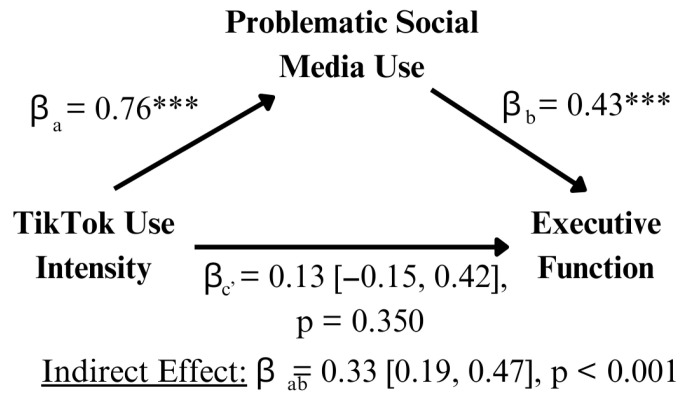
- PSMU fully mediated the TikTok-to-EF relationship: indirect effect β = 0.33 [0.19, 0.47], p < 0.001; direct effect β = 0.13 [−0.15, 0.42], p = 0.350.
- Depression and anxiety each partially mediated PSMU’s relationship to EF: depression indirect β = 0.23 [0.14, 0.32], p < 0.001, direct β = 0.25 [0.13, 0.36], p < 0.001; anxiety indirect β = 0.14 [0.06, 0.22], p < 0.001, direct β = 0.33 [0.22, 0.44], p < 0.001.
Methods
- Cross-sectional online Qualtrics survey of University of California, Riverside students recruited via SONA from May to July 2023; 357 initial participants, 346 retained after missing-data exclusion. Sample was 57% female, ages 17–51 (M = 19.90, SD = 2.66).
- Measures: BRIEF-A-SI for EF, SMAS-SF for PSMU, adapted Multidimensional Facebook Intensity Scale for TikTok Intensity (TTI), PHQ-9 for depression, and GAD-7 for anxiety.
- Analysis: composite scores, Spearman correlations due non-normal distributions, univariate and multivariate linear regressions with EF as outcome, R-squared change test, and three mediation analyses (PSMU mediating TikTok→EF; depression and anxiety separately mediating PSMU→EF).
Limitations
- The paper states the results are correlational, so directionality is explored but no concrete causal/directional statistical implications can be drawn; future longitudinal and causal work is needed.
- The paper notes reliance on self-report measures, possible social desirability biases, and recommends additional task-based EF and working-memory measures; it also calls for further validation of the TTI scale.
- The paper states conclusions are limited to the current measures and sample, and that different TikTok-use measures might relate to different aspects or measures of EF. Evident from the text: the sample is college students from one university, which may limit generalizability.
Model-written summary. Check it against the paper before relying on it.
Integrity signals
Registry
Cites
Statistics
Figures


Verification
Claims the paper makes
19 Valid · 4 Not valid · 18 Not checked · 47 Own results and interpretations
The cited sources support only part of this claim — read each source’s verdict below.
In the paper
“Moreover, PSMU heightens risks for mental health, including emotional instability (Twenge & Campbel, 2018), anxiousness (S. Li et al., 2025), and depression (Cunningham et al., 2021).”
§ The Relationship Between TikTok Usage and Executive Function Is Mediated by Problematic Social Media Use > 1. Introduction
What the sources say
- Partly supportedcites Twenge & Campbel, 2018 sourceExperimental — accuracy not yet measured
The Discussion reports that children and adolescents with higher screen-media use were more likely to show poor emotion regulation, supporting the emotional-instability portion attached to Twenge and Campbell. But the study examined overall screen time, not problematic social media use (PSMU), and its Discussion says its cross-sectional design cannot establish whether screen time causes lower well-being. The citations for anxiousness and depression are attached to other sources and are not judged here. (LLM, conf=0.89)
- Not matchedcites S. Li et al., 2025
Couldn’t be matched to a paper in Crossref, so it can’t be checked.
- Not checked — no full text of the sourcecites Cunningham et al., 2021 source
plainstates a cause- Asserted: passes — The authors put it forward as true.
- Checkable: passes — It can be checked against evidence.
- Load-bearing: passes — The paper’s conclusions depend on it.
- Based: passes — The paper gives a reason why it holds.
- Partly supported
The cited sources support only part of this claim — read each source’s verdict below.
In the paper
“Sleep quality, a known predictor of EF (Xie et al., 2019), is directly decreased by problematic phone usage (Cui et al., 2021).”
§ The Relationship Between TikTok Usage and Executive Function Is Mediated by Problematic Social Media Use > 1. Introduction
What the sources say
- Partly supportedcites Cui et al., 2021 sourceExperimental — accuracy not yet measured
The Results (Cross-lagged model; page unavailable) show that problematic mobile phone use predicted a higher subsequent sleep-quality score (effect 0.063); the Methods (Measurements; page unavailable) explain that higher scores mean poorer sleep quality. This supports a direct predictive association, but the citing sentence’s claim that phone use directly decreases sleep quality states a causal effect that the observational analysis does not establish. (LLM, conf=0.84)
plainstates a cause- Asserted: passes — The authors put it forward as true.
- Checkable: passes — It can be checked against evidence.
- Load-bearing: passes — The paper’s conclusions depend on it.
- Based: passes — The paper gives a reason why it holds.
- Partly supported
The cited sources support only part of this claim — read each source’s verdict below.
In the paper
“PSMU also creates heightened mind wandering (Lian et al., 2022), further contributing to WM failure as drifted attention damages filtering and prioritizing (Rummel & Boywitt, 2014; Hollis & Was, 2016; Awh et al., 2006).”
§ The Relationship Between TikTok Usage and Executive Function Is Mediated by Problematic Social Media Use > 1. Introduction
What the sources say
- Partly supportedcites Lian et al., 2022 sourceExperimental — accuracy not yet measured
The Discussion (§4.1; page unavailable) reports that mobile phone addiction positively predicted mind wandering. But the paper measured mobile phone addiction, not PSMU, and its Limitations (§4.4; page unavailable) say the cross-sectional study cannot establish a causal relationship. Thus, it does not support the claim that PSMU ‘creates’ heightened mind wandering. (LLM, conf=0.90)
plainstates a cause- Asserted: passes — The authors put it forward as true.
- Checkable: passes — It can be checked against evidence.
- Load-bearing: passes — The paper’s conclusions depend on it.
- Based: passes — The paper gives a reason why it holds.
- Partly supported
The cited sources support only part of this claim — read each source’s verdict below.
In the paper
“WM, a temporary and limited capacity memory (W. Zhang & Luck, 2008), has also been previously seen to be disrupted by PSMU through post-offloading (Tamir et al., 2018), memory failures, and increased negative affect (Sharifian & Zahodne, 2021; Frein et al., 2013).”
§ The Relationship Between TikTok Usage and Executive Function Is Mediated by Problematic Social Media Use > 1. Introduction
What the sources say
- Not checked — no full text of the sourcecites Tamir et al., 2018 source
- Partly supportedcites Sharifian & Zahodne, 2021 sourceExperimental — accuracy not yet measured
The Discussion reports that on days with higher social media use, participants reported greater negative affect and more everyday memory failures. But the Methods measured self-reported everyday lapses, not working memory, and the Limitations say the observational study cannot establish the direction or cause of the association. This source therefore does not establish that problematic social media use (PSMU) disrupted working memory. (LLM, conf=0.88)
- Not checked — no full text of the sourcecites Frein et al., 2013 source
plainstates a cause- Asserted: passes — The authors put it forward as true.
- Checkable: passes — It can be checked against evidence.
- Load-bearing: passes — The paper’s conclusions depend on it.
- Based: passes — The paper gives a reason why it holds.
The cited sources support only part of this claim — read each source’s verdict below.
In the paper
“SFV is linked to triggering distraction, memory attrition (Asif & Kazi, 2022), boredom (Tam & Inzlicht, 2024), WM dysfunction (Sha & Dong, 2021), and overall cognition (Nguyen et al., 2025).”
§ The Relationship Between TikTok Usage and Executive Function Is Mediated by Problematic Social Media Use > 1. Introduction
What the sources say
- Partly supportedcites Sha & Dong, 2021 sourceExperimental — accuracy not yet measured
The Results and Conclusions link TikTok use disorder to poorer forward and backward digit-span performance, which the study uses to assess memory loss. This supports a link to memory difficulties, but the study concerns adolescents with TikTok use disorder, not short-form video use generally, and does not establish working-memory dysfunction as a clinical condition. Section 2.2 describes the digit-span measures; page numbers are unavailable in our copy. (LLM, conf=0.87)
plainstates an association- Asserted: passes — The authors put it forward as true.
- Checkable: passes — It can be checked against evidence.
- Load-bearing: passes — The paper’s conclusions depend on it.
- Based: passes — The paper gives a reason why it holds.
- Partly supported
41 more claims · 3 with their cited sources checked
Create a free account to see all 88 claims and to verify the 5 references still open.
- Probably not a substantial claim. 32
- It may state two separate claims as one. 18
Statistics recomputed
Every reported test result, recomputed from its test statistic and degrees of freedom. A result shows as not adding up only once an independent check has confirmed it.
- ConsistentF(5, 340) = 47.82reported p < .001 · recomputed p < .001
“F(5, 340) = 47.82, p < .001”
- ConsistentF(6, 339) = 42.94reported p < .001 · recomputed p < .001
“F(6, 339) = 42.94, p < .001”
- ConsistentF(1, 340) = 11.32reported p < .001 · recomputed p < .001
“F(1, 340) = 11.32, p < .001”
Self-check
Percentages, sums and reported differences re-computed from the paper’s own numbers.
Each contradiction between two passages listed here was confirmed by an independent check.
Rated minor: it would not touch a result — a value no result rests on, a p-value that stays on the same side of the significance level, or a conflict that is clerical, resolved elsewhere in the paper, or outside its own findings.
In the paper
§ The Relationship Between TikTok Usage and Executive Function Is Mediated by Problematic Social Media Use > 3. Results > 3.2. Regression Models
“anxiety (β = 0.40”
§ The Relationship Between TikTok Usage and Executive Function Is Mediated by Problematic Social Media Use > 3. Results > 3.2. Regression Models
“[0.11, 0.38]”
Rated minor: it would not touch a result — a value no result rests on, a p-value that stays on the same side of the significance level, or a conflict that is clerical, resolved elsewhere in the paper, or outside its own findings.
In the paper
§ The Relationship Between TikTok Usage and Executive Function Is Mediated by Problematic Social Media Use > 3. Results > 3.2. Regression Models
“F(1, 340) = 11.32”
§ The Relationship Between TikTok Usage and Executive Function Is Mediated by Problematic Social Media Use > 3. Results > 3.2. Regression Models
“F(6, 339) = 42.94”
Citations
Cites
A Brief Measure for Assessing Generalized Anxiety Disorder: The GAD-7
Spitzer, R. L., Kroenke, K., Williams, J. B. W., & Löwe, B. (2006) · Archives of Internal Medicine · doi:10.1001/archinte.166.10.1092 · Cited by 31,765
Diamond, A. (2013) · Annual Review of Psychology · doi:10.1146/annurev-psych-113011-143750 · Cited by 13,268 · cited 2×
“Supporting EF’s role in goal-directed behavior are inhibition, WM, and cognitive flexibility (Diamond, 2012).”
A Developmental Perspective on Executive Function
Best, J. R., & Miller, P. H. (2010) · Child Development · doi:10.1111/j.1467-8624.2010.01499.x · Cited by 2,692 · cited 1×
“WM—specifically updating and monitoring—attention, and emotional control coalesce into EF (Roth et al., 2005; Best & Miller, 2010), and are all are strained by overused social media.”
Discrete fixed-resolution representations in visual working memory
Zhang, W., & Luck, S. J. (2008) · Nature · doi:10.1038/nature06860 · Cited by 1,622 · cited 1×
“WM, a temporary and limited capacity memory (W. Zhang & Luck, 2008), has also been previously seen to be disrupted by PSMU through post-offloading (Tamir et al., 2018), memory failures, and increased negative affect (Sharifian & Zahodne, 2021; Frein et al., 2013).”
Self-citationMonitoring Depression Treatment Outcomes With the Patient Health Questionnaire-9
L??we, B., Un??tzer, J., Callahan, C. M., Perkins, A. J., & Kroenke, K. (2004) · Medical Care · doi:10.1097/00005650-200412000-00006 · Cited by 1,354 · cited 1×
“The Patient Health Questionnaire 9 (PHQ-9; Lowe et al., 2004) measured depressive symptoms and severity.”
Twenge, J. M., & Campbell, W. K. (2018) · Preventive Medicine Reports · doi:10.1016/j.pmedr.2018.10.003 · Cited by 1,304 · cited 1×
“Moreover, PSMU heightens risks for mental health, including emotional instability (Twenge & Campbel, 2018), anxiousness (S. Li et al., 2025), and depression (Cunningham et al., 2021).”
On the capacity of attention: Its estimation and its role in working memory and cognitive aptitudes
Cowan, N., Elliott, E. M., Scott Saults, J., Morey, C. C., Mattox, S., Hismjatullina, A., & Conway, A. R. A. (2005) · Cognitive Psychology · doi:10.1016/j.cogpsych.2004.12.001 · Cited by 1,144 · cited 1×
“The EF skills of language comprehension, planning, and decision making are all supported by WM (Cowan et al., 2005), demonstrated broadly by WM predicting compliance to COVID-19 social distancing (Azer et al., 2024; Xie et al., 2020; W. Zhang et al., 2020).”
Interactions between attention and working memory
Awh, E., Vogel, E. K., & Oh, S.-H. (2006) · Neuroscience · doi:10.1016/j.neuroscience.2005.08.023 · Cited by 883 · cited 1×
“PSMU also creates heightened mind wandering (Lian et al., 2022), further contributing to WM failure as drifted attention damages filtering and prioritizing (Rummel & Boywitt, 2014; Hollis & Was, 2016; Awh et al., 2006).”
Social media use, social anxiety, and loneliness: A systematic review
O’Day, E. B., & Heimberg, R. G. (2021) · Computers in Human Behavior Reports · doi:10.1016/j.chbr.2021.100070 · Cited by 560 · cited 1×
“A total of 30–40% of adolescents claim symptoms of PSMU (Shahid et al., 2024), making them vulnerable to poor mental health (Cunningham et al., 2021; O’Day & Heimberg, 2021; Shahid et al., 2024), fractured relationships, and thwarted aspirations (Sun & Zhang, 2021).”
Sun, Y., & Zhang, Y. (2021) · Addictive Behaviors · doi:10.1016/j.addbeh.2020.106699 · Cited by 509 · cited 3×
“A total of 30–40% of adolescents claim symptoms of PSMU (Shahid et al., 2024), making them vulnerable to poor mental health (Cunningham et al., 2021; O’Day & Heimberg, 2021; Shahid et al., 2024), fractured relationships, and thwarted aspirations (Sun & Zhang, 2021).”
Research works printed but not linked: 3
- Asif, 2022, Examining the influence of short videos on attention span and its relationships with academic performance, International Journal of Science and Research, 13, 1877
- Gabor, 2015, Four facets of Facebook intensity—The development of the multidimensional Facebook intensity scale, Personality and Individual Differences, 100, 95
- Husain, 2024, The effect of social media addiction on attention span and aggression among university students, Kurdish Studies, 12, 6462
Cited by
Méndez, M. D. C. L., Wegmann, E., Müller, S. M., Padrón, I., Marrero, R. J., & Brand, M. (2026) · International Journal of Mental Health and Addiction · doi:10.1007/s11469-026-01695-3 · Cited by 2
Tian, Y., Gong, J. K., Chan, T. J., Mustafa, S. E., Lin, Y. Q., Zuo, Y., Zhang, Y. F., Chen, M. H., & Yuan, D. F. (2026) · Journal of Internet Commerce · doi:10.1080/15332861.2026.2622619 · Cited by 1
“Moreover, Golding et al. (2025) looked into the usage of TikTok, revealing that over-engagement of TikTok contributed to exacerbating executive functioning.”
Perceived Time Spent on TikTok, Overall User Satisfaction, and Parallel Psychological Costs
Zhang, Q., Yang, J., & Kim, D. (2026) · Behavioral Sciences · doi:10.3390/bs16050816 · Cited by 1
“Its recommendation algorithm, abundant content supply, and continuous scrolling interface can encourage prolonged and sometimes difficult-to-regulate use (Qiao et al., 2024; Golding et al., 2025).”
Xu, W., Shen, X., & WANG, J. (2026) · Journal of Adolescence · doi:10.1002/jad.70221 · Cited by 1
Xiao, Y., Du, J., Ding, Y., Zhang, M., Jiang, Y., Yang, Y., & Liu, J. X. (2026) · Behavioral Sciences · doi:10.3390/bs16071179 · Cited by 2
Metadata
- Authors
- Golding, J., Rallison, A., Zhang, K., Awan, A., Romero, F., Lacbain, J., Lee, S., Momand, S., Azer, L., & Zhang, W.
- Affiliations
- Department of Psychology, University of California, Riverside, 900 University Ave, Riverside, CA 92521, USA
- University of California, Riverside (US)
- University of California, Irvine (US)
- Venue
- Behavioral Sciences
- Publisher
- MDPI AG
- Published
- 2025-12-18
- Volume
- 15
- Issue
- 12
- Pages
- 1748
- ISSN
- 2076-328X (ISSN-L)
- PMC
- PMC12729990
- OpenAlex
- W4417454859
- Semantic Scholar
- fd99eba7458e5481f06775c042a72cd7541c752c
- Cited by
- 7
- References
- 57
- Citations by year
- 2026: 7
- FWCI
- 12.03
- Type
- journal article
- Language
- en
- Open access
- gold
- doi.org
- Licence
- Locations
- Behavioral Sciences (publishedVersion, cc-by)
- PubMed (publishedVersion)
- PubMed Central (publishedVersion, cc-by)
- DOAJ (DOAJ: Directory of Open Access Journals) (submittedVersion, cc-by-sa)
- Funders
- NIMH (R01MH117132)
- Topics
- Social Sciences › Sociology and Political Science › Impact of Technology on Adolescents
- Social Sciences › Communication › Digital Media and Philosophy
- Social Sciences › Communication › Media and Digital Communication
- Keywords
- TikTok, social media addiction, executive function, social media use intensity, mediation, university students, mental health, short video platforms
About these checks
Registry, retraction, Cites and statistics results are computed, not judged, with one exception: a printed reference that no index lists is read once by a model before it counts as a citation error. Claims are extracted by a model and kept only when their quote appears verbatim in the text; each cited source is then checked, with a model’s help, for whether it says what the claim relies on. Those verdicts can be wrong — read the claim’s quote and the cited source before relying on one.
The claim verdicts this report counts are experimental: their accuracy is not yet measured.
A language model drew the claims from the paper on 2026-10-10, under version 3 of the claim definition (model deepseek-v4.1-flash, prompt extract-v3).
A second model labelled each claim on 2026-10-10 (model jev-1.13-20260917, definition revision gold-guideline-v0.2).
Cited sources are checked with a language model’s help (gpt-6-sol).
Statistics and arithmetic are recomputed, not judged.
Confidence bands are shown only for fields calibrated on our annotated test set. None is calibrated yet, so no band is shown.
What counts as a claim ›How we measure confidence ›How we check this ›
Are you an author, or do you see a problem with this page? Request a review
How to cite
Cite CoChat for the checks on this page, and the paper for its own findings.
- This page
- CoChat. (2026). Citation check: The Relationship Between TikTok Usage and Executive Function Is Mediated by Problematic Social Media Use. https://app.cochat.ai/papers/10.3390/bs15121748
- The paper
- Golding, J., Rallison, A., Zhang, K., Awan, A., Romero, F., Lacbain, J., Lee, S., Momand, S., Azer, L., & Zhang, W. (2025). The Relationship Between TikTok Usage and Executive Function Is Mediated by Problematic Social Media Use. Behavioral Sciences. https://doi.org/10.3390/bs15121748
Data sources
Bibliographic data: Semantic Scholar, OpenAlex, Crossref.
Contains information from the Semantic Scholar Academic Graph Datasets, made available under the ODC Attribution License (ODC-BY 1.0).
Semantic Scholar’s data is described in: Kinney, R., et al. (2023). The Semantic Scholar Open Data Platform. arXiv:2301.10140.
